


Saving Baby KJ: The Heart-Racing Story of a Newborn, a Rare Disease and the Team That Never Gave Up Hope
A rare condition threatened the baby’s life. A team of medical researchers stepped forward with a first-of-its-kind genetic treatment
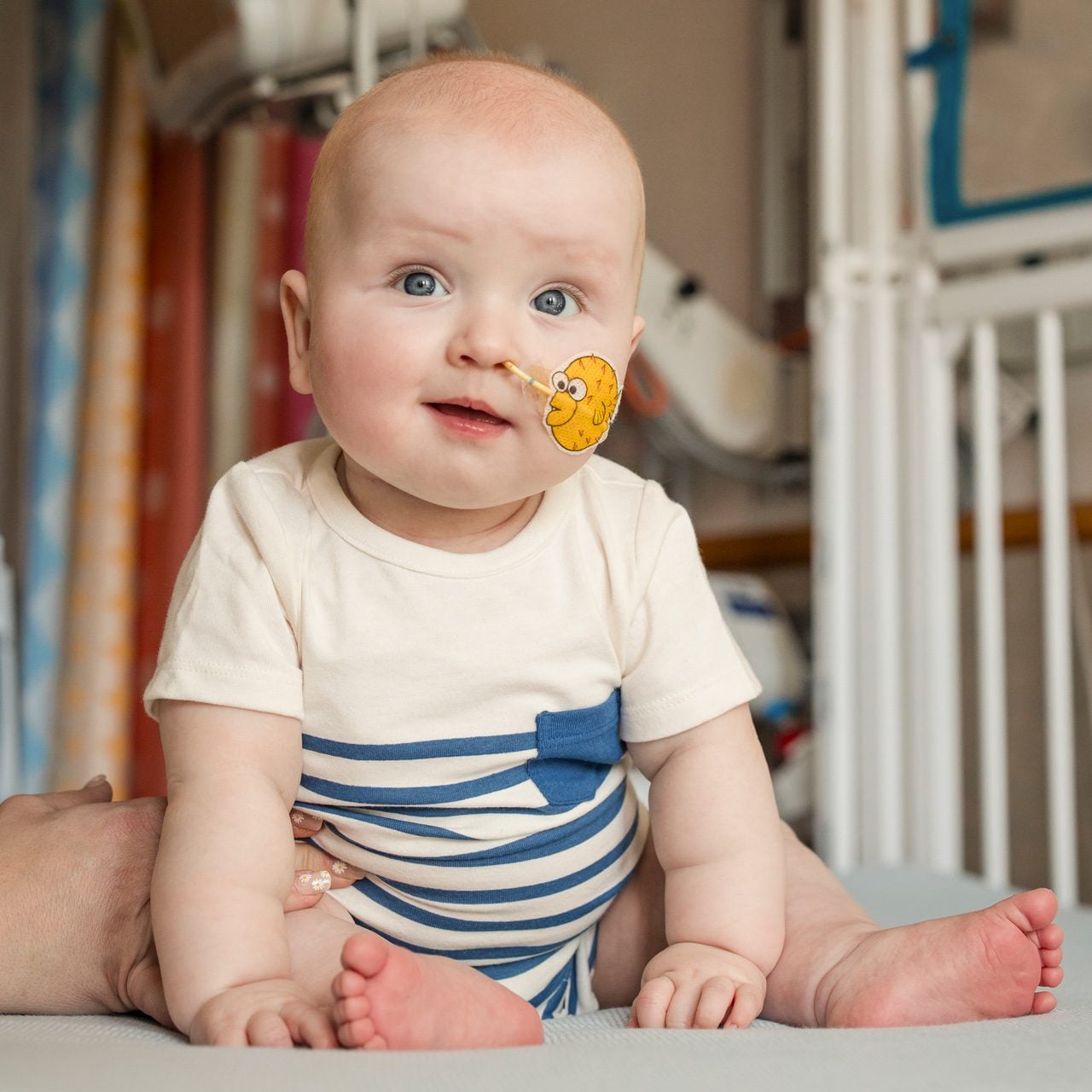
“A peanut.” That’s how Nicole and Kyle Muldoon described their tiny baby boy when they first saw—and fell madly in love with—him after he was born five weeks prematurely on Aug. 1, 2024, at the Hospital of the University of Pennsylvania in Philadelphia
“Like other preemies, he looked so impossibly fragile, so vulnerable as he lay in his crib in the hospital’s intensive care unit, hooked up to all those tubes and monitors,” remembers Nicole as she sits with Kyle in their modest suburban home in Clifton Heights, Pennsylvania. “He was so tiny. He was our little peanut!”
Kyle, a burly, 6-foot-tall steamfitter and part-time high school football coach, laughs and adds, “He weighed just 4 pounds, if that! But something about him—I’m still not sure what—told me he was a fighter, a strong baby.”
Based on what he would soon be going through, the newest member of the Muldoon family would need every ounce of that strength
When the Muldoons found out that Nicole was pregnant in early 2024, they decided that this would be the last child they’d be adding to their happy, growing household. They already had Nicole’s son, Sean, 12, whom Kyle had lovingly helped raise ever since he and Nicole had married about a decade earlier, and the two daughters they’d had together: Carson, who was 3, and Kennedy, 1-1/2
“Truth be told, when Nicole got pregnant again, I was hoping—kinda praying—that we’d have a boy,” says Kyle. “I’d always wanted a son of my own, and some of my union buddies at work had kidded me that I could only make girls. I’ve been blessed to have Sean, and I dreamed of having another son. I imagined watching the Philadelphia Eagles—my favorites—with him, and as he grew older, teaching him to play all the sports I loved.” On Aug. 1, Kyle was working on a job in downtown Philadelphia when he got an urgent call from Nicole. “Honey, it’s time!” she told him. “We gotta go to the hospital! Now!”
Although Nicole wasn’t due to give birth for five more weeks, she’d been having complications and contractions. Kyle dropped everything, drove home, picked up Nicole and rushed her to the hospital. Six hours later, she gave birth to a baby boy
As Kyle stood over his brand-new son’s crib, tears filled his eyes. Such a beautiful child, a dream come true, he thought. The couple decided to name him KJ, short for Kyle Junior. That evening, the proud father ordered a tiny Philadelphia Eagles football jersey for his newborn son
Get Reader’s Digest’s Read Up newsletterfor more true stories, fun facts, humor, cleaning, travel and tech all week long
A life-threatening discovery
Two days later, on Saturday morning, as Nicole and Kyle were watching KJ sleep in the hospital’s neonatal ICU, a neonatal doctor approached. KJ was sleeping more than was normal, wasn’t eating enough and was struggling to maintain his temperature, he said. The news got worse from there. “We checked your son’s blood ammonia level, which can be a marker for metabolic diseases, and it was high. Extremely high,” the doctor said. “Your son is very sick.”

Nicole and Kyle looked at each other, first confused and then terrified. Both struggled to make sense of what the neonatologist was telling them. Then the doctor said, “The good news is that the best place for your child to be treated for what we suspect he has is literally next door, right across the street at Children’s Hospital of Philadelphia, which has well-known experts in this field.”
He wasn’t exaggerating. After being transferred to the children’s hospital, little KJ underwent an array of tests. Heading his medical team was Rebecca Ahrens-Nicklas, MD, PhD, an internationally known metabolic physician, geneticist and scientist. Among her specialties is taking care of children, including infants such as KJ, with rare inherited disorders that affect the way their tiny bodies’ biochemistry works
One of the first things Dr. Ahrens-Nicklas and her team did was to place KJ on dialysis to filter the excess ammonia out of his blood and stabilize him. The doctors told Kyle and Nicole that KJ’s ammonia levels were so high that, left unchecked, they would cause brain damage, a coma or worse
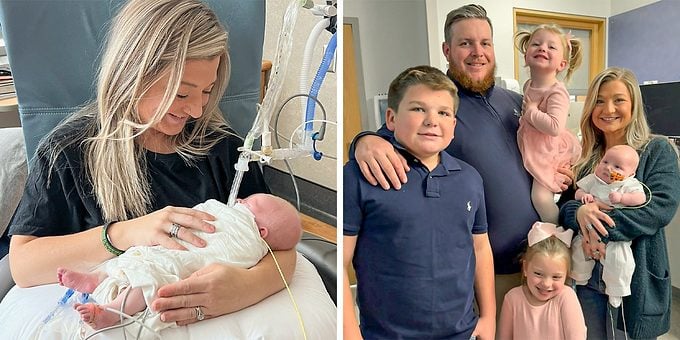
“It broke our hearts to see that little guy hooked up to a feeding tube, so many wires, IVs, monitors and a massive dialysis machine, but we knew he was in such good hands,” Nicole says. “We were in the right place with an expert medical team.” Adds Kyle, “We were now watching KJ fighting for his life.”
Once his ammonia levels fell, KJ was ready for further testing. Using a test developed by Dr. Ahrens-Nicklas and her team that analyzes some 3,500 genes, virtually all of KJ’s medically relevant DNA, it was discovered that he had carbamoyl-phosphate synthetase 1 (CPS1) deficiency
The condition is exceedingly rare, affecting about one in 1.3 million babies. It is caused by a mutation in the CPS1 gene that impairs the body’s ability to process protein, which in turn leads to dangerously high levels of ammonia in the blood. This condition, hyperammonemia, can damage the liver and the brain, and if left untreated, it can be fatal. Frighteningly, 50% of infants born with CPS1 deficiency die in their first week; survivors often suffer severe neurodevelopmental challenges, and many receive a liver transplant, which can lead to complications caused by a lifetime of immunosuppressant drugs.
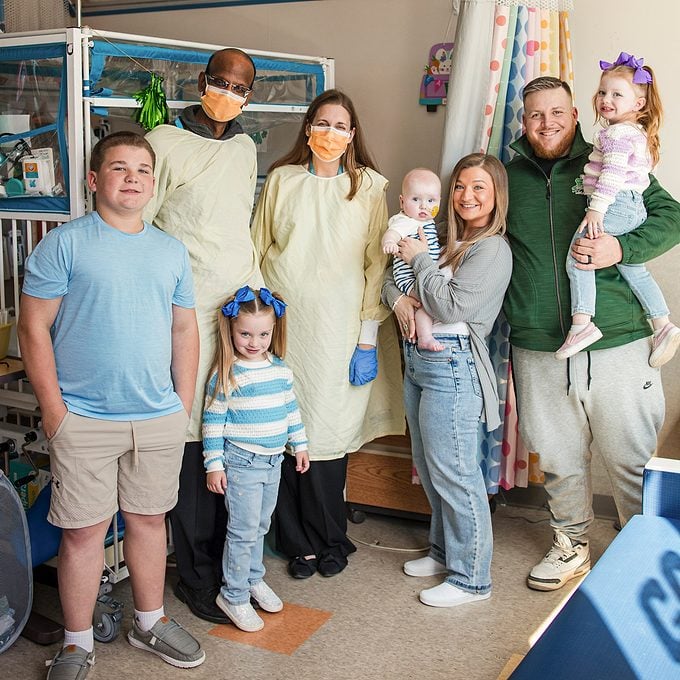
Now, as Kyle and Nicole watched their tiny, blue-eyed, days-old son sleep in the ICU, they both had the same thought: His life was hanging in the balance. Later that day, still confused by KJ’s diagnosis, Nicole and Kyle typed “CPS1 deficiency” into Google. They were shocked to read about the condition’s high death rates and to see terms such as “severely disabled” and details about end-of-life care
“It was devastating and confusing,” Kyle remembers. “I didn’t tell Nicole, but I wondered if KJ would ever wear the Philadelphia Eagles jersey I had bought for him.”

The couple quickly recovered from their shock and set about learning everything they could about CPS1 deficiency. They joined Facebook support groups, reached out to other parents online who were facing the same medical issue, and became a nearly constant presence, along with KJ’s siblings, at his hospital bedside—talking to him, singing to him and caressing him
Meanwhile, his doctors put him on a severely protein-restricted diet, took him off dialysis and administered glycerol phenylbutyrate, which helped keep his blood ammonia levels down. KJ was also added to the liver transplant list and would be eligible for a transplant once he reached his 1st birthday. But he was always at risk—an illness or infection could send his ammonia levels skyrocketing and cause irreversible brain damage. Or death
An untested treatment
While the medical team at Children’s Hospital continued to treat KJ, Dr. Ahrens-Nicklas reached out to longtime genetic research associates, including Kiran Musunuru, MD, PhD, MPH, a cardiologist, geneticist and expert in gene editing at Pennsylvania State University
Sitting in her expansive lab at Children’s Hospital of Philadelphia, Dr. Ahrens-Nicklas remembers the aha moment when she felt they might be able to help KJ. “By coincidence, we’d been working for a couple of years on a gene-editing process, a personalized treatment tailored for just one specific patient,” she says
The idea was to formulate a drug that would act as a gene editor, locating and repairing a patient’s faulty or “broken” gene responsible for the disease, like correcting a misspelled word in a sentence. But there was a catch. Early attempts by Dr. Ahrens-Nicklas, Dr. Musunuru and their associates to create tailored gene-editing therapies for CPS1 deficiency had taken more than a year to complete—too long to help babies at risk of dying in the weeks and months after they were born. But the team kept at it and, during more than two years of experimentation, had shaved months off their production schedule.

This type of gene-editing treatment had never been used on a patient, but now, with KJ in imminent danger, the team knew they had to act quickly. “The clock was ticking, and the race was on,” says Dr. Musunuru. Adds Dr. Ahrens-Nicklas, “We thought KJ just might be the right patient in the right place at the right time to receive this procedure. But there were a lot of ifs.”
The research, which involved cooperation from almost a dozen partners—universities, research labs and private companies—throughout the United States and Canada, would need funding and FDA approval, and it would have to be done fast. And the team needed Kyle and Nicole’s permission before administering the newly developed drug to their son
With 2-month-old KJ attached to a ventilator in the nearby ICU, Dr. Ahrens-Nicklas met with Kyle in the hospital to explain the gene-editing approach. “I want to let you know that we don’t have any guarantees that our team can produce this gene therapy in time to save KJ,” she told him. “This gene-editing process has never been done before. KJ would be making history if this works.” She added, “Kyle, I really don’t want to give you any false hopes—”
Kyle cut her off. “Dr. Rebecca, my hopes are on me. If this all goes sideways and my world comes crashing down—if this doesn’t work—that’s on me to pick up the pieces. You just do your best, and if this comes, we will be ready.”
At a later meeting with KJ’s team of doctors, Nicole and Kyle asked a slew of questions and eventually gave their permission to proceed with the treatment. “They said even if the gene therapy procedure wasn’t ready in time to help KJ, they wanted to use this opportunity to help research gene editing in the hope that it could someday help another child,” remembers Dr. Ahrens-Nicklas. “That almost made me cry.”
Working with KJ’s specific mutation, which had been identified just days after his birth, researchers grew cells in petri dishes that contained his genetic sequence. Next, they used the cells to target and correct his mutation with a gene-editing delivery system called CRISPR, developed years earlier. Then, the newly developed drug, designed specifically for KJ, would be tested on animals
Formulating the plan
Danaher, a life sciences company in Iowa, helped produce part of the drug and dubbed it kayjayguran, after KJ. To gauge the therapy’s reliability, it was tested on mice and monkeys in separate labs. Aldevron, a biotech company in North Dakota and a stand-alone operating company and brand within Danaher, was tasked with assembling the elements of the drug into a single treatment. All the companies involved agreed to charge just for the raw materials they used, keeping costs to a minimum. Even the FDA fast-tracked approval of the treatment for KJ, granting a rare emergency exemption to the review process usually required before starting research on human subjects.
Professor Fyodor Urnov, PhD, with the Innovative Genomics Institute at the University of California, Berkeley, worked on the gene-editing program. “I can’t think of a better example of the adage ‘It takes a village’ than the cooperation that produced this treatment,” he says. “Everyone involved was burning the midnight oil to get this done. I’ve been in this field for 26 years, and I have never seen anything like this. It speaks to the goodness of the human heart.”
Dr. Musunuru agrees: “This should have taken almost a year to complete. But it was completed in just under seven months. I’d call that a miracle.” Dr. Ahrens-Nicklas had briefed the Muldoons regularly during the months it took to develop the gene-editing treatment for KJ. But when it came time to let them know that the team was ready to administer the approved drug, she admits that she was beside herself. “I was terrified and excited at the same time,” she remembers. “This had never been done before, so we didn’t know if it would work or if there might be serious medical side effects.”
She met the couple in the hospital that had become a home away from home for them, and as 6-month-old KJ slept blissfully unaware, she repeated, “I am sorry, but there are no guarantees.”
Kyle says he and Nicole understood what was at stake. “Our child was sick, very sick. He either had to have a liver transplant or receive this new medicine—this science fiction stuff—that had never been given to anybody before. It was a difficult choice for us. But we felt this was the best possible scenario for a life that we didn’t, at that point, know if he would be able to have.”
A true miracle
On Feb. 25, 2025—which Dr. Ahrens-Nicklas describes as “one of the most exciting and terrifying days of my life”—staffers prepared to inject a low dose of the newly minted drug into tiny KJ’s IV line over the course of two hours to help prevent any adverse reactions. The drug was made up of two components: a “guide RNA,” often described as molecular GPS, that would guide the gene-editing mechanism to the exact part of KJ’s genome that needed to be fixed; and a “base editor” that would then correct the “misspelling” in that specific gene by chemically converting one DNA letter into another.
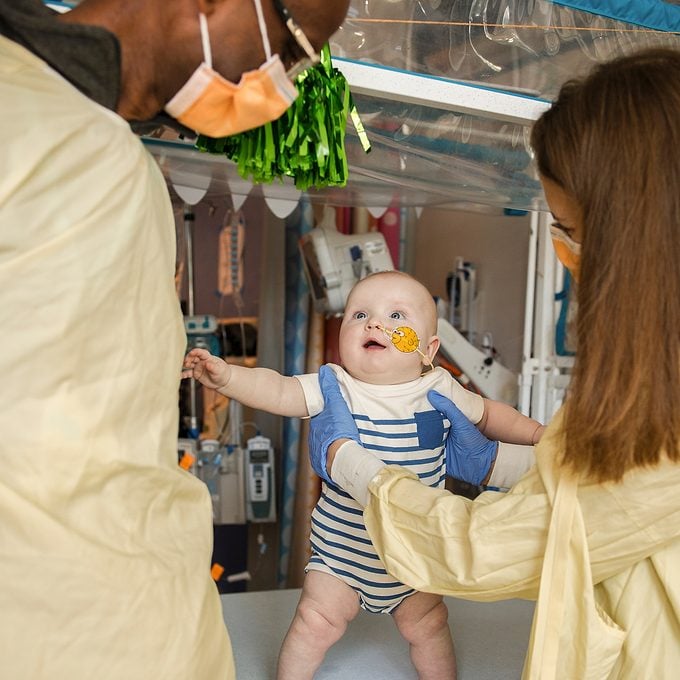
Kyle and Nicole, the medical team and a large crowd of hospital staffers—who had come to love KJ and his persistent smile during his 209 days in the hospital—were gathered in the ICU. More stood in the hallway outside the unit, smiling at Kyle and Nicole and giving them a thumbs-up. This was the day everyone had been waiting and working for. When the doctors began the infusion, “You could hear a pin drop,” remembers Kyle. To everyone’s amazement, KJ, the first person in history to receive a personalized gene-editing drug, slept soundly throughout the entire procedure.
A few days after the infusion, the color returned to KJ’s cheeks. He began putting on weight, and even though he had been taken off glycerol phenylbutyrate, he showed no signs of increased ammonia levels. The medical team eventually gave him two higher doses of the infusion. He still showed no ill effects and continued to grow and thrive. “He soon got the chubby cheeks we love so much,” Nicole says
Across the country, Urnov of the Berkeley genomics institute was driving home after dropping his 8-year-old daughter off at school when he found out that, after receiving his first infusion, KJ had started to gain weight. Overwhelmed, Urnov had to pull his car over
“My primary emotion was anxiety—How is the child doing? Did we do everything right? So when I heard the news, I started to cry,” says Urnov. “I was a very small particle in this story, but it was undoubtedly the most meaningful moment of my entire profession. I know that every one of the 200-plus people who were associated would probably say something similar.”
Others agree. “This is an important first step toward an entirely new type of personalized medicine,” Dr. Musunuru says. “I think it’s going to completely transform the way we practice medicine, particularly in the area of rare diseases for which there are few treatments. I don’t think it’s exaggerating to say that this is the future of medicine.”
Says Dr. Ahrens-Nicklas, “I really hope that 10 years from now, targeted personalized therapies are available for most of my patients. That would be the dream.”
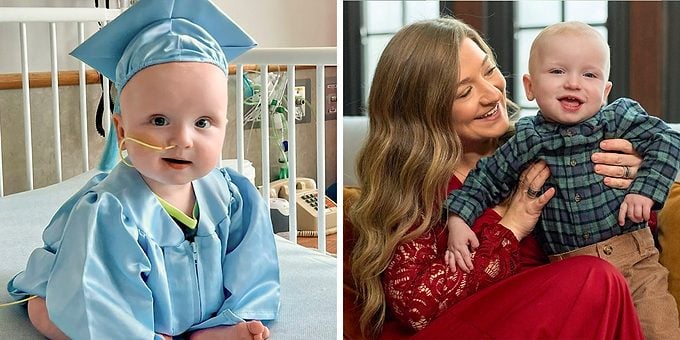
On Tuesday, June 3, 2025, after spending the first 307 days of his life at Children’s Hospital of Philadelphia, KJ Muldoon was ready to go home. To mark the occasion, Nicole dressed him in a baby-blue cap and gown to mark his “graduation” from the hospital
When she, Kyle, Sean, Kennedy and Carson accompanied KJ out of his room, they were met by scores of hospital employees clapping, hooting, hollering and blowing kisses to the little boy they had cared for. “I broke down in tears of joy,” remembers Nicole. Once outside the hospital, the family was escorted home by a motorcycle unit of the Philadelphia Police Department
Last December, a week before Christmas, KJ took his first steps at home. And he continues to get stronger. He’s put on so much weight that Kyle had to buy him a larger Philadelphia Eagles jersey. Says the proud father, “He’s our very own, living miracle baby.”
Why trust us
At Reader’s Digest, we’re committed to producing high-quality content by writers with expertise and experience in their field in consultation with relevant, qualified experts. We rely on reputable primary sources, including government and professional organizations and academic institutions as well as our writers’ personal experiences where appropriate. We verify all facts and data, back them with credible sourcing and revisit them over time to ensure they remain accurate and up to date. Read more about our team, our contributors and our editorial policies.

A K-9’s Race to Find a Missing Boy

A Teen, a Speeding Car and a Race to Save His Life

A Kayaking Trip Turned into a Fight for Survival
