


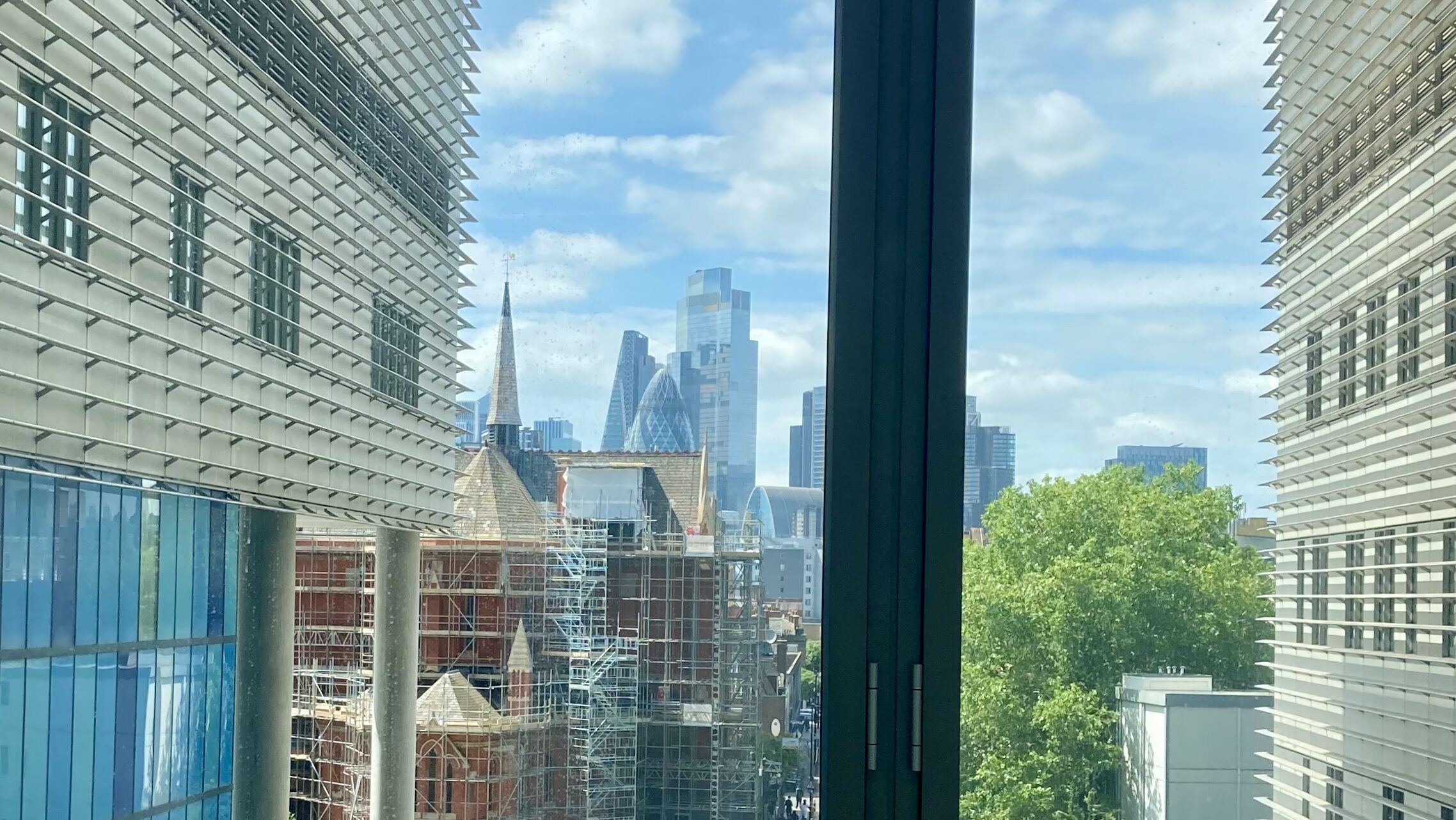
Photo taken by Elaine Skidmore, inside of The Royal London Hospital
Culture Editor Thomas Deakin shares his experience of brain surgery, explaining how it equipped him with a fresh perspective on studying and a toolkit for everyday life.
On 14 April 2026, after returning to London from a holiday in the Lake District with my parents, I grabbed some valuables from my flat to return home to Cambridge as I was feeling particularly unwell
Disoriented and exhausted, I went to the pizza restaurant opposite to see if some food would make me feel better. Unable to coherently read the menu, I sat down to eat. The next thing I knew, I woke up in the Royal London Hospital and was informed that I had experienced a seizure and would likely need brain surgery to remove a suspected tumour
Despite the inevitable concern arising from this diagnosis, I remained determined to finish my coursework and sit my exams, knowing that diligently taking my seizure medication would maintain my health in the meantime
After completing my assignments and undergoing roughly 15 check-ups within the span of a month, I returned to Royal London Hospital on 20 May to have the suspected tumour surgically removed. Although the coping mechanisms I had learnt through therapy meant I mostly remained calm in the lead-up to the surgery, I had a spike in anxiety and panic attacks the night before the surgery. The uncertainty of what might happen, combined with the enormity of the situation, left me sleepless and isolated until the surgery itself alleviated those concerns.
Due to factors such as my age and the suspected tumour being located in the Wernicke’s area of my brain, I was selected by the hospital as a candidate for a partially awake craniotomy. This mostly resembled a typical brain surgery, with the notable exception that I was awake for three of the four hours I was being operated on
Specialists in surveying eloquent (i.e. functionally important) areas of the brain, the surgeons monitored my brain activity during the operation by asking me IQ test-style questions to measure my aptitude in certain areas and getting me to talk about my interests. These methods successfully limited my movement and contributed to the surgery’s success because the tight control of my speech ensured that I was focusing on a different part of my body. As well as making the removal of the suspected tumour easier, this enabled me to detach myself from the stress of the surgery and remain upbeat amidst the uncertainty.
Towards the end of the awake period of the surgery, the suspected tumour was safely removed. I then spent the following three days recovering in hospital before being discharged home for the remainder of my two-week recovery.
The first week at home was particularly rough. With the plaster around my scar needing to remain in place through May, my mobility was heavily limited. Simultaneously, my energy levels were incredibly low. Sleeping between ten and fifteen hours a day affected my mental health in the hours I was awake
Although I have now moved on from these early stages, my long-term recovery will involve remaining on seizure medication (Levetiracetam Amarox), having regular scans for at least a year, and adjusting to life with an official epilepsy diagnosis. This will prevent me from driving for at least a year and alcohol is off the menu until at least my next appointment in November—although these are minor concerns compared to the maintenance of my health
On 29 May, nine days after the successful surgery, I thankfully found out that what was in my brain was not just benign, but not even a tumour at all. For unknown reasons, I had a lesion that was a low pressure cavernoma—a non-genetic anomaly that was much larger than had initially been seen during the MRI. Effectively, there had been a fast-growing, tomato-sized mass in my brain that could not spread to other parts of the body but which could have had dire consequences on my mental capacity had it spilled out of the linguistic centre in my brain where it was based.
Defined as a cluster of abnormal blood vessels, I was informed that a failure to remove the cavernoma could have led to a bleed outside the brain and thus a stroke that would have incapacitated my ability to read and speak. Despite this revelation striking both relief and fear in me, a neurosurgical appointment later the same day confirmed that I have a good prognosis and that it is very likely this seizure was a one-off
Whilst it was undeniably a strenuous month and a half, having the incident, surgery, and results all within 45 days demonstrated to me that, despite its problems, the NHS remains a largely effective healthcare provider for UK residents. In particular, the frequent appointments at St. Barts and the Royal London Hospital in the build-up to the surgery, although time-consuming, ensured I was treated with both care and compassion
Another thing that helped me through this stressful time has been the help of my friends and family. Coming from a city not too far from London, I was grateful to have my parents nearby, so that I could constantly rely on their support
Furthermore, whilst living in London to revise for my exams and coursework, the support of my friends helped me to remain grounded and focused, preventing me from being overwhelmed by the impending surgery. Following my two-week recovery period at my family home, I was able to return to London, and the support of my friends—including during a six-day holiday to Italy—made my already quick recovery even smoother.
Whilst the first two weeks after the surgery were incredibly rough, the weeks that followed became a period of immense growth and self-reflection. What I ultimately learnt from this unene: resilience and self-care
The presence of the cavernoma has taught me that life is full of struggles that seem impossible to overcome. However, like my past struggles with mental health, optimism and hard work can facilitate the transformation of these challenges. Although it would have been impossible to notice any signs of the cavernoma before the seizure, being placed onto a medication regimen has made me realise that self-care and leading a more structured lifestyle will ultimately make me a lot happier in the long run, as both my mental and physical health will remain strong if I prioritise my wellbeing over more trivial concerns.
Looking forward to my forthcoming second year at King’s, these newfound skills will mean I will have to adopt a different—arguably better—approach towards my studies too. Instead of treating my health as secondary to my grades, I will approach the two by understanding that they are interdependent and that my health must always come first
Being on medication will inevitably limit some aspects of my second year. Yet knowing my health is better and feeling excited for the safer road ahead, I am determined not to let this condition prevent me from living my life to the full. The prospect of studying abroad in my second semester means I may need to adjust when and how I take my medication, but resilience will help me navigate these changes successfully.
Before this whole experience, I was often not very cautious about my health and ignored the unexplained bouts of paranoia I frequently experienced, something that can now be partially attributed to the cavernoma and its effects. Whilst I am not going to claim I am fully changed by the surgery, this experience has forced me to put things into perspective and incentivised me to work harder at what I love doing and retain my self-worth
When the cavernoma was removed during the surgery, I was awake. Upon being told it had been successfully removed, I cried tears of joy and said,“I can live my life again.” It is my hope—and my belief—that I can honour this opportunity
To read more of Roar’s personal essays, click here
Science & Innovation
‘We won’t know the long-term effects for years’: Melisa Kose from Inspire The Mind
Inspire The Mind (ITM) is a Denmark Hill based magazine which focuses on mental health. Founded in 2019, ITM is a collaboration of researchers
Anoushka Sinha27 April 2026
Science & Innovation
Single gene research forcing psychiatry to rethink mental illness
Staff Writer Jorja Adamczyk discusses recent research suggesting a link between genes and mental illness. The University of Leipzig in Germany has recently discovered
Jorja Adamczyk21 February 2026

Science & Innovation
Serotonin: A New Hope for Schizophrenia Treatment?
Staff Writer Lavanya Mahendrakumar discusses recent schizophrenia research from King’s College London (KCL). Researchers, led by Professor Oliver Howes, at the Institute of Psychiatry
Lavanya Mahendrakumar29 December 2025


Science & Innovation
A Coffee a Day Keeps the Doctor Away: the Anti-Aging Effects of Coffee
Staff Writer Lavanya Mahendrakumar discusses recent research published from King’s College London suggesting that coffee could be linked to slower aging. A new study
Lavanya Mahendrakumar8 December 2025
