


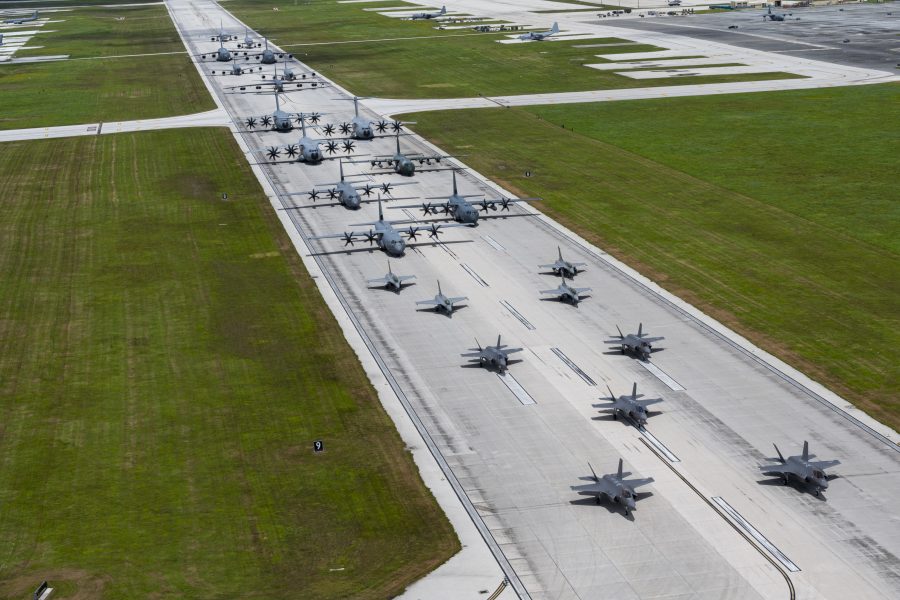
Years of Chinese gray-zone bullying designed to fracture international coalitions have backfired. Instead of isolating individual nations, coercive behavior has catalyzed global unity, driving a historic 20-nation coalition straight into Australia’s Northern Territory to draw a collective line in the sand
As forces mobilize across northern Australia for Exercise Pitch Black — running from July 17 to Aug. 7 — the Royal Australian Air Force (RAAF) is hosting a stabilized deployment of up to 100 advanced aircraft and 2,500 personnel.
This massive multinational asset integration network serves as a live-theater masterclass, demonstrating how the mechanics of deterrence and assurance theory work to neutralize Beijing’s expansionist ambitions
According to deterrence theory, a state successfully deters an adversary only when the challenger views its capability to resist and retaliate as entirely credible and frictionless. A coalition cannot project this level of deterrence if operations stall because a localized ground crew lacks the parts or training to service a partner’s aircraft
This reality has driven a strategic pivot toward interchangeability, an operational doctrine demanding that ground crews seamlessly service, refuel, and rearm any allied jet using local infrastructure and common munitions. Pitch Black provides the physical baseline for this component of deterrence by integrating a diverse, entirely NATO-capable combat fleet into a single land-based air force
Plug-and-play
Advanced fifth-generation stealth assets, led by the US Air Force, RAAF, and Japan Air Self-Defense Force F-35 Lightning II, serve as the technical backbone, pairing directly with NATO-standard fighters. These include the Indian Air Force Rafale, the German and Spanish Eurofighter Typhoon, and the Republic of Korea Air Force F-16.
Crucially, this plug-and-play combat footprint is enabled by a cross-compatible aerial refueling fleet acting as a universal technical translator. Boom-and-drogue dual-rigged platforms — such as the Singaporean and French A330 MRTT alongside the RAAF KC-30A — deploy both underwing hose pods and rigid tail booms.
Operating in unison with probe-only tankers like the British Voyager and Spanish A330, this collective umbrella sustains joint fighter formations containing completely disparate national refueling architectures. By extending the combat radius of these combined wings across the vast expanse of the Indo-Pacific without friction, this refueling framework directly neutralizes Beijing’s strategy of forcing Western forces to operate from vulnerable, long-range stand-off distances
To appreciate the distinct tactical architecture of Pitch Black, it must be contrasted with Exercise Talisman Sabre. Held biennially, Talisman Sabre represents a multi-domain joint warfare framework focused on concentrated power projection, recently bringing together allied carrier strike groups to practice large-scale amphibious landings through overwhelming conventional mass
Pitch Black shifts the strategic focus entirely to land-based air superiority and survivalics philosophy that winning a high-intensity war against China requires a rapid transition from static, centralized distribution to a highly kinetic, flexible network
This is achieved by operationalizing Agile Combat Employment, effectively transforming the coalition into an airborne guerrilla force. Instead of clustering assets on single, vulnerable target grids like Guam, forces are scattered and relocated across multiple alternative, austere airfields operating seamlessly across RAAF Bases Darwin, Tindal, and Amberley
Information Dominance
This geographic dispersion forces China to scatter its surveillance assets and allows highly disparate units to combine overwhelming combat power simultaneously. To systematically dismantle China’s Anti-Access/Area-Denial bubbles, the coalition pairs this distributed guerrilla posture with advanced electronic attack jamming, multi-domain maritime tracking, and emission control (managing or silencing electronic, radio, and infrared signals to avoid enemy detection while keeping essential combat systems working).
This environment serves as a critical testbed for Information Dominance and AUKUS Pillar II electronic warfare protocols, using older aircraft as “missile trucks” for stealth platforms to render China’s massive investments in land-based missile grids obsolete through network integration
A sophisticated irony of this strategic landscape is the participation of non-aligned Southeast Asian nations who maintain vital economic ties with China. The answer lies in strategic hedging. While local commerce dependencies tilt toward cooperation with Beijing, regional governments acutely understand that total, unchecked Chinese military hegemony serves no one’s sovereign interests
They are joined by embedded personnel deployments from Brunei and Malaysia, who participate alongside specialized enablers like the Singaporean G550 Airborne Early Warning aircraft and European partners to build shared security baselines. The singular exception is Papua New Guinea’s PAC-750 utility transport, which bypasses the high-speed tactical network to operate safely
Shattered illusion of coercion
This collective participation directly fulfills the core tenets of assurance theory. In international statecraft, small or non-aligned nations often face intense pressure to capitulate to aggressive neighbors out of a profound sense of isolation.
True assurance requires a dominant power or coalition to demonstrate a binding, credible commitment to protect and uphold the sovereignty of its partners, directly disrupting China’s strategy of using bilateral economic leverage to isolate individual states
Pitch Black acts as an inclusive Credible Assurance Platform. It physically assembles all four Quadrilateral Security Dialogue (Quad) nations’ air arms — the US, Australia, Japan, and India — on a single flight line alongside non-aligned partners.
By integrating these non-aligned states directly into a high-end allied air umbrella that shares a native software language, the exercise provides the psychological and operational backing these nations need to resist gray-zone coercion. It signals to Beijing that its tactics of incremental intimidation will fail against a unified, cross-regional alignment anchoring the Second Island Chain.
The strategic message for Beijing is simple: collective political will and decentralized combat capability are the only real-world antidotes to revisionist expansion. For a decade, China operated under the illusion that gray-zone bullying could isolate individual Indo-Pacific states
Pitch Black shatters that calculation completely. By attempting to intimidate its neighbors, Beijing has instead forced a fractured hemisphere to rapidly mature into a unified, combat-interchangeable air combat machine under the guidance of RAAF commanders
As Winston Churchill famously warned: “An appeaser is one who feeds a crocodile, hoping it will eat him last.”
Across the outback corridors of Australia, the 20 nations of Pitch Black have delivered a definitive response: the era of regional appeasement is over. If Beijing chooses to trigger a conflict, it will not find vulnerable, isolated targets, but a highly synchronized, multinational expeditionary network ready to project instant, unified retaliation across the entire Indo-Pacific
