


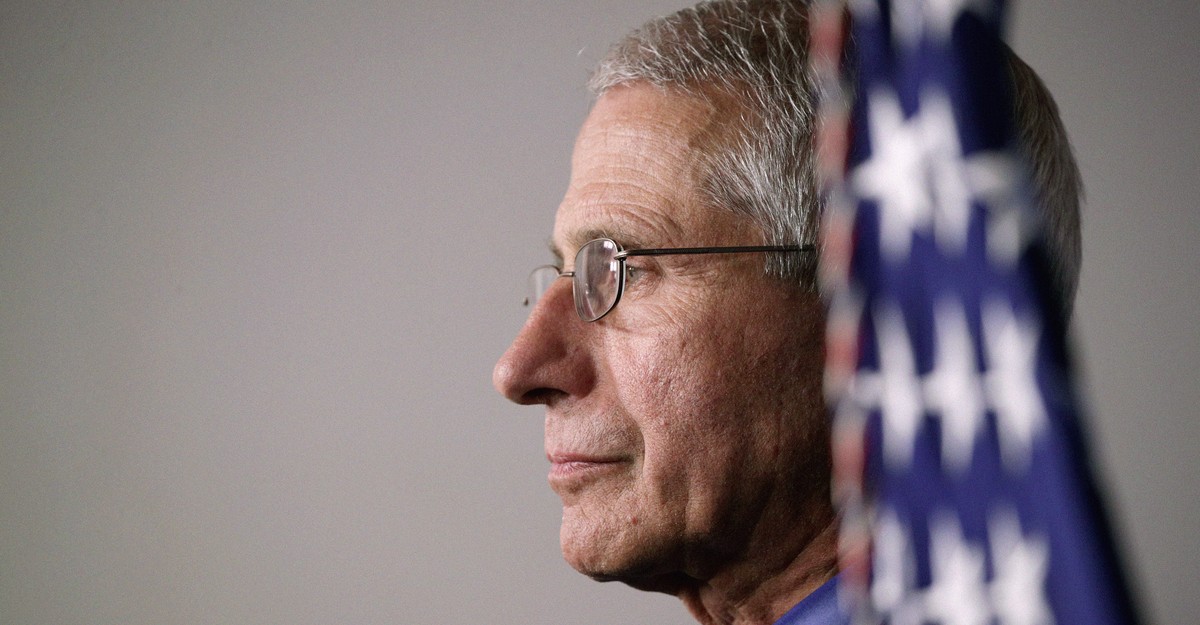
When Anthony Fauci arrives on Capitol Hill tomorrow to testify before Congress, he will be trailed by a security detail he’s paying for himself. Fauci has been testifying before the nation’s elected officials for roughly four decades now, since his days at the forefront of early AIDS research. In years past, he would have prepped by consulting colleagues and poring over data—he would have been there, as he might say, to speak for science. Now he’s under a subpoena from the Senate Homeland Security and Governmental Affairs Committee, and has been conferring with his lawyers on how best to navigate a grilling about his own actions—and what seems to be an effort to catch him in a lie, one that isn’t covered by the blanket presidential pardon he received from Joe Biden. Once famed for being America’s consummate nonpartisan scientist, Fauci is now a far more polarizing kind of public figure: beloved and reviled for what he’s said to represent; targeted by threats to end his life. The more he talks, the more he stands to lose.
This is not the professional coda that Fauci’s half century in government once seemed to be heading toward. For decades, he has been one of the nation’s best-known and most-respected scientists. In the late 1960s, Fauci helped lead a team at the National Institutes of Health that repurposed cancer therapies as cures for several once-fatal rheumatological conditions. His later partnerships with AIDS activists and his push to accelerate experimental-drug trials for HIV helped transform the infection into a survivable condition. He went on to serve as a chief architect of PEPFAR, a global HIV-prevention-and-care program that has prevented an estimated 25 million deaths since 2003. And over the course of his nearly 40 years as the head of the National Institute of Allergy and Infectious Diseases, he turned one of the NIH’s quietest branches into a $6 billion research juggernaut. Fauci has “saved more lives, created more amazing infrastructures for developing research opportunities, cured more people, provided health care to more people both in the United States and abroad, probably, than any single scientist in his lifetime,” Larry Corey, an infectious-disease expert at the Fred Hutchinson Cancer Center, told me.
His achievements speak to his scientific credentials, but also to his ambition and savvy. Fauci was a master of the system: He knew how to acquire and maintain scientific power; he had the ear of both academics and politicians. He eagerly courted attention, while maintaining that he was “completely nonpolitical,” to the point that even his close colleagues at NIAID had no idea how he voted in elections. “Congress really saw him as a straight shooter,” Judith Feinberg, an infectious-disease researcher who worked at NIAID early in her career, told me, without “a particular political axe to grind.” Fauci was that rare bureaucrat who could be given a Presidential Medal of Freedom by George W. Bush and then be praised as a “once-in-a-century public health leader” by Barack Obama.
But ever since President Trump retook office in 2025, his administration has engaged in a systematic effort to obliterate Fauci’s legacy. One of Trump’s first actions in office—just days after Biden issued his pardon—was to strip away Fauci’s government-funded security detail. Fauci’s image was cut out from a mural on the NIH campus around the same time. By the end of spring, the administration had rerouted government webpages once dedicated to information on COVID resources to a new site, alleging that Fauci had tried to hide the “true origins” of COVID. Trump officials went on to largely dismantle PEPFAR, imperiling many of the 20 million people the program has supplied with lifesaving therapies. They ousted most of NIAID’s long-standing leadership, including several officials who served under Fauci for years, as well as Jeanne Marrazzo, the director who succeeded him; they forced out Fauci’s wife, Christine Grady, once a bioethicist at the NIH, and arrested David Morens, one of Fauci’s longtime advisers. (Morens has pleaded not guilty to charges of conspiring to hide and destroy government records.) “Anything that he had his name on, or that was under his accomplishments, is being destroyed,” Judith Currier, an infectious-disease expert at UCLA, told me. (The White House and the Department of Health and Human Services did not respond to requests for comment.)
The attacks haven’t let up. In recent days, Rand Paul, now the chair of the Senate Homeland Security and Governmental Affairs Committee, has released troves of documents related to Fauci; among them are more than 1,500 pages from Fauci’s private diary. In one set of entries, which runs from the end of 2019 through his retirement from government at the end of 2022, Fauci meticulously chronicled his growing fame. “Truly unbelievable,” he wrote in May of 2020. “People naming their dogs after me. Sally Quinn saying that I was the erotic lead male in a book she wrote in 1994.”
Fauci has observed this campaign of vengeance and humiliation mostly without public comment—marking one of the quietest stretches of his career to date. (He declined to be interviewed for this article.) Tomorrow, though, Paul is forcing him to talk. At the age of 85, Fauci will be dragged onto the Senate floor to defend his reputation—but something bigger will be contested, too: not what Fauci did during his years in government, but how he did it—the way he wielded his nonpartisanship to gain resources for his institute and stay in the good graces of powerful people. That approach was once routine, and Fauci perhaps its most skilled practitioner. Now its future is in doubt.
For all of Fauci’s fame and clout, he was not necessarily the most obvious choice, in early 2020, to be the public face of the United States’ response to COVID. In title alone, the CDC director, then Robert Redfield, would have been a far more obvious choice, Georges Benjamin, the executive director of the American Public Health Association, told me. But the Trump administration instead put Fauci onstage
Through the early months of the pandemic, as people scrubbed down their groceries and watched news clips of bodies being piled into refrigerated trucks, Fauci’s calm, science-focused statements were a stabilizing force. Eventually some came to regard him with a singular reverence—as if public health were a new religion, and Fauci its living idol. His likeness appeared on T-shirts, socks, and buttercream-frosted donuts; there were Fauci bobbleheads and face-masked Fauci action figures; people put up yard signs declaring In Fauci we trust. On votive candles dedicated to “Saint Fauci,” artists ringed his gray hair with a golden halo. At times, Fauci appeared to embrace his status as expertise personified. “A lot of what you’re seeing as attacks on me, quite frankly, are attacks on science,” he told MSNBC in 2021.
But his fame quickly began to cut both ways. If some Americans (especially establishment-minded Democrats) designated him the heroic embodiment of public health, others (including the MAGA and proto-MAHA crowds) quickly cast him as its lead villain: a power-drunk official who overhyped the benefits of masking, tanked the economy, annihilated small businesses, and pointlessly disrupted learning for millions of children. For the first time, Fauci was openly and repeatedly clashing with a president, too. He masked in public when Trump would not, and he contradicted Trump’s wild claims about injecting bleach and taking hydroxychloroquine. His strategy of aligning himself with the public-health consensus, which had once endeared him to politicians, now made him appear to be a partisan opponent. In the early months of COVID, Fauci’s staff at NIAID began to flag the most violent emails in his inbox for a security team. One man said that Fauci and his family would be “dragged into the street, beaten to death, and set on fire.” (That man was convicted of threatening a federal official and sentenced to more than three years in federal prison.) By the end of 2020, he was traveling with bodyguards.
Certainly, Fauci made mistakes. Early on, for instance, he advised against the widespread use of masks amid a shortage of them and then reversed that position. “I don’t think the communication around that was particularly good,” Emily Erbelding, a former director of NIAID’s Division of Microbiology and Infectious Diseases who was ousted from her role last year, told me. “It was just No masks, and then all of a sudden Everybody’s wearing masks, and you must wear a mask.” But Fauci was also asked to weigh in on seemingly every pandemic policy, including many far outside his purview, and he was doing so as everyone’s understanding of the virus was evolving rapidly and in real time. When Fauci said that sending kids back to school without a vaccine could be risky, and that opening schools in areas experiencing intense viral transmission would not be prudent, many people took that to mean Fauci said to keep all kids home, indefinitely. (School closures were ultimately up to individual states and districts, and decisions about them were complicated by demands from teachers’ unions.)
If Fauci was the patron saint of all that was good about public health, he was also demonized for all of its failings. By the fall of 2020, the apolitical persona that Fauci had cultivated over nearly half a century had started to come apart
Fauci has described the principles that drive him—public service, integrity, clarity of thought and speech—as the yield of his Jesuit schooling. He came to understand that, as a doctor working at the NIH, he could aid not just individual patients or a single hospital, but potentially entire nations that stood to benefit from cutting-edge research. And despite repeated offers to be nominated for NIH director, he chose to remain at NIAID—in part to remain in proximity to the HIV/AIDS research that he felt closest to, his colleagues told me, but also because he didn’t want the baggage that came with being a political appointee. He preferred to maintain unchallenged influence, they said, over almost his entire field.
That penchant for control was coupled with a sizable ego. I spoke with 15 of Fauci’s friends and former colleagues, and they described him as someone who adored the attention that came with being a go-to health expert for journalists and presidents alike. “He certainly embraced that role—sometimes, I thought, a little too much,” Hugh Auchincloss, Fauci’s former deputy director at NIAID who retired in 2024, told me. The pandemic diary entries fit that assessment: The phrase prolonged standing ovation appears seven times throughout; his admirers are repeatedly described as being brought to tears by his presence. “As soon as people recognized me there was a wave of applause and squealing and screaming and clapping and thanking me with multiple people coming and asking for selfies,” he wrote in May of 2021. “It was a little bit embarrassing, but it was just a manifestation of how people need a symbol of integrity and truth.”
Many people told me that Fauci could be a challenging supervisor. He was a chronic workaholic who expected the same of his top officials. In his institute, everyone knew that if you were early to a meeting with Fauci, you were on time; if you were on time, you were late; if you were late, you were in serious trouble. “He has a very Italian temper, and he’s famous for losing it,” especially at people who pretended to understand what they did not, Judith Feinberg told me. To get on Fauci’s good side was to earn his confidence, his respect, and the benefits of his network of resources; to land on his bad side was to be carved into shreds inside his office, the worst of his rampages audible through the closed door.
Fauci could inspire others’ fury, too, even well before the pandemic. During the early days of the HIV/AIDS epidemic, activists from the gay community lambasted him and his institute for the plodding pace of research on the virus. In 1988, the playwright and activist Larry Kramer wrote an open letter describing Fauci as a murderer and a “fucking son of a bitch of a dumb idiot”; two years later, the group ACT UP surged onto the NIH campus to burn Fauci in effigy, carrying a casket that read Fuck you, Fauci. (He later invited those same activists to weigh in on the state of AIDS research, eventually converting them into allies.)
His biggest adversaries now, though, are not representatives of a marginalized group that many Americans once condemned, but some of the country’s most influential figures in media and politics. Joe Rogan has described him as a “monster”; Elon Musk has said he was a “freaking demon.” Health Secretary Robert F. Kennedy Jr. published a 500-page book called The Real Anthony Fauci, which accuses him of having organized a “historic coup d’état against Western democracy” and seized a “power enjoyed by few rulers and no doctor in history.” (Meanwhile, the book lionizes people who promote AIDS denialism and anti-vaccine views.) Trump has referred to Fauci as a “disaster” and an idiot “who got it wrong.”
Fauci’s most extreme critics don’t just contend that he endorsed wrongheaded pandemic-era mitigations; they allege that he played a role in starting the pandemic—that under his direction, NIAID knowingly funded dangerous research that boosted coronaviruses’ ability to infect and kill humans. Fauci “knows a lot more than he’s told so far,” Jeffrey Sachs, a Columbia University economist who chaired TheLancet’s COVID commission and has been publicly critical of Fauci, told me. (Sachs has argued that the coronavirus may have originated from U.S.-funded research, and that Fauci knew this very early on and tried to hide that fact.)
The consensus view among virologists is that the virus that causes COVID likely spilled into humans from a wild animal—a known and common cause of new epidemics. Several agencies within the U.S intelligence community agree, but a few others have come to the opposite conclusion. In any case, some senior leaders in the Trump administration, as well as members of the GOP majorities in Congress, feel certain that the pathogen first emerged from a Chinese laboratory. To them, Fauci is a prime culprit in this story: As they see it, he concealed evidence linking NIAID to the Chinese facility where that research occurred. Rand Paul, in particular, seems bent on getting Fauci prosecuted for allegedly bribing and coercing intelligence officials to aid in his cover-up. “He has not really gotten his just deserts,” Paul recently told Fox News. “There needs to be repercussions.” (Paul’s office did not respond to repeated requests for comment.)
Fauci, for his part, has vehemently denied that NIAID bankrolled irresponsible research, and maintains that his former institute is not to blame for COVID; he has called the notion of a cover-up “preposterous” and pointed to an email from February 2020—in which he said that if legitimate evidence of a lab leak emerged, it should be reported to intelligence officials—as confirmation of his transparency. Fauci has also openly favored the natural-origin hypothesis, as have most others in his field. All along the way, he has continued to present himself as someone whose primary allegiance is to the facts—a “nonpolitical” person to the end. Yet much of the public has long since stopped perceiving him as such. By the 2020 election, Fauci had become a campaign talking point; Trump mocked Biden for trusting Fauci, and accused Fauci of being a Democrat. (Fauci has long been registered as an independent.)
In December 2020, Fauci accepted Biden’s offer to become the president’s chief medical adviser, a position he’d never previously held. And in early 2025, hours before Biden left office, the president issued Fauci a full and unconditional pardon for “any offenses against the United States which he may have committed or taken part in” over the previous 11 years. Many on the right took that as an admission of Fauci’s guilt for COVID-related crimes. At the very least, it was an indication that Fauci’s strategy of scientific separatism had come up short. Now he needed politics to protect him.
For many Americans, Fauci remains a public-health icon. A recent poll shows that, nearly four years after he left government, more than half of Americans still have confidence in what he said about public health. In that regard, he polls far better than health officials who are currently in office, including Kennedy and Mehmet Oz
But polling also suggests that trust in Fauci has ticked down over time. Several of his former colleagues told me they worry that Americans will continue to sour on him as the political fight over his legacy drags out. For the moment, Fauci is constrained in his ability to defend himself. Paul has argued that Fauci’s sweeping pardon precludes him from invoking his Fifth Amendment right. But whether he could plead the Fifth throughout the hearing comes down to whether there is “a realistic threat of prosecution,” which still seems highly plausible, Richard Hughes IV, a legal expert at George Washington University, told me. But that defensive strategy, even if effective, could also leave a lasting mark on Fauci’s legacy: For the scientist who never shied away from attention, and who came with all the answers, the repetitive demurral would surely be excruciating.
Even if Fauci emerges unscathed, several of his friends told me they despair at the disruption this saga is causing to his life. (Although the death threats against his three daughters have mostly subsided, he and his wife have continued to receive them.) Fauci still holds a teaching position at Georgetown University and regularly travels to give talks—accompanied by security guards. But at 85, he is weary; some of his closest friends told me they want nothing more for him than peace. Barney Graham, a former deputy director of the NIH’s Vaccine Research Center, told me that he and some of his colleagues feel some survivor’s guilt as they watch Fauci endure attack after attack: “He kind of martyred himself for the sake of all the other scientists.” Several were reluctant to criticize Fauci in any way, on the theory that doing so would only give more fodder to his right-wing critics. (A few of his close friends and colleagues declined to speak with me at all, citing fears that their words would not help Fauci.)
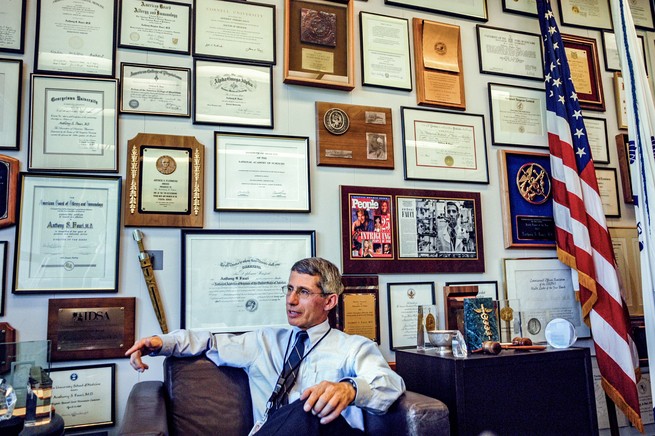
If Fauci’s legacy now seems fragile, that may be partly due to how he built it, Jeanne Marrazzo, the most recent NIAID director, told me. Many of the researchers in top leadership positions at NIAID were Fauci’s longtime colleagues; the institute’s priorities were heavily shaped by his personal research goals. Fauci “owned an empire,” she said, and when you own an empire, “it lives and dies with you.” The first time she walked into the director’s office after Fauci had retired, it still resembled a self-curated shrine, its walls covered with awards and celebrity-studded photographs that hadn’t yet been cleared. Fauci obviously wanted his own presence at the NIH to last, she told me. In the days after Trump’s second inauguration, Fauci emailed her to ask what would happen to an expensive portrait of him, completed in 2023, that had never been hung.
Marrazzo inherited Fauci’s throne in the fall of 2023; the Trump administration forced her into administrative leave less than two years later. (Kennedy personally fired her at the end of 2025, after she filed a whistleblower complaint criticizing recent shake-ups at the NIH; Marrazzo has since sued the Trump administration for wrongful termination.) Unlike many other members of NIAID’s leadership, she had never been personally close to Fauci, and she took over NIAID eager to nudge the institute in new directions. But as far as she could tell, succeeding him seemed enough to make her a target.
Several of Fauci’s friends and former colleagues told me that they were hopeful that, with the passage of time, the vitriol would fade, administrations would change over, and the history books would ultimately memorialize Fauci for the scientific advances he spearheaded and the lives he saved. At the same time, several of the people I talked with admitted that Fauci’s recent experiences had forced them to reflect on what it meant to be a scientist in the modern era, when the practice of research and public health is under political attack.
They may understand that the approach to scientific leadership at which Fauci most excelled—moving through the nation’s politics, instead of being caught up in them—no longer works the way it did before. Americans have been advised by top health officials to second-guess traditional scientific expertise; some of those same officials now profess neutrality as they make “gold-standard science” their euphemism for political control. For decades, Fauci stood before the nation to offer steady and nonpartisan advice. In tomorrow’s hearing, that voice of science may not be heard at all.
Explore More Topics
Anthony Fauci
