


Joseph Figliolia
The American Medical Association Digs in Its Heels on Pediatric Gender Transition
A new policy on gender medicine disregards mounting evidence against the practice
/
Health Care, The Social Order, Politics and Law
/ Eye on the News/
Health Care, The Social Order, Politics and Law
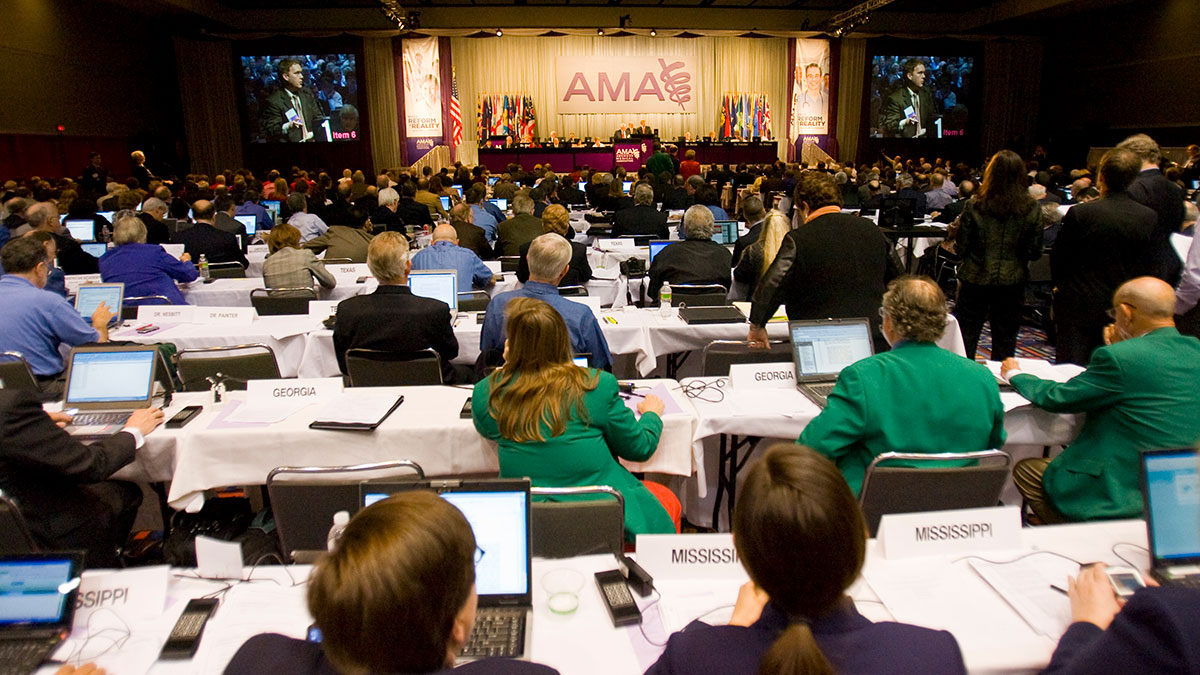
Last month, the American Medical Association (AMA) quietly strengthened its support for youth gender medicine when its House of Delegates met in Chicago for its annual meeting. The AMA’s new policy, “Gender Affirming Healthcare and Research,” reaffirms the organization’s commitment to pediatric medical transition, calls for the restoration of research funding, and explicitly states that surgical interventions fall under the “affirming care” medical protocol. Notably, the adopted language contains no minimum age for treatment eligibility.
The AMA’s reaffirmed stance on youth gender medicine lays bare the ethical tension between adhering to the principles of evidence-based medicine and the impulse to maximize access to treatment in the service of “patient autonomy.”
Finally, a reason to check your email
Sign up for our free newsletter today.
The language ultimately adopted by the House of Delegates was a substitute resolution recommended by the Reference Committee on Science and Technology that combined two proposed resolutions on “affirming care” into a single new policy. One of those proposed resolutions called for restoring research funding for youth gender medicine, including clinical trial research, while the other called for “preserving gender affirming surgical care access.”
The latter resolution, on preserving access to gender-affirming surgical care, is particularly noteworthy. After the American Society of Plastic Surgeons (ASPS) issued a position statement against surgical interventions for youth under 19, the AMA told the New York Times that, “in the absence of clear evidence, the AMA agrees with ASPS that surgical interventions in minors should be generally deferred to adulthood.” Facing backlash from its members, the AMA tried to walk back its statement, accusing the New York Times of misrepresenting the organization’s position on youth surgeries; the Times issued a formal fact-check defending its coverage.
Among the most paradoxical elements of the unadopted version of the surgical care resolution is the assertion that pediatric medical transition is evidence-based and presumably safe for use in standard clinical practice yet still requires more research to validate its effectiveness. Summarizing testimony regarding the resolution, the Reference Committee observed: “Supporters advocate for expanded funding, clinical trials, and longitudinal studies to strengthen the scientific foundation of care and ensure decisions remain evidence-based and patient-centered, stressing gaps in evidence should prompt further study and not justify restricting treatment” (emphasis added).
The language in the AMA’s “Gender Affirming Healthcare and Research” implies that access to youth gender medicine should be predicated on “patient centered, shared decision making.” This framing echoes activist language that often emphasizes patient autonomy and “embodiment goals” when accessing interventions. This framing fails to grapple seriously with the “low certainty” evidence for benefits—and growing evidence for harms—that must be considered in any serious ethical analysis of youth gender medicine.
The findings of systematic reviews have consistently undermined the claim that pediatric medical transition is “medically necessary.” These reviews have prompted medical practice reversals in the U.K., Sweden, and Finland. Moreover, the potential physiological and psychological harms of puberty blockers and cross-sex hormones are well documented. Even the New York Timesrecently acknowledged the concerning risk-benefit ratio of these interventions.“For now, because there are credible scientific claims of irreversible harms, such treatments for those under 18 should be barred pending further study,” writes Thomas B. Edsall.
Given the weight of this evidence, the AMA’s maintaining the status quo on youth gender medicine is difficult to square on medical ethical grounds. Patient autonomy is important, but it doesn’t override the doctor’s commandment to “do no harm” and to maximize patient health
For similar reasons, critics argue that even clinical trial research on medical interventions for dysphoric minors is fundamentally unethical. In the U.K., critics of a planned puberty blocker trial argue that exposing minors to an experimental practice with documented harms is unethical on its face, and that we still need to know more about how gender dysphoria naturally progresses absent medical intervention. Hundreds of clinicians even signed an open letter addressed to then-U.K. Health Secretary Wes Streeting, arguing that it is more ethical to finish a data-linkage study tracking outcomes among already-transitioned individuals than it is to subject new patients to these interventions.
The AMA’s obstinacy in the face of the mounting evidence against pediatric medical transition—and the organization’s transparent commitment to empowering gender clinicians to shape future guidelines and research protocols—should shatter all illusions about the objectivity of U.S. medical associations and the incentives shaping their policies
Indeed, the AMA adopted another resolution at the same meeting that calls on the organization to expand its advocacy efforts at the state and federal level to protect access to youth gender medicine. This includes developing a “comprehensive advocacy and policy blueprint to prevent, counter, and mitigate restrictions on safe, evidence-based, and medically appropriate health care.”
The AMA’s policies advance the vested interests of the gender medicine leok back at this era of U.S. medicine, the AMA and its fellow travelers will come off as enablers, not healers
Joseph Figlioliais a policy analyst at the Manhattan Institute
Donate
City Journal is a publication of the Manhattan Institute for Policy Research (MI), a leading free-market think tank. Are you interested in supporting the magazine? As a 501(c)(3) nonprofit, donations in support of MI and City Journal are fully tax-deductible as provided by law (EIN #13-2912529)
Further Reading
–
–
-article
–
–
-article
–
–
-article
–
–
-article
