


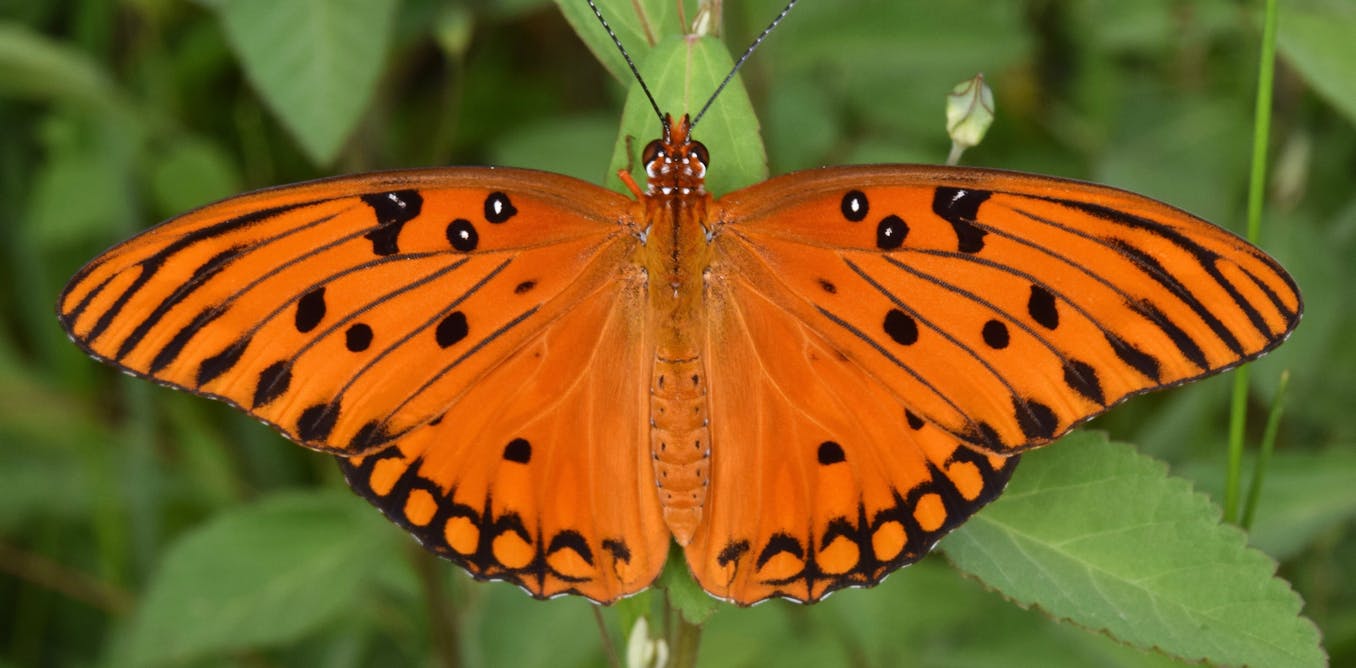
(Wikimedia Commons/ Christina Butler), CC BY
Butterflies are charismatic, colourful and cherished around the world. One of the most diverse groups of insects, with more than 19,000 described species, they inspire international organizations such as the North American Butterfly Association and the Xerces Society, as well as countless websites devoted to their identification, monitoring and natural history
This fascination is so widespread that it shapes the science we do. In our research, we’ve shown that people are far more likely to photograph and report some butterfly species than others, simply because they’re more colourful and look more interesting. That collective enthusiasm has transformed butterflies into one of the best-studied insect groups on Earth
Now, new research suggests butterflies are more than just pretty faces — they may hold clues to healthy aging
Our own research focuses on how organisms adapt to their environments and what these changes reveal about broader ecological processes. Jayme Lewthwaite has studied Canadian butterflies for over a decade, studying traits associated with their changing ranges. Arne Mooers is a comparative biologist, probing adaptation by considering differences between related species
Here we consider why exceptionally long-lived butterflies evolved in the first place, and what their biology might (and might not) tell us about aging generally
A butterfly that eats pollen
An international team of researchers recently took a close look at one group of butterflies — the Heliconius genus — that have evolved lifespans many times longer than other butterflies
Part of this longer lifespan seems to be due to a unique adaptation: whereas most adult butterflies rely entirely on sugary nectar to fuel them, Heliconius butterflies have evolved to also eat pollen
This protein-rich food in this group maintaining muscle function far longer than their non-pollen feeding relatives
The researchers suggest this observation may help us understand aging in other species, including humans, by identifying mechanisms that extend health span — the period of life spent in good health — rather than simply lifespan
From sensors to bullet trains
(Wikimedia Commons/Vera Kratochvil), CC BY
Butterflies have inspired helpful breakthroughs before. For instance, the blue morpho is a striking tropical species with blue wings that shimmer in the light
The arrangement of the microscopic layers behind this iridescent “structural colour” has inspired a broad range of sensors and even anti-counterfeit films
And of course, butterflies are not alone: the natural world is constantly inspiring scientific advances in other fields. The streamlined shape of kingfisher beaks helped engineers redesign Japan’s bullet trains to make them quieter and more energy-efficient
But back to these healthy Heliconius. To appreciate the new observations, we have to first ask: why do we age at all?
Safe lives are longer lives
Technically, aging is a decrease in performance as time goes by, generally leading to an increase in the probability of dying. As anyone who finally gave up on their old rust-bucket jalopy knows, things eventually wear out beyond the point of repair
But when do you stop investing? Species that are likely to die from external forces no matter how much they invest in their health have evolved to invest less in maintaining performance, because, truly, what’s the point? The rule for such species is “live fast,” and they age quickly. In contrast, species who live in relatively safe environments have evolved to keep on investing
So, for instance, because trees are relatively safe places, arboreal mammals live longer than similar-sized species that spend their life on the ground
Opossum populations living on predator-free islands have evolved to age more slowly than populations of the same species living on the mainland. If you are expected to live to see another spring and produce another litter, evolution will favour genes that actively slow aging
Insects live very perilous lives. Birds like swallows and hummingbirds can eat thousands of them per day so few live more than a month or two in nature
The exceptions prove the rule: cicadas live 13 to 17 years but spend most of their lives safe underground; queen termites are the longest-lived insects we know, laying eggs for decades, nestled deep in their mounds, far from predators and disease
Distasteful to birds
(Wikimedia Commons/Bill Bouton), CC BY-SA
Some Heliconius species can live over 10 months in an insectarium. Importantly, even when deprived of pollen, they seem to age more slowly
So, it isn’t just their diet that prolongs their life. They have evolved. These species are distasteful to birds and have bright and distinctive colouring. Birds learn quickly to avoid them. So, it could be that Heliconius lead less-perilous lives than your average butterfly
In contrast, several of the shorter-lived cousins the authors compared Heliconius to, though they mimic distasteful species, may be more palatable. Perhaps they are more likely to be eaten
With this in mind, as the authors themselves suggest, it would be interesting to gather data on predation rates in the wild. If the chance of being eaten is lower in slow-aging Heliconius species than in, for example, quick-aging Dione species, it stands to reason that evolution favoured longevity, as it did for the opossums. Diet might matter, but only indirectly
Another interesting data point would be the external mortality rates of a shorter-lived, protein-feeding Heliconius, such as the H. eleuchia
Protein for longevity?
(Wikimedia Commons/Richard Bartz), CC BY-SA
Eating protein is having its moment, though eating more does not usually contribute to longevity in humans. Then again, we don’t eat pollen
That said, the long-lived Heliconius is different from humans in a potentially more important way: the protein the butterflies eat is used primarily for making eggs, something they continue to do right until the end of their lives. We, of course, have not evolved to live like this
So, while these Heliconius live longer lives than their cousins, it remains to be seen if they are set to become trend-setting nutrition gurus. More likely, learning how short- and long-lived species maintain their condition will shed light on the general physiology of aging
