



First-born children are more likelythan their siblingsto develop mental health problems later in life, a groundbreaking new study suggests
Previous studies have indicated that younger siblings tend to suffer lower rates of some diseases, like allergies, likely due to older brothers or sisters bringing in more microbes into their homes
But the research has been unclear as to whether a child’s birth order is linked more broadly to overall health risks
The new study, based on health data of over 10 million people from five million two-child families submitted for commercial insurance claims over a period of two decades, showed that the risks of developing at least 150 diseases were indeed determined by one’s birth order
Researchers compared the health data of first-borns with those of second-bornswithin the same household as well as from different families, matching them by sex, birth year, location and similar parental ages. They noted that the datasets were analysed in accordance with privacy requirements
They found that the risks of the children developing 150 diseases in later life varied based on their order of birth, according to the study published in the journal Nature Health
First-borns were likelier than their younger siblings to be diagnosed with neurological and mental health conditions, including autism and ADHD, Tourette syndrome, depression and anxiety
In contrast, second-born children were more often diagnosed with substance abuse problems, digestive issues like gastritis, shingles, migraines, and some joint conditions
“Birth order is associated with disease risk more broadly than previously appreciated,” the study noted
One possible reason for the varying disease risk could be parents watching their first child more closely, leading to earlier diagnoses of conditions like autism and ADHD, researchers said
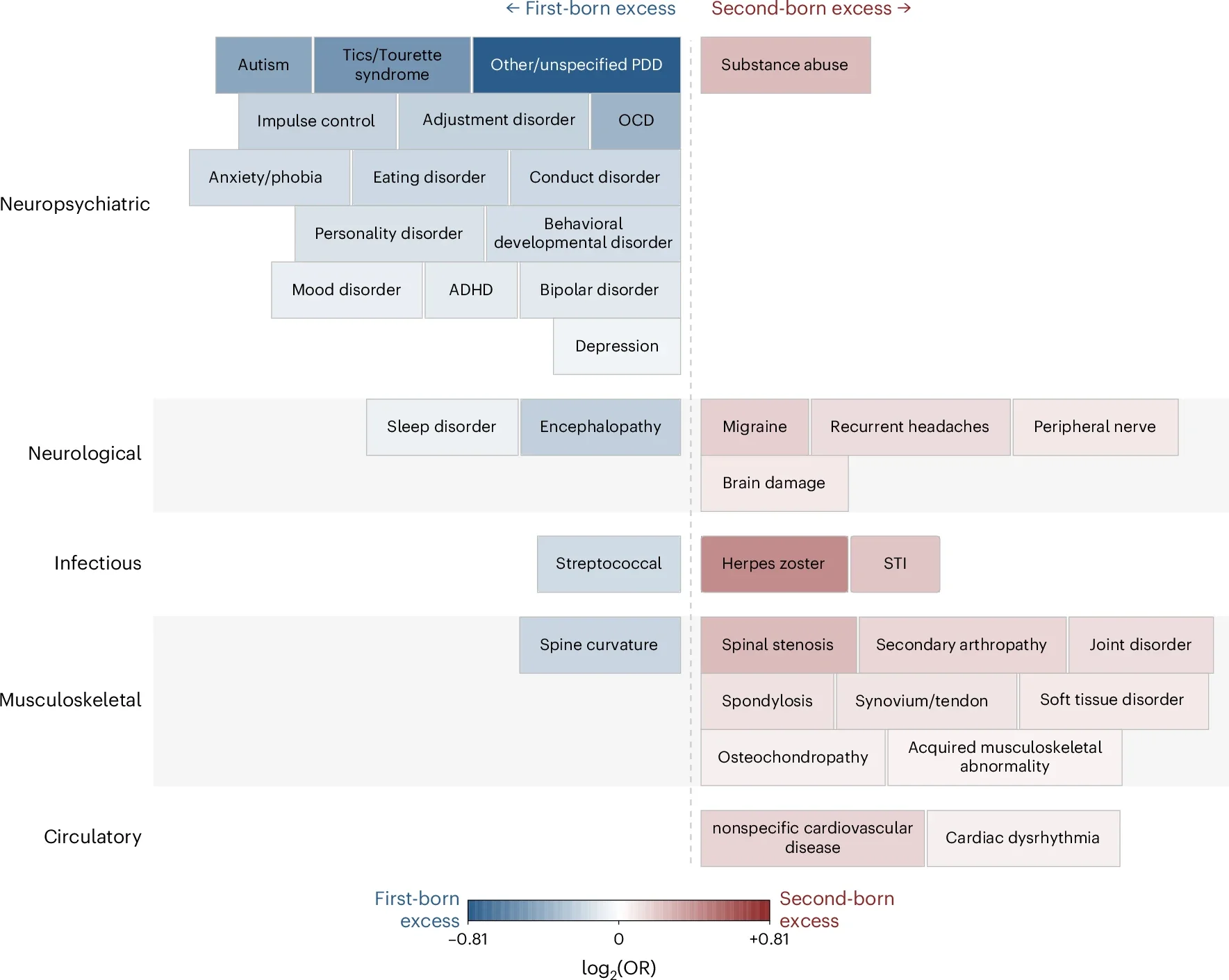
Younger siblings appear to be at a relatively higher risk of substance abuse because they are exposed to older peer groups at an earlier age, they reason
“The second-born excess for substance abuse aligns with sociological theories of later-born risk-taking behaviour,” the study noted
However, researchers caution that the findings are only statistical associations and should not be interpreted as direct evidence of birth order causing any particular disease
“The most conservative interpretation is that neuro-developmental associations probably reflect a mixture of pregnancy-order biology, parental surveillance, diagnostic timing, residual confounding rather than one uniform mechanism,” they wrote. “The convergence of evidence from between-family and within-family designs, combined with validation controls and robustness analyses, is consistent with a mixture of physiological, immunological and social mechanisms.”
Researchers hope future studies will evaluate whether this pattern is replicated in households with more than two children
