


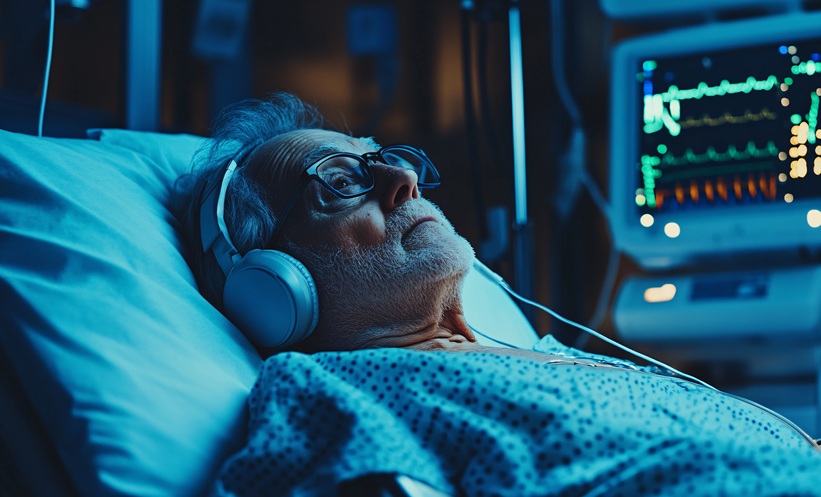
RESEARCHERS have found that listening to personalised vocal music during acute stroke hospitalisation can improve psychological well-being, with patients reporting reduced anxiety, depression, and better sleep quality compared with standard care, according to a new randomised clinical trial
Randomised Trial of Personalised Vocal Music Listening
Researchers conducted a single-centre randomised trial with blinded outcome assessment, enrolling patients aged 18 to 85 years with acute stroke within 24 to 96 hours of onset, a National Institutes of Health Stroke Scale (NIHSS) score below 10, preserved comprehension, and no major cognitive or psychiatric disorders
Of 165 eligible patients, 150 were randomised 1:1 to music listening or standard care (75 per group; mean age 67.9 years; 36.7% female). The intervention consisted of one-hour weekday sessions of personalised Italian vocal music delivered feasibility, acceptability, and Hospital Anxiety and Depression Scale (HADS) and EQ visual analogue scale scores at discharge, with insomnia severity as a secondary outcome
Music Listening Linked to Improved Mood and Sleep
Feasibility outcomes were met, with a 91% enrolment rate, 6.7% dropout, and a median cumulative listening time of 6 hours; over 80% of participants rated the intervention highly acceptable
At discharge, the music group had lower depression scores (adjusted mean difference [aMD] −2.68, 95% CI −3.90 to −1.47) and lower anxiety scores (aMD −1.86, 95% CI −2.93 to −0.79) than controls (p<0.001 for both), and better sleep quality (aMD −2.83, 95% CI −4.43 to −1.24, p<0.001). Quality of life, measured on the EQ visual analogue scale, was comparable between groups (p=0.94). These associations remained significant in multivariable and sensitivity analyses, and no adverse events related to the intervention were observed.
Implications for Music-Based Support in Stroke Care
These findings have suggested that early, personalised vocal music listening during acute stroke hospitalisation is feasible and acceptable, and is associated with improved mood and self-perceived sleep quality. As this was a single-centre trial without an active sham control, the findings may not generalise to all stroke patients. The authors have suggested that music listening, as a low-cost intervention, could be integrated into acute stroke management, including in resource-limited settings.
Giacalone G et al. Music listening and multiple dimensions of well-being in acute stroke: a randomized clinical trial. JAMA Netw Open. 2026;9(7):e2623732
Featured image: HISTOCK on Adobe Stock
Author:
Katrina Thornber
