



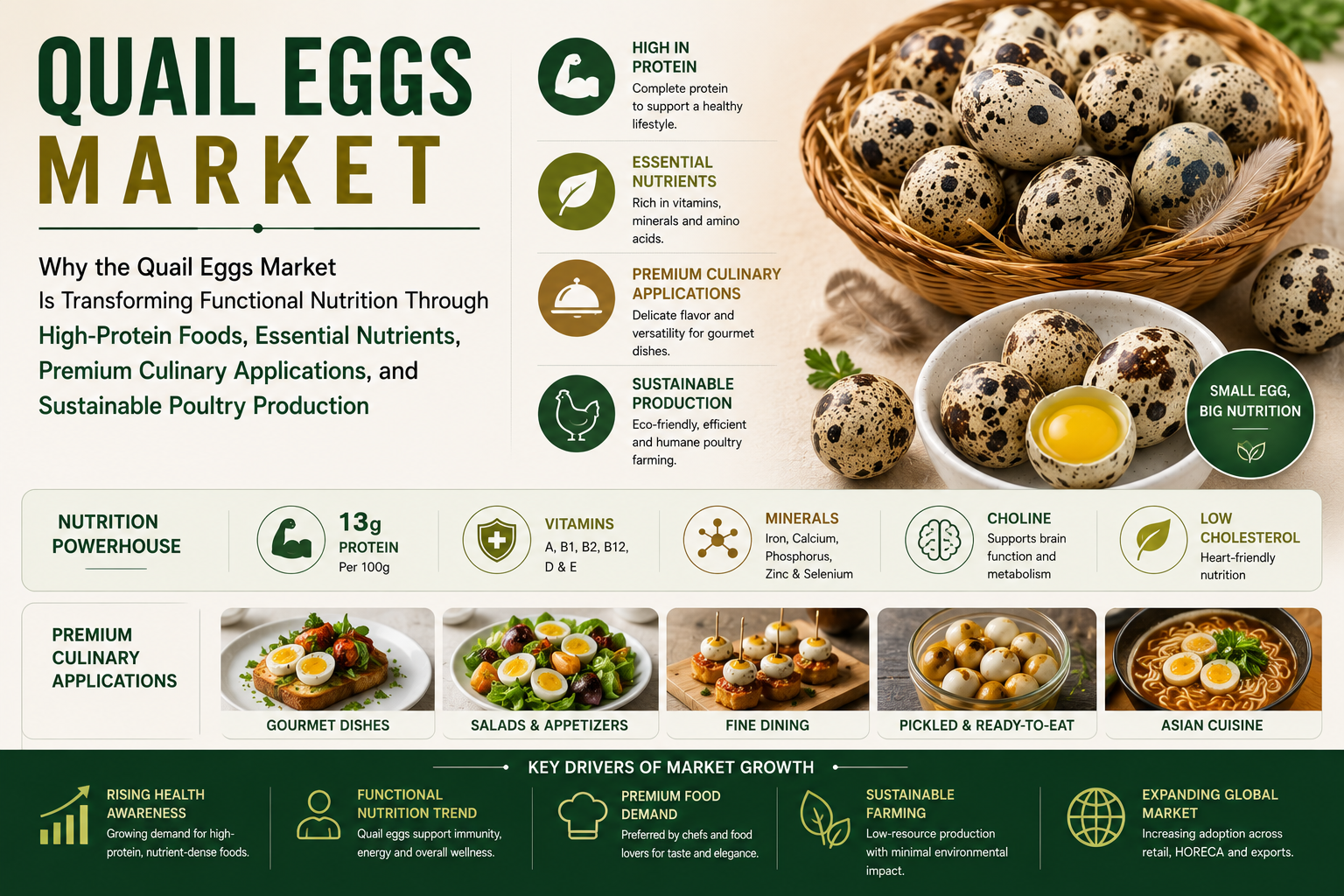
Why the Quail Eggs Market Is Transforming Functional Nutrition Through High-Protein Foods, Essential Nutrients, Premium Culinary Applications, and Sustainable Poultry Production: Industry Analysis and Forecast by Spherical Insights & Consulting
RELEASE DATE:
Aug 2026Author:
Spherical InsightsAccording to a research report published by Spherical Insights & Consulting, the Global Quail Eggs Market Size is projected to grow from USD 2.30 Billion in 2025 to USD 3.53 Billion by 2035, at a CAGR of 4.4% during the forecast period 2026-2035.
Request Free SampleSpeak to Analyst
According to a research report published by Spherical Insights & Consulting, the Global Quail Eggs Market Size is projected to grow from USD 2.30 Billion in 2025 to USD 3.53 Billion by 2035, at a CAGR of 4.4% during the forecast period 2026-2035
The quail eggs market is gaining attention as consumers, food manufacturers, restaurants, and nutrition-focused businesses increasingly seek compact, nutrient-rich alternatives to conventional poultry products. Quail eggs are small but contain valuable proteins, vitamins, minerals, fats, and other nutrients, making them attractive within functional nutrition and premium food categories. Their distinctive appearance and flavor have also created demand in gourmet cooking, catering, specialty food products, and ready-to-eat meals.
Compared with conventional chicken eggs, quail eggs offer a differentiated product proposition based on their size, patterned shells, culinary presentation, and nutritional profile. They are increasingly used in salads, appetizers, bakery products, Asian cuisine, restaurant dishes, packaged foods, and specialty diets. Rising consumer interest in protein-rich foods and minimally processed animal products is creating additional opportunities for producers
The market is also benefiting from the relatively compact production requirements associated with quail farming. Quails generally require less space than larger poultry, creating opportunities for small-scale farms and diversified agricultural businesses. As agricultural producers look for alternative incomeing as an attractive niche within the broader poultry industry
Latest Market Statistics and Growth Outlook
The global quail eggs market is developing as part of the wider expansion of the eggs and poultry products industry. While market valuations vary depending on whether studies include only fresh quail eggs or also processed products, the underlying demand environment is supported by increasing egg consumption, expanding foodservice activity, premiumization, and consumer interest in nutrient-dense foods
Asia remains particularly important to quail egg production and consumption because quail eggs are well established in several regional cuisines. Japan, China, Indonesia, the Philippines, Thailand, and other Asian markets have long incorporated quail eggs into traditional and modern dishes. Demand is also expanding in North America, Europe, and other regions through restaurants, specialty retailers, ethnic food channels, and online grocery platforms
The broader egg industry provides an important foundation for the category. Global egg production has expanded substantially over the past decades, while the Food and Agriculture Organization of the United Nations continues to identify eggs as an importantsumer acceptance of eggs supports opportunities for differentiated varieties such as quail eggs
Ready to lead the Quail Eggs Market?
Discover the regional trends and growth factors shaping the industry. We’re here to assist with expert, personalized data
Call +1 303 800 4326 or Send us a message for a personalized consultation
Growth Drivers
One of the strongest drivers for the quail eggs market is the growing preference for protein-rich foods. Consumers are increasingly paying attention to protein intake as part of active lifestyles, sports nutrition, healthy aging, and balanced diets. Quail eggs can serve as a convenient
Another important factor is the expansion of premium and specialty foods. Restaurants and foodservice operators use quail eggs to enhance the visual appeal of dishes, particularly appetizers, salads, sushi, tapas, breakfast meals, and gourmet preparations. Their small size allows chefs to incorporate multiple eggs into a single serving, creating attractive presentations
Urbanization is also contributing to demand. As consumers increasingly purchase prepared meals and convenience foods, food manufacturers have opportunities to introduce boiled, peeled, canned, pickled, frozen, or otherwise processed quail egg products
Meanwhile, the growth of small-scale farming is encouraging agricultural diversification. Quail farming can complement existing poultry operations and provide farmers with another
Applications Across Food and Nutrition
The applications of quail eggs extend well beyond household consumption. In the foodservice industry, they are increasingly used as premium ingredients in restaurants, hotels, catering services, and specialty dining establishments
In food processing, quail eggs can be incorporated into ready-to-eat meals, canned foods, pickled products, salads, snacks, and convenience foods. Their distinctive appearance provides an opportunity for manufacturers to differentiate products on retail shelves
The bakery and confectionery industries also represent potential application areas because eggs contribute important functional properties such as emulsification, binding, aeration, and texture. Quail eggs can therefore be incorporated into selected premium bakery and culinary formulations
Additionally, quail eggs are increasingly associated with functional nutrition. Consumers interested in nutrient-dense foods may view them as an alternative proteinupported by appropriate scientific evidence and regulatory compliance rather than relying on unsupported health claims
Government Initiatives and Food Safety
Government policies supporting poultry farming, food safety, agricultural diversification, livestock development, and smallholder farmers can indirectly strengthen the quail eggs market. In India, programs and institutions supporting poultry development, animal husbandry, veterinary services, biosecurity, and rural entrepreneurship provide an enabling environment for alternative poultry production
Food safety remains particularly important as the market expands. Proper handling, sanitation, refrigeration, packaging, transportation, and traceability are essential for maintaining product quality and consumer confidence. Producers must comply with applicable food safety regulations governing egg production, processing, labeling, storage, and distribution
Technology Overview
Technology is increasingly influencing quail egg production. Modern farms are adopting automated feeding and watering systems, controlled housing environments, improved ventilation, temperature monitoring, lighting management, and digital farm-record systems
Automation can help producers manage labor requirements while improving consistency in feeding and production. Sensors and connected monitoring systems can also help farmers track environmental conditions and identify potential problems earlier
Packaging technology is another important area. Improved protective packaging can reduce shell breakage during transportation, while modified packaging formats can extend shelf life and improve retail presentation. Processing technologies such as automated washing, grading, boiling, peeling, and packaging can help transform quail eggs from a niche farm product into a scalable convenience food
Future Importance of the Quail Eggs Market
The future of the quail eggs market will increasingly depend on the convergence of nutrition, convenience, culinary innovation, agricultural diversification, and sustainable production. As consumers search for alternative proteinive position between everyday poultry products and premium specialty foods
The next stage of market development is likely to involve greater product diversification, improved cold-chain infrastructure, online distribution, modern packaging, automated farming, and value-added processing. Producers that prioritize food safety, consistent quality, efficient production, and transparent sourcing can strengthen consumer trust
Ultimately, the quail eggs market represents a growing niche within the global poultry and functional food ecosystem. Its combination of nutritional value, culinary versatility, compact production potential, and premium positioning could create new opportunities for farmers, food processors, retailers, restaurants, and technology providers in the years ahead
Rising Consumer Demand for Nutrient-Dense Foods
The quail eggs market is benefiting from the broader shift toward nutrient-dense and protein-rich food choices. Consumers are becoming more attentive to the nutritional composition of everyday foods and are increasingly seeking ingredients that combine protein with essential micronutrients
Quail eggs provide protein along with nutrients such as vitamin B12, riboflavin, selenium, phosphorus, iron, and choline. Their small serving size also makes them convenient for meal preparation and portion-controlled recipes
The increasing popularity of high-protein diets, fitness-oriented nutrition, and balanced eating is therefore creating opportunities for quail eggs across supermarkets, specialty food stores, restaurants, and online grocery platforms
Premiumization Is Creating New Market Opportunities
Premiumization is becoming an important trend across the global food industry, and quail eggs fit naturally into this movement. Their distinctive speckled shells and smaller size provide visual differentiation from conventional chicken eggs
Restaurants and chefs increasingly use quail eggs in premium appetizers, salads, sushi, tapas, breakfast dishes, and gourmet meals. Food manufacturers can also use them to create specialty packaged products
This premium positioning can allow producers to move beyond competing solely on volume and price. Instead, businesses can differentiate through freshness, packaging, farm-to-table sourcing, organic or specialty production where applicable, and value-added processing
Expansion of Processed and Convenience Products
Convenience is becoming a major factor influencing food purchasing decisions. This trend is encouraging companies to develop processed quail egg products that require minimal preparation
Boiled and peeled quail eggs, canned quail eggs, pickled products, ready-to-eat packs, and prepared meal ingredients can increase accessibility for consumers. These formats are particularly relevant for restaurants, catering companies, hotels, institutional kitchens, and busy households
Value-added processing can also help producers increase product shelf life and reduce dependence on fresh-egg sales. However, maintaining appropriate food safety, temperature control, packaging integrity, and labeling standards remains essential
Foodservice and Hospitality Industry Drives Demand
Foodservice represents an important application area for quail eggs. Their attractive appearance and convenient portion size make them useful for chefs seeking distinctive ingredients
Hotels and restaurants can incorporate quail eggs into breakfast buffets, salads, appetizers, sandwiches, noodles, rice dishes, and specialty menus. Catering companies can also use them for bite-sized foods and event-based presentations
The continued expansion of hospitality, tourism, premium dining, and food delivery services can therefore contribute to demand. In emerging markets, greater exposure to international cuisines may also introduce consumers to new quail egg recipes and applications
Asia-Pacific Remains a Key Production and Consumption Region
Asia-Pacific has a strong connection with quail eggs because of established culinary traditions and significant poultry production. Quail eggs are consumed in various forms across countries including Japan, China, Thailand, Indonesia, the Philippines, and other Asian markets
The region’s large population, expanding urban middle class, established food-processing sector, and strong restaurant industry provide favorable conditions for continued market development
Japan is particularly notable for the incorporation of quail eggs into packaged meals, lunch boxes, salads, and other food products. In other Asian markets, quail eggs are commonly found in street foods, soups, noodle dishes, snacks, and traditional preparations
Meanwhile, international food trends are helping expand awareness of quail eggs outside traditional consumption regions
Sustainable Poultry Production Creates Opportunities
Sustainability is becoming increasingly important throughout agriculture. Quail farming can provide an alternative production model for farmers seeking to diversify poultry operations
Because quails are small birds, producers can potentially operate them in relatively compact production systems compared with larger poultry species. This can make quail farming attractive to some small and medium-sized agricultural businesses
However, sustainability should not be assumed solely because quails are smaller. Feed sourcing, energy use, water consumption, manure management, housing systems, transportation, animal welfare, and production efficiency all influence environmental performance
Technology can help improve these areas through efficient feeding systems, environmental monitoring, waste management, optimized housing, and data-driven production planning
Digitalization and Smart Farming
Digital agriculture is opening new possibilities for quail producers. Smart monitoring systems can collect information related to temperature, humidity, ventilation, lighting, feed consumption, and flock conditions
Farmers can use digital records to identify production patterns, monitor performance, and improve reo reduce manual labor and improve consistency
Artificial intelligence and predictive analytics could eventually support more advanced poultry management by identifying unusual environmental conditions or production changes. For smaller farms, however, the adoption of technology will depend heavily on affordability, technical skills, and access to reliable infrastructure
E-Commerce Expands Market Reach
Online grocery and direct-to-consumer platforms are becoming increasingly relevant to specialty food products. Quail eggs can benefit because consumers searching for unusual ingredients, specialty foods, or regional products can discover them through digital marketplaces
Farmers and food companies can use online channels to build direct relationships with customers and communicate information about sourcing, freshness, packaging, production methods, and recipes
Social media marketing is also helping specialty food producers demonstrate new ways to prepare quail eggs. Recipe videos, cooking tutorials, restaurant content, and food influencers can increase awareness among consumers who have never purchased the product
Unlock exclusive market insights. Blog news—Download the Brochure now and dive deeper into the future of the Market
Major Challenges Facing the Market
Despite its growth potential, the quail eggs market faces several challenges. One major issue is consumer awareness. In markets where quail eggs are not traditionally consumed, consumers may be unfamiliar with their preparation, nutritional profile, pricing, and culinary uses
Supply-chain infrastructure is another challenge. Fresh eggs require careful handling and suitable storage conditions. Breakage during transportation can also create financial losses, making protective packaging particularly important
Feed costs, disease management, labor availability, energy expenses, and fluctuations in poultry input prices can affect farm profitability. Small producers may also face difficulties achieving economies of scale
Regulatory compliance represents another important consideration. Producers and processors must meet food safety requirements while maintaining appropriate hygiene, traceability, labeling, and storage practices
Future Opportunities for Producers and Food Companies
The market offers significant opportunities for businesses willing to develop differentiated products. Producers can explore premium fresh eggs, organic or specialty offerings where regulations and production standards permit, processed products, ready-to-eat packs, and foodservice-oriented formats
Food manufacturers can also develop quail egg-based convenience meals, snack products, pickled varieties, and premium culinary kits
Another opportunity lies in branding. Farm-origin stories, transparent sourcing, responsible production practices, and high-quality packaging can help companies establish stronger connections with consumers
As demand for alternative protein-rich foods continues to develop, quail eggs can move from a specialty ingredient toward a more widely recognized food category
Competitive Landscape and Industry Development
Competition in the quail eggs market includes specialized quail farms, poultry producers, food processors, distributors, supermarkets, restaurants, and specialty food companies. The competitive environment remains fragmented in many markets, with local producers playing a significant role
Larger businesses can gain advantages through automated production, established distribution networks, standardized quality control, and processing capabilities. Smaller farms can compete through freshness, local sourcing, specialty production, direct sales, and differentiated branding
The future competitive landscape will increasingly reward companies that combine efficient production with strong food safety, innovative packaging, reliable distribution, and consumer education
Outlook
The quail eggs market is transitioning from a niche poultry segment into an increasingly diversified food category. Demand is being supported by protein-focused nutrition, premium culinary applications, convenience foods, foodservice expansion, digital commerce, and agricultural diversification
The strongest opportunities are likely to emerge where producers connect traditional quail farming with modern processing, packaging, marketing, and smart agriculture. As consumer interest in differentiated and nutrient-rich foods continues to grow, quail eggs could gain a stronger position in both specialty and mainstream food markets
Innovation Is Reshaping the Quail Eggs Market
Innovation is becoming an important factor in the development of the quail eggs market as producers move from conventional fresh-egg sales toward value-added products. Modern businesses are investing in improved farm management, automated feeding, climate control, egg grading, packaging, processing, and digital monitoring
Automation can improve operational consistency by supporting feeding, watering, egg collection, and environmental management. Sensors can monitor temperature, humidity, ventilation, and other farm conditions, helping producers maintain suitable environments for quail production
Processing technology is also expanding opportunities. Boiled and peeled quail eggs, canned products, pickled eggs, ready-to-eat packs, and prepared food ingredients can provide consumers with convenient alternatives to fresh products. These innovations can increase product accessibility while creating additional revenue opportunities for producers and processors
Packaging Technology Creates Product Differentiation
Packaging is becoming increasingly important as the market develops. Quail eggs are relatively fragile, and effective packaging can help minimize breakage during transportation and retail handling
Modern packaging designs can also improve product visibility and provide information regarding freshness, storage, nutritional content, preparation, and sourcing. Retail-ready packaging can help quail eggs compete more effectively within supermarkets and specialty food stores
Sustainable packaging represents another potential development area. Producers may increasingly explore recyclable, lightweight, or reduced-material packaging while maintaining adequate protection. The balance between sustainability, product safety, cost, and transportation performance will remain important
Regional Opportunities
Asia-Pacific is expected to remain an important region for quail egg production and consumption because of established culinary traditions and strong poultry production infrastructure. Growing urbanization and foodservice development can support additional demand for processed and convenient quail egg products
In North America, opportunities are linked to specialty foods, gourmet restaurants, ethnic cuisines, farmers’ markets, premium grocery, and online retail. Greater consumer exposure to international dishes could increase awareness of quail eggs
Europe offers opportunities through premium food, culinary tourism, specialty retail, and foodservice. Consumers’ growing interest in provenance and differentiated food products may encourage producers to emphasize local sourcing and production standards
Latin America and the Middle East and Africa also represent developing opportunities as foodservice industries expand and consumers gain greater exposure to specialty poultry products. Market development in these regions will depend on production infrastructure, consumer awareness, distribution networks, and food safety systems
India Offers Attractive Growth Potential
India represents a potentially important market for quail eggs because of its large population, expanding foodservice sector, agricultural diversification, and growing interest in alternative poultry products
Quail farming can provide opportunities for small and medium-sized farmers seeking to diversify beyond conventional poultry. The development of organized supply chains, veterinary services, hatcheries, processing facilities, cold-chain infrastructure, and market linkages could further support the industry
Restaurants and food businesses can also create new demand through innovative menus. Quail eggs can be used in salads, appetizers, breakfast products, noodles, rice dishes, and fusion cuisine
Digital commerce could further expand access by connecting specialized producers with consumers beyond traditional local markets
Unlock exclusive market insights. Blog news—Download the Brochure now and dive deeper into the future of the Market
Sustainability and Responsible Production
Sustainability is expected to become a stronger consideration throughout the quail eggs market. Producers are increasingly looking at ways to improve re
Efficient feed management can help reduce waste and production costs. Improved housing and ventilation systems can support better environmental management, while manure can potentially be managed through composting and other agricultural applications where appropriate
Water conservation, energy-efficient equipment, responsible feed sourcing, and optimized transportation can further contribute to improved environmental performance
The industry’s long-term sustainability will depend not only on the biological characteristics of quail production but also on how farms manage feed, energy, water, waste, transportation, and animal welfare
Consumer Education Will Be Critical
One of the biggest opportunities for market expansion is consumer education. In markets where quail eggs are unfamiliar, consumers may not know how to prepare them or how they differ from chicken eggs
Food brands can address this gap through recipe content, preparation instructions, nutritional information, cooking demonstrations, and social media campaigns. Restaurants can also introduce quail eggs through accessible dishes rather than limiting them to premium menus
Digital platforms provide an especially effective channel for educating younger consumers. Short cooking videos and recipe demonstrations can show how easily quail eggs can be incorporated into everyday meals
Product Diversification Will Strengthen Market Growth
The future market is unlikely to depend exclusively on fresh quail eggs. Product diversification could become one of the strongest strategies for increasing consumption
Potential categories include:
- Fresh shell quail eggs
- Boiled and peeled quail eggs
- Pickled quail eggs
- Canned quail eggs
- Ready-to-eat quail egg snacks
- Quail egg meal kits
- Foodservice packs
- Premium specialty products
- Processed ingredients for prepared foods
These products can target different consumer groups and distribution channels. Fresh products can serve households and restaurants, while processed formats can appeal to convenience-focused consumers
Competitive Strategies for Market Participants
Companies operating in the quail eggs market can strengthen their competitive position through several strategies. Quality consistency will remain fundamental because consumers and foodservice businesses expect reliable egg size, freshness, packaging, and safety
Brand differentiation can also create opportunities. Producers can emphasize local sourcing, farm transparency, specialty production, responsible farming practices, or premium packaging where these claims can be substantiated
Food processors can focus on convenience and extended usability, while restaurants can differentiate through creative recipes and premium presentation
Partnerships between farmers, processors, distributors, retailers, restaurants, and online marketplaces may also improve supply-chain efficiency and market reach
Challenges That Could Influence Future Growth
Despite its potential, the market will continue to face operational and commercial challenges. Feed price fluctuations can affect production economics, while disease risks require appropriate veterinary management and biosecurity
Transportation is another challenge because fresh eggs are fragile and require careful handling. Insufficient cold-chain infrastructure can create quality and shelf-life problems in markets with developing distribution systems
Consumer misconceptions and limited awareness may also restrict demand. In addition, fragmented production can make it difficult to maintain consistent supply and standardized quality
Addressing these challenges will require investments in farm modernization, training, quality management, logistics, processing, and consumer education
Future Outlook
The future of the quail eggs market is closely connected to several major food and agriculture trends, including high-protein nutrition, premiumization, convenience, specialty foods, smart farming, sustainable agriculture, and digital commerce
As consumers become more interested in differentiated from their distinctive nutritional and culinary positioning. At the same time, technological advancements can help producers improve efficiency, quality, packaging, traceability, and distribution
The strongest growth opportunities are likely to emerge from value-added products rather than fresh eggs alone. Processed, ready-to-eat, packaged, and foodservice-oriented products can help expand consumption while increasing the commercial value of quail production
Unlock exclusive market insights. Blog news—Download the Brochure now and dive deeper into the future of the Market
Conclusion
The quail eggs market is evolving through the convergence of functional nutrition, premium food culture, convenience, agricultural innovation, and sustainable production. What was once primarily a specialty poultry product is gaining broader relevance across restaurants, food processing, retail, hospitality, and nutrition-oriented food categories
Future growth will depend on the ability of producers and food companies to improve production efficiency, strengthen food safety, adopt advanced technologies, develop convenient products, and educate consumers about culinary applications. At the same time, responsible reingly important
With continued innovation in farming, processing, packaging, distribution, and digital marketing, the quail eggs market has the potential to establish a stronger position within the global specialty food and poultry ecosystem
Need help to buy this report?
Inquiry Before Buy
Didn’t find what you were looking for?
Thank You!
We have received your message and would like to thank you for writing to us. If your inquiry is urgent, please use the telephone number listed below to talk to one of our staff members. Otherwise, we will reply by email as soon as possible
+1 303 800 4326+91 9561448932[email protected]
