



Leadership Gap in Structural Heart Disease Trials Persists
Print
Font Size
A
A
A
On this page:Resources
Women remain underrepresented in authorship and leadership roles of clinical trials of structural heart disease (SHD), and targeted efforts and policies to diversify trial leadership may help address the downstream inequities in the generation of cardiovascular evidence, according to a systematic review and meta-analysis published Aug. 12 in JACC: Advances
The analysis included interventional SHD trials published in high-impact journals from Jan. 1, 2010, to Dec. 31, 2025, and was conducted using Preferred Reporting Items for Systematic Reviews and Meta-Analyses guidelines
Sahar Samimi, MD, et al., examined whether each trial reported an oversight committee and assessed women’s representation as committee members, committee chairs and senior authors. Pooled estimates were generated using random-effects meta-analysis, and temporal trends were evaluated using generalized linear mixed-effects meta-regression
The primary outcome was women’s representation on trial steering or executive committees, defined as the proportion of women among named committee members. Secondary outcomes included the proportion of committees composed entirely of men; women serving as committee chairs or leaders; women appearing as first or last author; and women’s trial enrollment. The investigators also assessed trends in committee gender composition, women’s committee leadership and women’s trial enrollment.
Among the 88 eligible trials, 68% reported a steering committee and 56% named committee members. In trials with available committee membership data, women held 7% of committee seats, served as committee chair of 12% of trials and were senior authors of 14% of publications. Nearly two-thirds of committees were composed entirely of men
Women’s representation on committees did not increase significantly over time (odds ratio [OR] per year: 1.02; p=0.70). Their representation as committee chairs increased numerically, but the change was not statistically significant (OR per year: 1.41; p=0.075)
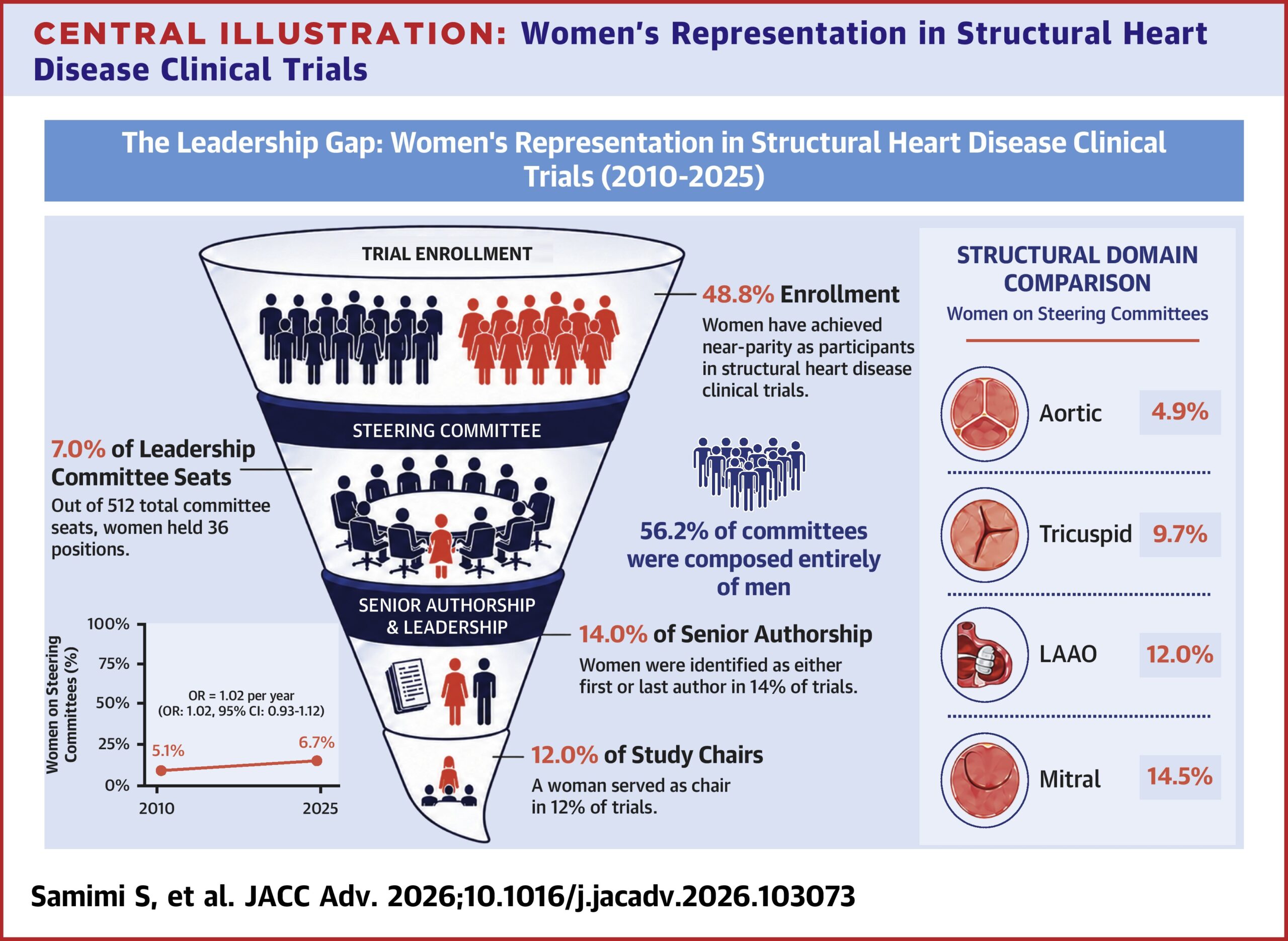
“These findings highlight persistent gender disparities in trial leadership, which may influence how cardiovascular evidence is generated, interpreted and translated into clinical practice,” write the authors. They add that “structured programs that provide early exposure to cardiovascular trial leadership…should be expanded through professional societies, scientific meetings, research institutes and academic departments to support the development, visibility and networking of future women leaders in SHD research.”
“The persistence of disparities in clinical trial leadership reflects deeply embedded norms within academic and clinical research environments,” write ACC President Roxana Mehran, MD, FACC; Dipti Itchhaporia, MD, MACC; and Puja B. Parikh, MD, FACC, in an accompanying editorial. Achieving equity in trial leadership, they write, “is essential to advancing the field and ensuring that innovation is inclusive, representative and broadly applicable. The challenge is no longer to define the problem or propose solutions – it is to implement them.”
Citation:
Keywords:Interventional Cardiology,Gender,Women in Cardiology,Leadership,Clinical Trials as Topic
