


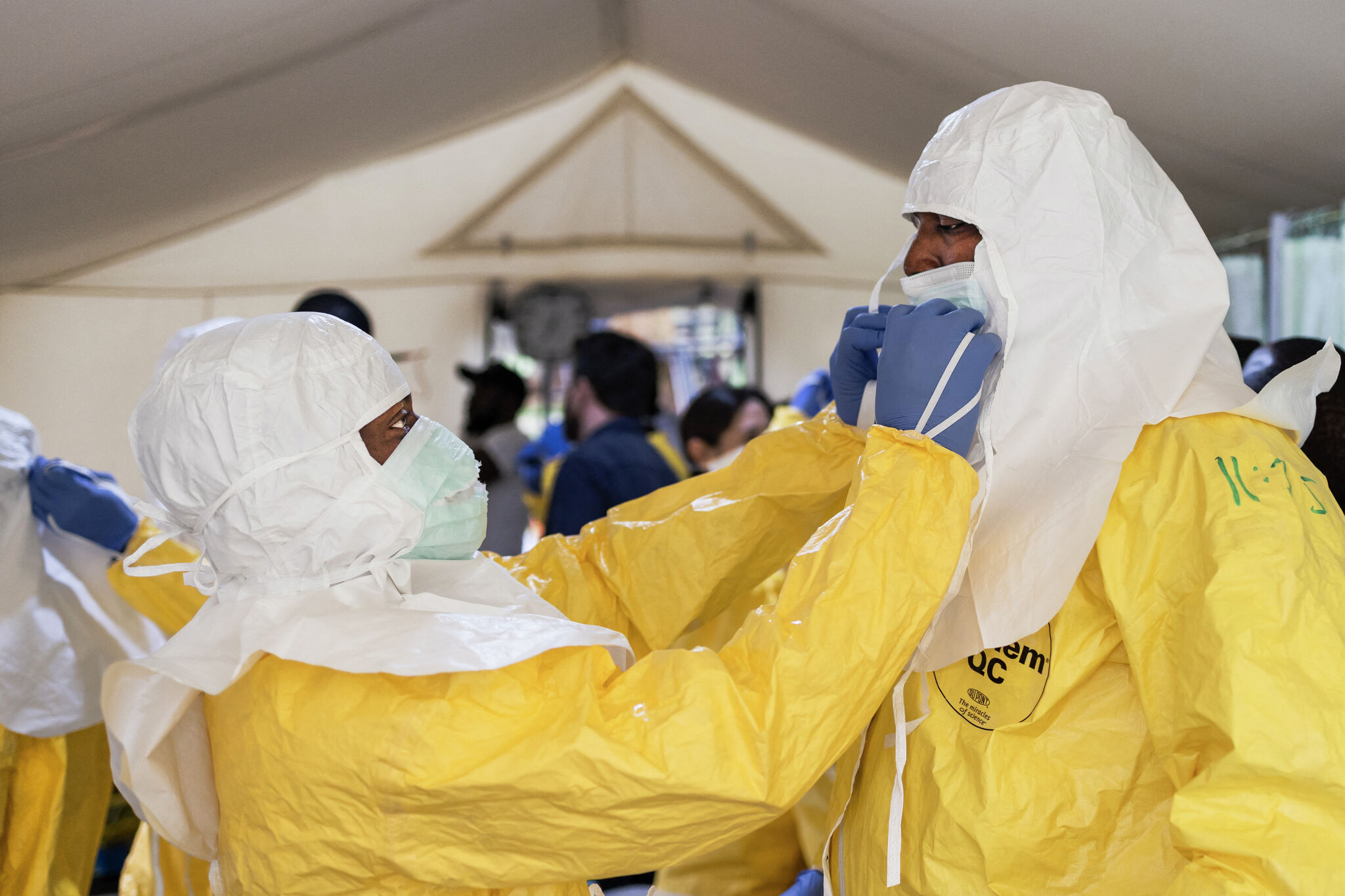
Misinformation and distrust are among the challenges facing <a href="https://healthylife7.com/cyclosporiasis-salmonella-outbreaks-signal-need-for-more-investment-in-u-s-food-system-says-expert-harvard-t-h-chan-school-of-public-health/” title=”Cyclosporiasis, salmonella outbreaks signal need for more investment in U.S. food system, says expert | Harvard T.H. Chan School of Public Health”>public health workers in the Democratic Republic of Congo as they confront the second-deadliest Ebola outbreak on record. Even though the virus has faded from U.S. headlines, key organizations are still at work providing medical care and training to counter the spread of the disease
Since the World Health Organization’s May 17 declaration of a public health emergency, over 4,300 cases of the Bundibugyo strain of the Ebola virus have been confirmed and more than 2,000 people have died in Congo, according to the U.S. Centers for Disease Control and Prevention
More than 650 people were in isolation with Ebola in Congo as of Aug. 4, the country’s National Public Health Institute said. Twenty cases and two deaths were reported in neighboring Uganda as well, but no new cases have been reported there since June 21, the World Health Organization said
Article continues below this ad
The worst Ebola outbreak in history, which hit several countries in West Africa from 2014 to 2016, claimed over 11,300 lives
The current outbreak is only the third of the Bundibugyo strain in central Africa. Congo officials are reporting a 44% fatality rate for the rare strain, which does not yet have a vaccine. Military conflict in eastern Congo, where the outbreak is centered, has made the medical response more difficult
“When everybody became aware of what was happening, we were already months behind where we should have been as a global community in stopping the spread of this disease,” said Erica Tavares, a senior director of the International Medical Corps
The U.S. has pledged $512 million in direct aid in response to the outbreak and enacted a travel ban, temporarily preventing non-U.S. citizens traveling from the affected region from entering the country
Meanwhile, public health workers in Congo continue to toil against Ebola
Article continues below this ad
Below, KFF Health News profiles five organizations involved in the ongoing public health work there. A fraction of the groups working in Congo, they’re a mix of smaller, local organizations and larger, internationally known groups
1. Africa Centres for Disease Control and Prevention
Africa CDC is the African Union’s public health agency, in charge of helping health institutions in its member states with disease threat detection and response. With the WHO, Africa CDC announced a joint Ebola response plan on June 5. The organizations said they would need more than $500 million over the following six months for the effort
Their primary goal is to strengthen cross-border communication and collaboration under a unified “One Response” plan. Africa CDC has released guidelines for travel and public gatherings, urging people to implement prevention methods including avoiding contact with bodily fluids instead of issuing blanket travel restrictions to affected areas
Article continues below this ad
This subagency within the Congolese Ministry of Public Health is tasked with monitoring and documenting the virus. Institute officials are conducting on-the-ground testing and have set up laboratories in Ituri province, the area hardest hit by the virus
In July, the agency said it had also stepped up detection and monitoring of the virus’s evolution. Genomic surveillance, or analyzing the virus’s genetic code, is an “essential tool” for containing the virus, officials said in a news release. It also helps with vaccine development, which is underway with trials of potential vaccines
3. Doctors Without Borders
Doctors Without Borders has worked in Ituri for over two decades responding to humanitarian and medical crises. The well-known international organization provides emergency medical aid, as well as disease surveillance
Article continues below this ad
Kate White, an emergency medical coordinator for the organization, is working in Bunia, the capital of Ituri. In a phone interview, she said the financial stability and size of MSF, the abbretner organizations in the region to distribute ree current Ebola outbreak
Looking forward, she said, MSF will reinforce some of its existing programs, including providing general healthcare, to prepare for any additional spread of the Ebola virus
4. International Medical Corps
Since mid-May, International Medical Corps members have provided case management and community education specific to Ebola and the current outbreak
IMC operates rapid response teams in the region and has established treatment centers where patients can receive medicine and other care, as well as centers where people await test results
Article continues below this ad
“We’re also supporting the continuity of primary healthcare in the most at-risk regions,” Tavares said in an interview. “We want people to continue to come to facilities.”
The training of local health professionals is a focus of IMC’s work in Congo. It is also one way the organization partners with other entities, such as Africa Humanitarian Action
“Historically, we’ve always had training as part of our response program,” Tavares said. “It means that [other organizations] will just have that much more capacity in the future and looking forward.”
Eventually, IMC-run facilities will be turned over to local healthcare leaders, Tavares said, and her hope is that the communities will then be better equipped to respond to future outbreaks. IMC also focuses on improving hygiene and water sanitation, she said
5. SOFEPADI
SOFEPADI is a Congolese nonprofit that primarily serves women and girls. The women-led organization works to prevent gender-based violence, reduce inequality, and help women take charge of their own healthcare
In the Ebola outbreak, SOFEPADI officials say, they are working to protect women. During past outbreaks, women have been overrepresented in Ebola deaths due to their increased exposure as caregivers in their communities. The functioning of communities, in turn, is dependent on the health of women
“If the women fall, the whole community falls with them,” SOFEPADI officials wrote in French in a June 1 post on their website
KFF Health Newsis a national newsroom that produces in-depth journalism about health issues and is one of the core operating programs atKFF— the independent
