


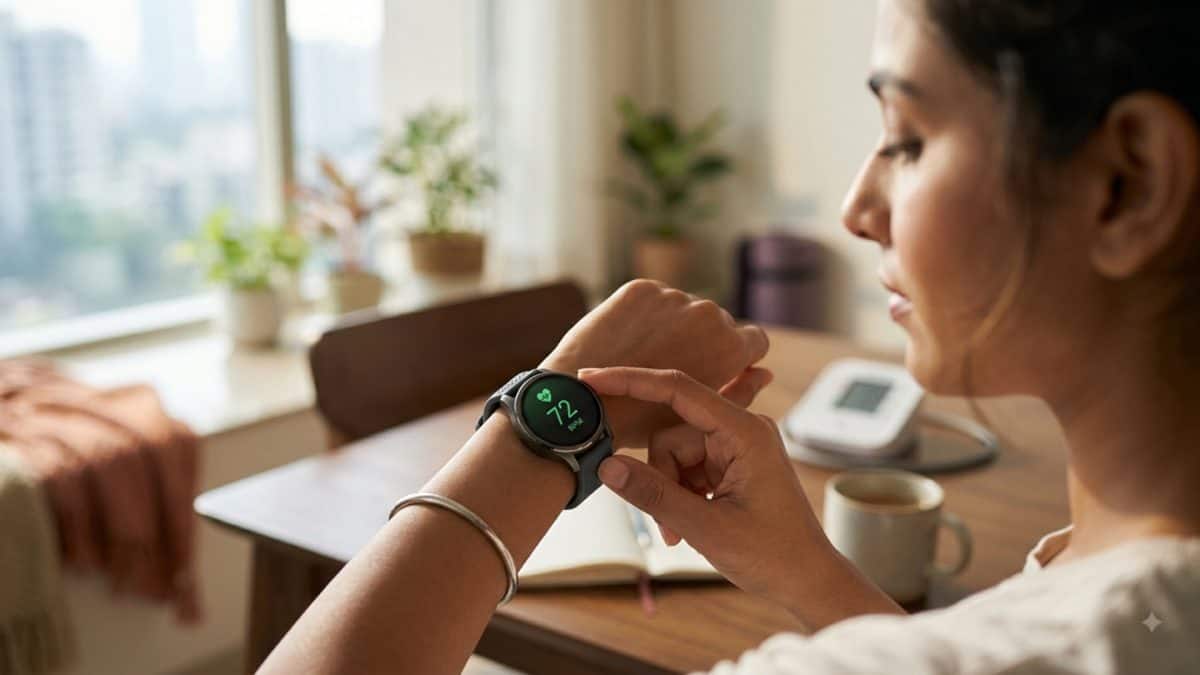
Can your smartwatch really tell if your heart is healthy? Doctors explain
HomeLive TV
Sections
WorldEntertainmentExplainersCricketSportsOpinionIndiaTechAutoLifestyleHealthBusinessVideosImpact ShortsWeb Stories
Shows
VantageFirstpost AmericaFirstpost AfricaFirst SportsSpotlightLive TV
Events
FIFA World CupUnion BudgetIndependence DayDelhi Elections 2025
Can your smartwatch really tell if your heart is healthy? Doctors explain
Smartwatches can track heart rate and flag irregular rhythms, but cardiologists explain why a normal reading cannot rule out heart disease
Your smartwatch may know how fast your heart is beating. It may even record an ECG, flag an irregular rhythm and send an alert when something looks unusual. That can be useful. But there is a big difference between spotting a warning sign and knowing that your heart is healthy
With wearable devices becoming increasingly sophisticated, it is easy to assume that a normal reading means everything is fine. Cardiologists caution against that assumption. A smartwatch can help monitor certain aspects of heart activity, but it cannot replace a proper cardiac evaluation
“Smartwatches can be useful for identifying certain warning signs, particularly changes in heart rate or rhythm,” says Dr Ashok Malpani, Interventional Cardiologist, BM Birla Heart Hospital. “The short answer is, not completely.”
Advertisement
What can a smartwatch actually detect?
Most commercial smartwatches use optical sensors to continuously monitor pulse rate. Some also have a single-lead electrocardiogram (ECG) feature that records the heart’s electrical activity
That combination can sometimes pick up an abnormally high heart rate, an irregular rhythm or patterns that may suggest atrial fibrillation (AF), a type of abnormal heart rhythm
Dr Chirag D, Consultant – Interventional Cardiology, Aster Whitefield Hospitals, says the devices can be valuable as detection tools. “A smartwatch could be valuable as a detection device for certain heart conditions, but it can’t, on its own, inform you that your heart is entirely healthy.”
A normal reading does not mean a healthy heart
This may be the most important thing to remember if you regularly check your heart rate on your watch
“A smartwatch generally cannot assess whether a person has blocked arteries, significant structural heart disease, valve problems or other conditions that may exist without obvious symptoms,” Dr Malpani says
Someone can have coronary artery disease, a valve disorder or cardiomyopathy and still have heart-rate readings that appear normal
Dr Chirag also points out that even when a smartwatch has an ECG function, it is not equivalent to the test performed in a hospital or clinic. “Moreover, even a smartwatch equipped with ECG is only capable of providing an incomplete view of the heart’s electrical activity in comparison with a regular 12-lead ECG.”
Advertisement
A clinical 12-lead ECG records electrical activity from multiple points on the body. A smartwatch typically uses a single lead, so the information it provides is much narrower
Research is also exploring whether smartwatch ECG recordings combined with artificial intelligence could help screen for certain structural heart conditions. But Dr Chirag says that work is still at an early stage
What about blocked arteries and high cholesterol?
This is where people can easily overestimate what wearable technology can do. A smartwatch may monitor your pulse or rhythm, but it generally cannot tell you whether your arteries are narrowed or blocked. It also cannot independently diagnose high blood pressure or high cholesterol
“Someone may have high blood pressure, high cholesterol or early coronary artery disease without experiencing any symptoms, and a smartwatch may not detect these problems,” says Dr Malpani
Smartwatch alerts can be wrong too
There is another side to wearable monitoring: an alert does not automatically mean something is seriously wrong
Dr Chirag says smartwatch readings can be affected by movement, poor skin contact, limitations of the sensor and signal quality. This means wearables can sometimes produce false-positive notifications
Advertisement
“A smartwatch-generated photoplethysmography is helpful in detecting arrhythmia, but it is not considered a reliable test on its own to make a diagnosis; the results of ECG need to be clinically interpreted,” he says, referring to American Heart Association guidance on atrial fibrillation
In simple terms, a notification is a reason to pay attention, not a diagnosis to make on your own. The same applies in reverse. A watch that does not send an alert cannot tell you that nothing is wrong
What should you do when your watch flags an irregular rhythm?
Don’t panic, but don’t ignore it either. A persistent or repeated abnormal reading is worth discussing with a doctor, particularly if you are experiencing symptoms at the same time
Dr Malpani says unusual readings accompanied by “chest discomfort, breathlessness, dizziness, fainting or unexplained palpitations” should prompt medical attention
Dr Chirag similarly advises that recurring heart palpitations, chest pain, unexplained breathlessness, fainting or unexpected fatigue should be assessed by a doctor regardless of what the smartwatch reports
A physician may then decide whether you need a clinical ECG, blood tests, an echocardiogram, ambulatory monitoring or other cardiac investigations
So, how should you use a smartwatch?
Think of it as a monitoring tool that can help you notice changes, rather than a machine that can certify your heart as healthy. It can be particularly useful for people who experience intermittent symptoms that may not occur during a short consultation. A record of heart-rate patterns or an irregular-rhythm alert can give a doctor another piece of information to work with
But it does not replace the basics. “Ultimately, your smartwatch can tell you a lot about your heart’s activity but it cannot give your heart a clean bill of health,” Dr Malpani says
Regular medical check-ups, blood pressure and cholesterol monitoring, a healthy lifestyle and appropriate cardiac evaluation remain important, even if your wrist keeps telling you everything looks normal
By Zinia Bandyopadhyay
Chief Sub Editor with a decade of experience in digital media, known for digging into behind-the-scenes trierd, she spends her time ferociously hitting the keyboard, daydreaming between deadlines, travelling, chasing street food, and cracking unapologetically bad jokes
First Published:Aug 14, 2026, 18:43:08 IST
Advertisement
Advertisement
Trending Stories

Patriotism beyond the flag: 10 small things you can do for India
From voting in local elections to conserving water, here’s what patriotism looks like beyond a single day of celebration.
2 min read
Independence Day 2026: 20 regional Indian recipes to cook at home
This Independence Day, explore India’s culinary diversity with 20 lesser-known regional recipes shared by chefs Ranveer Brar and Sanjeev Kapoor.
6 min read
Switzerland’s Grand Train Tour turns 10: The only rail journey that links the country’s 8 panoramic routes into one loop
Eight rail stages, four language regions, five UNESCO sites: Switzerland’s Grand Train Tour marks its 10th anniversary with new themed routes.
2 min read
Independence Day 2026: 10 things about the Indian flag that may surprise you
From its evolution before independence to the meaning behind its colours, here are 10 lesser-known facts about the Indian flag that reveal its deeper significance
4 min read
Crocodile brains have barely changed in 100 million years, and scientists finally know why
New CT scans of 43 crocodile species — living and extinct — reveal a brain design so effective it survived the extinction of the dinosaurs largely untouched.
1 min read
Advertisement
Advertisement
Up Next
