


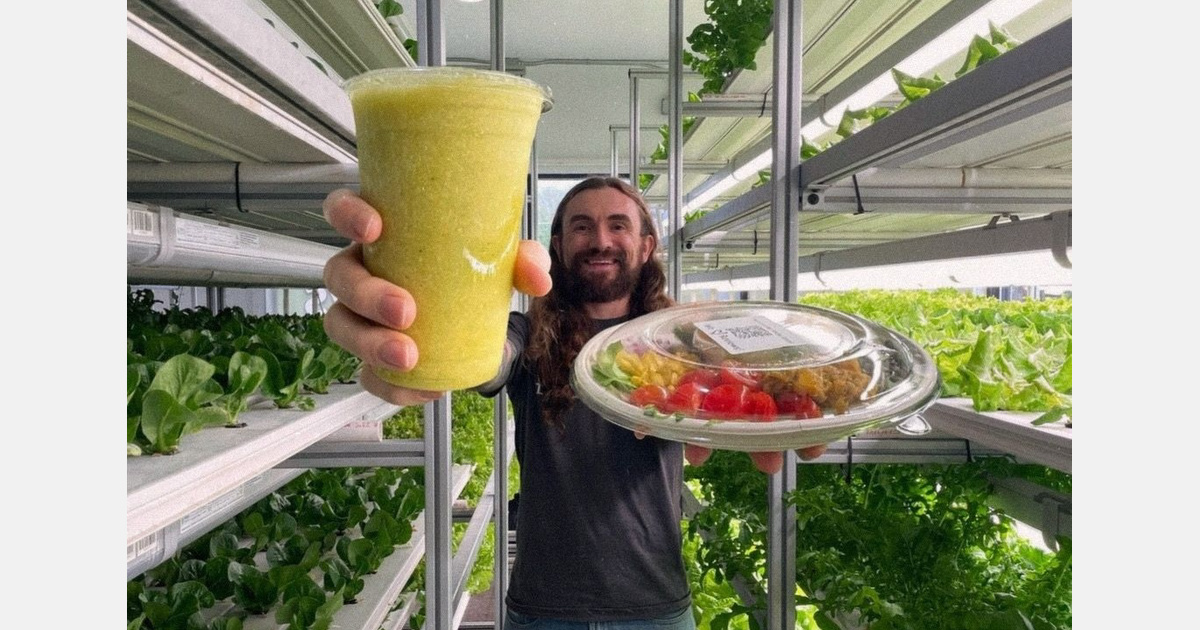
Clayton Farms operates quick-service restaurants built around on-site farms, harvesting greens steps from the kitchen and serving them minutes later in salads, wraps, and smoothies. Chief Farmer Clayton Mooney set out the reasoning behind the model
“The moment food is harvested, it’s dying. Within 72 hours, that food has lost half its flavor and half its nutrition. By harvesting and serving from the same location, we deliver food with double the flavor and double the nutrition of anything sitting on a grocery shelf.” According to Clayton, the format has served more than 350,000 people to date.© Clayton Farms
Metrics driving the businessClayton says two metrics have governed the company since its founding: food produced per square foot and farm CAPEX per square foot. Food produced per square foot per year rose from 3 lbs in 2017 to 22 lbs in 2026, while farm CAPEX per square foot fell from $500 to $130 over the same period
“In 2019, we used basic computer vision to understand plant health. Today, we have the opportunity for computer vision to advance our understanding of plant health, inventory, and labor tracking. And voice AI to assist in operations, further reducing labor requirements at all locations,” Clayton says
“Robotics in agriculture has not had a clear path to positive ROI until now. The blockers have historically been on both the engineering labor costs and the physical component costs. We are eliminating these blockersing arm is planned for 2026, a harvesting arm for 2027, and 3D-printed farm equipment parts by 2028
“Our environmental, nutrient, and lighting controls will be managed by biological AI agents. Each Clayton Farms Salads location will have the best Air Quality Index (AQI) among quick service restaurants,” Clayton says of the company’s 2027 plans.© Clayton FarmsClayton with Danen Pool, Co-Founder and CTO of Clayton Farms
Nutrition, disease, and the case for scale”Heart disease is responsible for 1 in every 4 deaths in the United States today. The ingredients that we grow naturally contain peptides (VPCL, TTVW, TMW, IR, KF, EF) which combat heart disease,” Clayton says. He says in-house ingredient production will grow from 6 of 60 ingredients at the first location to 12 with a second location, opening in San Francisco this summer, and to 30 by 2029
“America spends $2.5 trillion yearly on food. America spends double that yearly on healthcare. What you eat is your death sentence,” Clayton says.© Clayton Farms
The location roadmapClayton set out a location count of 2 in 2026, 6 in 2027, 18 in 2028, and 70 in 2029. “Each location is a self-contained farm-to-person operation, owned and operated by Clayton Farms,” he says, adding that locations carry “one-tenth the industry CAPEX” and that “vertical integration allows us to create valuable streams of data and our own models.”Two Clayton Farms Salads locations are now open, with the San Francisco location opening in July 2026. © Clayton FarmsFor more information:Clayton FarmsClayton Mooney, Co-Founder and Chief Farmer[email protected]www.claytonfarms.com
