



Rare Triple-Negative Breast Cancer Is Not One Disease
Triple-negative breast cancer is usually defined by what it lacks: estrogen receptor, progesterone receptor, and HER2 overexpression or amplification
But that definition can conceal substantial biological diversity
A 2026 review published in npj Breast Cancer argues that rare histologic subtypes of triple-negative breast cancer should not automatically be approached as variants of the same disease. Instead, histology can identify tumors with markedly different molecular drivers, immune environments, prognoses, and potentially different therapeutic vulnerabilities (Gouveia et al., 2026)
Rare histologic subtypes collectively account for approximately 5–10% of TNBC cases. Although individually uncommon, together they represent a clinically meaningful population that has historically been underrepresented in trials and frequently grouped with conventional invasive carcinoma of no special type, or NST
That may create a problem
Some rare TNBC histologies have indolent courses and excellent long-term outcomes. Others are highly aggressive, relatively resistant to standard chemotherapy, and prone to early distant relapse
The central message of the review is therefore straightforward: triple-negative receptor status alone may not be enough to define prognosis or treatment strategy
Why Does Histology Matter in Triple-Negative Breast Cancer?
Most TNBC is histologically classified as invasive carcinoma of no special type. However, the WHO classification recognizes several distinct breast cancer entities that can also have a triple-negative phenotype
- Metaplastic breast carcinoma
- Adenoid cystic carcinoma
- Secretory carcinoma
- Carcinoma with apocrine differentiation
- Acinic cell carcinoma
- Triple-negative invasive lobular carcinoma
- High-grade neuroendocrine carcinoma
- Invasive carcinoma NST with a medullary or lymphocyte-rich growth pattern
- These tumors can differ substantially from conventional TNBC NST.
The review emphasizes that some are driven by characteristic genomic alterations, while others show distinct immune phenotypes or transcriptional subtypes. Consequently, applying therapeutic evidence generated predominantly from TNBC NST to every triple-negative tumor may risk either overtreatment or undertreatment(Gouveia et al., 2026)
TNBC Is a Clinical Category, Not a Single Pathologic Entity
An important distinction begins with classification itself
Under the WHO framework, TNBC is not considered a distinct histopathologic diagnosis. It is an immunohistochemical category defined by receptor status
Histologic type remains a separate diagnostic dimension
This distinction becomes particularly important when a rare tumor is triple-negative but behaves very differently from conventional high-grade basal-like TNBC
For example, classic adenoid cystic carcinoma is often triple-negative but generally follows an indolent course. High-grade metaplastic carcinoma may also be triple-negative but can demonstrate aggressive behavior and poor chemotherapy responsiveness
The receptor profile may therefore look similar while the underlying diseases are biologically very different (Gouveia et al., 2026)
Which Rare TNBC Subtypes Have a More Favorable Prognosis?
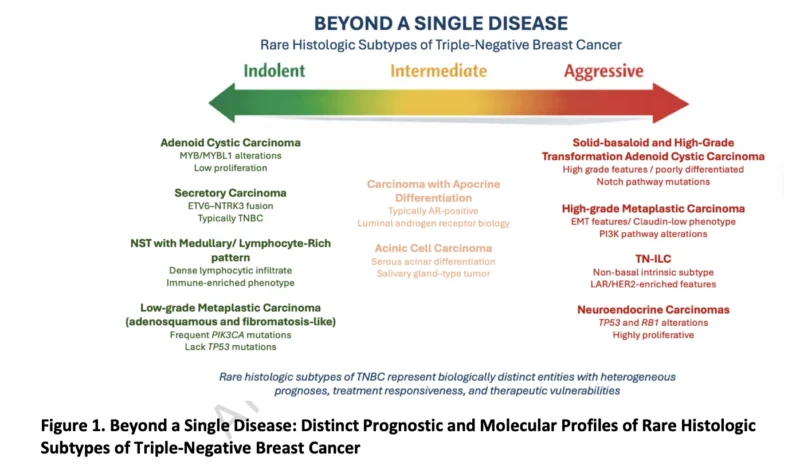
The review proposes a pragmatic prognosis-oriented framework dividing rare histologies into favorable, intermediate, and poor-prognosis groups
Classic Adenoid Cystic Carcinoma
Classic adenoid cystic carcinoma of the breast accounts for less than 0.1% of breast cancers
Despite frequently being triple-negative, it generally has an indolent natural history and excellent long-term outcomes
Recurrent alterations involving MYB or MYBL1, including gene fusions and amplifications, are characteristic molecular features
In early-stage disease, surgery alone is often curative, and available evidence suggests limited benefit from systemic chemotherapy(Gouveia et al., 2026; Arpino et al., 2002)
Importantly, this favorable behavior does not apply uniformly to all adenoid cystic carcinomas. Solid-basaloid variants and tumors with high-grade transformation behave much more aggressively
Secretory Carcinoma
Secretory carcinoma represents less than 0.15% of breast carcinomas and is one of the clearest examples of molecularly defined rare breast cancer
Its hallmark is the ETV6–NTRK3 fusion
The alteration can be detected through FISH, RT-PCR, or next-generation sequencing, while pan-TRK immunohistochemistry can be used as a screening approach
Most secretory carcinomas are low grade and slow growing, with excellent outcomes following local therapy
When advanced disease develops, however, the presence of an NTRK fusion creates an important therapeutic opportunity because TRK inhibitors can be used within a tumor-agnostic precision-oncology framework (Gouveia et al., 2026; Drilon et al., 2018; Doebele et al., 2020)
Lymphocyte-Rich or Medullary Growth Pattern
Tumors historically called medullary breast carcinoma are no longer considered a separate WHO subtype
They are now classified as invasive carcinoma NST with a medullary or lymphocyte-rich growth pattern
Despite often displaying high-grade cytology, these tumors can have more favorable outcomes than stage- and grade-matched conventional TNBC
They are characterized by prominent tumor-infiltrating lymphocytes and enrichment for immune-related signatures, including interferon-γ pathways and cytotoxic T-cell infiltration (Gouveia et al., 2026)
Low-Grade Metaplastic Carcinoma
Not all metaplastic breast carcinomas behave aggressively
The review distinguishes low-grade fibromatosis-like and low-grade adenosquamous carcinoma from conventional high-grade metaplastic tumors
These rare forms generally follow a more indolent course
NCCN guidance cited by the authors categorizes these as favorable histologies and recommends against routine adjuvant systemic chemotherapy
Low-grade fibromatosis-like carcinoma frequently contains PIK3CA and TERT promoter alterations, while low-grade adenosquamous carcinoma can harbor PIK3CA mutations. Both typically lack the TP53 alterations that characterize many high-grade metaplastic carcinomas (Gouveia et al., 2026)
Which Rare TNBC Subtypes Have Intermediate Prognosis?
Apocrine TNBC
Triple-negative carcinoma with apocrine differentiation represents a biologically unusual form of TNBC
Approximately 70–80% of triple-negative apocrine carcinomas express androgen receptor, and many fall within the luminal androgen receptor molecular subtype
They tend to occur in older patients and often show lower proliferation than conventional TNBC
Molecularly, apocrine TNBC is enriched for alterations involving PIK3CA, PTEN, and TP53, while immune infiltration and PD-L1 expression can be relatively low
The review cites data showing a 7-year breast cancer-specific survival of 86% for apocrine TNBC versus 74% for non-apocrine TNBC, although outcomes across published cohorts remain heterogeneous (Gouveia et al., 2026)
Acinic Cell Carcinoma
Acinic cell carcinoma accounts for less than 0.1% of breast cancers
Although it resembles salivary gland acinic carcinoma morphologically, the molecular biology is different
Breast acinic cell carcinomas lack the characteristic NR4A3 overexpression found in many salivary gland tumors and instead demonstrate abnormalities more typical of high-grade TNBC, including frequent TP53 mutations
Overall prognosis appears relatively favorable compared with conventional TNBC, but the review notes that more than one-quarter of patients may experience adverse outcomes and that approximately one-third of cases are associated with a high-grade ductal component (Gouveia et al., 2026)
Which Rare TNBC Subtypes Are More Aggressive?
High-Grade Metaplastic Breast Carcinoma
High-grade metaplastic carcinoma represents one of the most clinically challenging rare TNBC histologies
These tumors commonly demonstrate:
- TP53 alterations
- PI3K/AKT pathway alterations
- Mesenchymal or claudin-low transcriptional features
- Epithelial-mesenchymal transition
- Frequent PD-L1 expression
Despite some immune-related biological features, conventional metaplastic tumors frequently show limited sensitivity to standard neoadjuvant chemotherapy
Historical pCR rates with chemotherapy alone have generally been below 10%
In a real-world cohort using a KEYNOTE-522-type chemoimmunotherapy regimen, metaplastic tumors achieved a pCR rate of approximately 16%, considerably below that reported for TNBC NST in the same analysis (Gouveia et al., 2026; Barroso-Sousa et al., 2026)
Another prospective institutional cohort cited in the review reported a pCR rate of 22%, although tumors with stromal TILs ≥60% achieved a substantially higher pCR rate of 62% (Abuhadra et al., 2025)
These findings suggest that the immune microenvironment may matter even within a single rare histologic subtype
Triple-Negative Invasive Lobular Carcinoma
Triple-negative invasive lobular carcinoma represents less than 1% of breast cancers
It differs substantially from conventional basal-like TNBC
TN-ILC is enriched for:
- CDH1 alterations
- PIK3CA alterations
- ERBB2 alterations
- Recurrent ESRRA hotspot mutations
- Androgen receptor expression
Luminal androgen receptor and HER2-enriched transcriptional features
Despite relatively low proliferation and apparently more indolent histologic characteristics, retrospective studies have reported inferior outcomes compared with TNBC NST
One analysis cited in the review found comparable pCR rates between TN-ILC and NST but markedly lower event-free survival, highlighting that chemotherapy response alone may not capture the full biology of this disease (Gouveia et al., 2026)
Neuroendocrine Carcinoma
High-grade neuroendocrine carcinoma of the breast, particularly small-cell carcinoma, is exceptionally rare and aggressive
True neuroendocrine carcinomas require extensive neuroendocrine differentiation, and metastatic disease from another organ, particularly lung or gastrointestinal tract, must be carefully excluded
Triple-negative high-grade neuroendocrine carcinomas commonly demonstrate TP53 and RB1 alterations, paralleling extrapulmonary small-cell carcinoma biology
Platinum-etoposide regimens are often extrapolated from small-cell lung cancer, but prospective studies comparing this approach against conventional anthracycline- and taxane-based breast cancer chemotherapy are lacking
Optimal treatment therefore remains uncertain (Gouveia et al., 2026)
Why Are Metaplastic Tumors Particularly Important for Immunotherapy Research?
Metaplastic breast carcinoma currently has more immunotherapy-specific data than most other rare TNBC histologies
In the DART/SWOG S1609 cohort, 17 patients with metastatic metaplastic breast carcinoma received nivolumab plus ipilimumab
The objective response rate was 18%
Importantly, the responses that occurred were highly durable, exceeding 28 months, despite some responding tumors having low tumor mutational burden, low PD-L1 expression, and absent tumor-infiltrating lymphocytes (Adams et al., 2022)
These findings illustrate one of the broader challenges highlighted by the review: biomarkers that predict benefit in conventional TNBC may not behave identically in rare histologies
Could NTRK Fusions Create a Precision-Oncology Opportunity?
Secretory carcinoma offers perhaps the clearest example
Because the disease is driven by ETV6–NTRK3, treatment can potentially follow the molecular alteration rather than the breast cancer label
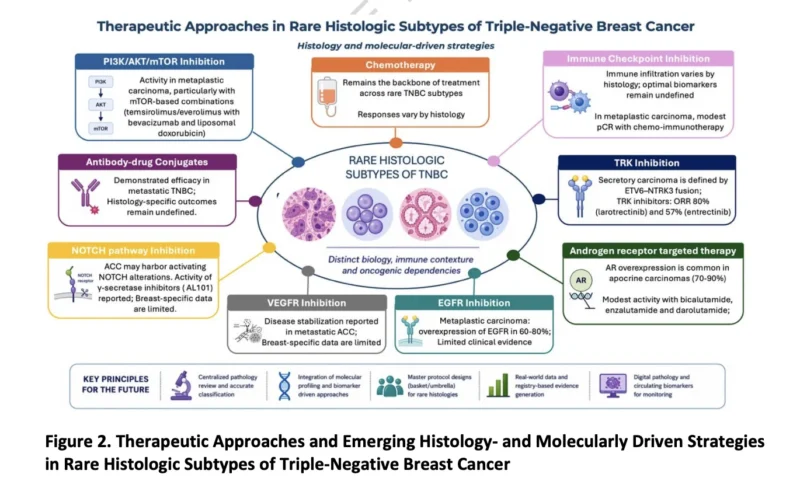
In pooled basket trials, larotrectinib achieved an objective response rate of approximately 80% across NTRK fusion-positive solid tumors
Entrectinib produced an overall response rate of approximately 57% across tumor types, including responses among patients with breast cancer (Drilon et al., 2018; Doebele et al., 2020)
The studies were not specific to secretory breast carcinoma, but they demonstrate how rare histology and molecular testing can intersect with tumor-agnostic treatment
Could Androgen Receptor Targeting Matter in Apocrine TNBC?
Apocrine TNBC provides another potential biomarker-driven strategy
In the Phase II UCBG 3-06 START trial, patients with AR-positive advanced TNBC received darolutamide or capecitabine
The 16-week clinical benefit rate was:
- 29% with darolutamide
versus
- 59% with capecitabine
However, among tumors with high AR transcriptional activity, the clinical benefit rate with darolutamide reached 57%
The study suggests that androgen receptor immunohistochemistry alone may be insufficient and that transcriptional evidence of AR pathway dependence could provide more informative patient selection (Bonnefoi et al., 2025)
Earlier studies with enzalutamide and bicalutamide reported clinical benefit rates of approximately 19–25%
Is PI3K/AKT/mTOR Another Potential Vulnerability?
PI3K/AKT/mTOR pathway alterations occur across several rare TNBC histologies
Combined pathway mutations have been reported in approximately 57% of metaplastic carcinomas, while PIK3CA alterations are frequent in apocrine TNBC and triple-negative lobular carcinoma
In metaplastic breast cancer specifically, retrospective and early-phase data have suggested activity with mTOR-based combinations
One Phase I analysis reported an objective response rate of 21%, increasing to 31% in tumors with PI3K pathway aberrations versus 0% without those alterations (Basho et al., 2017)
These data are exploratory but support further biomarker-directed investigation
What About Antibody-Drug Conjugates?
Antibody-drug conjugates have transformed metastatic TNBC more broadly, including agents targeting TROP2 and HER2
However, the review highlights a major evidence gap
Pivotal ADC trials have generally not reported outcomes according to rare histologic subtype
Consequently, efficacy demonstrated in conventional TNBC NST cannot automatically be assumed to be identical in tumors with different target expression, immune environments, molecular subtype, and proliferation
This is particularly relevant as increasingly effective systemic therapies become available while rare tumors remain numerically underrepresented in large trials
Could Some Rare TNBCs Be Overtreated?
Potentially
This is one of the most clinically important implications raised by the review
Adenoid cystic carcinoma, secretory carcinoma, lymphocyte-rich tumors, and certain low-grade metaplastic carcinomas may have much more favorable natural histories than conventional TNBC NST
Treating every triple-negative tumor according to receptor status alone could therefore expose some patients to systemic therapy from which the benefit is uncertain
At the opposite end of the spectrum, aggressive histologies such as high-grade metaplastic carcinoma, triple-negative lobular carcinoma, and neuroendocrine carcinoma may require alternative strategies or prioritization for clinical trials
The challenge is therefore not simply escalation
It is matching treatment intensity to biology
What Needs to Change in Rare TNBC Research?
The authors propose several priorities
Centralized pathology review is particularly important because rare histologies can be difficult to classify and diagnostic terminology has historically been inconsistent
Molecular profiling should be incorporated systematically to identify alterations such as NTRK fusions, PI3K pathway abnormalities, NOTCH activation, and AR-driven biology
Basket and umbrella trials may also be particularly valuable because they allow enrollment according to molecular vulnerability rather than requiring large numbers of patients with a single rare histology
Finally, contemporary TNBC trials should prospectively report outcomes according to histologic subtype
Without histology-stratified analyses, it remains difficult to know whether advances demonstrated in conventional TNBC apply equally to these biologically distinct tumors (Gouveia et al., 2026)
The Bottom Line
Triple-negative breast cancer is not a single biological disease, and rare histologic subtypes make that heterogeneity particularly visible
Some rare TNBCs, including classic adenoid cystic carcinoma and secretory carcinoma, can have remarkably favorable outcomes despite lacking ER, PR, and HER2
Others, particularly high-grade metaplastic carcinoma, triple-negative invasive lobular carcinoma, and high-grade neuroendocrine carcinoma, may behave more aggressively and respond differently to conventional treatment
Molecular alterations further separate these diseases
ETV6–NTRK3 defines secretory carcinoma
MYB/MYBL1 alterations characterize classic adenoid cystic carcinoma
PI3K/AKT/mTOR abnormalities are enriched in several rare subtypes
Androgen receptor biology is particularly relevant to apocrine TNBC
CDH1, PIK3CA, ERBB2, and ESRRA alterations distinguish triple-negative lobular carcinoma
The implications reach beyond pathology
If prognosis, treatment sensitivity, immune biology, and actionable alterations differ according to histology, then receptor status alone may be an incomplete framework for precision treatment
As Gouveia and colleagues conclude, rare histologic TNBC subtypes should not simply be considered peripheral variants of basal-like disease
The future direction is an integrated framework combining histology, molecular profiling, immune biology, and clinical behavior to determine which patients need treatment intensification, which may be candidates for de-escalation, and which could benefit most from biomarker-driven therapy
References
- Gouveia MC, Bonadio RC, Barroso-Sousa R, et al. Beyond a single disease: review of rare histological subtypes of triple-negative breast cancer with implications for prognosis and treatment. npj Breast Cancer. 2026. doi:10.1038/s41523-026-01018-8.
- Thomas A, Reis-Filho JS, Geyer CE Jr, Wen HY. Rare subtypes of triple negative breast cancer: Current understanding and future directions. npj Breast Cancer. 2023;9:55.
- Abuhadra N, et al. Predictors of response to neoadjuvant chemo-immunotherapy in metaplastic triple-negative breast cancer. npj Breast Cancer. 2025;11:110.
- Adams S, et al. A multicenter phase II trial of ipilimumab and nivolumab in unresectable or metastatic metaplastic breast cancer: DART, SWOG S1609. Clinical Cancer Research. 2022;28:271-278.
- Bonnefoi H, et al. Darolutamide or capecitabine in triple-negative, androgen receptor-positive, advanced breast cancer: UCBG 3-06 START. Lancet Oncology. 2025;26:355-366.
- Drilon A, et al. Efficacy of larotrectinib in TRK fusion-positive cancers in adults and children. New England Journal of Medicine. 2018;378:731-739.
- Doebele RC, et al. Entrectinib in patients with advanced or metastatic NTRK fusion-positive solid tumours. Lancet Oncology. 2020;21:271-282.
- Basho RK, et al. Targeting the PI3K/AKT/mTOR pathway for mesenchymal triple-negative breast cancer. JAMA Oncology. 2017;3:509-515.
- Breast Oncology
Adenoid Cystic CarcinomaApocrine Breast CancerBreast Cancer Pathologylobular breast cancermetaplastic breast cancermolecular profilingNeuroendocrine Breast CancerPrecision Oncologyrare-breast-cancerSecretory CarcinomaTNBCtriple-negative breast cancer
