



Therapeutic Drug Monitoring in Pediatric IBD:
Search
AdvertisementAdvertisement
August 17, 2026/Pediatrics/Gastroenterology, hepatology & <a href="https://healthylife7.com/making-food-security-nutrition/” title=”Making food security nutrition”>nutrition
Therapeutic Drug Monitoring in Pediatric IBD: Symptom Management Is No Longer Enough
Why it’s a key strategy to optimize biologic therapies and improve outcomes in pediatric IBD
Image content: This image is available to view online
View image online(https://assets.clevelandclinic.org/transform/3405581d-4eab-4752-9c46-44a477a59f6b/CHP_8600408_06_30_26_1695_AMO)
The goals of pediatric inflammatory bowel disease (IBD) therapy are to control symptoms, optimize nutrition and growth, correct abnormal laboratory values, including inflammatory markers, and ultimately achieve mucosal healing
Advertisement
Cleveland Clinic is a non-profit academic medical center. Advertising on our site helps support our mission. We do not endorse non-Cleveland Clinic products or services.Policy
A recent position paper from the North American Society for Pediatric Gastroenterology, Hepatology and Nutrition (NASPGHAN) endorses therapeutic drug monitoring (TDM) as a key strategy to optimize biologic therapies and improve outcomes in pediatric IBD
“In the past, we often used levels in a reactive manner when a child with IBD was symptomatic,” says Sandra Kim, MD, Chair of Cleveland Clinic’s Division of Gastroenterology, Hepatology and Nutrition and a member of the Pediatric IBD Center at Cleveland Clinic Children’s. She is also a coauthor of the NASPGHAN report
“We now have a better understanding of which levels are associated with optimal mucosal healing, and we’re better able to predict how to optimize medications for more favorable treatment responses,” Dr. Kim explains
Why the treatment paradigm is shifting
Biologic therapies are driving this paradigm shift in IBD treatment. Tumor necrosis factor antagonists (anti-TNF) emerged nearly three decades ago and transformed the treatment landscape for children with IBD. With favorable, evidence-based data, these medications are an essential part of therapy
Guidelines for biologic therapy monitoring
The authors’ recommendations are based on an extensive literature review. The following dosing and monitoring schedule varies by condition, including acute severe UC, perianal fistulas, and very early onset IBD (VEOIBD)
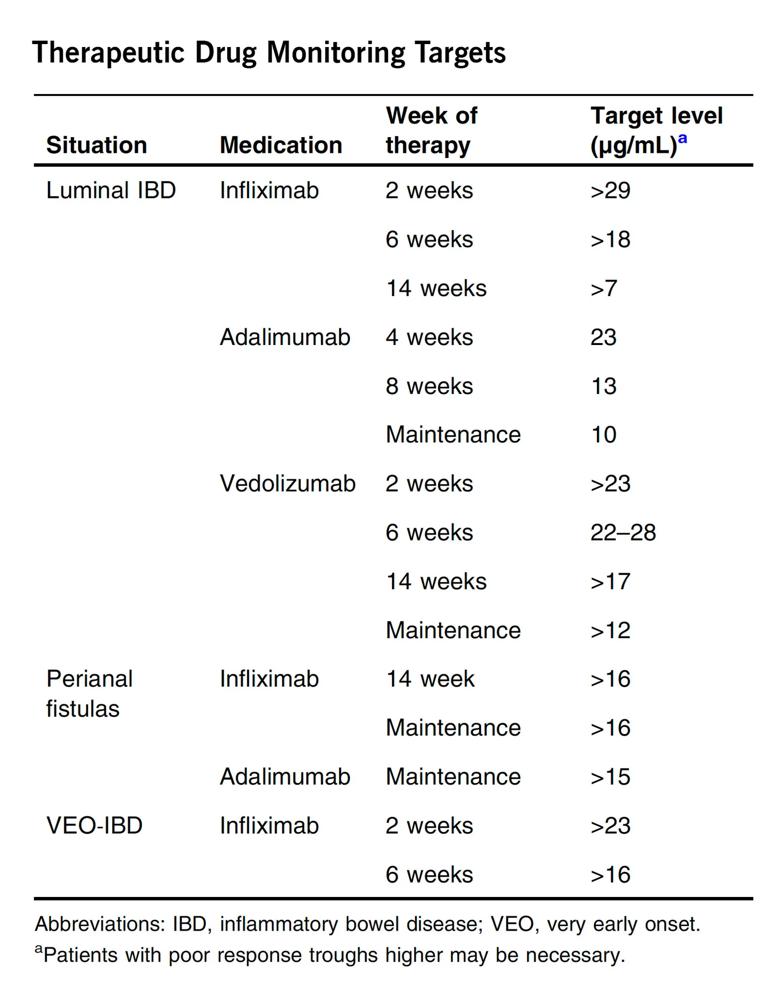
Image content: This image is available to view online
View image online(https://assets.clevelandclinic.org/transform/cfe61d28-50b2-40d8-a872-6e97db0e5632/drug-monitoring-table)
This table was originally published in Felipez LM, Ali S, de Zoeten EF, Griffiths AM, Kim SC, Patel AS, Rosh JR, Adler J. North American Society for Pediatric Gastroenterology, Hepatology, and Nutrition position paper on the therapeutic drug monitoring in pediatric inflammatory bowel disease. J Pediatr Gastroenterol Nutr. 2025 Oct;81(4):1100-1117. doi: 10.1002/jpn3.70158. Epub 2025 Jul 21. PMID: 40692184; PMCID: PMC12484717. It is republished under the terms of the Creative Commons Attribution‐NonCommercial License.
Induction TDM: A critical window early in treatment
Achieving optimal drug levels is essential, especially for growing children, who often require dosing adjustments due to more rapid drug clearance, changes in weight, and development. This can lead to inadequate response and secondary adverse events during the induction and maintenance phases of treatment
Advertisement
“We know that the inflammation is often most severe at the beginning of treatment,” Dr. Kim explains. “Proactive TDM during induction decreases the likelihood of suboptimal medication levels, which can increase the risk of developing antidrug antibodies [ADA]. This can reduce medication effectiveness and could ultimately limit future use.”
The authors cite studies highlighting an association between higher drug concentrations during induction TDM and favorable therapeutic outcomes later in treatment. In contrast, suboptimal drug concentrations, particularly at Week 14, have been linked to a higher risk of ADA development, lower drug levels and poorer response
These findings suggest that monitoring ADA levels can inform treatment decisions and, potentially, prevent loss of response. If lower ADA levels are detected, for example, dose escalation or adding an immunomodulator may be warranted. If ADA levels are higher, switching to another medication in the same class may be considered
Maintenance TDM: Preventing loss of response
Most of the TDM data in the maintenance phase come from the settings of sudden loss of response. However, the authors emphasize that proactive monitoring remains important after induction
“Proactive TDM is just as important during the maintenance phase to ensure adequate ongoing dosing, rather than reacting to sudden uncontrolled disease, which can include switching medications or, potentially, surgery and hospitalization,” explains Dr. Kim
Why optimization matters even more in children
Another reason why drug optimization matters in children: only four biologic therapies are FDA-approved for use in children. The fourth was only approved in April 2026 and has a different mechanism of action from the first three. Compare this with the 14 FDA-approved therapies for adult IBD, which have multiple different mechanisms
Advertisement
“Because kids don’t have as many medications available, we need to be thoughtful about optimizing their efficacy and not burn through medications,” explains Dr. Kim
Infliximab and adalimumab, the mainstay biologic options for children, target the same immune pathway. Ustekinumab, originally approved for adults with Crohn’s disease in 2016, is the first pediatric-approved biologic with a non-anti-TNF mechanism; it targets interleukin (IL)-12/23
Vedolizumab, another biologic drug and an attractive option because of its intestine-specific targets (anti-integrin), is currently approved for adults with moderate-to-severe Crohn’s disease and ulcerative colitis. Although it is not yet approved for pediatric patients
Dr. Kim is hopeful that this will change soon, given its GI tract specificity and less systemic impact on the immune system
The takeaway message
The evidence for TDM is compelling and offers a means to optimize biologic therapies for pediatric IBD
“We understand the challenges facing providers and patients alike. We are confident these recommendations will ultimately lead to better outcomes for our children living with Crohn’s disease and ulcerative colitis. They deserve no less,” says Dr. Kim
Advertisement
Advertisement
Related Articles

August 10, 2026/Pediatrics/Gastroenterology, hepatology & nutrition
When Pediatric GI Symptoms Need Both Gastroenterology and Psychology
https://consultqd.clevelandclinic.org/when-pediatric-gi-symptoms-need-both-gastroenterology-and-psychology
An integrated approach to care

May 6, 2026/Digestive/Research
Patients With IBD Who Undergo Colon Cancer Surgery Have Higher Blood Clot Risk
https://consultqd.clevelandclinic.org/patients-with-ibd-who-undergo-colon-cancer-surgery-have-higher-blood-clot-risk
Elevated risk persists for more than a year after surgery, plus more insights from the first study to quantify risk specifically for CRC surgery

October 17, 2025/Digestive/News
Cleveland Clinic Names Anthony de Buck, MD, as New Section Head of IBD
https://consultqd.clevelandclinic.org/cleveland-clinic-names-anthony-de-buck-md-as-new-section-head-of-ibd
Insights from Dr. de Buck on his background, colorectal surgery and the future of IBD care

May 12, 2025/Digestive/Research
New Study Highlights LMWH’s Role in Lowering VTE Incidence After IBD Surgery
https://consultqd.clevelandclinic.org/new-study-highlights-lmwhs-role-in-lowering-vte-incidence-after-ibd-surgery
Findings help close the knowledge gap around VTE practice patterns

February 4, 2025/Digestive/Innovation
How Cleveland Clinic Is Advancing IBD Treatment Through Global Collaboration
https://consultqd.clevelandclinic.org/how-cleveland-clinic-is-advancing-ibd-treatment-through-global-collaboration
The Integrated Program aligns IBD care and research across Cleveland Clinic locations
November 4, 2024/Pediatrics/Gastroenterology, hepatology & nutrition
When Food Is Medicine: Updated Evidence on Nutritional Therapies and Pediatric IBD
https://consultqd.clevelandclinic.org/when-food-is-medicine-updated-evidence-on-nutritional-therapies-and-pediatric-ibd
Diet has a profound impact on how the intestine functions

October 18, 2024/Pediatrics/Gastroenterology, hepatology & nutrition
Roundtable Convenes to Improve Outcomes for Young Adults With IBD
https://consultqd.clevelandclinic.org/roundtable-convenes-to-improve-outcomes-for-young-adults-with-ibd
Patients, caregivers and healthcare partners explore challenges during key transition points in care

May 22, 2024/Digestive/Research
Study Finds No Connection Between OSMs and Increased Cancer Rates in IBD Patients
https://consultqd.clevelandclinic.org/study-finds-no-connection-between-osms-and-increased-cancer-rates-in-ibd-patients
Reassuring results, but patient education is still important
Ad
Rendered: Mon Aug 17 2026 07:15:47 GMT+0000 (Coordinated Universal Time)
