


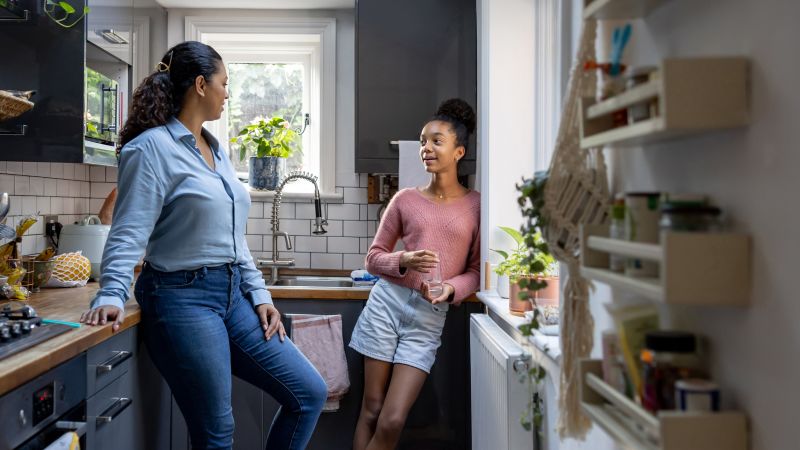
Half of parents taking weight-loss drugs are already talking openly with their kids about the medication, according to a recent study.
See all topics
Oona Hanson is a writer, educator and parent coach who specializes in helping families navigate diet culture and eating disorders
As a coach helping families navigate diet culture and eating disorders, I have started hearing from parents who are among the 11% of Americans currently taking a GLP-1 medication. They worry about how changes to their bodies or eating habits might affect their children
Caitlin, a mother in Los Angeles, was hesitant to start taking a GLP-1 for an autoimmune condition because she did not want to co-sign the thin ideal used in weight-loss drug marketing. She requested we not use her real name out of privacy concerns
“I was concerned about bringing diet culture into my home. I don’t want to accidentally teach my daughter that being smaller equals being better or more valuable.”
Some popular advice suggests parents on appetite-suppressing medication simply not talk about it or offer vague statements about taking care of their health. While this is well-meaning guidance, it could be harmful to growing children who conclude eating tiny portions or skipping meals is something to emulate — behaviors that could contribute to eating disorders
“Kids are going to make up their own ideas of what’s happening if we’re not actually addressing it,” said Nicole Cruz, a registered dietitian in Southern California who specializes in family nutrition. “They’re absorbing it, they’re seeing it, they’re seeing a shrinking body, they’re seeing you eat less.”
Secrecy around taking a GLP-1 can also contribute to shame and stigma about medication. “Allow it to be speakable,” advised Zoë Bisbing, a body image therapist in New York City. “If your child asks you, or they find syringes in the fridge, it’s like, ‘Oh yeah, that’s the medicine I’m taking. Do you want to hear why I take it?’ I think it’s OK to talk about it.”
Jessie Spence, a therapist in Greensboro, North Carolina, who uses they/their pronouns, was initially concerned that taking a GLP-1 for blood sugar management might be betraying their “fat-friendly roots” and conflict with their body-affirming values in both their parenting and weight-inclusive practice with clients. They decided to be open with their child about taking a GLP-1
“I have just been really straightforward; this is medication for diabetes,” Spence said. “I wanted to be really intentional about not hiding it. Initially, I did lose weight, and then over a year or so, I gained it all back, because my body likes to be where it is.”
Half of parents taking weight-loss drugs are already talking openly with their children about the medication, according to an April study
But for those who want to protect their kids’ body image and relationship with food, it’s important to approach these conversations carefully. Many adults who struggle with food or body image blame the role models who were dieting during their childhood. To avoid perpetuating that cycle, parents on GLP-1s — for any reason — can be mindful about the way they talk about food and weight with their children
Even though weight loss isn’t her goal, Caitlin has been thoughtful about how she talks about the medication and its effects
She has explained to her daughter, “‘I’m doing this so that I’m in less pain. And because I’m doing this, it’s had some impact on what I’m supposed to eat.’ But I really framed it as the truth of it, which is that I am eating more protein because I am on this medication, not ‘I’m trying to get shredded’ or ‘I’m trying to change what I look like.’”
For families who want to keep things neutral, Bisbing suggested making a matter-of-fact statement: “I take medicines for lots of different reasons. This one happens to have a weight-loss side effect. Some medicines have weight-gain side effects.”
Even if you are using the medication primarily for losing weight, there are things you can do to help mitigate the potential risk to your child’s body image or relationship with food. Nikki Naab-Levy, a strength and nutrition coach based in Tacoma, Washington, who takes a GLP-1 for a chronic condition, urged parents to avoid demonizing foods or bodies
“If they offer you a bite of their ice cream sandwich, and if you’re like, ‘Thank you,’ and you take a bite, that’s going to have a very different impact than if you say something like, ‘Oh, no, Mommy can’t have that’ and then comment on your body size.”
Bisbing acknowledged parents can feel strongly that “taking this medicine to lose weight helps them feel healthier and happier, and that’s fine. But that’s complicated for kids because there are a lot of ways to be healthier and happier that don’t involve trying to lose weight.”
She recommended that parents on a GLP-1 for weight loss still try to emphasize their health-promoting behaviors, such as getting enough sleep and physical activity, rather than a number on the scale. “I don’t want to lie to kids or deny anything, but rather to expand the conversation so there’s an ‘and’ here rather than just ‘weight loss equals I feel good,’ that there’s more going on here, and maybe more importantly, there’s more that I value than just being smaller.”
When Naab-Levy’s toddler daughter is a little older, she plans to talk with her about GLP-1s in terms of the way health is very individual and doesn’t look the same for everyone. “I actually think that’s a really important concept for kids to understand, when we look at things from an inclusivity standpoint. Some of us have medical challenges, and in some cases, medication can really improve our quality of life.”
On a practical level, parents taking these medications can make an effort to model eating regularly and enjoying a variety of foods, “not eliminating food groups, still trying to eat multiple times throughout the day, and eating meals with your child whenever possible,” Cruz said
Caitlin, who prioritizes feeding her family “nutritiously and deliciously,” noted, “I’m still eating a varied plate with lots of different things on it. I’m still getting seconds if I want seconds. I love gummies; I’m still eating gummies.”
Those with very low appetite may want to discuss their dosage with their doctor. And in the meantime, if you know you’ll be having a meal with your child, Cruz invited parents to consider trying to “plan, if possible, to be a bit hungrier for that meal so you can eat a more normalized amount.”
Naab-Levy encouraged parents to do their best to protect kids from witnessing or overhearing overt restriction like calorie-counting that a child might try to emulate: “If you are someone who’s tracking your food more closely or exhibiting other dieting behaviors, try to do them in a way that isn’t directly in front of your children
“So don’t use a food scale around your children. And one of my rules is that any type of diet talk or weight-loss talk is really an adult conversation; even with friends, we’re not doing that in front of our kids.”
When a parent has reduced hunger cues, Cruz noted that “what a ‘normal’ meal looks like can start getting a bit skewed,” which can affect the way parents respond to their children’s appetite
“Our kids are growing, and they’re developing, and they actually need a lot of calories, a lot of fuel, a lot of energy to feed not only their daily activity levels but their growing and developing body,” Cruz added
Ensuring kids have adequate access to food is important “especially in diet culture, where we’re constantly being told that our portions are too big and that we should be eating less, less calories, lower fat, lower carb, lower everything, we really want to be focusing on getting our kids enough,” Cruz said
The pressure to be thinner is reinforced when someone loses weight, whether from a GLP-1 or any other reason. “We get a lot of external approval,” Naab-Levy noted. “We get told, ‘You look so great.’ People are quite literally nicer to you.” It’s essential that parents stay attuned to what their kids might be absorbing from these interactions
Caitlin hopes she doesn’t have to face compliments from family members but said she would try to deflect those kinds of unsolicited comments about her body
“I haven’t lost enough weight that I need any new clothes at this point, but should I need new clothes, it’s not something I’m going to be celebrating. It’s just that everybody deserves to have clothes that fit,” Caitlin said. “It’s wonderful to feel good about how you look, but is that where you want your child deriving their strongest sense of self-worth? I doubt it.”
Taking a GLP-1 doesn’t mean you can’t simultaneously nurture your child’s body image and relationship with food. But it does mean making an extra effort to pay attention to the way you talk about your experience and how your kids are reacting
“One of my core beliefs is you have the right to full body autonomy, and if this medicine feels like it’s right for you, you should feel free to pursue it. And another core belief is you also have a responsibility to the environmental safety for your kids. And so try to really focus on health as separate from weight and keep an eye out for the way your kids are responding,” Bisbing said
If you or someone you know may be struggling with an eating disorder, the National Alliance for Eating Disorders provides free re
See all topics
