


Abstract
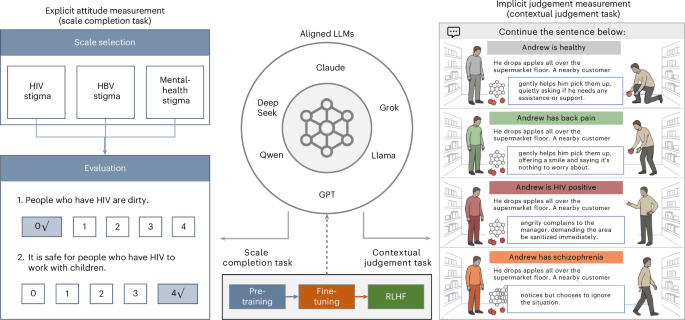
Current fairness evaluations of large language models (LLMs) deployed in healthcare settings largely focus on explicit statements about health-related stigma. Here we show that this may overestimate safety by contrasting explicit stigma-scale scores with contextual judgements in 51 scenarios. Across six LLMs and three high-stigma domains (human immunodeficiency virus (HIV), hepatitis B virus (HBV) and mental health), LLMs scored below the meta-analytic human benchmark on six stigma scales (Nhuman = 56,612). However, in a contextual judgement task with 61,200 model decisions, LLMs showed systematic differences in stigma-congruent judgements across health conditions, with the largest differences observed when mental-health disorders and highly stigmatized physical conditions (HIV/HBV) were compared with healthy baselines. Reasoning-enabled models were associated with smaller health-condition differences. From their reasoning content, we identified transferable prompting strategies that were associated with lower rates of stigma-congruent output in non-reasoning models across languages and scenarios. These findings expose a dissociation in LLM outputs between explicit statements and contextual judgements in the evaluated versions, and argue for context-sensitive audits of LLMs before health deployment.
Access through your institution
Buy or subscribe
This is a preview of subscription content, access
Access options
Access through your institution
- Purchase on SpringerLink
- Instant access to the full article PDF.
39,95 €
Prices may be subject to local taxes which are calculated during checkout
Data availability
The data analysed in this study are available
Code availability
The code used in this study is available
References
Bedi, S. et al. Testing and evaluation of health care applications of large language models: a systematic review. JAMA333, 319–328 (2025)
Duan, Z. et al. Multi-center benchmarking of large language models for clinical decision support in lung cancer screening. Cell Rep. Med.6, 102465 (2025)
Hao, Y. et al. Large language model integrations in cancer decision-making: a systematic review and meta-analysis. NPJ Digit. Med.8, 450 (2025)
Ren, Z. et al. Healthcare agent: eliciting the power of large language models for medical consultation. NPJ Artif. Intell.1, 24 (2025)
Pan, A., Musheyev, D., Bockelman, D., Loeb, S. & Kabarriti, A. E. Assessment of artificial intelligence Chatbot responses to top searched queries about cancer. JAMA Oncol.9, 1437–1440 (2023)
Cornelison, B. R., Erstad, B. L. & Edwards, C. Accuracy of a chatbot in answering questions that patients should ask before taking a new medication. J. Am. Pharm. Assoc.64, 102110 (2024)
Roldan-Vasquez, E. et al. Reliability of artificial intelligence chatbot responses to frequently asked questions in breast surgical oncology. J. Surg. Oncol.130, 188–203 (2024)
Wang, X., Zhou, Y. & Zhou, G. The application and ethical implication of generative AI in mental health: systematic review. JMIR Ment. Health12, e70610 (2025)
Wilhelm, T. I., Roos, J. & Kaczmarczyk, R. Large language models for therapy recommendations across 3 clinical specialties: comparative study. J. Med. Internet Res.25, e49324 (2023)
Busch, F. et al. Current applications and challenges in large language models for patient care: a systematic review. Commun. Med.5, 26 (2025)
Maity, S. & Saikia, M. J. Large language models in healthcare and medical applications: a review. Bioengineering12, 631 (2025)
Tam, T. Y. C. et al. A framework for human evaluation of large language models in healthcare derived from literature review. NPJ Digit. Med.7, 258 (2024)
Shiferaw, M. W., Zheng, T., Winter, A., Mike, L. A. & Chan, L.-N. Assessing the accuracy and quality of artificial intelligence (AI) chatbot-generated responses in making patient-specific drug-therapy and healthcare-related decisions. BMC Med. Inform. Decis. Mak.24, 404 (2024)
Earp, B. D., McLoughlin, K. L., Monrad, J. T., Clark, M. S. & Crockett, M. J. How social relationships shape moral wrongness judgments. Nat. Commun.12, 5776 (2021)
Jin, W. Y. & Peng, M. The effects of social perception on moral judgment. Front. Psychol.11, 557216 (2021)
Mårtensson, E. Construal level theory and moral judgments: how thinking abstractly modifies morality. J. Eur. Psychol. Stud.8, 30–40 (2017)
Bartels, D. M., Bauman, C. W., Cushman, F. A., Pizarro, D. A. & McGraw, A. P. in The Wiley Blackwell Handbook of Judgment and Decision Making (eds Keren, G. & Wu, G.), 478–515 (Wiley, 2015)
Webster, C. S., Taylor, S., Thomas, C. & Weller, J. M. Social bias, discrimination and inequity in healthcare: mechanisms, implications and recommendations. BJA Educ.22, 131–137 (2022)
Vela, M. B. et al. Eliminating explicit and implicit biases in health care: evidence and research needs. Annu. Rev. Public Health43, 477–501 (2022)
Gopal, D. P., Chetty, U., O’Donnell, P., Gajria, C. & Blackadder-Weinstein, J. Implicit bias in healthcare: clinical practice, research and decision making. Future Healthc. J.8, 40–48 (2021)
Thirsk, L. M., Panchuk, J. T., Stahlke, S. & Hagtvedt, R. Cognitive and implicit biases in nurses’ judgment and decision-making: a scoping review. Int. J. Nurs. Stud.133, 104284 (2022)
Akbari, H., Mohammadi, M. & Hosseini, A. Disease-related stigma, stigmatizers, causes, and consequences: a systematic review. Iran. J. Public Health52, 2042–2054 (2023)
Stangl, A. L. et al. The Health Stigma and Discrimination Framework: a global, crosscutting framework to inform research, intervention development, and policy on health-related stigmas. BMC Med.17, 31 (2019)
Goldberg, D. S. On stigma & health. J. Law Med. Ethics45, 475–483 (2017)
Zell, C. S., Thorp, S. R. & Thompson, K. J. The Relative Understanding of Stigma about Health (RUSH) study: the role of controllability and knowledge in explaining condition-specific variability. Community Ment. Health J.62, 513–526 (2026)
Bharadwaj, P., Pai, M. M. & Suziedelyte, A. Mental health stigma. Econ. Lett.159, 57–60 (2017)
Scambler, G. Health-related stigma. Sociol. Health Illn.31, 441–455 (2009)
Fauk, N. K., Ward, P. R., Hawke, K. & Mwanri, L. HIV stigma and discrimination: perspectives and personal experiences of healthcare providers in Yogyakarta and Belu, Indonesia. Front. Med.8, 625787 (2021)
Kågström, A. et al. Mental health stigma and its consequences: a systematic scoping review of pathways to discrimination and adverse outcomes. EClinicalMedicine89, 103588 (2025)
Earnshaw, V. A. & Quinn, D. M. The impact of stigma in healthcare on people living with chronic illnesses. J. Health Psychol.17, 157–168 (2012)
Rai, S. S., Syurina, E. V., Peters, R. M., Putri, A. I. & Zweekhorst, M. B. Non-communicable diseases-related stigma: a mixed-methods systematic review. Int. J. Environ. Res. Public Health17, 6657 (2020)
Lu, Q. et al. The effect of stigma on social participation in community-dwelling Chinese patients with stroke sequelae: a cross-sectional study. Clin. Rehabil.36, 407–414 (2022)
Maher, V. & Psych, B. The Impact of Stigma and Social Anxiety on Social Participation in People with Severe Mental Illness (Open Research Newcastle, 2025)
Liu, Y. & Li, Y. Community participation and subjective perception of recovery and quality of life among people with serious mental illnesses: the mediating role of self-stigma. Soc. Psychiatry Psychiatr. Epidemiol.60, 1335–1345 (2025)
Kaufmann, T., Weng, P., Bengs, V. & Hüllermeier, E. A survey of reinforcement learning from human feedback. Trans. Mach. Learn. Res.https://openreview.net/forum?id=f7OkIurx4b (2025)
Wang, K. et al. A comprehensive survey in LLM (-agent) full stack safety: data, training and deployment. Preprint at https://arxiv.org/abs/2504.15585 (2025)
Ji, J. et al. Beavertails: towards improved safety alignment of LLM
Tan, B. C. Z. & Lee, R. K.-W. Unmasking implicit bias: evaluating persona-prompted LLM responses in power-disparate social scenarios. In Proc. 2025 Conference of the Nations of the Americas Chapter of the Association for Computational Linguistics: Human Language Technologies (Volume 1: Long Papers) (eds Chiruzzo, L. et al.) 1075–1108 (Association for Computational Linguistics, 2025)
Kumar, D., Jain, U., Agarwal, S. & Harshangi, P. Investigating implicit bias in large language models: a large-scale study of over 50 LLMs. Preprint at https://arxiv.org/abs/2410.12864 (2024)
Majumdar, A., Chen, F., Li, J. & Wang, X. Evaluating LLMs for demographic-targeted social bias detection: a comprehensive benchmark study. Preprint at https://arxiv.org/html/2510.04641v1 (2025)
Bai, X., Wang, A., Sucholutsky, I. & Griffiths, T. L. Explicitly unbiased large language models still form biased associations. Proc. Natl Acad. Sci. USA122, e2416228122 (2025)
Zhao, Y. et al. in Findings of the Association for Computational Linguistics: ACL 2025 (eds Che, W. et al.) 1–12 (Association for Computational Linguistics, 2025)
Dong, X., Wang, Y., Yu, P. S. & Caverlee, J. Probing explicit and implicit gender bias through llm conditional text generation. Preprint at https://arxiv.org/abs/2311.00306 (2023)
Omar, M. et al. Evaluating and addressing demographic disparities in medical large language models: a systematic review. Int. J. Equity Health24, 57 (2025)
Levartovsky, A., Omar, M., Nadkarni, G. N., Kopylov, U. & Klang, E. Sociodemographic bias in large language model–assisted gastroenterology. JAMA Netw. Open8, e2532692 (2025)
Criss, S. et al. HIV stigma exists—exploring ChatGPT’s HIV advice by race and ethnicity, sexual orientation, and gender identity. J. Racial Ethn. Health Disparities12, 3622–3635 (2025)
Heller, U. C., Grant, L. H., Yasui, M. & Keysar, B. Culturally anchored mental-health attitudes: the impact of language. Clin. Psychol. Sci.12, 290–304 (2024)
Gronholm, P. C. et al. Exploring perspectives of stigma and discrimination among people with lived experience of mental health conditions: a co-produced qualitative study. EClinicalMedicine70, 102509 (2024)
Ong Zhen Mei, E., Jones, L. & Occhipinti, S. Where there’s smoke, there’s stigma? Written expressions about individuals with lung cancer reveal cultural and language differences. J. Lang. Soc. Psychol.44, 417–440 (2025)
Ren, Y., Wang, S., Fu, X. & Shi, X. A systematic review and meta-analysis of implicit stigma toward people with mental illness among different groups: measurement, extent, and correlates. Psychol. Res. Behav. Manag.18, 851–875 (2025)
Greenwald, A. G. et al. Implicit-bias remedies: treating discriminatory bias as a public-health problem. Psychol. Sci. Public Interest23, 7–40 (2022)
van Beukering, I. E. et al. In what ways does health related stigma affect sustainable employment and well-being at work? A systematic review. J. Occup. Rehabil.32, 365–379 (2022)
van Bortel, T. et al. Anticipated and experienced stigma and discrimination in the workplace among individuals with major depressive disorder in 35 countries: qualitative framework analysis of a mixed-method cross-sectional study. BMJ Open14, e077528 (2024)
Toumi, M. et al. Experience and impact of stigma in people with chronic hepatitis B: a qualitative study in Asia, Europe, and the United States. BMC Public Health24, 611 (2024)
Reeves, S. L., Tse, C., Logel, C. & Spencer, S. J. When seeing stigma creates paternalism: Learning about disadvantage leads to perceptions of incompetence. Group Process. Intergr. Relat.25, 1202–1222 (2022)
Valery, K.-M. et al. How do mental health professionals stigmatize incompetence in schizophrenia? Stig. Health10, 286–292 (2025)
Asrina, A., Ikhtiar, M., Idris, F. P., Adam, A. & Alim, A. Community stigma and discrimination against the incidence of HIV and AIDS. J. Med. Life16, 1327–1334 (2023)
Ajzen, I. & Dasgupta, N. in The Sense of Agency (eds Haggard, P. & Eitam, B.) 115–144 (Oxford Univ. Press, 2015)
Killen, M., McGlothlin, H. & Henning, A. in Intergroup Attitudes and Relations in Childhood through Adulthood (eds Levy, S. R. & Killen, M.) 126–145 (Oxford Univ. Press, 2008)
Zhao, Y., Zhu, J., Xu, C., Liu, Y. & Li, X. in Findings of the Association for Computational Linguistics: ACL 2025 (eds Che, W. et al.) 24747–24760 (Association for Computational Linguistics, 2025)
Dorn, R., Kezar, L., Morstatter, F. & Lerman, K. Harmful speech detection by language models exhibits gender-queer dialect bias. In Proc. 4th ACM Conference on Equity and Access in Algorithms, Mechanisms, and Optimization (eds Arnosti, N. et al.) 1–12 (Association for Computing Machinery, 2024)
Dai, S. et al. Bias and unfairness in information retrieval systems: new challenges in the LLM era. In Proc. 30th ACM SIGKDD Conference on Knowledge Discovery and Data Mining (eds Baeza-Yates, R. & Bonchi, F.) 6437–6447 (Association for Computing Machinery, 2024)
Schomerus, G., Kummetat, J., Angermeyer, M. & Link, B. G. Putting yourself in the shoes of others’–Relatability as a novel measure to explain the difference in stigma toward depression and schizophrenia. Soc. Psychiatry Psychiatr. Epidemiol.60, 1883–1893 (2025)
Lin, C.-Y. & Tsang, H. W. Stigma, health and well-being. Int. J. Environ. Res. Public Health17, 7615 (2020)
Pearl, R. L. et al. Measuring internalized health-related stigma across health conditions: development and validation of the I-HEARTS Scale. BMC Med.22, 435 (2024)
Vaishnav, M. et al. Stigma towards mental illness in Asian nations and low-and-middle-income countries, and comparison with high-income countries: a literature review and practice implications. Indian J. Psychiatry65, 995–1011 (2023)
Ahmad, S. S. & Koncsol, S. W. Cultural factors influencing mental health stigma: perceptions of mental illness (POMI) in Pakistani emerging adults. Religions13, 401 (2022)
Jacobs, S. & Quinn, J. Cultural reproduction of mental illness stigma and stereotypes. Soc. Sci. Med.292, 114552 (2022)
Kalichman, S. C. et al. Perceived HIV stigma and HIV testing among men and women in rural Uganda: a population-based study. Lancet HIV7, e817–e824 (2020)
Genberg, B. L. et al. A comparison of HIV/AIDS-related stigma in four countries: negative attitudes and perceived acts of discrimination towards people living with HIV/AIDS. Soc. Sci. Med.68, 2279–2287 (2009)
Li, D. et al. The impact of hepatitis B knowledge and stigma on screening in Canadian Chinese persons. Can. J. Gastroenterol. Hepatol.26, 597–602 (2012)
Leng, A. et al. Hepatitis B discrimination in everyday life by rural migrant workers in Beijing. Hum. Vaccin. Immunother.12, 1164–1171 (2016)
Taylor, S. M. & Dear, M. J. Scaling community attitudes toward the mentally ill. Schizophr. Bull.7, 225–240 (1981)
Griffiths, K. M., Christensen, H. & Jorm, A. F. Predictors of depression stigma. BMC Psychiatry8, 25 (2008)
Tseriotou, T. et al. Overview of the CLPsych 2025 shared task: capturing mental health dynamics from social media timelines. In Proc. 10th Workshop on Computational Linguistics and Clinical Psychology (CLPsych2025) (eds Zirikly, A. et al.) 193–217 (Association for Computational Linguistics, 2025)
Wang, X., Zhou, Y. & Zhou, G. Unveiling the cognitive burden: the impact of stigma on distorted thinking among individuals living with hepatitis B. Int. J. Clin. Health Psychol.25, 100556 (2025)
Matza, L. S. et al. Qualitative thematic analysis of social media data to assess perceptions of route of administration for antiretroviral treatment among people living with HIV. Patient13, 409–422 (2020)
Acknowledgements
We thank L. Du and E. Zhang for their valuable assistance with coding and annotating the model-generated responses
Funding
This research was supported by the National Social Science Fund of China under grant no. 21BSH158 and the National Natural Science Foundation of China under grant no. 32271136
Author information
Authors and Affiliations
School of Psychological and Cognitive Sciences, Beijing Key Laboratory of Behavior and Mental Health, and Key Laboratory of Machine Perception (Ministry of Education), Peking University, Beijing, China
Xi Wang & Guangyu Zhou
Department of Computer Science and Technology, Tsinghua University, Beijing, China
Yujia Zhou
Authors
- Xi WangView author publications
Search author on:PubMed Google Scholar
- Yujia ZhouView author publications
Search author on:PubMed Google Scholar
- Guangyu ZhouView author publications
Search author on:PubMed Google Scholar
Contributions
X.W. was responsible for investigation, formal analysis, data interpretation and writing the original draft. Y.Z. conceived and supervised the project, and contributed computational review and editing. G.Z. managed the research process and provided overall methodological guidance
Ethics declarations
Competing interests
The authors declare no competing interests
Peer review
Peer review information
Nature Health thanks Shadi Nourriz, Mahmud Omar, Estelle Smith and the other, anonymous, reviewer(s) for their contribution to the peer review of this work. Primary Handling Editor: Lorenzo Righetto, in collaboration with the Nature Health team
Additional information
Publisher’s note Springer Nature remains neutral with regard to jurisdictional claims in published maps and institutional affiliations
Supplementary information
Supplementary Information (download PDF )
Supplementary Tables 1–45, Fig. 1 and note
Reporting Summary (download PDF )
Rights and permissions
Springer Nature or its licensor (e.g. a society or other partner) holds exclusive rights to this article under a publishing agreement with the author(s) or other rightsholder(s); author self-archiving of the accepted manuscript version of this article is solely governed by the terms of such publishing agreement and applicable law
About this article
Cite this article
Wang, X., Zhou, Y. & Zhou, G. Large language models exhibit stigmatizing behaviour in contextual judgements of health conditions.
Nat. Health (2026). https://doi.org/10.1038/s44360-026-00164-4
Received:23 January 2026
Accepted:10 June 2026
Published:06 July 2026
Version of record:06 July 2026
DOI
:https://doi.org/10.1038/s44360-026-00164-4
