


Download PDF
Abstract
This study aims to compare the effectiveness of face-to-face, individually delivered sustainable nutrition education for university students with that of a ChatGPT-generated educational brochure. The Sustainable Eating Behavior Scale, the Sustainable Food Literacy Scale, and the Sustainable Food Choice Questionnaire were used. Face-to-face group education was provided, and the ChatGPT-generated data was distributed to students in the brochure group without modification. In generalized linear mixed model analyses, while the main effect of time was strong for all scales (p < 0.001), statistically significant results were obtained for the time × education type interaction in the Behaviors Scale Towards Sustainable Nutrition (β = −27.47, p < 0.001), the Sustainable Food Literacy Scale (β = −38.54, p < 0.001), and the Sustainable Food Choice Scale (β = −26.41, p < 0.001). Face-to-face education yielded greater improvements across all scales compared to a ChatGPT-generated educational brochure. To the best of our knowledge, this study is the first in the literature to compare the effects of face-to-face and ChatGPT-generated educational brochure on sustainable nutrition. Although both types of education were effective, face-to-face nutrition education had a stronger effect than the ChatGPT-generated educational brochure. AI-powered tools may complement sustainable nutrition education; however, face-to-face education demonstrated stronger effects on the measured outcomes in the present study.
Subjects
- Education
- Environmental social sciences
- Health care
Introduction
Advanced technology products are now widely accessible in daily life thanks to recent advances. This has been facilitated by the accessibility provided by the internet and smartphones. As a result, the use of technology to access information previously available only to healthcare professionals has become widespread1. As a result, ChatGPT, one of the most widely used chatbots developed by OpenAI, was created. It uses complex machine learning algorithms to generate responses to text-based queries and to mimic human-like conversation 2. ChatGPT is an AI-powered conversational service, also known as a chatbot. Simply put, it is accessible via a web interface and generates natural responses to human requests (sentences that ask questions or pose problems). Since its development in November 2022, it has attracted attention in the media and scientific community3.
The applications of ChatGPT in health and medical sciences are being investigated4. In healthcare services, it is primarily used in fields such as microbiology, nursing, and parasitology. Beyond these fields, it is considered a promising tool for providing recommendations related to obesity5. It is also used to create diet plans and to obtain nutrition-related information6. Artificial intelligence technology began expanding the fields of nutrition science and nutrition research in the late 2010s. Numerous technological advances have been made in nutrition science to date, including personalized nutrition, the evaluation of diets and recipes, the management of disease diagnoses, parenteral nutrition, telehealth, and the use of mobile applications related to nutrition with wearable technologies, as well as the testing of food sustainability7.
Nutrition literacy refers to understanding the basic concepts and guidelines related to the effects of dietary choices on health. Individuals with sufficient nutrition literacy can critically evaluate their nutrition knowledge through dietary concepts and nutrition guidelines4. Nutrition and dietetics specialists are the most ideal professionals to provide dietary education to individuals8. As they operate at the intersection of food production systems, nutrition research, health, and individual economic sustainability, they are also important health professionals for providing a future-oriented perspective on sustainability. Nutrition and dietetics professionals need to focus on sustainability and place greater emphasis on environmental, economic, and ecological issues9.
Sustainable diets are those that have a low environmental impact, contribute to food and nutrition security, and promote healthy living for current and future generations10. Plant-based diets, reducing food waste, limiting consumption of ultra-processed foods, utilizing local food systems, and choosing sustainable seafood are key components of sustainable nutrition8. ChatGPT can contribute to teaching processes and areas such as innovation and development in education11. In their study, Göktaş12 measured ChatGPT’s performance on distance-learning exams in the field of tourism and observed that the success rate was low. Chen13 concluded that AI-derived responses frequently confuse incorrect suggestions with correct ones, a situation that is difficult for even experts to detect.
There remains a lack of information regarding the benefits and limitations of ChatGPT in the field of nutrition4. Additionally, the concept of sustainability and its integration are still in their early stages14. For example, Di Vaio et al.15 found that there is very little research discussing concepts such as sustainability and environmental awareness in conjunction with artificial intelligence. This situation suggests that artificial intelligence could negatively affect sustainability issues. Artificial intelligence systems typically use large amounts of data, including personal information such as individuals’ purchasing habits, dietary preferences, and health information, in order to function effectively. The ethical use of these data involves collecting, storing, and processing them in compliance with privacy laws and standards, and informing individuals about what data is collected and how it will be used14.
The ChatGPT chatbot also generates non-existent references or produces inconsistent data. The language used by artificial intelligence may lead users to make different predictions5. ChatGPT or similar artificial intelligence systems are not subject to scrutiny or evaluation regarding whether they provide incorrect or misleading information in fields such as nutrition or medicine. These systems generally generate responses based on the data they have been trained on, which may be derived from scientific literature or current medical knowledge, but this data is not continuously updated or monitored for accuracy. For this reason, users and practitioners should approach information provided by ChatGPT or similar artificial intelligence systems with caution and consult a medical or nutrition expert before making any decisions. ChatGPT and similar systems can be used as a resource, but they should not replace appropriate medical or nutritional advice16. It can also be used to provide health advice in place of healthcare professionals or directly to individuals, which raises different legal and ethical questions3.
This study aims to compare the effectiveness of face-to-face, individualized sustainable nutrition education with that of ChatGPT-generated educational brochure among university students undergoing significant changes in health and personal development. As ChatGPT’s use in the field of nutrition has become widespread recently, and the topic of sustainable nutrition has begun to attract attention, nutrition education on this subject must be carried out correctly. Given the ethical issues arising from ChatGPT’s use in nutrition and other health sciences, the results of this study are significant. The lack of studies in the literature directly investigating the relationship between sustainable nutrition education and ChatGPT constitutes the original value of this study.
Methods
In this educational intervention study, the sample size was calculated using G*Power. With an effect size of 0.5 and 80% power, the sample size required to compare dependent groups before and after education was determined to be 2717. It was planned to complete the education with a minimum of 54 participants, divided into an in-person education group and a ChatGPT-generated educational brochure group. However, because there could be dropouts (participants leaving the program), the education began with the maximum number of participants who could be reached beforehand, resulting in 164 participants.
Sample selection
This study was conducted on individuals aged 18–35 who were active students at Bitlis Eren University between January 2025 and June 2025. Individuals with any psychiatric disorder, pregnant women, and nursing mothers, as well as students enrolled in the Faculty of Health Sciences (nursing, midwifery, physical therapy and rehabilitation, nutrition and dietetics departments) were excluded from the study (as they may know about sustainable nutrition, which could influence the results). All procedures conformed to the Declaration of Helsinki. Before the data collection process began, permission was obtained from the Bitlis Eren University Non-Interventional Clinical Research Ethics Committee (02.01.2025/2024-9). All participants signed an informed consent form.
Data collection
Survey applications
A “general questionnaire form” was used to collect demographic information and record anthropometric measurements. In the administered questionnaires, the researchers recorded responses using face-to-face interviews, and participants’ statements served as the basis for the anthropometric measurements. Students participating in the sustainable nutrition education program were provided with comprehensive information on the topic of ‘sustainable nutrition’ based on literature reviews. Participants were recruited voluntarily through classroom and campus cafeteria announcements and general student invitations across the university. Students who agreed to participate and met the inclusion criteria were enrolled in the study. Students aged between 18 and 35 years who were actively enrolled at Bitlis Eren University were included in the study. Students who agreed to participate and met the inclusion criteria were enrolled in the study. Similar to a study that conducted nutrition education to avoid time bias18, pre-test surveys were administered to students who agreed to participate in and continue the study approximately 1 week before the education. Approximately two weeks after the education was delivered, post-test surveys were administered, and applications were also made to participants who would receive a ChatGPT-generated educational brochure within the same time frame. The Behaviors Scale Towards Sustainable Nutrition, the Sustainable Food Literacy Scale, and the Sustainable Food Choice Questionnaire were used to evaluate the educational activity.
Educational intervention
The face-to-face intervention consisted of a single individual educational session lasting approximately 10–15 min and was delivered by the researchers. The education was based on current literature regarding sustainable nutrition and covered sustainable food choices, food waste reduction, environmentally friendly dietary practices, and the consumption of local and seasonal foods. No structured discussion or question-and-answer session was conducted. For the comparison group, educational material generated by ChatGPT (version 3.5) was compiled into a brochure of approximately 1–2 pages and distributed to participants. The brochure covered topics comparable to those included in the face-to-face education. Although the content generated by ChatGPT was presented without modification, the brochure was reviewed by the research team prior to distribution to ensure its relevance and appropriateness for sustainable nutrition education.
Behaviors scale towards sustainable nutrition
The Behaviors Scale Towards Sustainable Nutrition is a tool that measures sustainable eating behaviors among adults aged 18–65. It was developed by Garipoğlu et al., in 2023. The scale consists of a five-point Likert-type rating (never, rarely, sometimes, often, and always), 29 items, and 4 subdimensions. The items are scored on a scale of 1 to 5. Items 1, 2, 3, 4, 5, and 6 address food preferences; items 7, 8, 9, 10, 11, 12, 13, 14, and 15 address reducing food waste; items 16, 17, 18, 19, 20, 21, 22, and 23 address seasonal and local nutrition; and items 24, 25, 26, 27, 28, and 29 address sub-dimensions of food purchasing. There are no reverse-scored items, and the lowest possible score on the scale is 29, while the highest possible score is 145. Subscale scores are obtained by dividing each participant’s score for a subscale by the number of items in that subscale. High total scores and subscale scores indicate more sustainable eating behaviors. The Cronbach’s alpha for the scale is 0.9219. In the present study, the Cronbach’s alpha coefficient for the Behaviors Scale Towards Sustainable Nutrition was 0.912, indicating high internal consistency.
Sustainable food literacy scale
The “Sustainable Food Literacy Scale,” which encompasses concepts such as healthy food consumption and environmental sustainability, was developed by Teng and Chih in 202220. The scale’s validity and reliability were assessed by Kubilay in 2023. The scale consists of 26 items and five subscales. These subscales are named Sustainable Food Knowledge I, Sustainable Food Knowledge II, Cooking and Kitchen Skills, Attitudes and Intention to Act, and Strategies for Action, respectively. The items on the scale are on a 7-point Likert scale, ranging from 1 (strongly disagree) to 7 (strongly agree). The total scores obtainable from the scale range from 26 to 182, with higher scores indicating greater sustainable food literacy. The Cronbach’s Alpha value for the scale was 0.94121.In the present study, the Cronbach’s alpha coefficient for the Sustainable Food Literacy Scale was 0.946, indicating high internal consistency.
Sustainable food choice questionnaire (SUS-FCQ)
The Sustainable Food Choice Questionnaire was developed by Verain et al., in 2021. Because traditional “food choice motivation” scales (e.g., Food Choice Questionnaire (FCQ) do not adequately cover these sustainability areas, a separate, comprehensive, and valid scale is applied to assess sustainable food choices. It is a two-dimensional survey consisting of 16 questions: “General sustainability” (13 items covering environmental, ethical, and animal welfare issues) and “Local and seasonal” (3 items). The evaluation is scored on a scale from 1 (Strongly Disagree) to 7 (Strongly Agree). The total scores obtainable from the scale range from 16 to 112, with higher scores indicating greater awareness and inclination towards sustainable food choices. When evaluating each individual’s results, the total of their responses to the questions for each dimension is calculated. Cronbach’s alpha values were 0.962 for the overall sustainability sub-dimension and 0.853 for the local and seasonal sub-dimension22. The validity and reliability analyses of the scale in Turkish were conducted by Özkaya in 2023, and Cronbach’s alphas were 0.961 for the sustainability sub-dimension, 0.971 for the local and seasonal sub-dimension, and 0.866 for the sustainability sub-dimension23. In the present study, the Cronbach’s alpha coefficient for the Sustainable Food Choice Questionnaire was 0.938, indicating high internal consistency (0.931 for the sustainability sub-dimension; 0.801 for the sustainability sub-dimension).
Statistical evaluation of data
Data analysis was performed using SPSS for Windows, version 27.0, and Jamovi (version 2.6.44) software. The distribution characteristics of continuous variables were assessed by examining the Shapiro–Wilk test, qq-plots, and skewness–kurtosis values. Continuous variables that were normally distributed were compared between the two groups using an independent samples t-test. The chi-square test was applied to categorical variables; Bonferroni-corrected z-tests were used to determine the direction of the difference in significant cells. Due to the repeated nature of the pre-test–post-test measurements and the failure to meet the normality assumption for some variables, Generalized Linear Mixed Models (GLMM) were used to examine the effects of the intervention. The models were estimated using Jamovi, and a random-intercept structure was specified at the individual level. Cases with missing data were automatically excluded from the mixed-model analyses. Time (pre-post), type of education (face-to-face/ChatGPT), and gender were included as fixed effects; age and BMI were included as covariates. The time × education interaction term was examined for each scale, and the intervention effect was interpreted based on this term. For model adequacy, the distribution of residuals, predicted–residual plots, and Pearson χ²/df values were checked; all models were found acceptable. Marginal R² (variance explained by fixed effects) and Conditional R² (total variance explained by fixed + random effects) values were reported for effect sizes. A significance level of p < 0.05 was accepted for all statistical tests.
Results
Table 1 presents the demographic characteristics of participants by educational background. A total of 164 university students participated in the study (82 women, 82 men). The average age of the participants was 22.51, and the average BMI was 23.18 kg/m². There was no significant difference between the face-to-face and ChatGPT groups in terms of age, BMI, gender, or place of residence (p > 0.05). However, significant differences were found between groups in the class-level and department-category variables (p < 0.001). The difference in the class variable was particularly evident in the ratios of grades 1, 2, and 4; the difference in the department variable stemmed from the distributions in departments related to social sciences (art, history, literature, etc.), sports and health-related departments (physical education, health management, optometry, etc.), and science and engineering departments (chemistry, computer engineering, etc.).
Pre- and post-test results of the face-to-face and ChatGPT-generated educational brochure on the behaviors scale towards sustainable nutrition
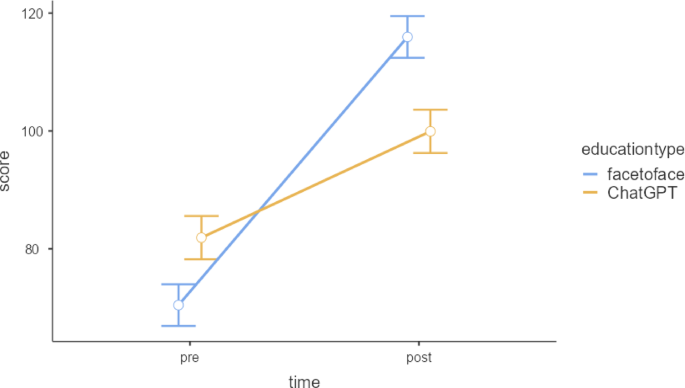
Table 2 presents the fixed effects and adjusted means from the linear mixed model used to explain the Behaviors scale scores towards sustainable nutrition. The effect of time in the model is extremely strong (β = 31.78, SE = 1.28, t = 24.82, p < 0.001), indicating that all participants showed significant improvement from the pre-test to the post-test. The main effect of education type is not significant (β = −2.29, p = 0.313), indicating that the face-to-face and ChatGPT groups are similar at the initial level. However, the interaction between time and type of education is very strong (β = −27.47, SE = 2.56, t = − 10.73, p < 0.001). This finding shows that the intervention’s effect differs between the two groups; it demonstrates that the impact of face-to-face education on development is significantly greater than that of ChatGPT. When examining the model’s corrected averages (EMMs), those who received face-to-face education showed scores of pre: 70.4 → post: 116.0 (≈ + 45.6 point increase), while the ChatGPT group’s scores were pre: 81.9 → post: 99.9 (≈ + 18 point increase). This difference reveals that face-to-face education has more than twice the impact on behavioral change. When demographic covariates were examined, age (β = 0.17, p = 0.759) and BMI (β = 0.12, p = 0.706) did not contribute significantly to the results. The main effect of gender is not significant (p = 0.365), but the interaction terms education type × gender (β = 12.33, p = 0.007) and time × gender (β = 11.08, p < 0.001) were found to be significant, while the triple interaction time × education × gender was not significant (β = 6.40, p = 0.213). While fixed effects explain 78.1% of the variance in the model’s explanatory power (Marginal R² = 0.781), the total variance explained by fixed and random effects together is 55.3.9% (Conditional R² = 0.553). As shown in Fig. 1, face-to-face education has a significantly greater positive effect on sustainable eating behaviors compared to a ChatGPT-generated educational brochure.
Pre- and post-test results of the face-to-face and ChatGPT-generated educational brochure of the sustainable food literacy scale
Table 3 presents the results of the linear mixed model used to explain Sustainable Food Literacy Scale scores. The model’s basic effect of time is quite strong; it shows that both groups improved significantly from the pre-test to the final test. (β = 35.21, SE = 1.79, t = 19.72, p < 0.001). Although the main effect of education type was not significant (β = 1.50, p = 0.631), a strong and significant interaction between time and education type was found (β = −38.54, SE = 3.57, p < 0.001). When examining the adjusted averages, the face-to-face group: Pre ≈ 87.4 → Post ≈ 141.8 (+ 54.4 point increase), ChatGPT group: Pre ≈ 108.0 → Post ≈ 123.8 (+ 15.8 point increase), indicating that face-to-face education resulted in approximately 3.5 times greater improvement.
When demographic variables were examined, the effects of age and BMI were not significant (p > 0.05), while the gender variable was found to be significant (β = 10.36, p = 0.002); the response to the type of education varied according to gender (β = 17.09, p = 0.007). However, in the three-way interaction (Time × Education × Gender) in the model, the effect of gender was not significant (β = −6.82, SE = 7.14, p = 0.341). While fixed effects explain 49.0% of the total variance (Marginal R² = 0.490), fixed and random effects together explain 74.4% of the total variance (Conditional R² = 0.744). Figure 2 also shows that face-to-face education is more effective for the Sustainable Food Literacy Scale.
Pre- and post-test results of the face-to-face and ChatGPT-generated educational brochure of the Sustainable Food Choice Questionnaire
Table 4 presents the fixed effects and adjusted means from the linear mixed model used to explain the SUS-FCQ scores. The main effect of time in the model is quite strong; a significant difference was found between participants’ post-test and pre-test scores (β = 24.63, SE = 1.23, t = 20.00, p < 0.001). While the main effect of education type was not significant (β = −1.26, p = 0.602), a significant interaction between time and education type was found (β = −26.41, p < 0.001). According to adjusted means, the face-to-face group showed an increase from pre: 63.0 → post: 100.9 (≈ + 37.9 points); the ChatGPT group showed an increase from pre: 75.0 → post: 86.4 (≈ + 11.4 points). The gender effect was significant (β = 9.62, p < 0.001), while both time (β = 6.29, p < 0.001) and time × education type (β = 11.72, p = 0.019) were significant. However, age (p = 0.616) and BMI (p = 0.724) did not show a statistically significant effect on the model. When examining the model’s explanatory power, fixed effects accounted for 45.3% of the variance (Marginal R² = 0.453), while fixed and random effects together accounted for 77.0% of the total variance (Conditional R² = 0.770). Figure 3 shows that face-to-face education is more effective on the Sustainable Food Choice Questionnaire over time.
Additional sensitivity analyses, including class year and academic section as covariates, yielded virtually identical findings across all models. The Time × Education Type interaction remained highly significant for all outcomes (p < 0.001). Neither class year nor academic section significantly contributed to most adjusted models, indicating that the observed intervention effects were robust to baseline group differences
Discussion
This study aims to compare the effects of face-to-face and ChatGPT-generated educational brochure sustainable nutrition education on sustainable nutrition behavior, sustainable food literacy, and sustainable food selection among university students. To the best of our knowledge, no intervention study in the literature compares face-to-face education with a ChatGPT-generated educational brochure approach to sustainable nutrition education. Our study found that both education methods provided significant improvements across all scales; however, mixed analyses across both education types and time revealed that face-to-face education had a stronger effect on sustainable nutrition behavior, food literacy, and sustainable food selection. These findings suggest that AI-supported tools can play an accessible and supportive role in nutrition education. However, face-to-face education demonstrated stronger effects on sustainable nutrition behavior, food literacy, and sustainable food choice outcomes in the present study. The magnitude of the observed improvements suggests that these interventions may yield meaningful educational and behavioral outcomes for college students. In particular, the significant increases in scores for sustainable eating behaviors, food literacy, and sustainable food choices indicate that nutrition education interventions can support healthier, more environmentally responsible food choices among young adults.
Young adults, especially students continuing their university education, are considered an important target group for nutrition interventions in public health, because the transition period from adolescence to young adulthood is critical for the development of new health behaviors24. The university environment is an ideal setting for implementing nutrition education interventions that can influence nutrition knowledge and behavior. The literature reports that nutrition interventions targeting university students, despite being implemented using different methods, have positive effects on nutrition knowledge and habits25. A nutritional education intervention among university students showed improvement, with the intervention group transitioning from unhealthy to moderately healthy habits, while the control group remained in unhealthy eating behaviors26. A study examining students’ views on sustainable nutrition found that many adopt a self-centered perspective, often focusing solely on health10. In their study, Engin and Sevim27 found that as undergraduate students’ sustainable nutrition knowledge score increased, their sustainable nutrition behavior score also increased. Another study has linked increased consumption of organic food and greater environmental awareness to more sustainable, healthier eating habits28. In her study, Huyard29, found that education for young adults positively influenced sustainable eating behaviors, such as meal planning, flexibility, choosing quality products, and mastering the preparation of fresh vegetables. Another study found that among university students, the focus of sustainable food consumption behavior was limited to seasonal fruits and vegetables and to purchasing regionally grown foods30. A 10-week program of sustainable nutrition education for children has been shown to positively impact their eating behaviors and attitudes31. Falakacılar and Yücecan32 showed that sustainable nutrition education provided to university students led to both sustainable nutrition behaviors and the acquisition of positive diet-related habits. A study conducted with students at the Faculty of Health Sciences found that nutrition education increased students’ sustainable, healthy eating behaviors33. Similarly, compared to students studying social sciences, students in nutrition and health departments were found to have significantly higher knowledge of food sustainability34. This situation also confirms the effectiveness of education related to sustainable nutrition. In our study, both ChatGPT-generated educational brochure and face-to-face education increased sustainable nutrition behavior, but face-to-face education was more effective over time. In this context, while AI-based tools such as ChatGPT offer an accessible and supportive option for sustainable nutrition education, face-to-face nutrition education demonstrated greater effectiveness in improving the measured outcomes in the present study.
University students’ insufficient knowledge of food literacy will expose them to various adult diseases and environmental crises, as it harms the modern food system. Additionally, food literacy skills will strengthen the formation of healthy eating habits, ultimately guiding them towards a sustainable life in an ecologically safe food environment35. Designing and implementing programs to foster food literacy can contribute to healthier, more sustainable eating habits36. Mollaei et al.37 found that food literacy is an important factor influencing sustainable food choices among university students. Recently, Teng et al., found that nutrition education added to the curriculum significantly improved students’ knowledge, skills, and attitudes toward sustainable food practices and food literacy, and also reduced food waste behaviors38. It has been observed that sustainable nutrition education provided to university students is positively associated with healthier and more environmentally responsible eating behavior39. Borlu and colleagues40 have shown that nutrition education for university students can be effective not only in promoting sustainable, healthy eating habits but also in improving environmental literacy. According to our results, sustainable food literacy increased in both the group using the brochure created by ChatGPT and the group receiving face-to-face education. However, when time and education method were considered together, face-to-face education was found to be more effective. A possible explanation for this finding is that face-to-face education increased participation and provided more opportunities for reinforcing the education content. However, these factors were not directly evaluated in the current study and should therefore be interpreted with caution.
The topic of individual food preferences is of great interest to researchers and stakeholders in the food industry. However, to steer food consumption toward a more sustainable direction, we need more information and a better understanding of the factors that influence consumers’ food preferences41. In the context of sustainable food consumption, certain food-choice motivations, such as environmental concerns, support sustainable choices. Other motivations, such as the perception that sustainable food is less tasty or less convenient, may be considered barriers to sustainable choices 22. Regarding university students’ access to higher-quality and healthier food options, it has been noted that university cafeterias offer unhealthy choices and that access to healthier options is limited or nonexistent24. This also demonstrates that unhealthy food choices negatively impact sustainability42. A study conducted among young adults across Canada found that more than half of participants had specific criteria (such as environmental perceptions and personal and behavioral factors) for their food choices 37. The visibility and understanding of sustainable foods among young adults (excluding organic foods, which have an established market identity) are very low43. Sahadeo et al.44 also emphasized that university students have low awareness of sustainability, which contributes to the prevalence of unsustainable and unhealthy food choices. They underscored the need for targeted educational interventions to close the knowledge gap and empower young adults to make conscious, sustainable food choices. Similarly, knowledge of and education on sustainable diets contribute to healthy food choices and sustainable behaviors among young adults45. One possible explanation for the greater effectiveness of face-to-face education may be that sustainable food choices involve behavioral and contextual factors beyond information acquisition alone. Future studies are needed to explore the mechanisms underlying these differences. Additionally, the significant effect of gender on the sustainable food literacy and sustainable food choice scales suggests that female students may have greater awareness of nutrition and environmental issues and be more receptive to education. There are studies in the literature supporting this finding40,46. However, gender-related interactions were not consistently observed across all models in our analyses, and the three-way interaction was significant only on the sustainable food choice scale. Therefore, the stronger improvement observed in the face-to-face education group may be related to factors such as feedback, social interaction, and active participation. However, these potential mechanisms were not directly assessed in the present study.
Artificial intelligence-powered tools have significant potential in providing quick access to information and standardized content in the field of nutrition. However, it is emphasized that these systems must be carefully examined for accuracy, timeliness, and contextual appropriateness47. A recent comprehensive review noted that artificial intelligence systems have shown potential to support personalized nutrition and improve outcomes in chronic disease management, although their accuracy varies in nutrition and dietetics48. Digital interventions have been found to have positive effects on eating behaviors, and these effects increase when combined with personalized feedback and counseling49. In his research, Samoita50 found that the chatbot was more successful at increasing nutritional knowledge than the group that received no intervention. However, a comparative study emphasized that ChatGPT cannot replace the personalized dietary counseling provided by dietitians, particularly because it cannot offer personalized motivation, emotional support, or clinically safe recommendations51. In a comparative study of responses to diet-related questions on an online platform provided by ChatGPT and human dietitians, it was observed that ChatGPT produced responses similar to those of dietitians, but it was concluded that it was unable to provide personalized answers52. A recent study among women found that online nutrition education has positive effects on sustainable eating habits53. A meta-analysis study also found that mobile app-based interventions may have positive effects on sustainable eating behaviors54. In their studies with young adults, Gençer Bingöl et al.55 found that web-based education increased participants’ scores for sustainable and healthy eating behaviors, while another similar study found that web-based education could be effective in supporting some outcomes related to sustainable eating among young adults. However, since sustainable and healthy nutrition is a multidimensional concept, it has been emphasized that higher-quality, more comprehensive web-based interventions to promote sustainable nutrition need to be developed and evaluated56. To the best of our knowledge, there are no publications in the literature directly similar to the application in our paper; however, AI-powered platforms have the potential to promote good nutrition habits through nutrition education57. However, there are some shortcomings in diet planning in the field of nutrition and dietetics. From a dietitian’s perspective, while ChatGPT has potential as a supplementary educational tool, significant shortcomings, particularly in detailed nutritional inquiries, need to be addressed58.
In recent years, it has been reported that AI-supported education systems can enhance accessibility, flexibility, and opportunities for personalized learning59,60. It is noted that generative AI tools, in particular, can support learning processes when used in conjunction with appropriate pedagogical approaches. However, it is emphasized that the use of AI-based systems without guidance may pose limitations in student engagement, deep learning, critical thinking, and long-term behavioral change61. Similarly, research in sustainability education indicates that discussion-based, interactive, and human-centered learning approaches are crucial for fostering sustainable behavioral change62. Therefore, the stronger improvement observed in the face-to-face education group may be related to factors such as feedback, social interaction, active participation, and reinforcement of educational messages. However, these potential mechanisms were not directly assessed in the present study. Additionally, the fact that individuals have different learning styles and that AI-supported content may create cognitive load for some students can affect the gains from education. Based on these findings, it is considered that AI-powered tools such as ChatGPT may be more appropriately used as a supportive component within hybrid education models rather than as a standalone method in sustainable nutrition education. Additionally, our results indicate that sustainable nutrition education can produce meaningful effects not only statistically but also in terms of behavior and educational outcomes. In particular, the observed improvements in sustainable dietary behavior, food literacy, and sustainable food choices suggest that university students can be supported in making more conscious, healthy, and environmentally responsible dietary choices. From this perspective, educational interventions focused on sustainable nutrition may contribute to improved health and environmental awareness among young adults.
Conclusion
Artificial intelligence-supported systems such as ChatGPT may contribute to nutrition education when used in accordance with ethical principles and professional standards. However, based on the present study’s findings, face-to-face education appeared to yield greater improvements in sustainable nutrition-related outcomes among university students. Therefore, AI-supported tools may currently be more appropriate as complementary components within hybrid educational approaches rather than as fully independent educational methods.
Improving sustainable nutrition awareness among university students may contribute not only to individual health but also to environmental sustainability and the achievement of the United Nations Sustainable Development Goals. Future studies should continue to evaluate the long-term effectiveness, reliability, and educational applicability of AI-supported nutrition education approaches
Limitations
Baseline differences were observed between the groups in terms of grade level and academic department distribution. As no formal randomization procedure was applied, residual differences between groups may have occurred despite efforts to recruit participants from the same university population. However, additional sensitivity analyses conducted based on these variables yielded similar results, indicating that the core findings remain robust and consistent despite these baseline imbalances. Another point to consider when interpreting the findings is that the ChatGPT group’s baseline scores on some scales were higher than those of the in-person education group. This situation may have created a ceiling effect, limiting the level of improvement observed in the ChatGPT group. Therefore, it is considered necessary to interpret the lower levels of improvement observed in the ChatGPT group with caution. Another limitation to consider is that the content of the face-to-face education may have been more closely aligned with the scale domains assessing the outcome variables than the educational materials generated by ChatGPT. This may have partially contributed to the relatively higher development observed in the face-to-face education group. In addition, participants in the ChatGPT group did not directly interact with ChatGPT and instead received a brochure containing ChatGPT-generated content. Therefore, the findings should be interpreted as a comparison between face-to-face education and a ChatGPT-generated educational brochure rather than direct ChatGPT-supported education.
Data availability
The datasets used and/or analysed during the current study available from the corresponding author on reasonable request
References
Kirk, D., van Eijnatten, E. & Camps, G. Comparison of answers between ChatGPT and human dieticians to common nutrition questions. J. Nutr. Metab.2023, 5548684. https://doi.org/10.1155/2023/5548684 (2023)
Han, J., Qiu, W. & Lichtfouse, E. ChatGPT in Scientifi c Research and Writing: A Beginner’s Guide. In: ChatGPT in Scientific Research and Writing. Cham: Springer; 1–109 (2024)
Chatelan, A., Clerc, A. & Fonta, P. A. ChatGPT and future artificial intelligence chatbots: What may be the influence on credentialed nutrition and dietetics practitioners?. J. Acad. Nutr. Diet.123(11), 1525–1531 (2023)
Garcia, M. B. ChatGPT as a virtual dietitian: Exploring its potential as a tool for improving nutrition knowledge. Appl. Syst. Innov.6 (5), 96. https://doi.org/10.3390/asi6050096 (2023)
Naja, F. et al. Artificial intelligence chatbots for the nutrition management of diabetes and the metabolic syndrome. Eur. J. Clin. Nutr.78 (10), 887–896. https://doi.org/10.1038/s41430-024-01346-5 (2024)
Tsiantis, V., Konstantinidis, D. & Dimitropoulos, K. ChatGPT in nutrition: trends, challenges and future directions. In Proceedings of the 17th International Conference on Pervasive Technologies Related to Assistive Environments (PETRA ’24) 1–6. https://doi.org/10.1145/3652037.3663898 (ACM, 2024)
Joshi, S., Bisht, B. & Kumar, S. Artificial intelligence assisted food science and nutrition perspective for smart nutrition research and healthcare systems. Syst. Microbiol. Biomanuf. 4, 86–101. https://doi.org/10.1007/s43393-023-00121-9 (2024)
Bastian, G. E., Buro, D. & Palmer-Keenon, D. M. Recommendations for integrating evidence-based, sustainable diet information into nutrition education. Nutrients13, 4170. https://doi.org/10.3390/nu13114170 (2021)
Burkhart, S., Verdonck, M., Ashford, T. & Maher, J. Sustainability in nutrition: Potential guiding statements for education and practice. J. Nutr. Educ. Behav.53, 663–676. https://doi.org/10.1016/j.jneb.2021.04.012 (2021)
Dornhoff , M., Hörnschemeyer, A. and Fiebelkorn, F. (2020) ‘Students’ conceptions of sustainable nutrition’, Sustainability, Vol. 12 No. 13, 5242 https://doi.org/10.3390/su12135242 (2020)
Yağar, S. D. ChatGPT’nin sağlık alanındaki potansiyel kullanımına ilişkin çıkarımlar. Ankara Üniversitesi Sağlık Bilimleri Fakültesi Sağlık Yönetimi Bölümü Dergisi. 11 (3), 1226–1240. https://doi.org/10.15295/bmij.v11i3.2264 (2023)
Göktaş, L. S. ChatGPT uzaktan eğitim sınavlarında başarılı olabilir mi? Turizm alanında doğruluk ve doğrulama üzerine bir araştırma. J. Tourism Gastronomy Stud.11 (2), 892–905. https://doi.org/10.21325/jotags.2023.1224 (2023)
Chen, S. et al. Use of artificial intelligence chatbots for cancer treatment information. JAMA Oncol.9 (10), 1459–1462. https://doi.org/10.1001/jamaoncol.2023.2954 (2023)
Du-Phuong Ta, M., Wendt, S. & Sigurjonsson, T. O. Applying artificial intelligence to promote sustainability. Sustainability16, 4879. https://doi.org/10.3390/su16114879 (2024)
Di Vaio, A., Boccia, F., Landriani, L. & Palladino, R. Artificial intelligence in the agri-food system: Rethinking sustainable business models in the COVID-19 scenario. Sustainability12, 4851. https://doi.org/10.3390/su12124851 (2020)
Arslan, S. Decoding dietary myths: The role of ChatGPT in modern nutrition. Clin. Nutr. ESPEN. 60, 285–288. https://doi.org/10.1016/j.clnesp.2024.03.018 (2024)
Faul, F., Erdfelder, E., Lang, A. G. & Buchner, A. G*Power 3: A flexible statistical power analysis program for the social, behavioral, and biomedical sciences. Behav. Res. Methods. 39 (2), 175–191. https://doi.org/10.3758/BF03193146 (2007)
Yetkin, B. Enhancing Knowledge and Attitudes Through Healthy Nutrition Education Among Older Adults at a Social Life Campus. Master’s thesis, İzmir Democracy University, Institute of Health Sciences, İzmir, Türkiye (2023)
Garipoğlu, G., Koç, B. M. & Özlü, T. Behaviors scale towards sustainable nutrition: Development and validity–reliability analysis. Nutr. Food Sci.53, 1226–1240. https://doi.org/10.1108/NFS-03-2023-0098 (2023)
Teng, C. C. & Chih, C. Sustainable food literacy: A measure to promote sustainable diet practices. Sustain. Prod. Consum.30, 776–786. https://doi.org/10.1016/j.spc.2021.12.020 (2022)
Kubilay, M. N. & Yüksel, A. Validity and reliability study of the Turkish adaptation of the sustainable food literacy scale. Gümüşhane Üniversitesi Sağlık Bilimleri Dergisi. 12 (4), 1562–1570. https://doi.org/10.37989/gumussagbil.1367727 (2023)
Verain, M.C.D., Snoek, H.M., Onwezen, M.C.,Reinders, M.J. and Bouwman, E.P. (2021) ‘Sustainable food choice motives: the development and cross-countryvalidation of the Sustainable Food Choice Questionnaire (SUS-FCQ)’, Food Quality and Preference, Vol. 93, 104267 https://doi.org/10.1016/j.foodqual.2021.104267 (2021)
Özkaya, B. N. Evaluation of Sustainable Food Choice and Adherence to the Mediterranean Diet in Adults. Master’s thesis, Hacettepe University (2023)
Dahl, A. A., Fandetti, S. M., Ademu, L. O., Harris, R., & Racine, E. F.(2024). Assessing the Healthfulness of University Food Environments: A Systematic Review of Methodsand Tools. Nutrients, 16(10), 1426. https://doi.org/10.3390/nu16101426 (2024)
Dodge, E., Abu Shihab, K. H. N., Aboul-Enein, B. H., Benajiba, N. & Faris, M. Effectiveness of nutrition interventions targeting university-level student populations across the League of Arab States: a systematic scoping review. Global Health Promotion. 32 (2), 34–45. https://doi.org/10.1177/17579759241270957 (2025)
Enriquez, J. P., Hernandez Santana, A. & Del-Cid, D. Y. Impact of nutritional education intervention on food choice motivations and eating behaviors among Latin American university students. Am. J. Health Educ.55 (5), 353–362. https://doi.org/10.1080/19325037.2024.2338072 (2024)
Engin, Ş. & Sevim, Y. Lisans öğrencilerinin sürdürülebilir beslenme hakkındaki davranışları ve bilgi düzeyleri ile besin tercihleri arasındaki ilişkinin incelenmesi: tek merkezli çalışma. Avrupa Bilim ve Teknoloji Dergisi. 38, 259–269. https://doi.org/10.31590/ejosat.1109521 (2022)
Kabasakal Çetin, A. Association between eco-anxiety, sustainable eating and consumption behaviors and the EAT-Lancet diet score among university students. Food Qual. Prefer.111, 104972. https://doi.org/10.1016/j.foodqual.2023.104972 (2023)
Huyard, C. Sustainable food education: what food preparation competences are needed to support vegetable consumption? Environ. Educ. Res.26, 1164–1176. https://doi.org/10.1080/13504622.2020.1779187 (2020)
Kamenidou, I. C., Mamalis, S. A., Pavlidis, S. & Bara, E.-Z. Segmenting the generation Z cohort university students based on sustainable food consumption behavior: A preliminary study. Sustainability11(3), 837. https://doi.org/10.3390/su11030837 (2019)
Ülker, M. T. et al. The effect of sustainable food literacy education on primary school nutrition attitudes and behaviours. J. Food Nutr. Community. 3 (1), 29–34. https://doi.org/10.58625/jfng-2472 (2024)
Pınarlı Falakacılar, Ç. The Effect of Sustainable Nutrition Education on Diet Quality, Carbon Footprint and Water Footprint Values in University Students. Doctoral dissertation, Lokman Hekim University. https://doi.org/10.13140/RG.2.2.15677.37604 (2024)
Yolcuoğlu, İZ. & Kızıltan, G. Effect of nutrition education on diet quality, sustainable nutrition and eating behaviors among university students. J. Am. Nutr. Assoc.41(7), 713–719. https://doi.org/10.1080/07315724.2021.1955420 (2022)
Torabian-Riasati, S., Lippman, S. R., Nisnevich, Y. & Plunkett, S. W. Food sustainability knowledge and its relationship with dietary habits of college students. Austin J. Nutr. Food Sci.5 No, 2, 1089 (2017)
Lee, Y., Kim, T. & Jung, H. Effects of university students’ perceived food literacy on ecological eating behavior towards sustainability. Sustainability14, 5242. https://doi.org/10.3390/su14095242 (2022)
Ares, G. et al. Development of food literacy in children and adolescents: implications for the design of strategies to promote healthier and more sustainable diets. Nutr. Rev.82 (4), 536–552. https://doi.org/10.1093/nutrit/nuad072 (2024)
Mollaei, S., Minaker, L. M., Lynes, J. K., & Dias, G. M. (2023). Perceptions and determinants of adoptingsustainable eating behaviours among university students in Canada: A qualitative study using focus groupdiscussions. International Journal of Sustainability in Higher Education, 24(9), 252–298 https://doi.org/10.1108/IJSHE-11-2022-0373 (2023)
Teng, C., Chiang, Y. C. & Chuang, C. Enhancing sustainable food literacy in hospitality education: assessing the impact on undergraduate students. Int. J. Sustain. High. Educ.. https://doi.org/10.1108/IJSHE-11-2024-0821 (2025)
Başar Gökcen, B. & Canpolat, E. B. Impact of sustainable nutrition education on dietary, environmental, and purchasing behaviors among university students: A cross-sectional research. Turk. Klin. J. Health Sci.10(4), 822–831. https://doi.org/10.5336/healthsci.2025-110858 (2025)
Borlu, A., Durmuş, H. & Öner, N. University students’ sustainable and healthy eating behaviors, along with their environmental literacy: a cross-sectional study. Ağrı Tıp Fakültesi Dergisi. 3 (3), 107–114. https://doi.org/10.61845/agrimedical.1653683 (2025)
Fernqvist, F., Spendrup, S. & Tellström, R. Understanding food choice: a systematic review of reviews. Heliyon10, e32492. https://doi.org/10.1016/j.heliyon.2024.e32492 (2024)
Global Nutrition Report. 2021 Global Nutrition Report: The State of Global Nutrition. https://globalnutritionreport.org/reports/2021-global-nutrition-report/ (2021)
Annunziata, A., Mariani, A. & Vecchio, R. Effectiveness of sustainability labels in guiding food choices: analysis of visibility and understanding among young adults. Sustainable Prod. Consum.17, 108–115. https://doi.org/10.1016/j.spc.2018.10.002 (2019)
Sahadeo, S., Naicker, A., Makanjana, O. & Olabisi, O. O. Awareness, knowledge and attitudes of food and nutrition sustainability, and food choice drivers among university students. Front. Sustain. Food Syst.9, 1589413. https://doi.org/10.3389/fsufs.2025.1589413 (2025)
Arslan, N. & Alataş, H. The relationship between sustainable nutrition and healthy food choice: A cross-sectional study. Eur. Res. J.9(2), 192–199. https://doi.org/10.18621/eurj.1226567 (2023)
Aguirre Sánchez, L. et al. What influences the sustainable food consumption behaviors of university students? A systematic review. Int. J. Public Health66, 1604149. https://doi.org/10.3389/ijph.2021.1604149 (2021)
Panayotova, G. G. Artificial intelligence in nutrition and dietetics: A comprehensive review of current research. Healthcare13(20), 2579. https://doi.org/10.3390/healthcare13202579 (2025)
Ngo, K. et al. The use of artificial intelligence (AI) to support dietetic practice across primary care: a scoping review of the literature. Nutrients17, 3515. https://doi.org/10.3390/nu17223515 (2025)
Chen, Y., Perez-Cueto, F. J. A., Giboreau, A., Mavridis, I. & Hartwell, H. The promotion of eating behaviour change through digital interventions. Int. J. Environ. Res. Public Health. 18 (20), 7488. https://doi.org/10.3390/ijerph18207488 (2021)
Samoita, J. An artificial intelligence nutritional education chatbot. In Data Science and Artificial Intelligence: Proceedings of the Kabarak University International Conference on Data Science and Artificial Intelligence. https://conferences.kabarak.ac.ke/index.php/dsai/article/view/23 (2023)
Onay, T., Bekar, D., Çoban, E., Doğan, N. & Günşen, U. Artificial intelligence in clinical nutrition: a descriptive comparison of ChatGPT- and dietitian-planned diets for chronic disease scenarios. J. Hum. Nutr. Dietetics. 38 (5), e70135. https://doi.org/10.1111/jhn.7013 (2025)
Choi, S. K., Moon, Y. & Jung, H. ChatGPT and human dietitian responses to diet-related questions on an online Q&A platform: a comparative study. Digit. Health. 11, 20552076251361381. https://doi.org/10.1177/20552076251361381 (2025)
Şahin-Bodur, G., Tunçer, E., Duman, E., Yılmaz, S. & Keser, A. Online education on sustainable nutrition affects women’s sustainable eating behavior and anthropometric measures. Public Health Nurs.42 (3), 1354–1364. https://doi.org/10.1111/phn.13548 (2025)
Curtin, E. et al. The effectiveness of mobile app-based interventions in facilitating behaviour change towards healthier and more sustainable diets: a systematic review and meta-analysis. Int. J. Behav. Nutr. Phys. Activity. 22, 122. https://doi.org/10.1186/s12966-025-01823-7 (2025)
Gençer Bingöl, F., Çakmak, Ö. N., Bayrak, R. & Doğan, S. Digital interventions in nutrition education: A web-based model for promoting sustainable nutrition among young adults. BMC Public Health25(1), 3946. https://doi.org/10.1186/s12889-025-25154-1 (2025)
Ghammachi, N., Dharmayani, P. N. A., Mihrshahi, S. & Ronto, R. Investigating web-based nutrition education interventions for promoting sustainable and healthy diets in young adults: a systematic literature review. Int. J. Environ. Res. Public Health. 19 (3), 1691. https://doi.org/10.3390/ijerph19031691 (2022)
Ojo, T. F., Akpor, O. A., Talabi, Y. J. & Afolalu, A. S. AI-powered platforms for interactive nutrition education based on WHO (World Health Organization) guidelines: an overview. ABUAD J. Eng. Res. Dev.. 8 (1), 161–168. https://doi.org/10.53982/ajerd.2025.0801.17-j (2025)
Liao, L. L., Chang, L. C. & Lai, I. J. Assessing the quality of ChatGPT’s dietary advice for college students from dietitians perspectives. Nutrients16, 1939. https://doi.org/10.3390/nu16121939 (2024)
Alkhawaja, L., Idris, M., Al-Sayyed, S. & Al Jaber, A. M. Exploring the impact of artificial intelligence on students’ skills for sustainable development in education. Front. Educ.10, 1691148. https://doi.org/10.3389/feduc.2025.1691148 (2025)
OECD. OECD digital education outlook 2026: Exploring effective uses of generative AI in education (OECD Publishing, 2026). https://doi.org/10.1787/062a7394-en
UNESCO. Guidance for Generative AI in Education and Research (UNESCO, 2025)
Leal Filho, W. et al. Using artificial intelligence in sustainability teaching and learning. Environ. Sci. Eur.37, 124. https://doi.org/10.1186/s12302-025-01159-w (2025)
Acknowledgements
We would like to thank Emine Ayaz and Irfan Ökten, assistant professors at Bitlis Eren University, for their contributions in announcing and contributing to the students involved in the data collection process
Funding
TÜBİTAK supported this study under the 2209-A – University Students Research Projects Support Program, specifically for undergraduate students
Author information
Authors and Affiliations
Nutrition and Dietetics, Bitlis Eren University, Rahva Campus, Five Minaret Neighborhood, Ahmet Eren Boulevard 13000 Center/BİTLİS, Bitlis, 13000, Turkey
Hilal Toklu Baloğlu, Ece Nur Ece, Asel Ada Sönmez & Başak Sağlam
Authors
- Hilal Toklu BaloğluView author publications
Search author on:PubMed Google Scholar
- Ece Nur EceView author publications
Search author on:PubMed Google Scholar
- Asel Ada SönmezView author publications
Search author on:PubMed Google Scholar
- Başak SağlamView author publications
Search author on:PubMed Google Scholar
Contributions
H.T.B. designed the research protocol, conducted the research, performed the statistical analysis, prepared the article, and assumed primary responsibility for the final content. E.N.E. contributed to the planning and management of the study and the data collection process. A.A.S. contributed to the data collection process, article writing, and translation. B.S. contributed to the data collection process and article writing. All authors reviewed the article
Ethics declarations
Competing interests
The authors declare no competing interests
Additional information
Publisher’s note
Springer Nature remains neutral with regard to jurisdictional claims in published maps and institutional affiliations
Supplementary Information
Below is the link to the electronic supplementary material
Supplementary Material 1 (download DOCX )
Supplementary Material 2 (download DOCX )
Rights and permissions
Open Access This article is licensed under a Creative Commons Attribution-NonCommercial-NoDerivatives 4.0 International License, which permits any non-commercial use, sharing, distribution and reproduction in any medium or format, as long as you give appropriate credit to the original author(s) and the source, provide a link to the Creative Commons licence, and indicate if you modified the licensed material. You do not have permission under this licence to share adapted material derived from this article or parts of it. The images or other third party material in this article are included in the article’s Creative Commons licence, unless indicated otherwise in a credit line to the material. If material is not included in the article’s Creative Commons licence and your intended use is not permitted by statutory regulation or exceeds the permitted use, you will need to obtain permission directly from the copyright holder. To view a copy of this licence, visit http://creativecommons.org/licenses/by-nc-nd/4.0/.
About this article
Cite this article
Toklu Baloğlu, H., Ece, E.N., Sönmez, A.A. et al. The effect of education provided to university students on sustainable nutrition: a comparison of ChatGPT and individual nutrition education.
Sci Rep16, 25913 (2026). https://doi.org/10.1038/s41598-026-62545-9
Received:22 January 2026
Accepted:13 July 2026
Published:18 August 2026
Version of record:18 August 2026
DOI
:https://doi.org/10.1038/s41598-026-62545-9
