



US Senator Ed Markey has repeatedly touted his support for Medicare for All — and his endorsement from its champion, Vermont Senator Bernie Sanders — saying his backing of a national single-payer system bolsters his progressive credentials
His Democratic primary opponent, US Representative Seth Moulton, says he, too, believes the country needs to rethink the cost of health care, but that it should instead embrace “universal health care.”
You may be thinking: What’s the difference?
Moulton’s pitch would cover the uninsured, but also allow for people to buy their own private insurance or enroll in an employer-sponsored plan. Markey’s ideal “Medicare for All” would eliminate private insurance in place of a single-payer system
But to hear it all differently, the two Democrats also are speaking from a somewhat similar script: Health care, as currently constructed, isn’t working. Premiums are rising, federal subsidies have been slashed, and it’s become increasingly difficult to access care
The Democratic hopefuls, and political watchers and policy experts, too, will say there’s actually quite a bitof daylight between them.That Markey and Moulton are leaning into these pitches ahead of the Sept. 1 primary speaks to the rising costs that are unsettling residents and businesses, and the candidates’ own attempts to assuage voters
It also underscores their mission to prove to Democratic primary voters which man truly has the liberal bona fides, as well as their desire to stand out in a race where both candidates often land on the same side of national issues
The US health care system is a hybrid of private insurance, employer-sponsored plans, and public programs such as Medicare and Medicaid. While the Affordable Care Act expanded insurance coverage, the United States remains one of the few developed nations without a fully universal health care system
Massachusetts has led in this area, reforming health care in 2006 and establishing a marketplace, the Massachusetts Health Connector, for those eligible for free and low-cost care
The term “Medicare for All” is regularly repackaged to fit a politician’s platform, but it often refers to legislation long championed by progressives that would establish a universal, single-payer national health insurance system, similar to those in Canada, the United Kingdom, or Taiwan, and eliminate private insurance. The version pushed by Sanders would, however, go further than any other country, experts say, in also covering dental, vision, and other costs
During a debate earlier this month, Markey affirmed that his support for Medicare for All makes him “a clear choice” as a progressive candidate “who is going to fight for the future of Massachusetts families.” The term “Medicare for All”was mentioned 12 times during the hour-long event; Markey accounted for 11 of the mentions
In doing so, he also boasted endorsements from a cadre of progressive leaders, such as Representative Ayanna Pressley, Senator Elizabeth Warren, and Sanders, the Vermont independent who has refiled the Medicare for All Act in the Senate every year since 2017. Warren made the idea a tentpole of her 2020 presidential campaign. Sanders, of course, did, too
“It’s about Medicare for All, which Congressman Moulton does not support,” Markey said during the debate. “My support for Medicare for All differs from his. He’s going to side with the insurance companies. He’s going to side with the big healthcare companies.”
Moulton’s more vague “universal health care” pitch veers closer to former president Barack Obama’s “Medicare for All Who Want It” approach, which Congress never passed
Universal health care, as Moulton has framed it, would offer public health insurance to those who want it while also keeping private health care plans available
Moulton, a Marine veteran who receives health care through the Department of Veterans Affairs, said having competition among health plans “brings down costs,” an argument that has been studied without a definitive conclusion. He also knocked the potential costs of instituting a single-payer system, which could run in the trillions
“Medicare should be available to all. [Markey] thinks it should be imposed on all,” he said. “We don’t need taxes to go up because of the Senator’s plan.”
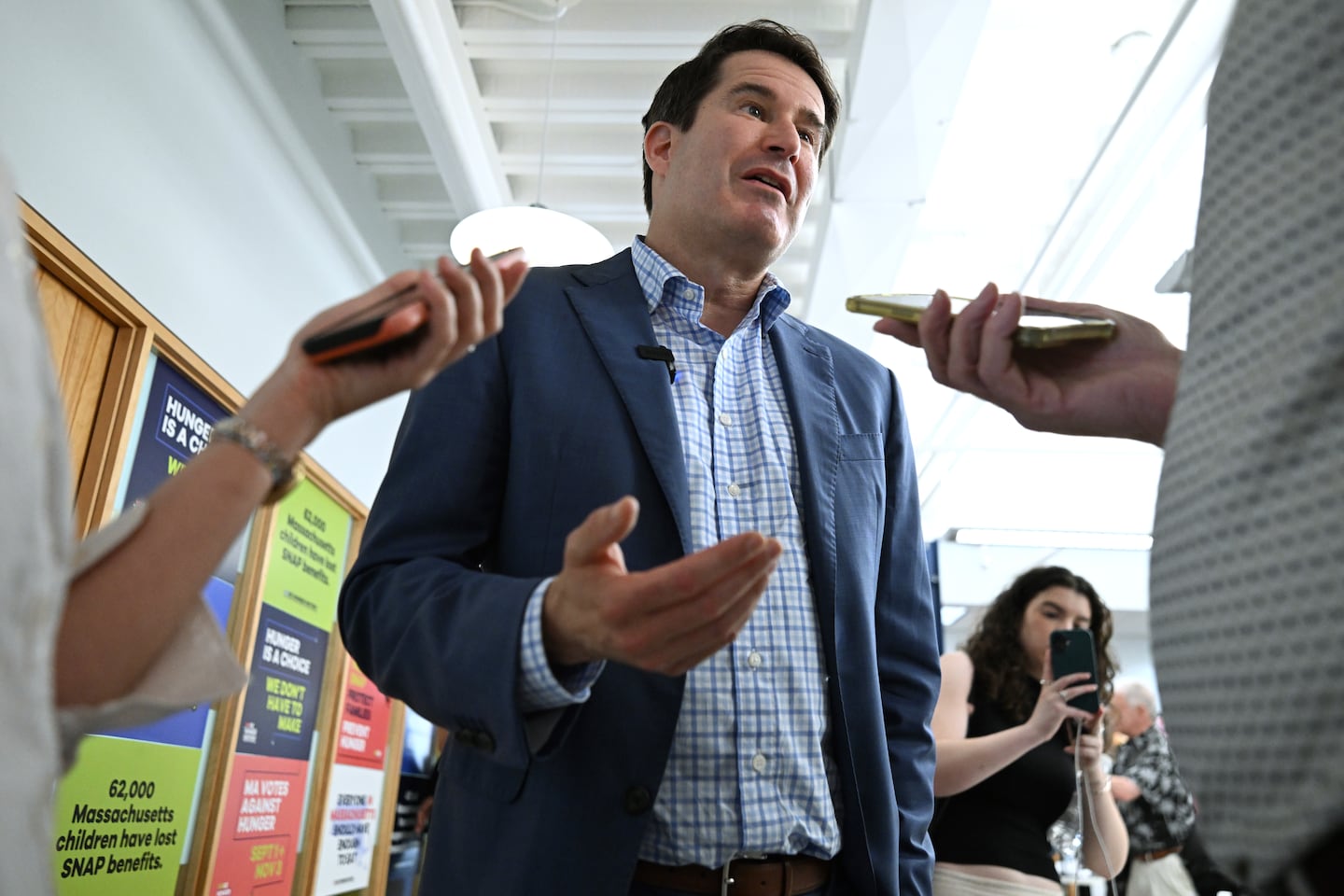
At an unrelated event in Boston on Wednesday, Moulton needled Markey, saying he “promised” Medicare for All when he was last elected in 2020
“We need an approach that would actually work,” Moulton said. “If you have a health care plan that you really like … you shouldn’t be forced off of that program.”
In a recent poll of likely 2026 midterm voters by health care research nonprofit KFF, 60 percent of Democratic voters said it is “extremely important” that candidates talk about healthcare costs. Nearly six in 10 said they were worried about affording health insurance or out-of-pocket costs for medical visits and prescription drugs
Ashley Kirzinger, the director of survey methodology at KFF, said the split between those who support transitioning to single-payer health care, à la Medicare for All, and those who want to reform the existing Affordable Care Act falls between “more progressive and more moderate wings.”
She added, however, that many people don’t fully understand the complex structures of different health insurance systems. “Messaging can have a lot of impact on public opinion,” she said
Plus, Massachusetts has already expanded health care coverage, and a far higher share of its population under 65 is insured — nearly 98 percent — than in the rest of the country. Ten percent nationwide reported being uninsured in a federal survey. That means voters here may care more about health care costs rather than access, Kirzinger said
To that end, some voters in well-insured Massachusetts may feel like Medicare for All is a solution to “other states’ problems,” said Leemore Dafny, an economist and public policy professor at Harvard Business School and the John F. Kennedy School of Government
“The bigger concern for voters in our state is affordability, and are we going to do something about that?” said Dafny, who oversaw health care at the Federal Trade Commission and advised the Congressional Budget Office for over a decade. “If people are voting with their local hats in mind, they are more concerned with how expensive it is to have the health care we have in Massachusetts.”
Mark Peterson, a political science professor at UCLA and senior fellow at the university’s Center for Health Policy Research, said in his experience polling voters, “very few people like the current version” of health care in the United States
He said the idea of expanding health insurance has come up in campaigns “more than I have ever seen before.”
“There is a basis for politicians to come forward and say, ‘We know this is what the public wants,’” Peterson said. “What we don’t agree on is how exactly to do it.”
Samantha J. Gross can be reached at samantha.gross@globe.com. Follow her @samanthajgross
