


Abstract
Background
Ambient volatile organic compounds (VOCs) exist as complex mixtures. Their short-term health associations in children remain poorly characterized
Objective
To evaluate short-term associations between ambient VOC mixtures and pediatric atopic dermatitis (AD) and asthma in Seoul, Korea, and to estimate the ecological attributable burden
Methods
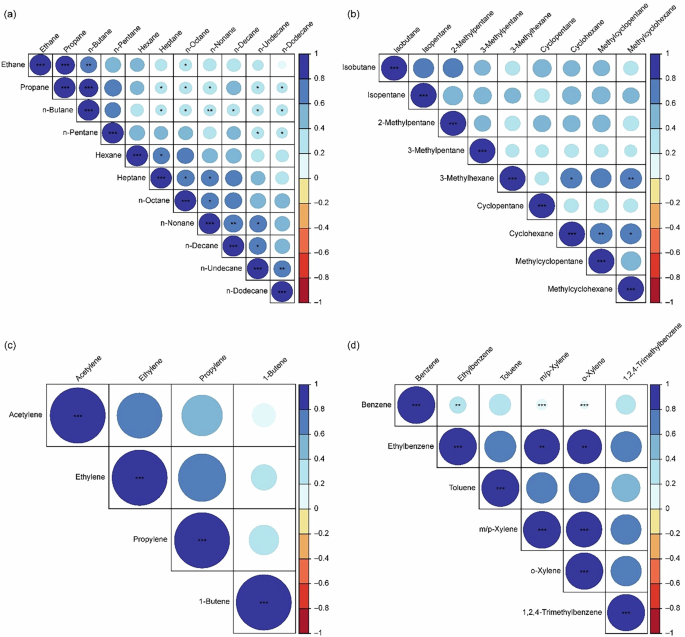
Daily counts of outpatient visits and hospital admissions among individuals aged <19 years in Seoul (2015–2019) were linked with citywide VOC concentrations grouped as n-alkanes (G1), branched/cyclo-alkanes (G2), alkenes/alkynes (G3), and aromatics (G4). Mixture associations were estimated using Weighted Quantile Sum regression (WQSR) and Bayesian Kernel Machine Regression. Population Attributable Fractions (PAFs) were calculated from WQSR-based relative risks under a hypothetical 25th-percentile lower-exposure scenario.
Results
Ambient VOC mixtures were associated with higher daily counts of outpatient visits and hospital admissions for pediatric AD and asthma. Toluene (G4) showed the highest WQSR weight (0.88 for AD; 0.75 for asthma), while hexane (G1) and cyclohexane (G2) also showed relatively high weights (AD: 0.67 and 0.38; asthma: 0.55 and 0.25, respectively). Generalized additive models showed broadly consistent single-compound associations. Estimated ecological PAFs under the 25th-percentile scenario were 7.0% for AD (G4) and 4.7% (G1), 4.0% (G2), and 6.5% (G4) for asthma.
Significance
Short-term exposure to ambient VOC mixtures, particularly aromatics, is associated with an increased pediatric burden of AD and asthma in Seoul. Toluene was identified as a key contributor, whereas the roles of other VOCs require further investigation because of potential shared
Impact
This study quantifies the short-term effects of ambient VOC mixtures on pediatric AD and asthma using advanced mixture models. The findings suggest that aromatic VOCs, particularly toluene, were consistently associated with the observed health outcomes. VOC mixture exposure may be associated with a measurable ecological burden of pediatric AD and asthma at the population level
This is a preview of subscription content, access
Access options
Access through your institution
- Purchase on SpringerLink
- Instant access to the full article PDF.
39,95 €
Prices may be subject to local taxes which are calculated during checkout
Data availability
All data generated or analyzed during this study are included in this published article
References
Pinart M, Benet M, Annesi-Maesano I, von Berg A, Berdel D, Carlsen KCL, et al. Comorbidity of eczema, rhinitis, and asthma in IgE-sensitised and non-IgE-sensitised children in MeDALL: a population-based cohort study. Lancet Respir Med. 2014;2:131–40
Jin L, Ge J, Cheng Y, Deng D, Wan P. Worldwide prevalence of atopic dermatitis in children between 2000 and 2021: a systematic analysis. Ann Allergy Asthma Immunol. 2025;134:603–9
Kim TH, Kim H, Oh J, Kim S, Miligkos M, Yon DK, et al. Global burden of asthma among children and adolescents with projections to 2050: a comprehensive review and forecasted modeling study. Clin Exp Pediatr. 2025;68:329–43
Olsson M, Bajpai R, Wee LWY, Yew YW, Koh MJA, Thng S, et al. The cost of childhood atopic dermatitis in a multi-ethnic Asian population: a cost-of-illness study. Br J Dermatol. 2020;182:1245–52
Yaghoubi M, Adibi A, Safari A, FitzGerald JM, Sadatsafavi M. The projected economic and health burden of uncontrolled asthma in the United States. J Allergy Clin Immunol. 2019;143:165–74
GBD 2021 Asthma and Allergic Diseases CollaboratorsGlobal, regional, and national burden of asthma and atopic dermatitis, 1990-2021, and projections to 2050: a systematic analysis of the global burden of disease study 2021. Lancet Respir Med. 2025;13:425–46
Jung CC, Su HJ, Liang HH. Association between indoor air pollutant exposure and blood pressure and heart rate in subjects according to body mass index. Sci Total Environ. 2016;539:271–6
Kim JH, Moon JY, Park EY, Lee KH, Hong YC. Changes in oxidative stress biomarker and gene expression levels in workers exposed to volatile organic compounds. Ind Health. 2011;49:8–14
Lin N, Rosemberg MA, Li W, Meza-Wilson E, Godwin C, Batterman S. Occupational exposure and health risks of volatile organic compounds of hotel housekeepers: field measurements of exposure and health risks. Indoor Air. 2021;31:26–39
Rautiainen P, Hyttinen M, Ruokolainen J, Saarinen P, Timonen J, Pasanen P. Indoor air-related symptoms and volatile organic compounds in materials and air in the hospital environment. Int J Environ Health Res. 2019;29:479–88
Gilbey SE, Reid CM, Huxley RR, Soares MJ, Zhao Y, Rumchev KB. The association between exposure to residential indoor volatile organic compounds and measures of central arterial stiffness in healthy middle-aged men and women. Int J Environ Res Public Health. 2022;19:981
Madureira J, Paciência I, Rufo J, Ramos E, Barros H, Teixeira JP, et al. Indoor air quality in schools and its relationship with children’s respiratory symptoms. Atmos Environ. 2015;118:145–56
Tang KT, Chen YS, Lee MF, Chen TT, Lai CC, Lin CC, et al. Exposure to volatile organic compounds may contribute to atopic dermatitis in adults. Biomedicines. 2024;12:1419
Wang Y, Meng Z, Wei S, Li X, Su Z, Jiang Y, et al. Urinary volatile organic compound metabolites and COPD among US adults: mixture, interaction and mediation analysis. Environ Health. 2024;23:45
Xiong Y, Liu X, Li T. The urinary metabolites of volatile organic compounds and asthma in young children: NHANES 2011–8. Heliyon. 2024;10:e24199
Wang X, Wang L, Zhao X, Zhang C, Wang X, Ma T, et al. Association between exposure to volatile organic compounds and allergic symptoms: Emphasis on the cocktail effect and potential mechanisms of toxicity. Ecotoxicol Environ Saf. 2025;293:118002
Bard D, Kihal W, Schillinger C, Fermanian C, Ségala C, Glorion S, et al. Traffic-related air pollution and the onset of myocardial infarction: disclosing benzene as a trigger? a small-area case-crossover study. PLOS One. 2014;9:e100307
Hagen JA, Nafstad P, Skrondal A, Bjørkly A, Magnus P. Associations between outdoor air pollutants and hospitalization for respiratory diseases. Epidemiology. 2000;11:136–40
Shin HH, Jones P, Brook R, Bard R, Oliver K, Williams R. Associations between personal exposures to VOCs and alterations in cardiovascular physiology: Detroit Exposure and Aerosol Research Study (DEARS). Atmos Environ. 2015;104:246–55
Tseng HW. Positive effect of exposure to ambient air volatile organic compounds on clinic visits for atopic dermatitis. Asian Pac J Allergy Immunol. 2025;43:451–63
Xiao S, Zhang Y, Zhang Z, Song W, Pei C, Chen D, et al. The contributions of non-methane hydrocarbon emissions by different fuel types of on-road vehicles based on tests in a heavily trafficked urban tunnel. Sci Total Environ. 2023;873:162432
Xiong Y, Huang Y, Du K. Health risk-orientedht Canadian cities and implications for prioritizing mitigation strategies. Environ Sci Technol. 2022;56:12077–85
Zhao S, Li R, Wang S, Liu Y, Lu W, Zhao Y. Emission of volatile organic compounds from landfill working surfaces: formation potential of ozone and secondary organic aerosols. Sci Total Environ. 2023;886:163954
Batterman S, Su FC, Li S, Mukherjee B, Jia C, Health Review Committee HEI. Personal exposure to mixtures of volatile organic compounds: modeling and further analysis of the RIOPA data. Res Rep Health Eff Inst. 2014;181:3–63
Wei C, Cao L, Zhou Y, Zhang W, Zhang P, Wang M, et al. Multiple statistical models reveal that specific volatile organic compounds affect sex hormones in American adult males: NHANES 2013–6. Front Endocrinol. 2023;13:1076664
Zhang M, Chen C, Sun Y, Wang Y, Du P, Ma R, et al. Association between ambient volatile organic compounds exposome and emergency hospital admissions for cardiovascular disease. Environ Sci Technol. 2024;58:5695–704
Kebalepile MM, Dzikiti LN, Voyi K. Using diverse data-limited setting. Atmosphere. 2024;15:303
Wei R, Wang J, Su M, Jia E, Chen S, Chen T, et al. Missing value imputation approach for mass spectrometry-based metabolomics data. Sci Rep. 2018;8:663
Fang X, Li R, Kan H, Bottai M, Fang F, Cao Y. Bayesian model averaging method for evaluating associations between air pollution and respiratory mortality: a time-series study. BMJ Open. 2016;6:e011487
Weng X, Tan Y, Fei Q, Yao H, Fu Y, Wu X, et al. Association between mixed exposure of phthalates and cognitive function among the U.S. elderly from NHANES 2011–4: three statistical models. Sci Total Environ. 2022;828:154362
Ferguson J, O’Connell M. Estimating and displaying population attributable fractions using the R package: graphPAF. Eur J Epidemiol. 2024;39:715–42
Gasparrini A, Guo Y, Hashizume M, Lavigne E, Zanobetti A, Schwartz J, et al. Mortality risk attributable to high and low ambient temperature: a multicountry observational study. Lancet. 2015;386:369–75
Wu Z, Chen X, Li G, Tian L, Wang Z, Xiong X, et al. Attributable risk and economic cost of hospital admissions for mental disorders due to PM2.5 in Beijing. Sci Total Environ. 2020;718:137274
Zhao Y, Wang S, Lang L, Huang C, Ma W, Lin H. Ambient fine and coarse particulate matter pollution and respiratory morbidity in Dongguan, China. Environ Pollut. 2017;222:126–31
Tseng HW, Lu LY. Short-term impact of exposure to ambient air volatile organic compounds on daily clinic visits for urticaria in Kaohsiung, Taiwan. Asian Pac J Allergy Immunol. 2025;43:521–30
Maître L, Guimbaud JB, Warembourg C, Güil-Oumrait N, Petrone PM, Chadeau-Hyam M, et al. State-of-the-art methods for exposure-health studies: results from the exposome data challenge event. Environ Int. 2022;168:107422
Zhu G, Wen Y, Cao K, He S, Wang T. A review of common statistical methods for dealing with multiple pollutant mixtures and multiple exposures. Front Public Health. 2024;12:1377685
Nurmatov UB, Tagiyeva N, Semple S, Devereux G, Sheik A. Volatile organic compounds and risk of asthma and allergy: a systematic review. Eur Respir Rev. 2015;24:92–101
Hsiao YY, Chen YH, Hung WT, Tang KT. The relationship between outdoor air pollutants and atopic dermatitis of adults: a systematic review and meta-analysis. Asian Pac J Allergy Immunol. 2022;40:295–307
CAS
PubMed
Google ScholarFujimaki H, Yamamoto S, Shwe TT, Hojo R, Sato F, Kunugita N, et al. Effect of long-term exposure to low-level toluene on airway inflammatory response in mice. Toxicol Lett. 2007;168:132–9
Shwe TT, Yamamoto S, Nakajima D, Furuyama A, Fukushima A, Ahmed S, et al. Modulation of neurologically related allergic reactions in mice exposed to low-level toluene. Toxicol Appl Pharmacol. 2007;222:17–24
Bronte-Moreno O, González-Barcala FJ, Muñoz-Gall X, Pueyo-Bastida A, Ramos-González J, et al. Impact of air pollution on asthma: a scoping review. Open Respir Arch. 2023;5:100229
Lai A, Owens K, Patel S, Nicholas M. The impact of air pollution on atopic dermatitis. Curr Allergy Asthma Rep. 2023;23:435–42
Kim JN, Chung SY, Oh IH, Kim JH, Jung E, Ahn Y. Estimation of burden of disease due to climate change in the Republic of Korea. Public Health Wkly Rep. 2024;17:1119–42
Feng X, Qiu F, Zheng L, Zhang Y, Wang Y, Wang M, et al. Exposure to volatile organic compounds and mortality in US adults: a population-based prospective cohort study. Sci Total Environ. 2024;298:172512
Clark SN, Lam HCY, Goode EJ, Marczylo EL, Exley KS, Dimitroulopoulou S. The burden of respiratory disease from formaldehyde, damp and mould in English housing. Environments. 2023;10:136
Acknowledgements
The authors thank the co-authors for their contributions and feedback on early versions of the analyses and the manuscript
Funding
This work was supported by the National Research Foundation of Korea (NRF) grant funded by the Korean Ministry of Science and ICT and the Ministry of Education [grant number 2019M3E7A1035155] and by the National Institute of Health (NIH) research project [grant number 2024-ER0908-01]
Author information
Authors and Affiliations
Institute for Environmental Research, College of Medicine, Yonsei University, Seoul, Republic of Korea
Minsun Lee, Kyungjun Jeong, Yongjin Lee & Changsoo Kim
Department of Preventive Medicine, Yonsei University College of Medicine, Seoul, Republic of Korea
Minsun Lee, Kyungjun Jeong, Kyungnam Kim, Jaelim Cho & Changsoo Kim
Department of Precision Medicine, Wonju College of Medicine, Yonsei University, Wonju, Republic of Korea
Dae Ryong Kang
Department of Pediatrics, Yonsei University College of Medicine, Seoul, Republic of Korea
Myung Hyun Sohn
Authors
- Minsun LeeView author publications
Search author on:PubMed Google Scholar
- Kyungjun JeongView author publications
Search author on:PubMed Google Scholar
- Kyungnam KimView author publications
Search author on:PubMed Google Scholar
- Jaelim ChoView author publications
Search author on:PubMed Google Scholar
- Dae Ryong KangView author publications
Search author on:PubMed Google Scholar
- Myung Hyun SohnView author publications
Search author on:PubMed Google Scholar
- Yongjin LeeView author publications
Search author on:PubMed Google Scholar
- Changsoo KimView author publications
Search author on:PubMed Google Scholar
Contributions
Minsun Lee: Writing—original draft. Kyungjun Jeong: Investigation. Kyoung-Nam Kim: Methodology. Jaelim Cho: Conceptualization. Dae Ryong Kang: Formal analysis. Myung Hyun Sohn: Methodology. Yongjin Lee: Data curation. Changsoo Kim: Writing—review and editing
Ethics declarations
Competing interests
The authors declare no competing interests
Ethics approval
The study was approved by the Institutional Review Board (IRB) of the Yonsei University Health System (IRB number: 4-2024-1027). The requirement for informed consent was waived owing to the retrospective nature of the study. All methods were performed in accordance with the relevant guidelines and regulations
Additional information
Publisher’s note Springer Nature remains neutral with regard to jurisdictional claims in published maps and institutional affiliations
Supplementary information
Supplementary_materials_final (download DOCX )
Rights and permissions
Springer Nature or its licensor (e.g. a society or other partner) holds exclusive rights to this article under a publishing agreement with the author(s) or other rightsholder(s); author self-archiving of the accepted manuscript version of this article is solely governed by the terms of such publishing agreement and applicable law
About this article
Cite this article
Lee, M., Jeong, K., Kim, K. et al. Short-term effects and attributable burden of ambient volatile organic compound mixtures on pediatric atopic dermatitis and asthma in Seoul.
J Expo Sci Environ Epidemiol (2026). https://doi.org/10.1038/s41370-026-00965-5
Received:20 February 2026
Revised:05 August 2026
Accepted:06 August 2026
Published:20 August 2026
Version of record:20 August 2026
DOI
:https://doi.org/10.1038/s41370-026-00965-5
