


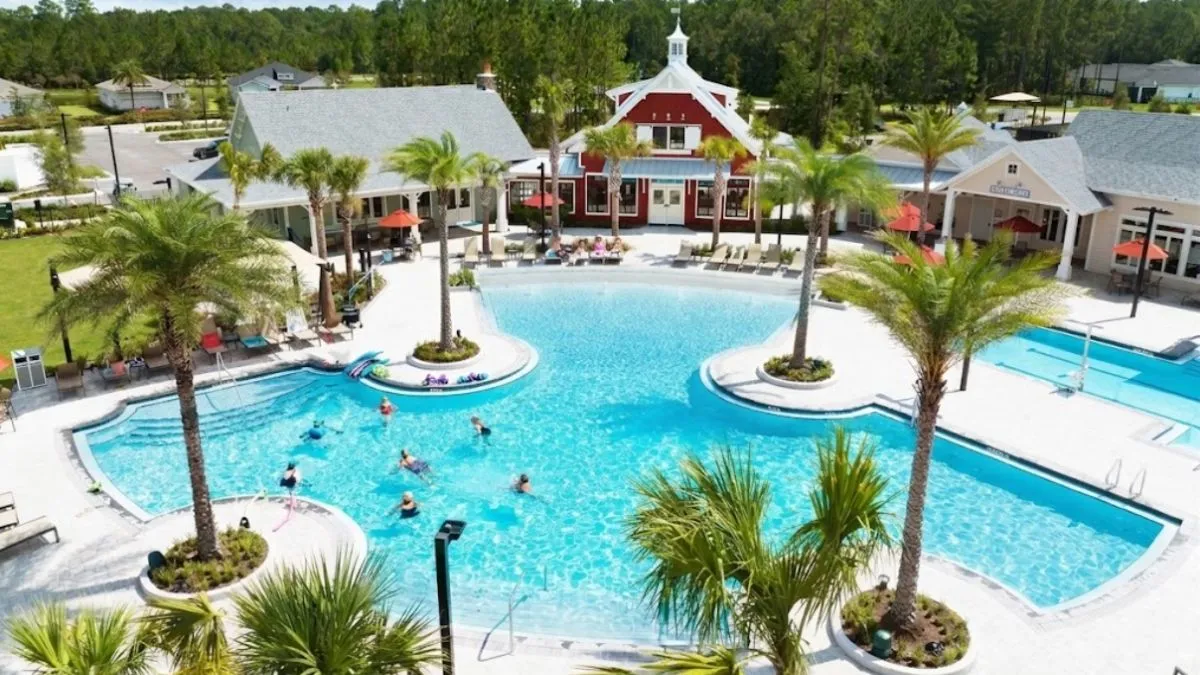
This week, Dream Finders Homes announced that its Reverie active adult brand will now include non-age-restricted lifestyle communities, a move to capture demand from empty nesters seeking a resort-style lifestyle without the typical age restrictions.
David Smith, Vice President of Active Adult at Dream Finders Homes, told HousingWire TBD that the core active adult offering will remain fully intact. The brand extension, known as Reverie Resort Lifestyle, gives Dream Finders a way to appeal to a broader group of buyers, particularly active empty nesters in their 50s and early 60s seeking a lifestyle-oriented community that isn’t limited by age constraints
The move by Dream Finders Homes, the 12th-ranked homebuilder in HousingWire’s Homebuilder Rankings and soon to be a top-10 builder following the acquisition of Beazer Homes, aligns with a broader industry shift.
Last year, PulteGroup expanded its popular Del Webb active adult brand with the non-age-restricted Del Webb Explore brand, which primarily targets buyers between 45-60 years of age. Taylor Morrison’s Esplanade brand also includes age-restricted and non-age-restricted communities, as does the Lennar Lifestyle brand.
Reverie Resort Lifestyle will allow Dream Finders to appeal to Gen X buyers who are still very active, often still working and uninterested in moving into an age-restricted community, but still crave the amenities, community and connection of a resort lifestyle. And, with homebuilder margins under pressure, capturing additional demand from resilient active adult buyers can boost overall profitability.
“We’re still very new with the Reverie brand, but we weren’t going to miss this opportunity to identify an underserved consumer in the market,” Smith said.
The Reverie brand’s evolution
Reverie was created in 2018, when Smith joined Dream Finders to build an active-adult division. At the time, Dream Finders had no track record of serving the 55-plus market. The name Reverie, coined to convey pleasant dream-like thoughts, aligns with the builder’s broader branding.
According to Smith, Dream Finders has observed a growing group of active, empty-nest buyers in their 50s and early 60s who are still working and not ready for a traditional age-restricted community. However, they want to downsize and live in a resort-style lifestyle community
“The average age in our active adults is closer to 64, maybe even 65 years of age, which is the fastest growing segment of the market. And we’re not ignoring that, but the lifestyle component just allowed us to open the net up a little bit wider,” Smith explained.
Amenities geared towards lifestyle and connection
Reverie Resort Lifestyle will offer floor plans and amenities that are very similar to traditional Reverie communities
Reverie offers a variety of amenities designed to create a “country-club feel.” Typical amenities include a gym, a resort-style pool with cabanas and live music and outdoor social spaces. Instead of a full-service restaurant, many Reverie communities feature food truck courts with seating, grassy areas and utility hookups so that rotating vendors can serve food and drinks by the pool.
To foster community and connection, clubhouses are programmed with various classes and events, as well as amenities such as golf simulators, billiards rooms, meeting spaces and fitness studios. Pickleball courts, unsurprisingly, have become a popular amenity.
“The number one amenity all the time is walking trails, so if you have a very walkable community and access to trails and sidewalks and things like that, that is a huge amenity,” Smith said, pointing to bike trails as another key amenity.
That is a big reason the first Reverie Resort Lifestyle community will open in Parker, CO, near an extensive network of biking and hiking trails.
“We said this would be an ideal first place for us in a market where there is an underserved consumer segment…that doesn’t really have a lot of options. But does it need to be age-restricted? We said no, it doesn’t. Maybe this is going to be more of the 50 to 60 crowd,” Smith said
Dream Finders typically likes to place Reverie communities within larger master-planned communities because MPCs allow active adult and lifestyle buyers to stay connected to kids and grandkids while still offering distinct, amenity-rich amenities.
“If the market tells us it should be 55-plus age-restricted, we’re going to do age-restricted, because…that’s where the buyer pool is the deepest. Sometimes it’s a little of both, and that’s what the resort lifestyle gives us,” Smith added.
Tapping into a resilient buyer segment
Active adult buyers are considered among the more resilient buyer segments, amid a market defined by elevated mortgage rates and affordability constraints. Many active adult buyers have built significant wealth and home equity, allowing them to pay cash or make large down payments.
Gen X, those born between 1965 and 1980 and the targeted buyer pool for the Reverie Resort Lifestyle brand, owned $14.14 trillion in home equity as of last year, according to data from LendingTree.
Many bought their first home when rates were north of 10%, so a 6.5% rate doesn’t necessarily deter them. And these buyers are also at a point in life where they don’t want to delay their next steps, regardless of what the broader macroeconomic conditions are.
“I would say all segments of the market have been impacted in some way. You can’t really point to one and go, ‘Oh, well, that one didn’t get affected.’ However, I would say active adult has seen more resilience,” Smith said.
Dream Finders doesn’t report specified financial results for its Reverie brand. However, some other public homebuilders have indicated that their active adult and lifestyle communities generate stronger margins than other buyer segments, since those buyers typically require fewer incentives.
For example, Taylor Morrison CEO Sheryl Palmer, on an earnings call in February, said that the builder’s Esplanade brand “drives superior home prices and gross margins that consistently exceed the balance of our business”, without disclosing specific margin differentials.Earlier this year, PulteGroupalso announced on an earnings call plans to shift more of its starts to its Del Webb communities. Not long ago, Del Webb accounted for about 20% of closings, but PulteGroup expects that share to soon rise to 25%, yet another indication of the segment’s resilience.
