


Every time your body fights a virus, cells are making split-second decisions that determine whether an infection spreads or stops. Some sacrifice themselves to protect the tissue around them. Others are hijacked before they get the chance. A Virginia Tech virologist just won a rare federal award to find out what tips the balance
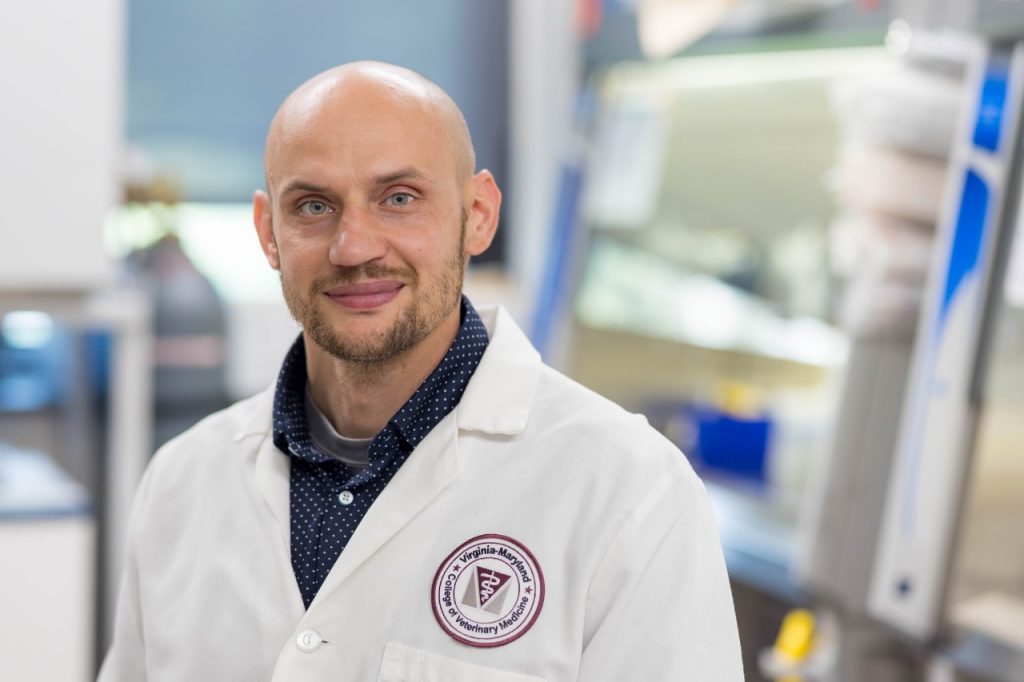
James Weger-Lucarelli, associate professor in the Department of Biomedical Sciences and Pathobiology at the Virginia-Maryland College of Veterinary Medicine, received a five-year, $2.01 million award from the National Institute of General Medical Sciences in July to investigate how infected cells live and die, and what they signal to their neighbors when they do. The grant could eventually point toward better antiviral drugs and more effective virus-based cancer treatments
The award is an R35 MIRA, a mechanism that funds an investigator’s entire research program rather than a single hypothesis. NIGMS awards these to scientists it considers worth backing long-term, giving them room to follow unexpected findings wherever they lead
“An R01 is more like you’re saying exactly what you’re going to do, almost experiment by experiment,” Weger-Lucarelli said. “This is more conceptual. You have a little more freedom to be exploratory, more innovative.”
When a virus infects a cell, the cell can trigger its own shutdown to stop the virus from replicating and escaping. Viruses have evolved to interfere with that decision. And when a cell does die, it can release chemical signals to surrounding cells, a biological warning broadcast that either rallies the immune response or, if a virus manages to redirect it, accelerates the spread
“The cell is trying to stop the virus, and the virus is trying to stop the host,” Weger-Lucarelli said. “It’s kind of like a tennis match between the two.”
A key part of the work involves moving that research out of flat laboratory dishes and into three-dimensional tissue models, where multiple cell types can interact the way they do in an actual body. The difference turns out to matter. In Weger-Lucarelli’s lab, viruses kill cells in standard 2D culture within two days. In 3D models, the same cells survive a week or more under identical conditions
“If we were doing it in 2D, we would have missed that entirely,” he said
The work connects to an ongoing collaboration with Samy Lamouille at the Fralin Biomedical Research Institute at VTC on oncolytic viruses, engineered to seek and kill tumor cells, as a potential treatment for glioblastoma. Dogs are among the few animals that develop glioblastoma naturally, giving the lab a clinical testing pathway that would be harder to access outside a veterinary college
“There’s a huge advantage of being at a vet school,” Weger-Lucarelli said, “especially with brain cancer. Dogs have naturally ocurring brain cancer that develops very similar to humans. Much easier than going into human clinical trials.”
Weger-Lucarelli is recruiting a postdoctoral researcher and plans to work at the bench alongside whoever joins. The five-year funding window lets a lab recruit and retain graduate students and postdocs without the uncertainty of annual grant cycles
“When you do an experiment and you get a result, a lot of times it’s something that no one’s ever done before,” he said. “It might not be a groundbreaking discovery every time. But it’s exciting to have an idea and then to be able to make it come to fruition.”
Contact:
540-231-9005
