


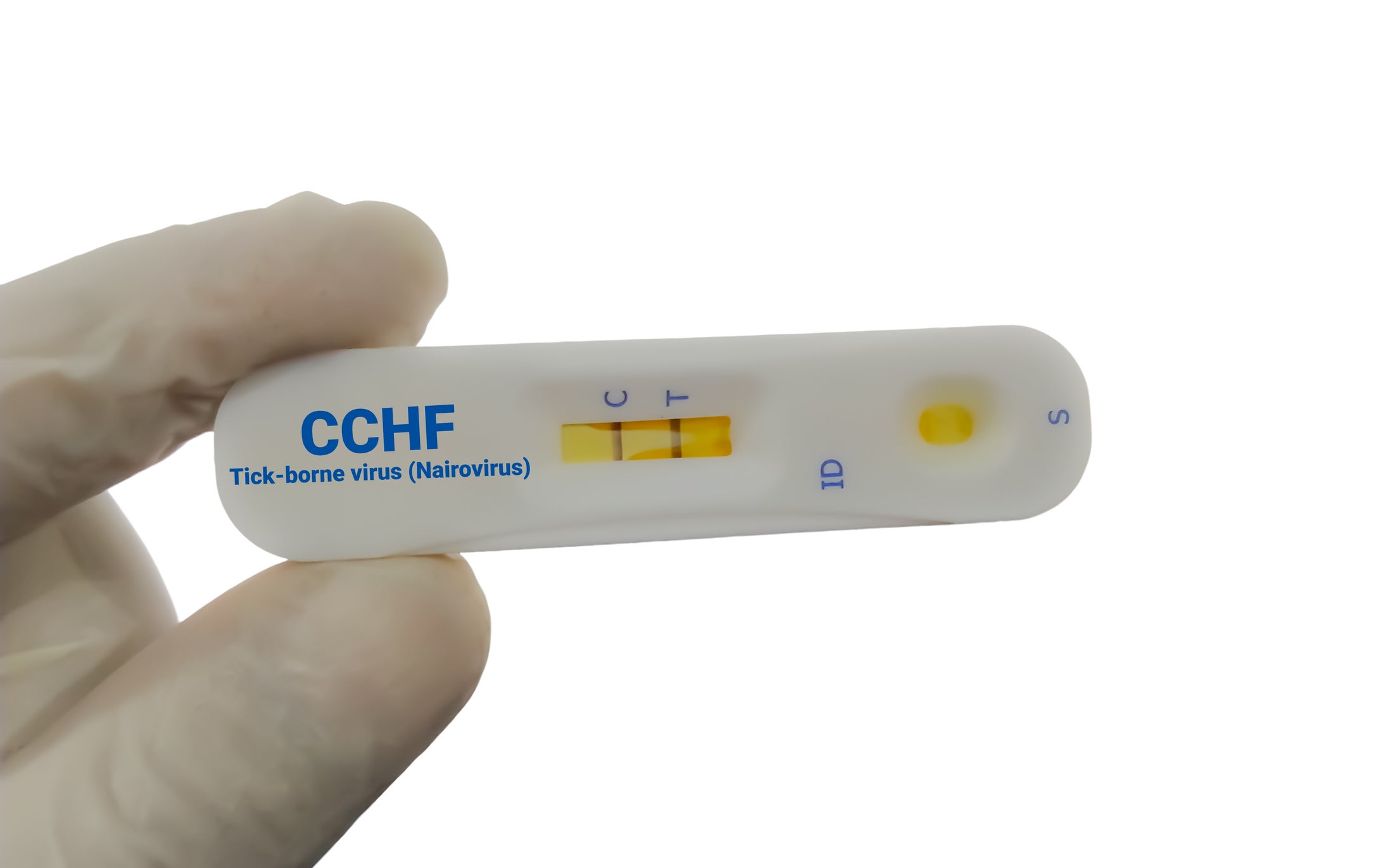
Crimean-Congo hemorrhagic fever virus (CCHFV) is a dangerous virus spread by ticks. It transmits Crimean-Congo hemorrhagic fever (CCHF), a serious disease that has been spreading into new regions in the world. Capable of killing up to 40% of people infected, it currently has no widely approved, highly effective treatments or vaccines.
Scientists led by Scott Pegan, a biomedical scientist at the University of California, Riverside, have now identified multiple targets for antibodies — proteins that protect us when an unwanted substance enters our body — that could one day help treat CCHF
The researchers focused on a specific part of CCHFV called the nucleocapsid protein (NP), an internal viral protein that has traditionally received little attention as a therapeutic target. While previously used to detect the virus, the scientists realized that targeting this protein with antibodies can offer protection against CCHFV infection.
The researchers identified four areas on the NP protein that antibodies can attach to. The NP protein is made of a “head” and a “stalk” region. The study, published today in Nature Communications, found that antibodies can protect against the virus regardless of whether they attach to the head or the stalk
In the mouse study, an antibody known as 9D5 — the most powerful protective antibody — shielded the animals from lethal infection and showed potential to protect against different strains of the virus
“This opens up new frontiers for what an antibody therapeutic for CCHF might look like,” said Pegan, a professor of biomedical sciences in the UCR School of Medicine
Pegan and his colleagues used X-ray imaging to see exactly how 9D5 binds to the head region of the virus’s NP. Because the spot where antibody 9D5 attaches is almost identical across different strains of the virus, it further highlights that 9D5, or antibodies like it, can protect against multiple versions of CCHFV
Pegan explained that CCHFV is primarily spread by Hyalomma ticks and can also spread from person to person, particularly in healthcare settings. Infection can begin with nonspecific symptoms but often progresses to severe hemorrhagic disease and organ damage.
CCHFV is present in Eastern and Southern Europe, northwestern China, central Asia, Africa, the Middle East, and the Indian subcontinent. The threat is also evolving, Pegan said. As environmental conditions change, the ticks that carry CCHFV have expanded into new areas, bringing the virus closer to densely populated regions
“When I started working on CCHF, it wasn’t considered as high a priority,” Pegan said. “But in recent years, the environments where these ticks live have been changing. As those ticks spread into new regions, the disease can spread with them.”
Mobilizing the immune system
The research builds on earlier work by Pegan and his team showing that antibodies directed at the virus’s NP can play an important role in protection. The 2024 study found that 9D5 protected mice from lethal CCHFV infection and recognized NPs from several virus strains.
The new finding is significant because the NP is not found on the outside of the virus, where antibodies typically target viral proteins. But the research indicates that the protein can appear on the surface of infected cells, creating an opportunity for antibodies to recognize and target it
Rather than directly neutralizing the virus, these antibodies appear to work through a different immune mechanism. Recent research has pointed to a pathway that uses an intercellular protein, TRIM21, to provide a protective response
“What’s interesting is that these are non-neutralizing antibodies,” Pegan said. “They’re not working in the same way as antibodies that bind to a viral surface protein and prevent the virus from entering a cell. Instead, they help mobilize the immune system to mount an effective response. It appears these NP-targeting antibodies may bind to an NP on the surface of the cell or a free-floating NP and are then taken inside the cell to interact with TRIM21. This enables the cells to present fragments of the NP to other immune cells that then can clear the infection.”
The researchers also discovered that 9D5 is not the only potentially protective antibody targeting the NP.
“We’ve shown that there are other sites that may have even greater potential for protective therapeutics,” Pegan said. “This discovery could be particularly important for developing antibody cocktails, in which multiple antibodies target different parts of the virus or infected cells.”
The next step for the team is to use the newly identified protective sites to find additional therapeutic antibodies, including those that offer strong protection against multiple CCHFV strains
“We need to find out what makes an antibody protective, what qualities we should look for in an antibody that’s going to provide good protection and broad-spectrum activity,” Pegan said
The current 9D5 antibody is a mouse antibody, meaning it is not itself expected to become a human treatment. Instead, the researchers hope the lessons learned from 9D5 will help them identify human or humanized antibodies suitable for further development
“We’ve not only discovered where protective antibodies can bind,” Pegan said. “We’ve also discovered there are multiple opportunities for antibodies to bind to this antigen and provide protection. The result is a clear blueprint to design new antibody drugs and combination treatments that can broadly protect against CCHFV.”
Pegan estimates that an antibody treatment could potentially reach patients in about five years, depending on the success of preclinical research and clinical trials
The approach, he said, could also have implications beyond CCHFV. Similar findings have emerged in research on other viruses, such as Lassa virus, suggesting that NPs may represent a broader class of therapeutic targets
“For decades, people have identified antibodies that bind to NPs, but most of that was for diagnostic purposes,” Pegan said. “It wasn’t really viewed as arrect.”
The research was funded by the National Institute of Allergy and Infectious Diseases of the National Institutes of Health as well as the Military Infectious Disease Research Program
Pegan was joined in the research by Joseph Golden, Aura Garrison, and colleagues at the U.S. Army Medical Research Institute of Infectious Diseases; Mohammad Sajadi at the University of Maryland School of Medicine; and Éric Bergeron of the Division of the Viral Special Pathogens Branch, Centers for Disease Control and Prevention
The title of the paper is “Structural and mechanistic insights into protective non-neutralizing antibodies targeting Crimean-Congo hemorrhagic fever virus nucleocapsid protein.”
Header image credit: Md Saiful Islam Khan/iStock/ Plus
Share this Article
