


Abstract
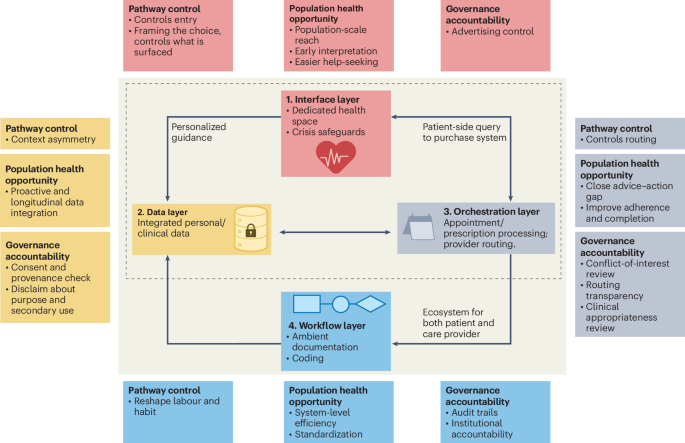
Health artificial intelligence (AI) built by consumer technology companies is shifting from an information tool towards pathway control. Major technology platforms are beginning to connect health-oriented large language model systems to medical records, appointment booking, pharmacy fulfilment, payment systems and clinical workflows. This shift matters especially in resource-limited settings, where health outcomes are often lost not only because traditional healthcare pathways are unavailable, but also because patients fail to complete the sequence of steps required to obtain care. This Perspective argues that the public health importance of consumer health AI now lies less in model performance alone than in platform integration depth: who controls the interface through which symptoms are interpreted, care is routed, payment is made and treatment is completed. We examine four emerging trajectories through case studies of OpenAI’s ChatGPT Health, Amazon’s Health AI, Ant Group’s Afu and Anthropic’s Claude for Healthcare. Analysis can be summarized into a pathway-level accountability framework that links integration depth to evaluation, procurement, routing transparency, data governance and exit options. Three population-level consequences that warrant greater attention were identified: changes in care completion, concentration of triage power, and new asymmetries in data and operational control. We suggest that existing governance and regulatory frameworks should be applied not only to models, but also to the care pathways and platform incentives these systems increasingly shape.
This is a preview of subscription content, access
Access options
Access through your institution
- Purchase on SpringerLink
- Instant access to the full article PDF.
39,95 €
Prices may be subject to local taxes which are calculated during checkout
Subjects
- Health care
- Health services
- Public health
References
Consumer-facing AI can improve public health—but more evidence is needed. Nat. Health1, 159 (2026)
Plantin, J. -C., Lagoze, C., Edwards, P. N. & Sandvig, C. Infrastructure studies meet platform studies in the age of Google and Facebook. New Media Soc.20, 293–310 (2018)
OpenAI. Introducing ChatGPT Health. https://openai.com/index/introducing-chatgpt-health/ (2026)
Staff, T. Perplexity health connects medical records and wearables in new AI push. TechRepublichttps://www.techrepublic.com/article/news-perplexity-health-ai/ (2026)
Amazon. Introducing Health AI | Personalized insights, human-powered care. Amazon Health AIhttps://health.amazon.com/health-ai/learn-more
Microsoft. Copilot for Health: your AI Assistant. Microsoft Copilothttps://www.microsoft.com/en-us/microsoft-copilot/for-individuals/do-more-with-ai/ai-for-daily-life/copilot-for-health-your-ai-companion-for-smarter-medical-decisions
Ant Group. Ant Group announces major upgrades to its 15-million-MAU AI health app AQ amid wider push into health sector. https://www.antgroup.com/en/news-media/press-releases/1765779300000 (2025)
South China Morning Post. Ant’s AQ health app tops 100 million users amid holiday surge. https://www.scmp.com/tech/article/3344359/ants-aq-health-app-breaks-through-100-million-users-amid-holiday-surge (2026)
Anthropic. Transform healthcare from insight to action. Healthcare | Claude by Anthropichttps://claude.com/solutions/healthcare
Mandl, K. D. How AI could reshape health care—rise in direct-to-consumer models. JAMA333, 1667–1669 (2025)
Lutes, M. E, & Hughes, R. IV. When the front door is an algorithm: guiding consumer use of AI in health care. Health Affairs Forefronthttps://doi.org/10.1377/forefront.20260302.877526 (2026)
Adler-Milstein, J., Murray, S. G. & Wachter, R. M. The market dynamics for third-party AI tools trying to compete with electronic health record developers. JAMAhttps://doi.org/10.1001/jama.2026.2394 (2026)
DataReportal. Digital 2026: Global Overview Report — Global Digital Insights. https://datareportal.com/reports/digital-2026-global-overview-report (2025)
Hwang, Y. -M., Ng, M. Y., Pillai, M., Sahai, M. P. & Hernandez-Boussard, T. The landscape of AI implementation in US hospitals. Nat. Health1, 99–112 (2026)
Rutunda, S. et al. Large language models for frontline healthcare support in low-re
International Telecommunication Union. Measuring digital development: facts and figures 2025. https://www.itu.int/hub/publication/d-ind-ict_mdd-2025-3/ (2025)
Nimo, C. et al. AfriMed-QA: a pan-african, multi-specialty, medical question-answering benchmark dataset. in Proceedings of the 63rd Annual Meeting of the Association for Computational Linguistics (Volume 1: Long Papers) (eds. Che, W. et al.) 1948–1973 https://doi.org/10.18653/v1/2025.acl-long.96 (Association for Computational Linguistics, 2025)
Ahia, O. et al. Do all languages cost the same? Tokenization in the era of commercial language models. in Proceedings of the 2023 Conference on Empirical Methods in Natural Language Processing (eds. Bouamor, H. et al.) 9904–9923 https://doi.org/10.18653/v1/2023.emnlp-main.614 (Association for Computational Linguistics, 2023)
Designated Health Professional Shortage Areas Statistics. Third Quarter of Fiscal Year 2026 Designated HPSA Quarterly Summary. https://data.hrsa.gov/Default/GenerateHPSAQuarterlyReport/?utm_
Journal of Urgent Care Medicine. One Medical: reimaging primary care around the consumer. https://www.jucm.com/one-medical-reimaging-primary-care-around-consumer/ (2016)
Mathis, W. S. et al. Vulnerability index approach to identify pharmacy deserts and keystone pharmacies. JAMA Netw. Open8, e250715 (2025)
Catalano, G., Khan, M. M. M., Chatzipanagiotou, O. P. & Pawlik, T. Pharmacy accessibility and social vulnerability. JAMA Netw. Open7, e2429755 (2024)
Fernández, E. V., Mcdaniel, J. & Carroll, N. Examination of the link between medication adherence and use of mail-order pharmacies in chronic disease states. J. Manag. Care Spec. Pharm.22, 1247–1259 (2016)
Wang, X., Seyler, B. C., Han, W. & Pan, J. An integrated analysis of spatial access to the three-tier healthcare delivery system in China: a case study of Hainan Island. Int. J. Equity Health20, 60 (2021)
Ye, P. et al. National-scale 1-km maps of hospital travel time and hospital accessibility in China. Sci. Data11, 1130 (2024)
Du, X., Du, Y., Zhang, Y., Zhu, Y. & Yang, Y. Urban and rural disparities in general hospital accessibility within a Chinese metropolis. Sci. Rep.14, 23359 (2024)
Huang, M. et al. Primary care quality and provider disparities in China: a standardized-patient-based study. Lancet Reg. Health West. Pac.50, 101161 (2024)
Xu, J., Powell-Jackson, T. & Mills, A. Effectiveness of primary care gatekeeping: difference-in-differences evaluation of a pilot scheme in China. BMJ Glob. Health5, e002792 (2020)
Huisman, L. et al. A digital mobile health platform increasing efficiency and transparency towards universal health coverage in low- and middle-income countries. Digit. Health8, 20552076221092213 (2022)
Lucyk, K., Tang, K. & Quan, H. Barriers to data quality resulting from the process of coding health information to administrative data: a qualitative study. BMC Health Serv. Res.17, 766 (2017)
Chernew, M. & Mintz, H. Administrative expenses in the US health care system: why so high?. JAMA326, 1679–1680 (2021)
Yan, A. S., Apathy, N. C. & Chen, J. Adoption of health information technologies by area socioeconomic deprivation among US hospitals. JAMA Health Forum6, e253035 (2025)
Adler-Milstein, J. & Jha, A. K. HITECH Act drove large gains in hospital electronic health record adoption. Health Affairs36, 1416–1422 (2017)
Chishtie, J. et al. Use of epic electronic health record system for health care research: scoping review. J. Med. Int. Res.25, e51003 (2023)
Wong, A. et al. External validation of a widely implemented proprietary sepsis prediction model in hospitalized patients. JAMA Intern. Med.181, 1065–1070 (2021)
Capoot, A. Epic Systems is building more than 100 new AI features for doctors and patients. Here’s what’s coming. CNBChttps://www.cnbc.com/2024/08/21/epic-systems-ugm-2024-ai-tools-in-mychart-cosmos-.html (2024)
Everson, J., Nong, P. & Richwine, C. Uptake of generative AI integrated with electronic health records in US hospitals. JAMA Netw. Open8, e2549463 (2025)
Nong, P., Adler-Milstein, J., Apathy, N. C., Holmgren, A. J. & Everson, J. Current use and evaluation of artificial intelligence and predictive models in US hospitals. Health Affairs44, 90–98 (2025)
Arora, R. K. et al. HealthBench: evaluating large language models towards improved human health. Preprint at https://doi.org/10.48550/arXiv.2505.08775 (2025)
Hicks, R. S. et al. HealthBench Professional: evaluating large language models on real clinician chats. Preprint at https://doi.org/10.48550/arXiv.2604.27470 (2026)
OpenAI. Making ChatGPT better for clinicians. https://openai.com/index/making-chatgpt-better-for-clinicians/ (2026)
Bulusu, P. Amazon launches Health AI agent on Amazon website and app with free 24/7 access to virtual care for Prime members. Amazon Newshttps://www.aboutamazon.com/news/retail/amazon-health-ai-agent-one-medical/ (2026)
Businesswire. Ant Group launches major campaign against health misinformation.businesswire.com/news/home/20250818527127/en/Ant-Group-Launches-Major-Campaign-Against-Health-Misinformation-
Anthropic. Advancing Claude in healthcare and the life sciences. https://www.anthropic.com/news/healthcare-life-sciences/ (2026)
Ramaswamy, A. et al. ChatGPT Health performance in a structured test of triage recommendations. Nat. Med.https://doi.org/10.1038/s41591-026-04297-7 (2026)
Center for Devices and Radiological Health. Clinical Decision Support Software. https://www.fda.gov/regulatory-information/search-fda-guidance-documents/clinical-decision-support-software/ (2026)
Mello, M. M. & Cohen, I. G. Regulation of health and health care artificial intelligence. JAMA333, 1769–1770 (2025)
Wang, M. Q. The ethics of Ant Afu: health AI within China’s super-app ecosystem. J. Med. Ethicshttps://blogs.bmj.com/medical-ethics/2026/01/30/the-ethics-of-ant-afu-health-ai-within-chinas-super-app-ecosystem/ (2026)
Sekalala, S. & Chatikobo, T. Colonialism in the new digital health agenda. BMJ Glob. Health9, e014131 (2024)
Garg, S., Bebarta, K. K. & Tripathi, N. The Ayushman Bharat Pradhan Mantri Jan Arogya Yojana (AB-PMJAY) after four years of implementation – is it making an impact on quality of inpatient care and financial protection in India?. BMC Health Serv. Res.24, 919 (2024)
Belenguer, L. AI bias: exploring discriminatory algorithmic decision-making models and the application of possible machine-centric solutions adapted from the pharmaceutical industry. AI Ethics2, 771–787 (2022)
World Health Organization. Ethics and governance of artificial intelligence for health. https://www.who.int/publications/i/item/9789240029200/ (2021)
Pan, J. et al. COMPASS-GH is a consensus roadmap for defining standards for safe, accurate and equitable AI in general health queries. Nat. Health1, 162–163 (2026)
Glasgow, R. E., Vogt, T. M. & Boles, S. M. Evaluating the public health impact of health promotion interventions: the RE-AIM framework. Am. J. Public Health89, 1322–1327 (1999)
Wang, H. et al. An evaluation framework for ambient digital scribing tools in clinical applications. NPJ Digit. Med.8, 358 (2025)
Collins, G. S. et al. TRIPOD+AI statement: updated guidance for reporting clinical prediction models that use regression or machine learning methods. BMJ385, e078378 (2024)
World Health Organization. Global strategy on digital health 2020–2025. https://www.who.int/publications/i/item/9789240020924/ (2021)
Greenhalgh, T. et al. Beyond adoption: a new framework for theorizing and evaluating nonadoption, abandonment, and challenges to the scale-up, spread, and sustainability of health and care technologies. J. Med. Int. Res.19, e8775 (2017)
Torabi, F. et al. A common framework for health data governance standards. Nat. Med.30, 26–29 (2024)
Shaw, J. & Sekalala, S. Health data justice: building new norms for health data governance. NPJ Digit. Med.6, 30 (2023)
World Bank Group. Implementation know-how brief. Data governance in health. https://documents1.worldbank.org/curated/en/099081723223522777/pdf/P175075036726f0a00832307b7ae23a06a6.pdf (2025)
China Government Website. National Internet Information Office. Interim measures for the management of generative AI services. https://www.gov.cn/zhengce/zhengceku/202307/content_6891752.htm (2023)
Omar, M. et al. Multi-model assurance analysis showing large language models are highly vulnerable to adversarial hallucination attacks during clinical decision support. Commun. Med.5, 330 (2025)
Omiye, J. A., Lester, J. C., Spichak, S., Rotemberg, V. & Daneshjou, R. Large language models propagate race-based medicine. NPJ Digit. Med.6, 195 (2023)
Obermeyer, Z., Powers, B., Vogeli, C. & Mullainathan, S. Dissecting racial bias in an algorithm used to manage the health of populations. Science366, 447–453 (2019)
Wu, E. et al. How medical AI devices are evaluated: limitations and recommendations from an analysis of FDA approvals. Nat. Med.27, 582–584 (2021)
Grundy, Q. et al. Data sharing practices of medicines related apps and the mobile ecosystem: traffic, content, and network analysis. BMJhttps://doi.org/10.1136/bmj.l920 (2019)
US Food and Drug Administration. Artificial intelligence/machine learning (AI/ML)-based software as a medical device (SaMD) action plan. https://www.fda.gov/media/145022/download (2021)
Acknowledgements
The AI Claude Sonnet 4.5 was used for grammar correction of the draft
Funding
P.A.K. is supported by UK Research & Innovation Future Leaders Fellowship (MR/T019050/1), Moorfields Eye Charity with The Rubin Foundation Charitable Trust (GR001753) and an Alcon Research Institute Senior Investigator Award. Y.W. is supported by an Alcon Research Institute Senior Investigator Award. The funders have no role in study design, data analysis, data interpretation or writing of the study
Author information
Authors and Affiliations
Institute of Ophthalmology, University College London, London, UK
Yilan Wu & Pearse A. Keane
Retina Division, Wilmer Eye Institute, Johns Hopkins University, Baltimore, MD, USA
T. Y. Alvin Liu
Scripps Research Translational Institute, San Diego, CA, USA
Eric J. Topol
NIHR Biomedical Research Centre at Moorfields Eye Hospital NHS Foundation Trust, London, UK
Pearse A. Keane
Authors
- Yilan WuView author publications
Search author on:PubMed Google Scholar
- T. Y. Alvin LiuView author publications
Search author on:PubMed Google Scholar
- Eric J. TopolView author publications
Search author on:PubMed Google Scholar
- Pearse A. KeaneView author publications
Search author on:PubMed Google Scholar
Contributions
Y.W. and P.A.K. conceived the paper. Y.W. drafted the manuscript. P.A.K., E.J.T. and T.Y.A.L. provided critical feedback and revisions on the manuscript. All authors contributed to the intellectual development of this paper. The final version of this paper has been seen and approved by all authors
Ethics declarations
Competing interests
P.A.K. is a cofounder of Cascader and has acted as a consultant for Retina Consultants of America, Roche, Boehringer Ingelheim and Bitfount; is an equity owner in Big Picture Medical; has received speaker fees from Zeiss, Thea, Apellis and Roche; has received travel support from Bayer and Roche; and has attended advisory boards for Topcon, Bayer, Boehringer Ingelheim and Roche. E.J.T. is an advisor to Microsoft AI, Perplexity AI, Abridge AI and Mercor
Peer review
Peer review information
Nature Health thanks Erping Long, Jiazhen Pan and Tom Pollard for their contribution to the peer review of this work. Primary Handling Editor: Lorenzo Righetto, in collaboration with the Nature Health team
Additional information
Publisher’s note Springer Nature remains neutral with regard to jurisdictional claims in published maps and institutional affiliations
Rights and permissions
Springer Nature or its licensor (e.g. a society or other partner) holds exclusive rights to this article under a publishing agreement with the author(s) or other rightsholder(s); author self-archiving of the accepted manuscript version of this article is solely governed by the terms of such publishing agreement and applicable law
About this article
Cite this article
Wu, Y., Liu, T.Y.A., Topol, E.J. et al. Integration of consumer AI into healthcare pathways.
Nat. Health (2026). https://doi.org/10.1038/s44360-026-00195-x
Received:18 May 2026
Accepted:29 July 2026
Published:21 August 2026
Version of record:21 August 2026
DOI
:https://doi.org/10.1038/s44360-026-00195-x
