


Immigration
The system meant to protect ICE detainees has collapsed
August 20, 20265:00 AM ET
Heard on All Things Considered
ICE Grievances
Listen·5:055:05
Transcript
- Download
- Embed
<iframe src="https://www.npr.org/player/embed/nx-s1-5850361/nx-s1-9895077" width="100%" height="290" frameborder="0" scrolling="no" title="NPR embedded audio player"> - Transcript
Delaney Hall detention center in Newark, N.J., on June 3. An NPR review has found that the grievance system in immigration detention, originally designed as a way to report violations of detention standards, is now barely operational.
Lianne Milton for NPRhide caption
toggle caption
Lianne Milton for NPR
One of the last remaining checks on Immigration and Customs Enforcement and private-prison contractors running immigration detention centers has all but collapsed, leaving thousands of people trapped in a system with nearly nonexistent oversight, according to an NPR review
The grievance system in immigration detention is designed to offer a safe channel to report violations of detention standards and seek redress, without fear of retaliation. It’s often the only recourse for people to submit complaints about detention issues, including mistreatment, unsanitary conditions, medical neglect and sexual assault. But an NPR review of documents, available data and interviews with experts has found the system — which in the best of times was a complex patchwork — barely operates and even at times backfires for those using it. It is one of the few remaining safeguards for immigrants in federal custodyafter the Trump administration effectively dismantled other oversight offices.
Detainees and their families tell NPR that in the very worst cases the absence of transparency and accountability, and the subsequent failure to adhere to mandated grievance guidelines, is one of the leading factors for the record number of deaths in detention — at least 53 since the start of President Trump’s second term
Immigration
Private prisons announce $1.4 billion in revenue as immigration detentions climb
Critics say it is the reason why more detainees are risking their lives to protest inhumane conditions and legal rights violations, in the form of widespread hunger strikes
The Department of Homeland Security declined to answer specific questions about how it handles detainees’ grievance claims, how DHS or private contractor employees are trained, what steps it takes to ensure private contractors — the largest being CoreCivic and The GEO Group — adhere to guidelines, or whether all detention facilities have a mandatory grievance committee. Instead, the office referred NPR to the 2011 Performance-Based National Detention Standards, which outline how the system is intended to work.
D.E.’s story
That system didn’t work for D.E., who has had a brain tumor growing in his head for the last 12 years
He was supposed to start chemotherapy the week he was picked up by ICE just a couple of blocks from his home
The first seizure in detention was terrifying, but the second was the worst
It was around 2 a.m. and D.E., one of more than a thousand detainees in the California City Detention Center, was lying on the lower bunk of his small cell. The CoreCivic guard who normally brought his nightly dose of Keppra, the medication he’s relied on twice a day for years to keep seizures at bay, was more than five hours late, and it wasn’t the first time. He’d had the first seizure just a couple of weeks earlier, and the telltale signs of an oncoming convulsion were in full effect: a relentless throbbing in his brain behind the 3-inch scar above his left ear. The blurred vision. The dizziness.
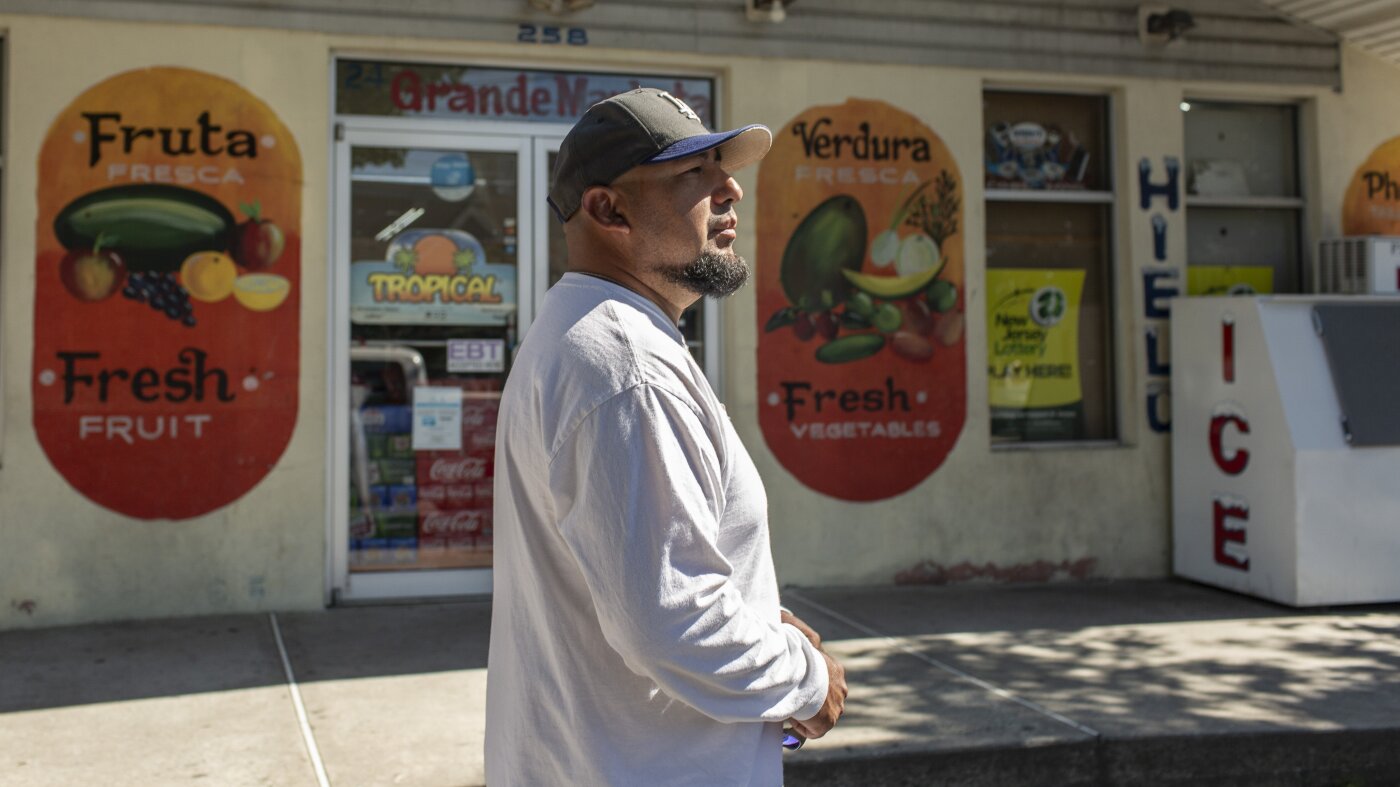
D.E., who requested that NPR use his initials only, stands near the location two blocks from his home in which he was violently arrested by ICE officials without a warrant, in Long Branch, N.J. D.E., 44, who has had a brain tumor for years, was denied medication by ICE officers and suffered several seizures.
Lianne Milton for NPRhide caption
toggle caption
Lianne Milton for NPR
“I could feel it coming and I didn’t want to hurt myself, so I jammed my arm between the metal bed frame and the wall to lock myself in place,” D.E., a Mexican national who requested that NPR only use his initials because he fears government retaliation, said in Spanish. Trapping his arm was the best precaution he could come up with to keep himself from accidentally falling face-first into the shared toilet that was just inches from his bed, he said. “It’s what I was most afraid of because I could have drowned.”
Recalling that night, D.E. described the episode as a sustained haze of torture. The next morning, he tried to document what he could remember in a medical grievance that has been reviewed by NPR
In practice, the grievance system should act as an internal accountability mechanism for both federally run and contracted detention facilities; the guidelines establish mandatory review and adjudication time frames
The grievance paperwork D.E. filled out after he was denied medication during ICE detention.
Lianne Milton for NPRhide caption
toggle caption
Lianne Milton for NPR
With limited space on the paper form, D.E. was as specific as he could be. “Hello. I am writing this letter to the Medical Services Department regarding a complaint about my medical condition,” he wrote on March 6. “It is a very aggressive issue involving a brain tumor that causes headaches and has triggered epileptic episodes lasting up to four hours. I am requesting that you provide me with a doctor specializing in radiation and chemotherapy, as my treatment was interrupted when I was detained by ICE on January 19.”
A breakdown of oversight
Lawmakers, immigration attorneys, advocates and detainees report that experiences like D.E.’s are ubiquitous across the nation’s detention centers, reflecting a broken grievance process
Trying to enforce the rules of the grievance system has always been challenging, Chris Brundage, the former deputy of the now-closed Office of the Immigration Detention Ombudsman, told NPR
That’s partly because it’s not one single set of standards that all operators must follow, Brundage said. “It’s a patchwork system that has never worked as intended,” he said, explaining that there are at least three different sets of detention standards that operators are working under, depending on when they signed their contracts. (Some operators are following guidelines established in 2011. Others, an updated version from 2016, and those with new contracts are following 2019 standards.)
D.E.’s documentation of medicine taken, his seizures and medical visits during his three months in detention.
Lianne Milton for NPRhide caption
toggle caption
Lianne Milton for NPR
Over the last two years, those problems have been significantly exacerbated by the evisceration of nearly all immigration detention oversight offices by the second Trump administration, he said
The Office of Detention Oversight, created by Congress to conduct internal inspections, and the Immigration Detention Ombudsman’s office tasked with investigating detainee deaths and other issues have had their budgets gutted and suffered massive layoffs. Both agencies sit within DHS. In the case of the ombudsman’s office, one of the only places that detainees could turn to to challenge a grievance denial outside of the immediate detention facility, it was fully shuttered in May
Another office whose budget has been slashed is the Office for Civil Rights and Civil Liberties, Brundage noted. In 2025, the administration slashed the CRCL staff from roughly 150 employees down to just a handful, effectively halting operations. The Government Accountability Project reported more than 500 active civil rights and detention-abuse complaints — including allegations of medical neglect, sexual abuse and dangerous conditions in immigration detention — were frozen or left uninvestigated.
Immigration
ICE detained a Venezuelan soccer pro. His case shows the immigration backlog crisis
At the time, the Trump administration said cutting hundreds of staff positions at the congressionally mandated offices was necessary to save money and because DHS claimed they were “internal adversaries that slow down operations.”
“I think what happened when these offices were effectively gutted and shut down, you lost that … legitimacy. And legitimacy means that they’re following the laws, regulations. But what happens if you don’t have transparency into the process and you don’t have accountability? Without those two things, that legitimacy erodes, ” Brundage said
Tracking grievances
Even before the closures it has been virtually impossible for lawmakers or inspectors to know how many grievances are filed at any given detention center each year, because neither ICE nor any of the private prison companies contracted by DHS are required to disclose that data to any review body. Also, even internally detention facility operators are not required to track data on how many grievance complaints are deemed to be founded, how the issue was resolved, or if it was challenged, whether the initial rejection was overturned.
Lawmakers and immigrant rights activists say that without such mandates, they are unable to decipher any patterns that could shed light on systemic problems, either at a single facility or across the entire system. Some suggest it is a deliberate ploy to keep the public in the dark about conditions on the inside of the nation’s fortress-like detention centers
Protesters stand outside Delaney Hall detention center on June 3.
Lianne Milton for NPRhide caption
toggle caption
Lianne Milton for NPR
The ACLU of Northern California partnered with the California Collaborative for Immigrant Justice to document the daily conditions of life in California immigration detention by tracking formal grievances during the Biden administration. The findings were published in a 2024 study called Resistance, Retaliation, Repression: Two Years in California Immigration Detention. The organization obtained grievances from detainees and their families, and Freedom of Information Act requests from the state’s six detention centers, which are all run by The GEO Group, CoreCivic, and Management & Training Corp. (Two new facilities, also run by private contractors, have been added since then.)
In all, the study reviewed 485 grievance complaints, concluding that the absence of accountability and transparency keeps conditions of detention, the grievances filed and their outcome hidden from public scrutiny. An analysis of the collected grievances revealed that complaints about the staff and their conduct, including facility management and bullying by staff, were the most common reason for grievances, with 179 documented allegations. Poor living conditions, including contaminated food, sleep deprivation, exposure to toxic mold and access to legal counsel, were the second most common reasons, with 141 filed complaints. And 94, roughly 20%, were medical grievances related to insufficient medical care and denial of medications.
Immigration
Controversial group wins $158M-contract to represent unaccompanied immigrant children
Based on the data, 71% of the 485 grievances were deemed as unfounded or rejected by detention center officials. Nearly 21% were either closed, undecided, or unknown. Only 8% of the total grievances found in favor of detained people. According to detention standards, officials are required to provide, in writing, a reason for a rejection of a complaint and detainees can appeal an unfounded determination up to two times. In the past, the issue could be escalated up to the Office of Civil Rights and Civil Liberties.
Ryan Gustin,senior director of public affairs at CoreCivic, which owns or operates 12 detention centers across the country, said its facilities are closely monitored by ICE and regularly undergo reviews and audits
Delaney Hall detention center in Newark, N.J., where D.E. was held initially before being transferred to two other facilities.
Lianne Milton for NPRhide caption
toggle caption
Lianne Milton for NPR
“We have a robust grievance process available to all detainees at each of our ICE-contracted facilities that provides multiple safe and discrete avenues for concerns to be raised, including toll-free telephone numbers,” Gustin told NPR. He added that most detainee concerns are processed through ICE’s Enforcement and Removal Operations’ Detention, Removals and Information Line
It is unclear if complaints made to one of the hotline numbers or those processed through ICE’s ERO removals and information line are treated in the same way as a formal grievance, that is, whether it is documented and added to a detainee’s file, and if detention center officials are required to abide by the same response timelines as a written complaint. CoreCivic referred all requests for clarification to DHS, which did not respond to NPR’s requests for comment
Mariel Villarreal, a senior attorney with the California Collaborative for Immigrant Justice, told NPR that many of the denials she has reviewed rarely offer any meaningful explanation for the rejection. “It’ll just be a few generic words,” she said. In other instances, there is no written record of the denial on the submitted complaint. (This is what happened in all four of D.E.’s grievances, filed about two years after the study at California City.)
“But even grievances that are ultimately founded, there’s often no real remedy to them. There’s nothing with teeth or no enforcement mechanism for making sure the grievance is actually addressed in a meaningful way,” Villarreal said
Villarreal noted other violations that she has witnessed, including facilities that have ignored a rule prohibiting a staff member who is accused of wrongdoing from ruling on a complaint about them
Immigration
Ex-wife says ICE agent who killed man in Maine had racist beliefs, violent tendencies
“We’ve heard complaints from people [saying], ‘I filed the grievance about this officer or this staff who did something bad or mistreated me,’ and they were the one that then adjudicated it. And the proof of that is that their name shows up in logs,” she said
The report also found that use of the grievance system can backfire. Villarreal said her clients have reported various forms of retaliation, including solitary confinement or getting transfers to detention facilities far from a complainant’s family and lawyers
“I have a feeling that a lot of people who are filing grievances in immigration detention are pretty aware of the fact that it’s essentially a sham,” Villarreal said. But the reason people in custody continue to file them anyway is because it’s the only way to document what’s happening to them, “because it’s their word against the whole system,” she said
“People are at the whim of whatever ICE wants to do with them”
Despite the Trump administration’s attempts to ban unannounced visitsby federal lawmakers,members of Congress have the legal authority to visit ICE detention sites at any time
Texas Congressman Joaquin Castro visits the Dilley Immigration Processing Center in south Texas about once a month. But, he told NPR, that’s become more difficult as ICE is enforcing more restrictive policies designed to block unannounced visits
“They no longer allow us to see people who want to sign up to see members of Congress when a [congressional delegation] is going to inspect the facility. Now we have to have specific permission to see particular people,” Castro said after a visit to the facility in June
U.S. Rep. Joaquin Castro, pictured at a press conference in Washington last year, visits the Dilley Immigration Processing Center in south Texas about once a month.
Kayla Bartkowski/hide caption
toggle caption
Kayla Bartkowski/Getty Images
Even so, Castro said he’s witnessed operational violations on nearly every visit. On a chaperoned tour in June, the congressman said he was taken into a room with a phone bank for detainees to use to anonymously report abuses, including a connection to a national rape hotline. But when he tested the line, he said it asked for the caller’s personal identification code
“The [CoreCivic] warden said he didn’t know why it was happening and that he would get back to me” about it, he said
He added: “I think for all intents and purposes, the grievance process, the resolution process, is non-functioning at this point. And these people are at the whim of whatever ICE wants to do with them.”
New Jersey State Attorney General Jennifer Davenport <a href="https://www.njoag.gov/governor-sherrill-attorney-general-davenport-health-commissioner-issue-statement-after-health-inspectors-are-prevented-from-conducting-a-full-inspection/” rel=”nofollow noopener” target=”_blank”>sued The GEO Group after staff at the Delaney Hall facility allegedly blocked health department inspectors from entering most of the complex during a scheduled visit in May. The inspection followed a hunger strike by detainees, who in a letter, complained about rotten or worm-infested food, medical neglect and being coerced into signing deportation orders. But the team of inspectors, which was tasked with conducting a biannual audit of more than 20 national detention standards, including the grievance system, was not allowed past the center’s kitchen facilities.
Immigration
They fought for the U.S. in Afghanistan. Now they worry about losing their green cards
In a statement to NPR, a DHS spokesperson said, “There are NO subprime conditions or abuse at Delaney Hall.” However, a recently released report of an August 2025 inspection of the facility during which inspections and compliance specialists from the Office of Professional Responsibility were also blocked from touring the entire facility, noted a slew of health violations. And a review of the facility’s suicide watch logs showed 19 instances where clinical staff failed to conduct mandatory 15-minute check-ins. Instead, documents showed gaps of up to 65 minutes.
The GEO Group referred NPR’s questions to DHS
In California, a U.S. District Court judge issued a preliminary injunction in a class-action civil suit brought by detainees and immigrant advocacy groups against ICE for allegedly subjecting immigrants to inhumane and illegal conditions at the Adelanto Processing Center — one of the largest immigration detention centers in the United States. At least four people have died in custody while detained at The GEO Group-run facility since September 2025
The lawsuit called Adelanto’s grievance process “slow and often futile,” adding that “detained individuals routinely wait more than a month for response after filing a grievance.” It also states that in some cases, The GEO Group staff have pressured detained individuals into withdrawing their grievances in order to receive help
The judge’s July ruling said the plaintiffs “have demonstrated they are likely to prevail — or at the least, raise serious questions — on the merits of their Fifth Amendment and Rehabilitation Act claims.”
She ordered the facility to immediately provide basic necessities. In addition, two independent monitors will have access to the detention center for unannounced inspections and to provide monthly reports, and detainees will have direct access to them in a confidential grievance system
D.E.’s grievances
D.E., 44, says he moved to the U.S. when he was 18 so he could help support his parents and siblings back home in Mexico. He’s been undocumented the entire time
As he was being handcuffed and pushed into an unmarked van in January, D.E. says he asked the officers to stop by his apartment so that he could grab his medication. They didn’t. Then when he arrived at Delaney Hall detention center in Newark, N.J., hours later, he told the medical intake staff about his condition
“I even told them in English: I have a Stage 4 brain tumor. I have to take 1,000 mg of Keppra at 9 a.m. and 9 p.m. I’m supposed to start chemotherapy this week,” he said
D.E. has been in the U.S. since he was 18. He is now 44 and was undocumented the entire time. He says he moved to the U.S. to support his parents and siblings back home in Mexico.
Lianne Milton for NPRhide caption
toggle caption
Lianne Milton for NPR
He also gave them the name of his doctor and the hospital where he was being treated about an hour away. “Please call them,” he begged
It’s unclear whether anyone at Delaney ever spoke to his medical team, but D.E. says the on-staff doctor at the detention facility reviewed his records and recommended that he be sent to a local hospital for chemotherapy. About two weeks later, he said an officer told him he didn’t need chemotherapy
Eventually, word got out and local activists started lobbying elected officials to intervene on his behalf. Days later, D.E. was transferred to a facility in Arizona for about a week, then shipped off to California City, where he says the inconsistent delivery of his meds triggered four seizures
All in all, the second seizure lasted about four hours off and on. It’s the worst one he’s ever had. Throughout it, he lost control of his body and the ability to speak. He recorded the details of the episode in a formal grievance the following morning. It was one of four medical grievances D.E. filed with the CoreCivic staff in March alone
“I filed them even though I knew nothing would change,” D.E. said. “My lawyer told me they were supposed to respond to the grievances within a week, but I never got any kind of response,” he added
NPR reviewed all four complaints and confirmed that the documents do not contain a response to D.E.’s requests for chemotherapy, access to cancer specialists, or plans to ensure the timely delivery of his medications from CoreCivic or DHS staff
According to the guidelines set by the DHS, a designated “grievance coordinator”is responsible for reviewing complaints, and staff must investigate and provide a written response, usually within five days. If the grievance involves an immediate threat to health or safety, the facility must respond within 24 hours
“That never happened,” D.E. said. Instead, “They would tell me that I would get treatment ‘soon’ but not set an appointment or a time frame,” he said. D.E. was eventually released from detention after filing a petition in state court
In more than three months in detention, D.E. never saw an oncologist
CorrectionAug. 20, 2026
An earlier version of this story misspelled the last name of Mariel Villarreal as Villareal
- trump administration
- immigration policy
- ICE detention
