


Add Us On GoogleAdd as a preferred source on Google
S.C. (WCSC) — Five doctors who recently returned from medical missions in Gaza shared their experiences with Lowcountry community members on Sunday
They described what they called a devastating lack of functional hospitals, basic medical supplies and specialized equipment
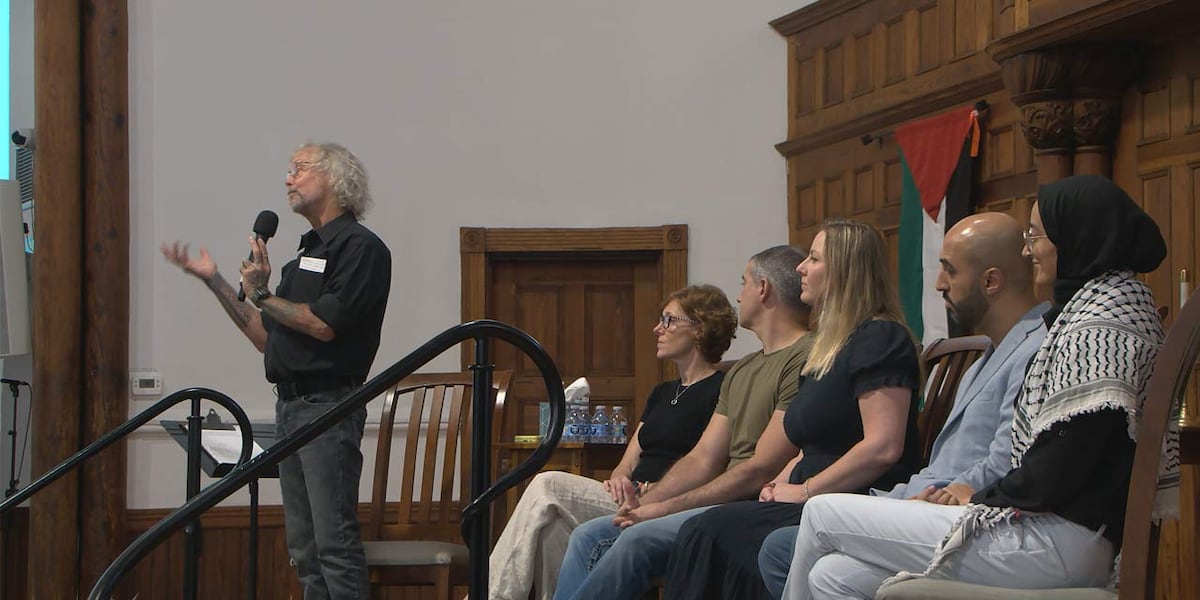
The panel, hosted by Free Palestine Charleston, took place in the sanctuary of Circular Congregational Church
Four of the five doctors live and practice medicine in Charleston
The physicians were Dr. Natalie Freidin, Dr. Safanah Siddiqui, Dr. Mike Mallah, Dr. Andre Uflacker and Dr. Jen Hubbard
Hearing what they said brought many in the audience and the physicians themselves to tears
Siddiqui, an interventional cardiologist, said she felt compelled to speak because her colleagues and patients in Gaza asked her to share their stories
“I came out because my colleagues and my patients in Gaza asked me to share their story. So, I came out telling my story on behalf of them,” Siddiqui said. “And because there’s no journalists allowed into Gaza, right now the only people that are being allowed into Gaza are healthcare workers as a part of emergency medical teams. And so it becomes on us to not just treat the patients as a part of our Hippocratic Oath, but also to prevent future patient deaths by telling the stories and hopefully ending the genocide so that more lives can be saved in Gaza.”
Siddiqui traveled to Gaza in July
She said she has seen support from the Charleston community
“I know there’s hundreds, if not thousands, of people in the community who are interested. It’s just, it’s hard to get the stories out there for various reasons. But, you know, I’ve been seeing the community support, and I know people are against genocide. I know people want to support righteous causes like the Palestinian cause. So, you know, this is what I expect from my community here,” Siddiqui said
Siddiqui said she wants people to remember the humanity of Palestinians
“That Palestinians are human. I think they are often dehumanized in the media from the perspective of our politicians. And we need to remember that these are humans. They love their children just as much as you love your children. They want to live just as much as we want to live. And they have a right to match,” Siddiqui said
Siddiqui said the medical care she and other doctors provided in Gaza does not address the root cause of the crisis
“I want to emphasize something I said on the stage, is that everything I did there was just a band-aid. Everything I did there, anything a doctor can go and do, is just treating a symptom. And the problem won’t end; the devastation won’t end until the genocide ends. And, you know, the healthcare system, the healthcare destruction is a symptom of the real problem, the disease that is the genocide,” Siddiqui said
Mike Mallah, a trauma surgeon and surgical care intensivist, said he wants the community to reflect on its role in the crisis
“I think what I want people to take from this panel is that we, as a community, are supposed to be about love and humanity. And I think right now, in regards to the situation in Gaza and Palestine, we’re falling short of that. Our community right now is supporting a weapons manufacturer, an Israeli weapons manufacturer, that is producing bombs and weapons of war that’s being used to commit a genocide in another place. And that money should be used here in our community to support our children, our healthcare workers here,” Mallah said.
Mallah said he decided to share his story after witnessing conditions in Gaza firsthand
“I decided to share my story because I have looked into and seen the abyss of genocide. And the people that are currently living and experiencing that asked me to tell the truth about what I saw. And I think people need to hear it,” Mallah said
Mallah traveled to Gaza in March 2024. He said he would like to return
The physicians said the people of Gaza want to know they have not been forgotten
Copyright 2026 WCSC. All rights reserved
