



Longer life expectancy is widely seen as one of society’s greatest achievements. Yet it comes with an increasingly costly downside: more people are spending years, and sometimes decades, living with chronic diseases
A new report by Zurich Insurance Group highlights the growing economic and financial implications of this trend. The study, «The Value of Chronic Care», analyzes more than 200 chronic conditions across all 38 OECD countries between 2014 and 2023.
Its central conclusion is that chronic disease is fundamentally changing the nature of financial risk. As premature deaths decline and people live longer with conditions such as cancer, cardiovascular disease, mental health disorders and neurological diseases, the financial impact is shifting from one-off events to sustained and uncertain exposure over time
The consequences extend well beyond rising healthcare costs. Chronic illness can affect an individual’s ability to work, maintain an income and remain financially independent, while also placing additional pressure on families and caregivers
For insurers and financial services providers, this creates a new risk equation. Financial protection is increasingly required not only at the point of diagnosis or in retirement, but throughout extended periods of illness that can span large parts of a person’s working life
Zurich argues that this development increases the importance of both insurance protection and long-term savings planning
Alison Martin, CEO Life, Health and Bank Distribution at Zurich
«People live longer, but too often with chronic conditions that affect their health, work and finances,» said Alison Martin, CEO Life, Health and Bank Distribution at Zurich. «By introducing prevention measures, intervening earlier and bridging public and private sectors, we can help people stay healthy, productive and financially resilient.»
Switzerland Tops the Ranking
The report introduces a new Chronic Care Index that measures how well countries are positioned to deal with the growing burden of chronic disease
Switzerland ranks first among all 38 OECD countries with a score of 80 out of 100. The Netherlands follows with 78 points, ahead of Luxembourg and Norway with 74 points each and South Korea with 73
At the bottom of the ranking are Lat
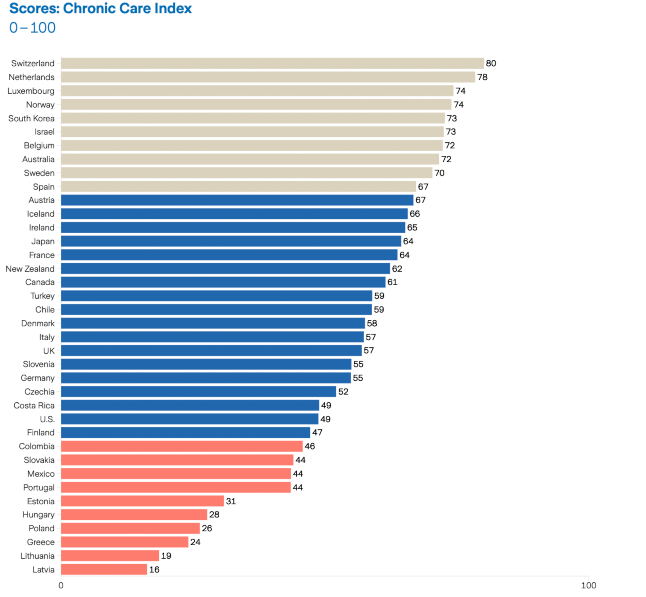
Switzerland’s position is particularly noteworthy given its aging population. The study concludes that aging societies do not automatically have to suffer worse health outcomes
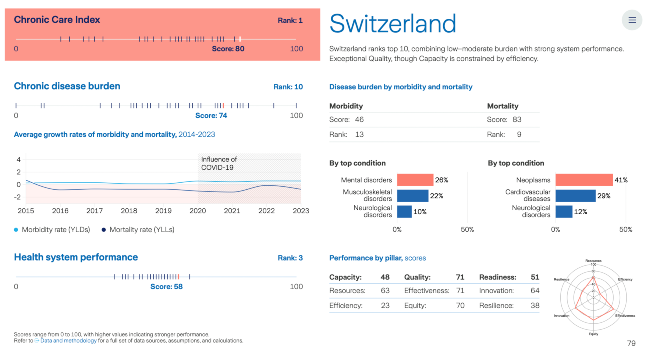
Strong coordination, high levels of trust and patient confidence in the healthcare system help Switzerland manage chronic conditions more consistently over time, according to the report
Spending Alone is Not Enough
One of the study’s key findings is that higher healthcare spending does not automatically lead to better outcomes
Countries with comparable healthcare capacity can achieve widely differing results. According to Zurich, the decisive factors include the effectiveness and coordination of care, access to healthcare and the ability to provide continuous support over time
Many existing healthcare systems were primarily designed to deal with acute medical events. They are now being tested by diseases that require lifelong management
Poorer outcomes are often associated with fragmented care, limited access and insufficient coordination
Living Longer – But Spending More Years in Poor Health
The overall burden of chronic disease has increased steadily across OECD countries over the past decade
However, the composition of that burden is changing
While mortality from some diseases has declined, morbidity – the time people spend living with illness or disability – is increasing more rapidly
Cancer and cardiovascular diseases each account for 21 percent of healthy life years lost across OECD countries. At the same time, conditions associated with long-term management are gaining importance
Mental health conditions and neurological diseases now account for 10 percent and 9 percent of the overall disease burden, respectively. Musculoskeletal disorders are responsible for another 9 percent
The result is a widening gap between lifespan and health span
Insurers Face a Broader Role
Zurich sees three main areas for action: earlier prevention, better integration of care throughout a patient’s journey and broader responsibility beyond public healthcare systems
The report argues that employers and insurers will have to play a greater role
Insurers, in particular, could increasingly provide access to prevention, early detection and ongoing support for people living with chronic conditions. Digital risk assessments, screening programs and services combining health data, behavioral support and clinical expertise are already emerging
The objective is to identify risks earlier and prevent chronic conditions from escalating
From Paying Claims to Managing Risk
The findings point to a potentially significant shift for the insurance industry
As chronic diseases become a decades-long financial challenge, the traditional model of providing protection against individual events is increasingly being complemented by services aimed at preventing and managing risks over time
For insurers, this could mean a greater focus on prevention and long-term customer support – and a closer integration of insurance, healthcare and financial planning
