



- Healthbeat
- Posts
- Cyclospora: 4 lessons from a massive outbreak
Good morning, and welcome to the first edition of our revamped Healthbeat National newsletter. I’m Alison Young, senior national reporter at Healthbeat
Every week, I’ll bring you important stories in public health, connecting what‘s happening on the ground with the bigger forces driving change. Whether you’re new to the list or have been with us for a while now, I’m glad you’re here
As the number of people stricken with cyclospora infections across the U.S. finally seems to be winding down, I recently spoke with Dr. Natasha Bagdasarian, the chief medical executive for the state of Michigan, about the challenges her state has faced investigating the outbreak
Michigan — where the state health department has confirmed more than 14,000 cases of infected people across the state, including hundreds of hospitalizations and two rare deaths — seems to be the outbreak’s epicenter based on case counts.
At its height, Bagdasarian said:
About 400 cases a day were being reported.
Health systems couldn’t keep testing supplies stocked
Labs were backlogged
Some healthcare systems restricted testing to hospitalized and immunocompromised patients
Yet those were only some of the challenges
The cyclospora outbreak also revealed disconnects in how the U.S. public health system — operating with reduced funding, fewer people and strained federal-state coordination — currently responds when confronted with a massive outbreak, according to what Bagdasarian told Healthbeat
Bagdasarian described four key lessons from this summer’s cyclospora outbreak.
But first, some important context
The Setup
During the two weeks before the Centers for Disease Control and Prevention issued national alerts on July 14 about this summer’s surge in cyclosporiasis cases, Michigan public health officials had already been issuing repeated warnings of “a large and growing outbreak” sickening state residents
On July 1, the Michigan Department of Health and Human Services announced it had received more than 170 reports of cyclosporiasis in just a nine-day period at the end of June — more than triple the 50 cases the state has in a typical year.
On July 17, Taylor Farms de Mexico recalled iceberg lettuce produced in central Mexico that has been linked to nearly 11,000 people sickened in 17 states, including Michigan
But the picture on the national level remains unclear.
The CDC’s overall count of cyclosporiasis cases nationwide has lagged behind case counts being posted by Michigan and other states, in part because of differences between state and federal reporting systems. Cases of the diarrheal disease have been reported in 47 states, plus the District of Columbia and Puerto Rico
And the huge outbreak linked to lettuce is not the only one fueling infections across the country this summer.

While lettuce has been linked to thousands of cases of cyclospora infections this summer, the /
At least six clusters of cyclosporiasis cases have no identifiedolina, for example, state health officials are eyeing parsley and cilantro as potential
From her vantage point in Michigan, Bagdasarian told Healthbeat that an already challenging outbreak response has been made more difficult by strains on the nation’s public health system
The Takeaways
1.States can’t independently solve multistate outbreaks.
“The lack of a coordinated federal response has been really challenging,” Bagdasarian said
As Michigan health officials searched for answers among their mounting reports of cyclospora infections, they only had access to the data they collected from Michigan patients, she said
That limited their view to only one piece of the larger puzzle.
States rely on the CDC and other federal agencies to compare data and learn about clues being identified beyond their borders.
“We simply cannot be the CDC,” Bagdasarian said. “We don’t have the manpower, the infrastructure, the funding for each state to do this work alone. We need a national coordinating body.”

Dr. Natasha Bagdasarian, Michigan’s chief medical executive (Photo courtesy of Michigan DHHS)
CDC officials did not answer questions from Healthbeat
Asked at a news conference last week whether federal budget and staffing cuts had weakened federal health agencies’ preparedness, Health and Human Services Secretary Robert F. Kennedy Jr. said the country is “more prepared than we’ve ever been before.”
Janet Hamilton, executive director of the Council of State and Territorial Epidemiologists, whose members are health department disease detectives, said the federal government’s support and coordination is critical in large, fast-moving multistate outbreaks
This summer, she said, “there have been gaps in the ability to analyze data and provide trend information back to the jurisdictions.”
2.Data challenges obscured the scope of the outbreak
Bagdasarian expressed concern about the continuing mismatch between the overall number of cyclospora infections that Michigan is reporting and the far lower numbers CDC has been posting for the state — which impacts the national tally
Michigan currently reports 14,277 cyclosporiasis cases — an undercount, because many are never tested, Bagdasarian said. The CDC, which reports ranges rather than case counts, says somewhere between 4,000 and 6,999 people have been sickened in Michigan
“If we can’t even talk about the scope of the issue,” Bagdasarian said, “I think it becomes difficult to then talk about how we interpret what happened this summer.”
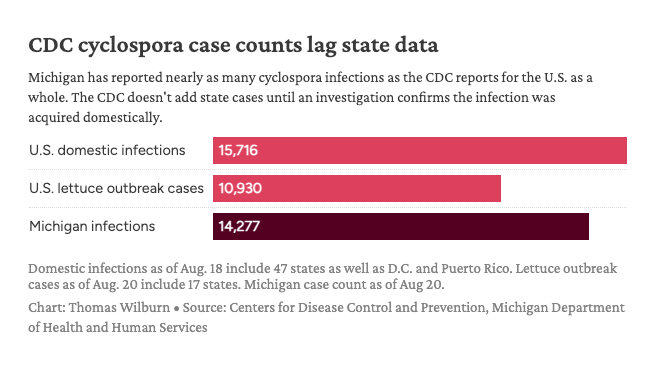
One issue is that the CDC distinguishes between infections acquired inside the United States and those related to international travel. It’s a distinction that requires interviewing patients about where and what they’ve been eating and drinking, not just having a positive cyclospora test result
But doing interviews takes time, especially with thousands of cases. CDC’s cyclosporiasis website acknowledges that it’s aware of thousands of cases still pending lab results or interview information
Michigan completed more than 7,000 interviews. But after that effort pointed toward lettuce as theined that doing additional interviews provided diminishing returns for public health decision-making.
Hamilton said antiquated data systems are contributing to the problem.
The nation’s system for gathering information on reportable diseases still largely relies on medical practices calling or faxing case reports to health departments, which then need to digitize or manually enter the data, she said. Public health groups have warned about this for years.
Electronic reporting remains limited and the pipeline for sending reports from states to the CDC also has challenges, Hamilton said
“You can’t do data analysis on data you don’t have,” she said
But even after CDC has the data, Hamilton said diminished analytic capacity at the agency from budget and staff cuts has affected how quickly it can send trends and insights back to the states
3.Federal public health budget cuts don’t stay federal
The CDC has been rocked by layoffs, retirements, and the departure of experienced public health experts. Until new CDC Director Erica Schwartz arrived this month, the CDC had been without a full-time director for nearly a year, after its last director was fired less than a month into the job
“The folks we are working with at the CDC and FDA are doing the best they can in a very difficult situation,” said Bagdasarian
CDC budget cuts also have trickled down to state and local health departments.
Between 85% and 95% of the applied epidemiology workforce in state health departments is federally funded, Hamilton said.
“So when the CDC’s budget is cut, that means states also see cuts, and I don’t think people understand that well,” she said
In Michigan, the state health department’s bureau of infectious diseases lost 23 people in “a department that was stretched thin,” Bagdasarian said. Local health departments across Michigan had to cut 123 staff members because of CDC funding cuts, she said.
Those are people who could have helped gather clues by interviewing the thousands of Michiganders sickened by cyclospora, she said
4.Without national leadership, information fragments
Bagdasarian said “lack of a national public health voice” has left a void that has fueled public confusion
The CDC didn’t put out its first national health alert or hold a press conference until two weeks after Michigan had already been warning its residents
In that vacuum, Bagasarian said she watched various experts who lacked access to data float incorrect theories in media reports about the
“Anyone who could have seen the data would have said, no, this is clearly associated with produce,” she said
Meanwhile, she said, Michigan’s state-specific guidance was treated as if it applied nationally.
“So then it became the whole country shouldn’t eat bagged lettuce, and that was never our intention,” Bagdasarian said.
“I can’t be the voice of public health guidance for the whole country when I am providing guidance for Michigan based on Michigan data.”
The Bigger Lesson
The U.S. public health system that protects us from foodborne illness and a wide range of other diseases is a decentralized safety net strained by significant financial cuts, losses of staff and expertise, and archaic information systems
The massive surge in cyclospora infections arrived amid record-breaking measles cases and numerous other infectious disease and environmental threats.
When the system is working, it is largely invisible
“It’s kind of like you don’t understand how important the pavement on the road is until the road has potholes in it,” said Hamilton
Reach me at[email protected]or through the messaging appSignalat alisonyoungreports.48. Read more aboutme and my work here. Forwarded this email?Sign up for freeto receive this newsletter
Looking for your next read? Check out these other great newsletters
|
|
|
|
