



Closing the Real-World Data Gap for Public Health
August 25, 2026 | Laura Burdulean, Rachel Joseph, Tabatha Offutt-Powell
For nearly two decades, real-world data (RWD) have reshaped how the health care ecosystem understands patient care, treatment patterns, and outcomes. Providers, researchers, insurance companies, life sciences organizations, and health technology platforms now depend on access to data from medical claims, pharmacy records, lab results, and electronic health records, including social determinants of health data, to guide decision-making. The breadth of stakeholders and data sources highlights a critical reality: the same data that support individual patient care and business operations are increasingly essential for public health surveillance and science-informed public health interventions.
State and territorial public health agencies have not had the same access. That gap affects how quickly public health agencies can detect outbreaks, identify emerging health trends, and evaluate the impact of interventions. Many states lack access to robust RWD, as well as the technical resights that impact the health of their communities
The Public Health Data Gap
State health departments hold some of the most important data in the country: vital records, disease surveillance, immunization and cancer registries, environmental exposures, and Medicaid claims. But those datasets are incomplete
Traditional surveillance was primarily built around reportable conditions, disease registries, vital records (births and deaths), and population-based annual surveys. While public health agencies have increasingly incorporated Medicaid claims data to better understand health care utilization and outcomes among vulnerable populations, surveillance systems were not originally designed to provide a comprehensive view of health care experiences across the entire population. As a result, the commercially-insured majority — including millions of working adults covered through employers — often remains underrepresented in the data used to monitor community health, identify emerging trends, and inform public health action. Moreover, funding for technical infrastructure has not kept pace. Many states lack the capacity to readily link datasets from numerous data systems within public health and subsequently perform robust analytics — capabilities widely available outside governmental public health agencies.
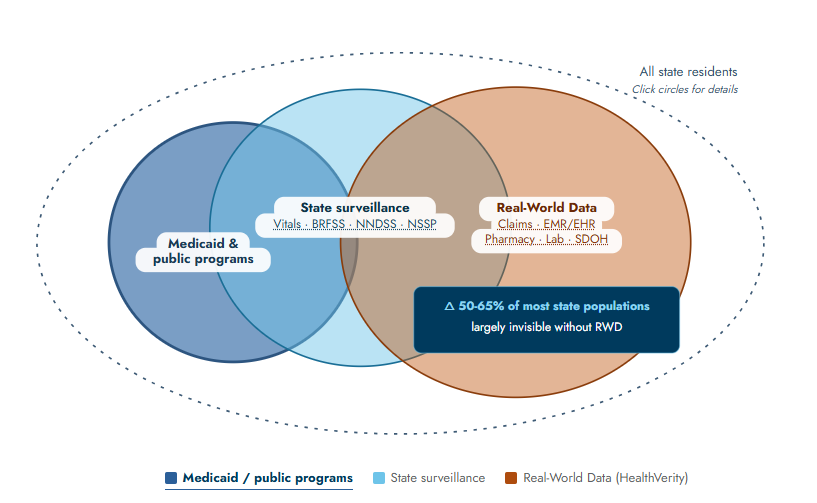
For state public health officials, the consequences are clear. Without access to RWD, agencies can struggle to fully measure chronic disease burden, understand behavioral health and overdose care patterns, identify gaps in preventive care, and evaluate outcomes across populations. When a new research question arises, agencies often start from scratch. Real-world data can help fill those gaps (see Figure 1)
Figure 1: Coverage of state residents across different data sources
A Public-Private Model, Governed by Public Health
In February 2026, ASTHO announced a partnership with Veritas Data Research and HealthVerity to launch the Public Health Data Consortium, a first-of-its-kind model designed to help jurisdictional public health departments receive access to real-world data,to meet priority needs and data gaps. The consortium provides technical support, such as data linkage capabilities and visualized dashboards, with regular updates that deliver timely insights into emerging public health trends
ASTHO serves as the consortium’s convener, facilitating a structure that supports direct jurisdictional participation and governance. Veritas Data Research provides the data platform and mortality data expertise. HealthVerity contributes identity resolution and access to the nation’s largest real-world data ecosystem. Together, the three organizations provide states with a working model to access the modern RWD ecosystem
The consortium shifts states from being passive participants in a broader data ecosystem to active stewards with governance authority and RWD-enhanced data insights. Rather than allowing data to be used through indirect or fragmented market pathways, states decide how data are used, protected, and leveraged to improve public health outcomes. The consortium establishes a framework where states shape policies governing data use, privacy protections, commercialization practices, and benefit-sharing.
“For too long, there have been challenges in bringing private and public entities together to address the gaps that plague our nation’s public health data and technology infrastructure,” said Jen Layden, Associate Dean of the Washington University School of Public Health and Senior Advisor to the consortium. “This consortium, by uniting on a common mission and placing governance in the hands of public health, is primed to be a game changer.”
State-Identified Priorities for the First RWD Dashboards
To demonstrate the power and insights that RWD can generate for public health, the consortium is launching a public webpage that highlights data insights across several high-priority focus areas
- Maternal health.
- Infant and child health.
- Substance use and overdose.
- Rural health.
- Chronic conditions.
This dashboard provides an entry point for jurisdictions interested in becoming part of a growing national effort to strengthen public health data use and collaboration. States can join the consortium as Emerging Participants, gaining access to additional RWD-built dashboard resources while helping inform the consortium’s future direction, priorities, governance, and analytic strategy. This pathway allows states to engage in the consortium’s work, explore the value of RWD, and evaluate opportunities for future participation as data-contributing members.
By contributing data, states can become Participating Members, gaining access to dashboards down to the zip-3 level that contain enriched, linked RWD data combined with state-contributed data assets, including vital records, syndromic surveillance, and immunization data.
The consortium’s first initial collaborative focus with state health agencies is mortality data, an area of demonstrated need among public health researchers, health systems/providers, insurance providers, and the life sciences field. By creating a trusted framework for data collaboration that operates within state laws, governance structures, and approved data use policies, the consortium aims to serve as a sustainable conduit for expanding access to critical public health data assets while generating value for all participating members.
Join and Engage With the Consortium
The consortium is actively engaging with public health jurisdictions. Agencies that join early help shape the governance model, the use case roadmap, and the technical priorities that will define how public health uses RWD for the next decade
Looking ahead, the consortium is also developing a Partner Network to engage organizations across the public health ecosystem in collaboration with ASTHO and state members. As the network takes shape, it will create opportunities for partners to support state-defined public health data priorities and contribute to the consortium’s emerging priority initiatives
State and territorial health agencies and ecosystem partners interested in the Public Health Data Consortium can reach the ASTHO team at phdc@astho.org
Detailed Description of Chart
The 50–65% estimate reflects a composite of evidence, not a single published statistic. Employment-based insurance covers 53.8% of the U.S. population, of which 65% are in self-funded employer plans exempt from mandatory state APCD submission following Gobeille v. Liberty Mutual (2016), representing an estimated 105 million people absent from even the most established state databases (US Census Bureau CPS, 2024; ASPE/RAND, 2023). Among the ~28 states with active All Payers Claims Databases (APCD), Colorado, Maryland, and Massachusetts each report approximately 75% of self-insured enrollees missing from their APCD, and Connecticut, the strongest-performing state, captures only 64% of its total population (ASPE background report on state APCDs; Inside Investigator, 2025). Medicare Advantage enrollees (54% of Medicare-eligible beneficiaries, managed by private insurers) represent an additional uncounted population in standard state surveillance systems (KFF, 2024).
