


Aircraft noise more damaging to wellbeing than previously thought
Government turns a blind-eye to inconvenient analysis
By
Alex Chapman
26 August 2026
A freedom of information request (FOI) submitted by NEF has identified a report commissioned by the Department for Transport (DfT) showing that the wellbeing losses associated with aircraft noise may be considerably worse than currently assumed. The report was not made available to decision makers considering the expansions of London City, Stansted, Luton and Gatwick airports
Acute noise exposure can disrupt sleep and is a well-known health risk factor, associated with significantly higher rates of both cardiovascular disease and stroke. Airports have schemes to offer the most severely affected communities free or subsidised noise insulation. This insulation significantly reduces the impact of noise on factors like sleep quality and concentration, but it cannot mitigate all of the negative impacts, particularly those experienced outside of the home. Significantly, this insulation subsidy is only offered to a tiny minority of the households affected by aircraft noise.
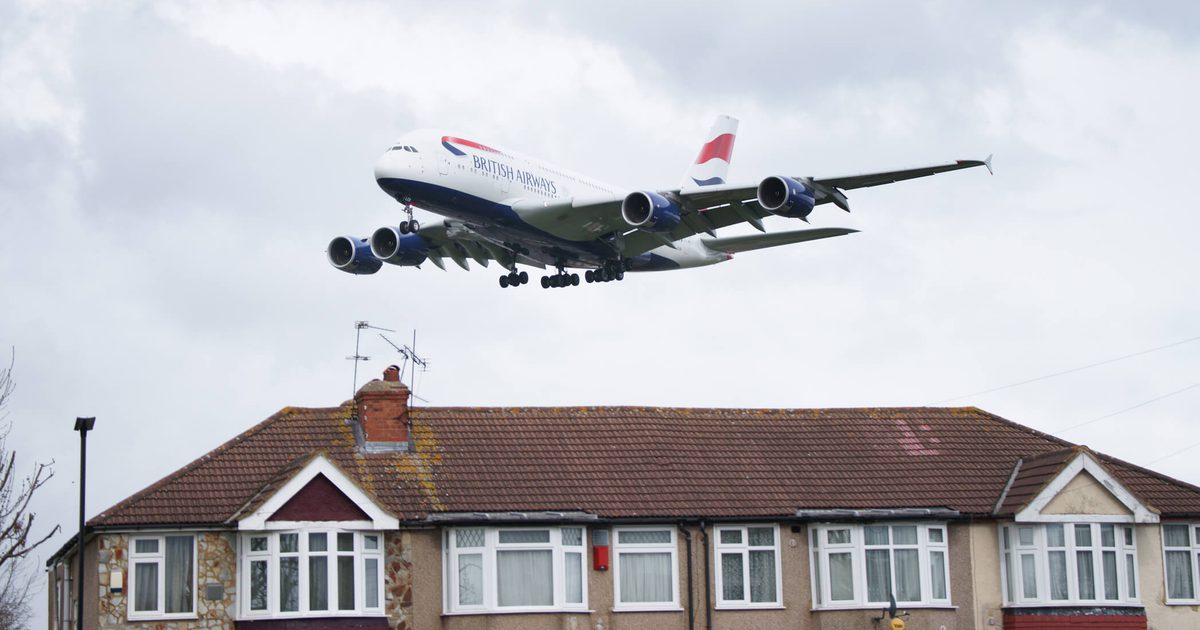
Over a million people in the UK are exposed to aircraft noise at home and in their neighbourhood and Transport for London (TfL) argue that London is the worst affected city in Europe. The huge airport expansion drive that successive UK governments and the aignificantly increase health and wellbeing harms
Communities, ang disputed the severity of the noise impact — particularly for the hundreds of thousands of people who are affected but not offered any form of insulation or compensation
Industry stakeholders argue that the levels of noise these people experience are negligible. As recently as December 2025 a director at the International Airlines Group (parent company to British Airways) told Parliament’s environmental audit committee that 57 decibels “is the point at which noise becomes annoying”
But this claim is highly misleading. A 2014 survey by the Civil Aviation Authority (CAA) found that just 28% of people described themselves as “not at all” annoyed by aircraft noise in the range of 54 – 56.9 decibels. Meanwhile 42% of households affected at this level reported being ”moderately” (18.5%), “very” (12.6%), or ”extremely” (10.9%) annoyed. The World Health Organisation (WHO) strongly recommend that aircraft noise exposure is limited to 45 decibels during the day and 40 decibels at night.
So how does this factor into government decisions about giving airports permission to grow?
The key question is how to weigh-up “annoyance”: if a project will create permanent noise annoyance at a “moderate” level for 10,000 people, what weight should that carry? Would such a level of community impact justify, for example, blocking an expansion that cuts the price of a flight ticket by £5 for 10,000 people?
The way government impact-assessment guidance approaches this is to monetise impacts, using monetary valuation to weigh very different types of benefit and cost – like balancing the annoyance of noise pollution with cutting the price of flying
Current guidance suggests that the monetised impact of an extra decibel of daytime aircraft noise at 56 decibels is just £75 per household per year. This is very low, and suggests that households are largely unbothered by the presence of noise at this level. But the figure seems at odds with the CAA’s findings that over 40% of people affected will be moderately, very, or extremely annoyed by the impact
A thought experiment: how much money would you have to be paid to accept the imposition of a “very” annoying noise in your neighbourhood?
This is where the DfT-commissioned report we have uncovered comes in. The report, completed in 2021, puts the amount required for a household to accept a one decibel increase in noise above 56 decibels at at least £900 (2025 prices), about 12 times higher than the current £75 figure the government uses (Table 1). This means, all other things being equal, households would require an additional income of around £900 a year in order to compensate them for the wellbeing they lose as a result of one decibel of additional aircraft noise. But they are highly unlikely to receive any compensation at all. This is a significant oversight, especially when considering that in communities around Luton and London City airports, some of the UK’s most deprived communities will be most affected by increased noise.
The gulf grows even greater at night. Official guidance puts the cost of an additional decibel of night-time aviation noise above 49 decibels at just £110. But the new DfT study puts its value at at least £3,100 (2025 prices), about 28 times higher. In other words, households would require £3,100 of additional income in order to compensate for the wellbeing lost to additional nightime aircraft noise. This is a huge discrepancy, particularly when aggregated across potentially tens of thousands of affected households.
Table 1: The wellbeing cost, per household, per year, of an additional decibel of avered DfT-commissioned report by Simetrica Jacobs
Noise change(decibels) | Current government guidance(TAG, 2025 prices) | Newly uncovered report(Simetrica Jacobs, 2025 prices) | |||
From | To | Day-time | Night-time | Day-time | Night-time |
49 | 50 | £36 | £109 | -£3,107 | |
50 | 51 | £58 | £136 | -£3,267 | |
51 | 52 | £61 | £143 | -£3,423 | |
52 | 53 | £64 | £150 | -£3,580 | |
53 | 54 | £67 | £158 | -£3,736 | |
54 | 55 | £70 | £165 | -£232 | -£3,891 |
55 | 56 | £73 | £172 | -£584 | -£4,044 |
56 | 57 | £76 | £180 | -£932 | -£4,197 |
57 | 58 | £79 | £187 | -£1,274 | |
58 | 59 | £84 | £196 | -£1,613 | |
59 | 60 | £90 | £206 | -£1,947 | |
60 | 61 | £94 | £215 | -£2,279 | |
61 | 62 | £99 | £224 | -£2,605 | |
62 | 63 | £104 | £233 | -£2,927 |
Notes: The Simetrica Jacobs report looks at the impact of ae insulation
A new runway at Heathrow has received strong government backing. Over 650,000 local residents are already affected by noise from planes departing and arriving at Heathrow airport, more than the population of the city of Manchester. Our best estimate, based on the airport’s published information, is that Heathrow currently offer noise insulation to under 50,000 local residents – less than a tenth of those impacted. Applying the findings of the newly uncovered Simetrica-Jacobs report to the population affected by noise from Heathrow (based on the numbers impacted in the Airport’s Noise Action Plan) suggests it would cost £500m per year (current prices) to compensate communities for day-time noise, and £1.1bn per year to compensate them for night-time noise. A total of £1.6bn would be required every year to fully compensate households for their lost wellbeing.
The report we have uncovered would have been highly pertinent to the expansion of London City airport, approved by this government over the summer of 2024. The approval increased the number of flights permitted to take off between 6:30am and 6:59am. The evidence submitted on behalf of the airport showed that tens of thousands of households will experience worsened noise impacts. Decision makers concluded however, that the scale of this harm was “negligible” in formal assessment terms, primarily because the impact mainly fell in the 51 – 63 decibel range. Had the inspectors assessing the proposal had access to a government-commissioned report suggesting that the wellbeing impact on affected households in this group was potentially 12 – 28 times higher than current government guidance suggests, a different conclusion may have been reached.
So why did a previous government choose not to publish the report and why were its findings not made available during this latest round of airport expansion applications? In their letter responding to our FOI this government only stated that:
“due to resourcing issues associated with the reprioritisation of work during theCovid-19 pandemic, the report was not taken forward to publication.”
We also spoke to a small number of atudy, about the study’s strengths and weaknesses. No one raised any fundamental issues with the report which would undermine its usefulness for decision making over the past five years. And no one provided any justification for the decision not to publish the report after the Covid-19 pandemic subsided
Regarding the reliability of the report, the government stated that
“It should also be noted that the Department considers that the methodological approach taken in the upcoming ANNE and ANAS studies will provide a more robust, comprehensive and up-to-date evidence base on the impacts of a
Reports on the ANNE and ANAS studies have now been published but, far from contradicting the report we accessede government has since admitted that the ANAS study “suggested that people are more annoyed by ated”
Despite a raft of airport expansion applications over the past few years, the government withheld key evidence showing the true impact of noise pollution on residents living around airports. This impact should be made clear to the public and taken into account when making decisions about airport expansion, including decisions about compensation for impacted households
- A copy of the Simetrica Jacobs report is available here.
- A copy of the response to our FOI request is available here.
Image: iStock
If you value great public services, protecting the planet and reducing inequality, please support NEF today
Make a one-off donation
£5£10£25£50£75£100
