


Abstract
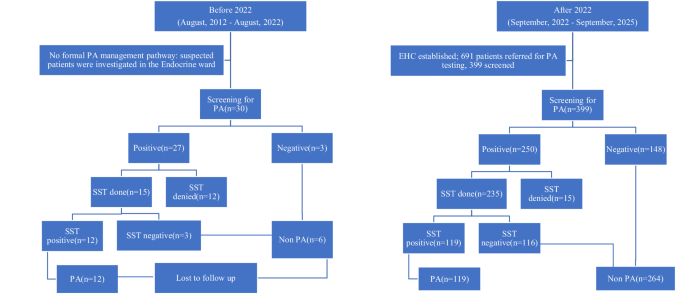
Primary aldosteronism (PA) is currently the most common specifically treatable and potentially curable cause of hypertension. However, it remains underdiagnosed, especially in low-middle-income countries (LMICs) in South Asia. International studies have highlighted the value of dedicated endocrine hypertension services for improving PA detection and management. The endocrine hypertension clinic (EHC) was established at the largest tertiary care hospital in Bangladesh in 2022. Consecutive hypertensive patients with a plasma aldosterone-to-renin ratio (ARR) > 50 were considered screen-positive and underwent a seated saline suppression test (SST). Patients with post-saline plasma aldosterone concentration (PAC) > 170 pmol/L were diagnosed with PA, and the remainder as non-PA. Clinical and biochemical outcomes of PA patients were collected longitudinally. Data from patients tested for PA prior to the EHC were retrieved from hospital records. Between 2012 to 2022, 30 patients were tested for PA and 12 were confirmed to have PA. Between 2022 to 2025, 399 patients underwent PA testing at EHC; 250 patients were screen positive and 119 were biochemically confirmed as PA. The age distribution was similar between pre-EHC and post-EHC patients with a significant female preponderance in the latter. Pre-EHC patients presented with more severe diseases including higher clinic SBP and proportion of uncontrolled blood pressure, lower serum potassium and increased frequency of hypokalemia, more severe target-organ damage, and higher rates of aldosterone-producing adenoma. EHC patients displayed excellent outcome. The establishment of first EHC in Bangladesh led to a paradigm shift in PA management, underscoring the feasibility and impact of such services in LMICs.
This is a preview of subscription content, access
Access options
Access through your institution
- Purchase on SpringerLink
- Instant access to the full article PDF.
39,95 €
Prices may be subject to local taxes which are calculated during checkout
Subjects
- Adrenal gland diseases
- Diagnosis
Data availability
Available on request
References
Alwan A. Global status report on noncommunicable diseases 2010 2011
Ezzati M, Lopez AD, Rodgers A, Vander Hoorn S, Murray CJ. Selected major risk factors and global and regional burden of disease. Lancet. 2002;360:1347–60
Zhou B, Bentham J, Di Cesare M, Bixby H, Danaei G, Cowan MJ, et al. Worldwide trends in blood pressure from 1975 to 2015: a pooled analysis of 1479 population-based measurement studies with 19 1 million participants. Lancet. 2017;389:37–55
Geldsetzer P, Manne-Goehler J, Marcus M-E, Ebert C, Zhumadilov Z, Wesseh CS, et al. The state of hypertension care in 44 low-income and middle-income countries: a cross-sectional study of nationally representative individual-level data from 1· 1 million adults. Lancet. 2019;394:652–62
Islam JY, Zaman MM, Haq SA, Ahmed S, Al-Quadir Z. Epidemiology of hypertension among Bangladeshi adults using the 2017 ACC/AHA hypertension clinical practice guidelines and joint national committee 7 guidelines. J Hum Hypertension. 2018;32:668–80
Stowasser M, Gordon RD. Primary aldosteronism: changing definitions and new concepts of physiology and pathophysiology both inside and outside the kidney. Physiological Rev. 2016;96:1327–84
Käyser SC, Dekkers T, Groenewoud HJ, van der Wilt GJ, Carel Bakx J, van der Wel MC, et al. Study heterogeneity and estimation of prevalence of primary aldosteronism: a systematic review and meta-regression analysis. J Clin Endocrinol Metab. 2016;101:2826–35
Loh K-C, Koay ES, Khaw M-C, Emmanuel SC, Young WF Jr. Prevalence of primary aldosteronism among Asian hypertensive patients in Singapore. J Clin Endocrinol Metab. 2000;85:2854–9
CAS
PubMed
Google ScholarBrown JM, Siddiqui M, Calhoun DA, Carey RM, Hopkins PN, Williams GH, et al. The unrecognized prevalence of primary aldosteronism: a cross-sectional study. Ann Intern Med. 2020;173:10–20
Sharmin-Jahan MA, Hasanat MA, Fariduddin M, Fuller Peter J, Yang J. Prevalence of primary aldosteronism in the tertiary outpatient setting in Bangladesh: A Prospective Study 2025
Monticone S, D’Ascenzo F, Moretti C, Williams TA, Veglio F, Gaita F, et al. Cardiovascular events and target organ damage in primary aldosteronism compared with essential hypertension: a systematic review and meta-analysis. Lancet Diabetes Endocrinol. 2018;6:41–50
Funder JW, Carey RM, Mantero F, Murad MH, Reincke M, Shibata H, et al. The management of primary aldosteronism: case detection, diagnosis, and treatment: an endocrine society clinical practice guideline. J Clin Endocrinol Metab. 2016;101:1889–916
Velema M, Dekkers T, Hermus A, Timmers H, Lenders J, Groenewoud H, et al. Quality of life in primary aldosteronism: a comparative effectiveness study of adrenalectomy and medical treatment. J Clin Endocrinol Metab. 2018;103:16–24
Yang J, Fuller PJ, Stowasser M. Is it time to screen all patients with hypertension for primary aldosteronism? Med J Aust. 2018;209:57–9
Williams TA, Lenders JW, Mulatero P, Burrello J, Rottenkolber M, Adolf C, et al. Outcomes after adrenalectomy for unilateral primary aldosteronism: an international consensus on outcome measures and analysis of remission rates in an international cohort. Lancet Diabetes Endocrinol. 2017;5:689–99
Hundemer GL. Primary aldosteronism: cardiovascular outcomes pre-and post-treatment. Curr Cardiology Rep. 2019;21:93
Liu Y-y, King J, Kline GA, Padwal RS, Pasieka JL, Chen G, et al. Outcomes of a specialized clinic on rates of investigation and treatment of primary aldosteronism. JAMA Surg. 2021;156:541–9
Jaffe G, Gray Z, Krishnan G, Stedman M, Zheng Y, Han J, et al. Screening rates for primary aldosteronism in resistant hypertension: a cohort study. Hypertension. 2020;75:650–9
Turcu AF, Nhan W, Grigoryan S, Zhang L, Urban C, Liu H, et al. Primary aldosteronism screening rates differ with sex, race, and comorbidities. J Am Heart Assoc. 2022;11:e025952
Lim YY, Shen J, Fuller PJ, Yang J. Current pattern of primary aldosteronism diagnosis: delayed and complicated. Australian J Gen Pract. 2018;47:712–8
Mulatero P, Monticone S, Burrello J, Veglio F, Williams TA, Funder J. Guidelines for primary aldosteronism: uptake by primary care physicians in Europe. J hypertension. 2016;34:2253–7
Sukor N, Sunthornyothin S, Tran TV, Tarigan TJ, Mercado-Asis LB, Sum S, et al. Health care challenges in the management of primary aldosteronism in Southeast Asia. J Clin Endocrinol Metab. 2024;109:1718–25
Kumar A. Screening of a population of young hypertensives for primary hyperaldosteronism. J Hum Hypertens. 1994;8:731–2
CAS
PubMed
Google ScholarTsan K, Yang J, Nainani A, Libianto R, Russell G. Screening for primary aldosteronism in primary care: a scoping review. Family Pract. 2024;41:851–6
Nainani AK, Yang J, Peters S, Russell G. ‘I can’t understand why others don’t screen more’: a qualitative study exploring why Australian general practitioners screen for primary aldosteronism. BMJ open. 2022;12:e061671
Lim YY, Libianto R, Shen J, Young MJ, Fuller PJ, Yang J. Impact of Victoria’s first dedicated endocrine hypertension service on the pattern of primary aldosteronism diagnoses. Intern Med J. 2021;51:1255–61
Thuzar M, Young K, Ahmed AH, Ward G, Wolley M, Guo Z, et al. Diagnosis of primary aldosteronism by seated saline suppression test—variability between immunoassay and HPLC-MS/MS. J Clin Endocrinol Metab. 2020;105:e477–e83
Reincke M, Bancos I, Mulatero P, Scholl UI, Stowasser M, Williams TA. Diagnosis and treatment of primary aldosteronism. Lancet Diabetes Endocrinol. 2021;9:876–92
Young WF Jr. Diagnosis and treatment of primary aldosteronism: practical clinical perspectives. J Intern Med. 2019;285:126–48
Lim V, Guo Q, Grant CS, Thompson GB, Richards ML, Farley DR, et al. Accuracy of adrenal imaging and adrenal venous sampling in predicting surgical cure of primary aldosteronism. J Clin Endocrinol Metab. 2014;99:2712–9
Umakoshi H, Ogasawara T, Takeda Y, Kurihara I, Itoh H, Katabami T, et al. Accuracy of adrenal computed tomography in predicting the unilateral subtype in young patients with hypokalaemia and elevation of aldosterone in primary aldosteronism. Clin Endocrinol. 2018;88:645–51
Jahan S, Lu ZX, Akram M, Hasanat M, Fariduddin M, Fuller PJ, et al. The diagnostic utility of the captopril challenge test for primary aldosteronism in a Bangladeshi population: a prospective study. Pathology. 2025;57:917–24
Mulatero P, Stowasser M, Loh K-C, Fardella CE, Gordon RD, Mosso L, et al. Increased diagnosis of primary aldosteronism, including surgically correctable forms, in centers from five continents. J Clin Endocrinol Metab. 2004;89:1045–50
Stowasser M, Gordon RD. The renaissance of primary aldosteronism: what has it taught us? Heart, Lung Circulation. 2013;22:412–20
Yang J, Burrello J, Goi J, Reincke M, Adolf C, Asbach E, et al. Outcomes after medical treatment for primary aldosteronism: an international consensus and analysis of treatment response in an international cohort. Lancet Diabetes Endocrinol. 2025;13:119–33
Funder JW. Primary aldosteronism: clinical lateralization and costs. Oxford University Press; 2012. 3450-2
Ruhle BC, White MG, Alsafran S, Kaplan EL, Angelos P, Grogan RH. Keeping primary aldosteronism in mind: deficiencies in screening at-risk hypertensives. Surgery. 2019;165:221–7
Meara JG, Leather AJ, Hagander L, Alkire BC, Alonso N, Ameh EA, et al. Global Surgery 2030: evidence and solutions for achieving health, welfare, and economic development. Lancet. 2015;386:569–624
Li N, Huang J, Zheng B, Cai H, Liu M, Liu L. Cost‐effectiveness analysis of screening for primary aldosteronism in China. Clin Endocrinol. 2021;95:414–22
Acknowledgements
We are grateful to the staff at the Endocrine Hypertension Clinic, BSMMU, including the nurses, residents, research assistants, and registrars who helped to evaluate the patients
Funding
Dr. Sharmin Jahan is a Ph.D. student at Monash University, Clayton, Victoria, Australia. She is a recipient of the Monash Graduate Scholarship and Monash International Tuition Scholarship. A/Prof Jun Yang is supported by a NHMRC Investigator Grant (APP1194576)
Author information
Authors and Affiliations
Centre for Endocrinology and Metabolism, Hudson Institute of Medical Research, Clayton, VIC, 3168, Australia
Sharmin Jahan, Muhammad Akram, Peter J. Fuller & Jun Yang
Department of Endocrinology and Metabolism, BSMMU, Shahbag, 1000, Dhaka, Bangladesh
Sharmin Jahan
Department of Molecular and Translational Science, Monash University, Melbourne, VIC, 3168, Australia
Sharmin Jahan, Peter J. Fuller & Jun Yang
Department of Medicine, Monash University, Clayton, VIC, 3800, Australia
Jun Yang
Authors
- Sharmin JahanView author publications
Search author on:PubMed Google Scholar
- Peter J. FullerView author publications
Search author on:PubMed Google Scholar
- Jun YangView author publications
Search author on:PubMed Google Scholar
Contributions
JY, PJF and SJ contributed to the conceptualization and study design. SJ performed data collection and investigation. SJ and MA carried out formal statistical analysis and data curation. SJ drafted the initial manuscript. JY, PJF, and MA critically revised the manuscript for intellectual content. All authors read and approved the final version of the manuscript and agree to be accountable for all aspects of the work
Ethics declarations
Competing interests
The authors declare no competing interests
Ethical approval
This study was conducted in full accordance with the principles of the Declaration of Helsinki. Ethical approval was granted by the Institutional Review Board of BSMMU (Approval number: [IRB-766]). Written informed consent was obtained from all individual participants prior to inclusion in the study
Additional information
Publisher’s note Springer Nature remains neutral with regard to jurisdictional claims in published maps and institutional affiliations
Rights and permissions
Springer Nature or its licensor (e.g. a society or other partner) holds exclusive rights to this article under a publishing agreement with the author(s) or other rightsholder(s); author self-archiving of the accepted manuscript version of this article is solely governed by the terms of such publishing agreement and applicable law
About this article
Cite this article
Jahan, S., Akram, M., Fuller, P.J. et al. The impact of setting up an endocrine hypertension clinic at a tertiary care hospital in Bangladesh.
J Hum Hypertens (2026). https://doi.org/10.1038/s41371-026-01203-z
Received:18 December 2025
Revised:02 August 2026
Accepted:13 August 2026
Published:26 August 2026
Version of record:26 August 2026
DOI
:https://doi.org/10.1038/s41371-026-01203-z
