


We Cannot ‘Make America Healthy Again’ While Dismantling SNAP
By Heather Hartline-Grafton, DrPH, RD, Senior Advisor, Hunger & Health, and Gina Plata-Nino, JD, Director of SNAP Policy and Advocacy
Earlier this week, U.S. Secretary of Agriculture Brooke Rollins highlighted the Trump administration’s Make America Healthy Again (MAHA) agenda and cited changes to the Supplemental Nutrition Assistance Program (SNAP) as evidence of federal leadership in nutrition and health. U.S. Department of Agriculture (USDA) similarly describes its MAHA strategy as strengthening nutrition programs, expanding healthier choices, and supporting families. Yet that narrative omits a critical part of the story: Policies advanced alongside the MAHA agenda are making SNAP harder to access, administer, operate, and evaluate at precisely the moment families are struggling with high food costs and food insecurity.
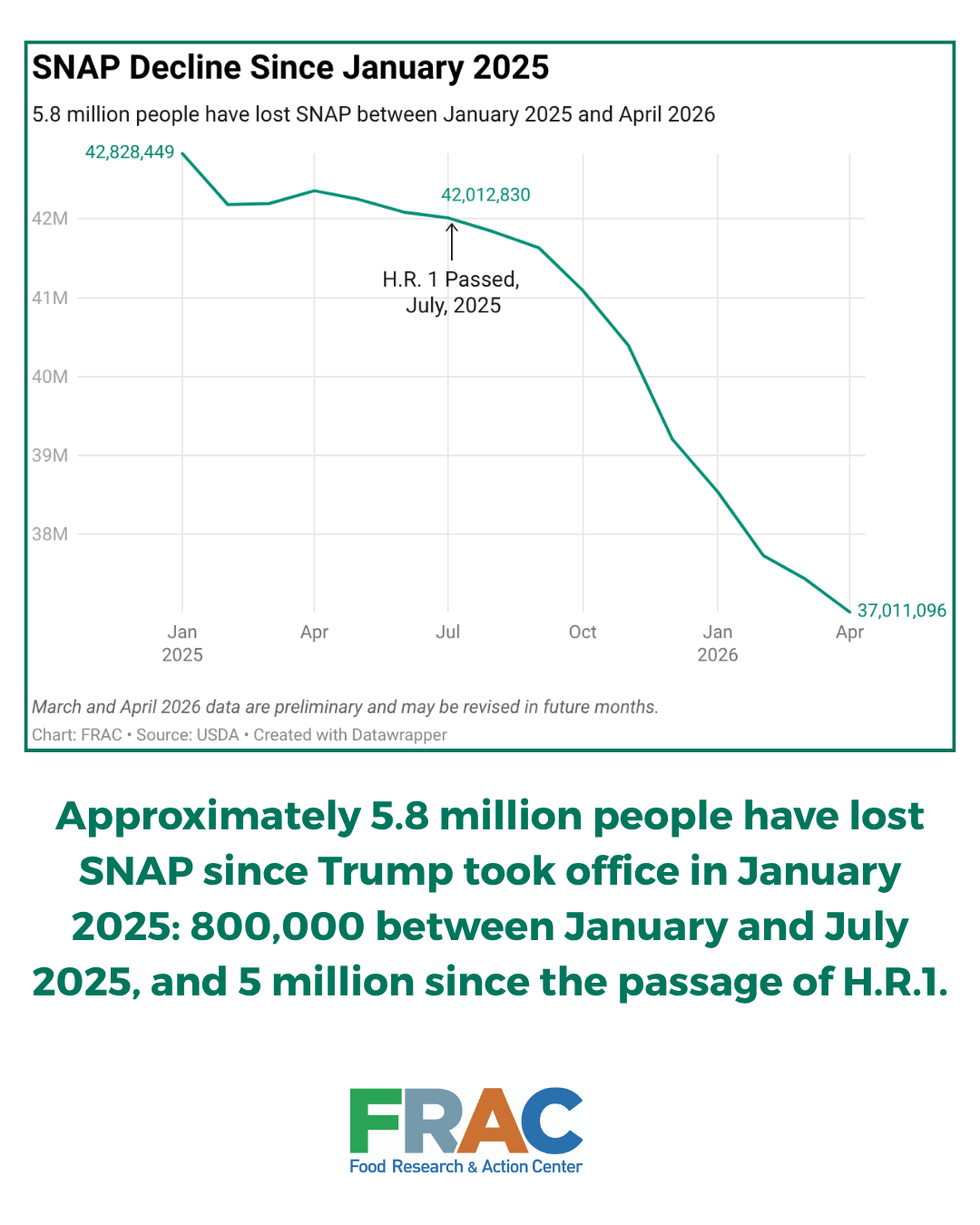
Grocery prices remain elevated, with food-at-home prices 2.7 percent higher in June 2026 than a year earlier, while decades of research demonstrate SNAP’s important role in reducing food insecurity and supporting economic stability. These policies must also be considered alongside the more than 5 million people who have already lost access to SNAP following recent eligibility and participation changes implemented according to the budget reconciliation law (H.R. 1).
Against this backdrop, a new FRAC research report highlights SNAP’s role in alleviating poverty; improving food security, nutrition, and health outcomes; and reducing health care utilization and costs for vulnerable Americans. The program’s impacts would be even more profound if benefits were increased to more adequate levels and access were expanded through meaningful, thoughtful policy change. However, recent federal and state policy changes threaten SNAP’s economic and health gains.
Given its size and reach, SNAP has been the target of efforts to improve the nutrition and health of people with low incomes and wages for decades. In more recent years, renewed attention to SNAP has been driven in part by state and federal initiatives surrounding the MAHA movement. Unfortunately, misconceptions and misinformation about SNAP and its participants have too often resulted in policies that are unsupported by evidence and that undermine health.
Implications of H.R. 1 for SNAP and Health
One of the most consequential recent policy changes occurred with the enactment of H.R. 1 (also known as the “One Big Beautiful Bill Act”) on July 4, 2025, which fundamentally weakened SNAP by reducing access to benefits for millions of people. The law also weakened SNAP’s food-purchasing power by reducing benefit adequacy and defunding SNAP-Education (SNAP-Ed), the program’s primary and evidence-based nutrition education initiative.
Cutting off food benefits and eliminating nutrition education for Americans with low incomes will not “Make America Healthy Again.” Leading experts in public health, medicine, nutrition, law, and economics have described how the fallout from H. R. 1 is likely to exacerbate health disparities, reduce program participation, increase food insecurity, contribute to negative nutrition and health outcomes, and undermine SNAP’s ability to effectively and quickly respond to unfavorable economic conditions.i,ii,iii,iv,v,vi,vii,viii,ix Early implementation data indicate these changes are already affecting program participation: More than 5 million individuals have lost SNAP benefits nationwide since the law was enacted.
Implications of Food Restrictions for SNAP and Health
Beginning in 2025, multiple states implemented restrictions on the purchase of certain foods and beverages with SNAP benefits, often under the pretext to “Make America Healthy Again” (or, in some cases, to make their particular state “healthy again”). Although a federal district court issued a significant ruling that invalidated USDA’s approvals of SNAP food-restriction demonstrations in five states, demonstrations remain in effect in 18 other states despite the absence of evidence that these policies improve diet quality or health and despite longstanding concerns that they undermine participants’ dignity, choice, and autonomy To make matters worse, states have been granted broad authority to restrict SNAP purchases despite failing to address structural inconsistencies embedded in waiver design and failing to design evaluations that can produce credible, generalizable evidence.
Restrictions on the purchase of certain foods and beverages with SNAP benefits will not “Make America Healthy Again.” According to a commentary in the American Journal of Public Health : “Evidence does not support the assertion that setting nutrition standards for eligible SNAP purchases will improve diet quality or health. On the contrary, evidence suggests that should restrictions be implemented, they may instead produce a paradoxical effect through accumulation of new stressors that exacerbate preventable health disparities.”
Implications of Other Federal Policy Changes for SNAP and Health
Monitoring the consequences of H.R. 1, as well as other harmful policies directed at federal nutrition assistance, has become much more difficult following USDA’s termination of the Household Food Security Report and the associated Current Population Survey Food Security Supplement, the nation’s gold-standard measure of household food security. .
The ending of the Food Security Supplement, creates a substantial evidence gap precisely when major changes to federal nutrition and health programs are affecting millions of households. Eliminating the nation’s primary food security monitoring system does not reduce hunger; rather, it limits the ability to detect emerging trends, evaluate policy impacts, and respond before worsening food insecurity translates into higher rates of chronic disease, greater health care utilization, and deeper economic hardship for individuals and families.
All of these concerns are further compounded by broader federal policy changes affecting health care and food access.
New Medicaid work requirements are projected to cause millions of eligible adults to lose health insurance coverage primarily because of administrative barriers rather than changes in employment.
Cutting off people from health insurance among the Medicaid population will not “Make America Healthy Again.” Instead, it will increase the number of uninsured individuals in the nation and shift health care costs to hospitals, health care providers, taxpayers, and state governments already facing significant fiscal constraints.
Restricting SNAP participation for convenience and other small food stores will negatively impact economies, food insecurity, and health. The administration’s updated SNAP retailer stocking standards, which will disproportionately impact small stores and threaten their eligibility for participating in SNAP, are set to go into effect in a few weeks. These stores represent about 70 percent of all SNAP retailers, and the new stocking standards could prompt thousands of these smaller retailers to leave SNAP or lose authorization, potentially reducing an important source of federal dollars for local economies, as well as reducing food access in underserved communities.
Protecting and Strengthening SNAP
Making SNAP more difficult to access, administer, and evaluate is a counterproductive strategy for improving the nation’s nutrition and health, especially amid other damaging federal policy changes that threaten food security and health. To “Make America Healthy Again,” we must invest in and strengthen SNAP through more adequate benefit levels and better program access. We cannot “Make America Healthy Again” while dismantling SNAP.
Learn more: SNAP: An Evidence-Based Program to Improve Food Security, Health, and Well-Being.
Take Action
America cannot become healthier by weakening one of the nation’s most important and durable anti-hunger and nutrition assistance programs, particularly when hunger remains elevated, groceries remain unaffordable for many households, and communities increasingly depend on SNAP and the charitable food system to meet basic needs.
Since your Member of Congress is in your district during recess, use this ret, and email to confirm that, when they return to D.C. in mid-September, they will remember the daily struggles of Americans trying to make ends meet. And remind them that hunger is a political choice, and you hope they will vote and use their influence to ensure that any legislative action restores, protects, and strengthens SNAP.
Nguyen, K. H., Gago, C. M., & de Cuba, S. E. (2026). Eroding the foundation: health and social needs of adult SNAP participants in an era of policy change. Health Affairs Scholar, 4(4), qxag086.
Eicher-Miller, H. A., & Gundersen, C. (2026). Concerns for United States food security amid changes in work requirements of the Supplemental Nutrition Assistance Program (SNAP) and the termination of nutrition education through the Supplemental Nutrition Assistance Program-Education (SNAP-Ed). American Journal of Clinical Nutrition, 123(6), 101306.
Austin, A. E., Ettinger de Cuba, S., Maierhofer, C. N., Naumann, R. B., & Shafer, P. R. (2026). Protecting SNAP as a critical public health intervention. Preventive Medicine, 204, 108518.
Bleich, S. N., & Plata-Nino, G. (2026). Changes to SNAP under H.R. 1 and the implications for food insecurity. JAMA Health Forum, 7(1), e260158.
Bauer, L., & Schanzenbach, D. W. (2025). SNAP Cuts in the One Big Beautiful Bill Act Will Significantly Impair Recession Response. Hamilton Project. Available at: https://www.hamiltonproject.org/publication/post/snap-cuts-in-the-one-big-beautiful-bill-act-will-significantly-impair-recession-response/
Coakley, K. E., Buro, A. W., Thompson, O. M., Tinkle, M. B., & Jimenez, E. Y. (2026). Implications of federal nutrition policy changes for maternal and child health. Journal of Obstetric, Gynecologic, and Neonatal Nursing, online ahead of print.
Abba-Aji, M., & Galea, S. (2026). The health implications of US federal changes to nonhealth structures and policies. Journal of Health Politics, Policy and Law, 51 (2), 211–224.
Bleich, S.N., & Seligman, H. (2026). Federal nutrition assistance programs 2021 to 2025: Policy expansion and contraction. Milbank Quarterly, online ahead of print.
Caputo, V., & Just, D. R. (2025). Adjustments, evidence and political tensions in the US Supplemental Nutrition Assistance Program. Nature Food, 6, 1115–1123.
