


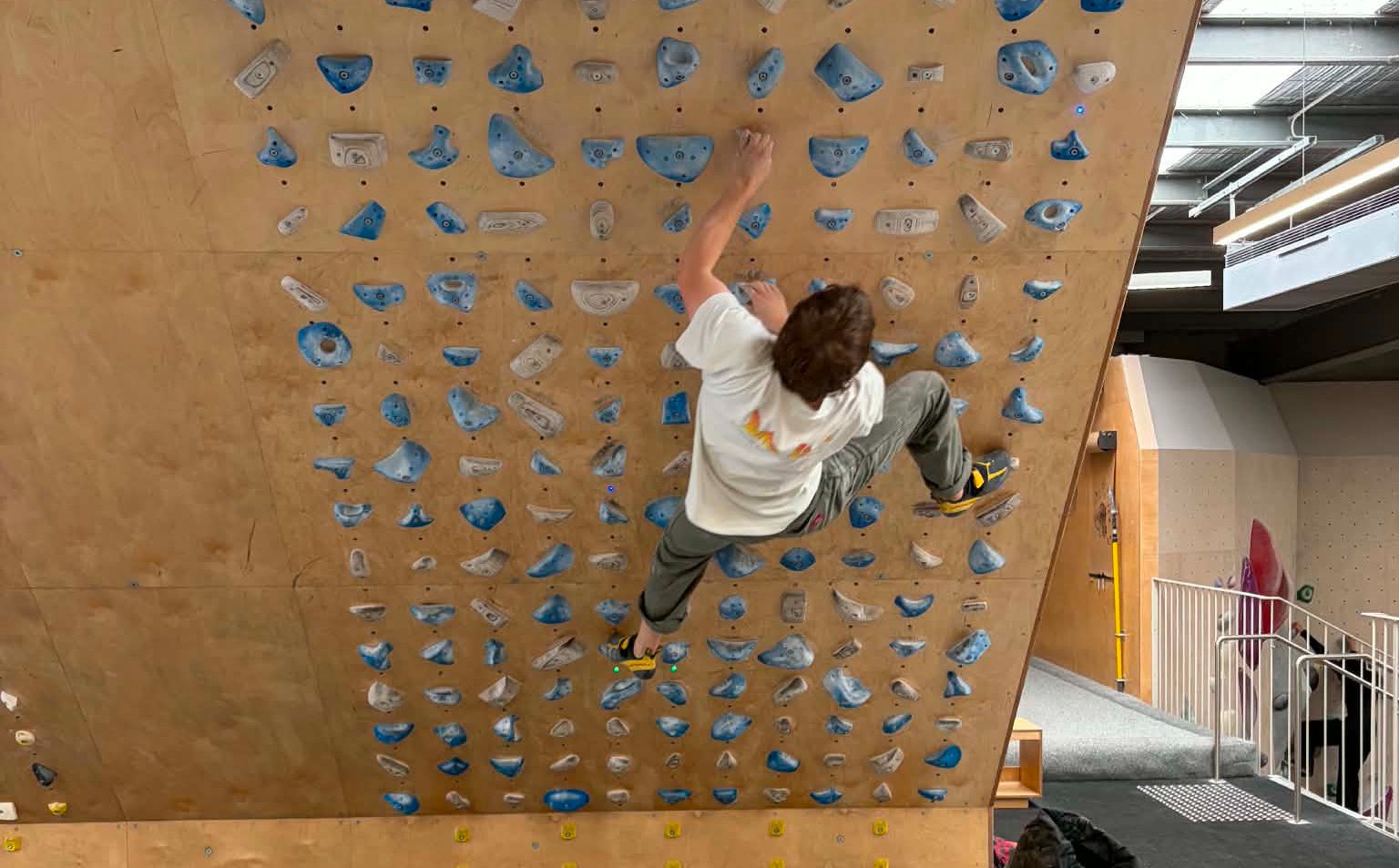
I was on a random visit to Melbourne, Australia, and thought I would drop in on a bouldering gym. The closest to my digs was Rocket Climbing in West Footscray, a four year old gym servicing, among others, students from nearby universities
I walked into a culturally diverse group seeking out some plastic between lectures
At first I felt like I had wandered into a classroom where I did not know the subject. I was surrounded by climbers moving confidently between the walls, talking through problems and working things out together. After a few minutes I realised the blackboard had changed. The problems on the wall were rewritten regularly, chalk was provided for all and there was no teacher at the front. Everyone seemed to be teaching someone else. A climber would work out a sequence, another would watch, offer some beta, have a go and then return to the wall. I was about to get a new education.
Rocket was clean as a hospital, well lit and a bit of a schmooze fest. It has to be. Bouldering gyms are booming. There is an appetite for climbing, coffee and conversation and at most gyms you get all three. Melbourne now has somewhere around 15 to 20 dedicated bouldering and mixed climbing venues, although the number is hard to nail because the scene is changing so quickly
There’s reasons for that. Melbourne is as flat as a tack and if you want to boulder on real rock you have to leave the city. The gyms have brought the climbing to the people. With bouldering there are no ropes, no partner required, no mission and no long drive. You can boulder between lectures, after work or simply as a workout. It’s just easy
That accessibility is part of the appeal, sure, but it is not the whole story. Some people come because they want to climb outside. Others are perfectly happy climbing indoors. For them, the gym is not a substitute for rock. It is simply where they climb. My idea about climbing has been challenged. I have always thought the gym was where you trained so you could go climbing. For plenty of people, the gym is where you go climbing, destination full stop
Inside Rocket I met Charlie Erdmont and Matt Follent. They were working on the Spray Board, following the gym app to work out which illuminated hold matched the problem on their phones. Phone, eyes on wall, chalk up, beta walk the wall, repeat
I had assumed they were regular climbing partners. They had only just met. Matt had sat down to try some climbs on the MoonBoard when he introduced himself to Charlie. Within minutes they were climbing, talking and working out problems together
That chance meeting reminded me of something Conrad Wansbrough, a climber in his late forties and a member of Rock It Bouldering in Derwent Park, Tasmania, told me about his own experience in bouldering gyms
“It’s like a game of chess whilst hanging upside down pulling on plastic. What’s different is you get behind the people you play.”
I could see that in Charlie and Matt. They were having a yarn between climbs, but at the same time they were trying to outmanoeuvre each other and having fun doing it. Conrad described the interaction as being like a rap dancing battle. There is competition, but it is wrapped in play and conversation
Charlie has been bouldering in Melbourne for almost ten years. Like most beginners, he had no idea what he was doing and initially tried to muscle his way through climbs with little technique. He got hooked on the quick progression. Today he has a clear idea of what makes a good gym
“Good holds, a range of facilities that can service all climbers, a clean gym and regular setting.”
Rocket delivers. Upstairs are boards, hangboards and weights. Downstairs, the setting is, as Charlie puts it, “quite futuristic”, with moves that look great on Instagram, but there are enough old school style climbs to get him conditioned for outdoors. Charlie was training for a Grampians and Arapiles trip in September, so he was on the boards rather than the commercial sets
“The sets definitely matter,” he says. Pulling hard moves and finding flow through challenging sequences is what he wants. More than simply crimping, he enjoys “figuring out beta and doing some cool moves.”
The problems stay up for around six weeks. That gives climbers time to work the harder stuff and use the rest for training, while putting pressure on the setters to keep the place fresh. Good problems bring people back. It would be an interesting stat to know how regularly gyms change up their walls across the globe but that would require work and I hate math
Des, the manager, was route setting with three other guys while I was there. He was more interested in managing his crew and getting the setting right than talking about the business. He was reluctant to speak, so I schmoozed my way under his defence. Watching him work was probably more revealing anyway
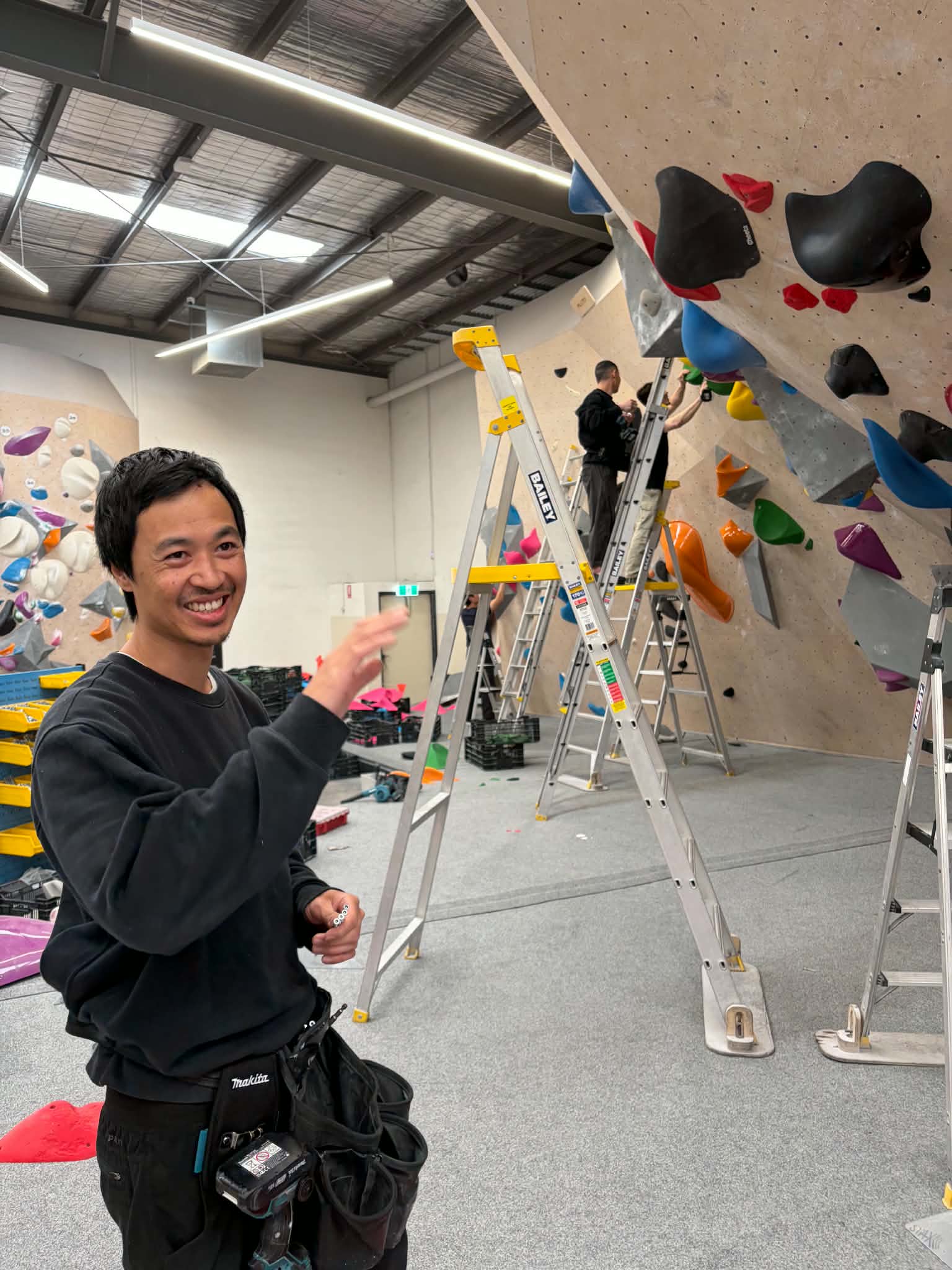
What I found in this gym, pocketed amongst suburbia and industry, was a community built around movement. Some were mates, many had arrived alone. They were getting their hands chalked, talking through problems, falling onto the mats and getting back on the wall. Music filled the gym and everyone was absorbed in the same pursuit, but there was plenty of interaction around it
Conrad sees something similar at his local, Rock It Bouldering. He goes to the gym for fitness, but also for connection. He describes a bouldering gym as a melting pot because the activity itself encourages interaction
“At a climbing gym you attend with a partner, you gear up. It takes time out of your session and the crux is not at eye level so the partnership isn’t as good as bouldering where both climbers are right amongst it, no waiting too long.”
With bouldering, everyone can see the same problem. You can watch someone climb, work out an idea, have a go yourself and talk about what happened. When someone falls, another person might brush the holds while they recover. There is an unwritten bouldering etiquette developing around these small acts. They are social signs and, with conversation, comes connection. Conrad shared
“Friendships form quickly, interaction with others is a part of the process.”
The more often you attend, the more familiar the faces become. Conrad puts it another way: “I exercise my gums as well as my body.”
And there is something for almost everyone. Kids can climb without needing a large amount of equipment or a complicated introduction to the sport. Parents can sit with a coffee while their children climb. Beginners can watch others and learn, while experienced climbers can train for whatever they are pursuing outside. The best gyms allow all of these things to happen at the same time
The challenge for gym owners is not simply building bigger walls or adding more problems. It is creating somewhere people want to return to. Modern gyms are already moving in that direction with youth programs, women’s sessions, introductory classes and serious training facilities. I am not convinced bigger is always better. A smaller gym can have character, and less space means fewer bills. What matters may be what happens around the climbing
If you are going to build a bouldering business, why not make the gym a meeting place? Do your session, have a coffee or a beer, play some climbing tri your mates, meet some new ones, hang around a while. The climbing gets people through the door, but the social side may be what keeps them coming back
What is happening in Melbourne is not isolated. Bouldering has become part of an international shift, although each country has arrived at it from a different direction
In the United States, bouldering has become a major commercial industry. According to the Climbing Business Journal, there are now roughly 270 bouldering focused gyms in the country, with 95 percent having opened in the past 15 years. In both 2024 and 2025, bouldering gyms accounted for 73 percent of new US climbing gym openings, an all time high
The American boom is beginning to mature. The Climbing Business Journal’s 2025 Gyms & Trends report recorded 40 new US gyms in 2025, with 28 net new gyms after closures. North America as a whole added 41 net new gyms, a 4.7 percent net growth rate
Canada sits somewhere between the American commercial explosion and Australia’s smaller, more geographically constrained market. The Climbing Business Journal recorded 11 new Canadian gyms in 2025, giving Canada a 6.5 percent net growth rate. In cities such as Vancouver, Calgary and Toronto, the gym can be a training ground for the mountains and crags as much as a destination itself
Australia is different again. The population is much smaller, but Melbourne has developed a remarkable density of bouldering gyms. Geography has helped. Real rock is not close, so the city has made its own climbing landscape indoors. The social side has then become part of the experience
Charlie sums up the Australian appeal neatly. “There are plenty of new gyms popping up in Melbourne which is great!” he says. “Bouldering is just so much more accessible than ropes.” He trains hard inside “so I can climb hard routes outdoors when the weather comes good.”
That may be the interesting thing about the modern bouldering gym. There does not have to be one reason for being there. One climber is training for a route in the Grampians. Another is learning how to climb. Someone else has come for a workout. Someone has arrived alone and leaves having made a friend. A child is learning to climb while a parent drinks coffee. Someone else simply likes solving movement problems on plastic
I walked into Rocket expecting to see a place where people trained. I left thinking I had seen something bigger. Bouldering has escaped the corner of climbing where it once lived. It is accessible, social and urban. The gym is no longer simply somewhere to train when the weather is bad. For many people it is where climbing happens, and increasingly it is where climbing community happens too
Build the walls, make the problems, sure. But give people somewhere to meet, somewhere to talk and somewhere they want to return to. You’ll chalk up more than solving problems, you’ll build something better, community. Most things start through a conversation and there is plenty of that bouldering. I could hold onto that
