


September 1, 2026
Africa remains a testing ground for the PLA’s expeditionary capabilities and equipment, posing political and strategic implications for African governments
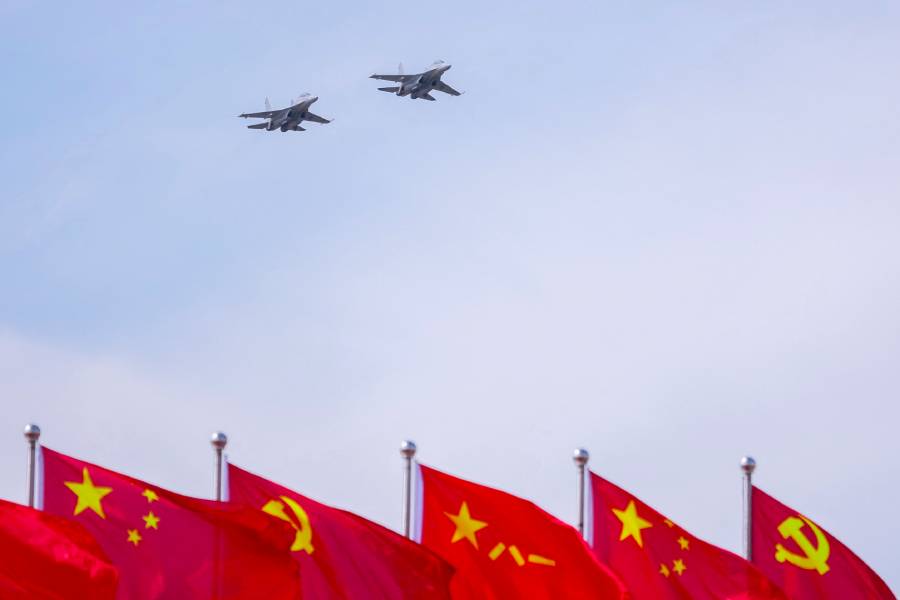
Two Chinese J-16 fighter jets take part in an air show in September 2025. (Photo: AFP)
“Eagles of Civilization 2026,” the latest China–Egypt air force warfighting exercise, is a significant step up in scale, complexity, and power projection from China’s previous military training drills in Africa, including last year’s Eagles of Civilization
The latest drill continues the trend toward larger and more complex China-led exercises in Africa
The Chinese deployment included six 4.5-generation Shenyang J-16 (“hidden dragon”) jet fighters, two Xi’an YY-20A aerial refueling tankers, and two Y-20A strategic transports, one Shaanxi KJ-500 airborne early warning and control (AEW&C) aircraft, two Harbin Z-20K medium-lift utility helicopters, and one Shaanxi Y-9 transport platform for localized radar jamming and suppression
The latest drill continues the trend toward larger and more complex China-led exercises in Africa. These include:
- “Will for Peace 2026” naval exercises (also called Exercise Mosi III) involving China, Russia, South Africa, and Iran under the auspices of BRICS Plus
- “Eagles of Civilization 2025” between China and Egypt
- “Peace Unity 2024” ground, naval, and air exercises involving China, Tanzania, and Mozambique
The 2026 Sino-Egypt drill demonstrated the ability of the People’s Liberation Army Air Force (PLAAF) to move an integrated combat package more than 6,000 km across two continents and four countries in roughly 9 hours, with YY-20A tankers providing aerial refueling en route
Egypt employed French-supplied 4.5-generation Rafales against Chinese J-16s, a step change from the 2025 exercise where Cairo’s MiG-29s sparred with Chinese J-10s. This match-up allowed the PLAAF to test the J-16 against an advanced Western fighter outside of China and gain operational insights
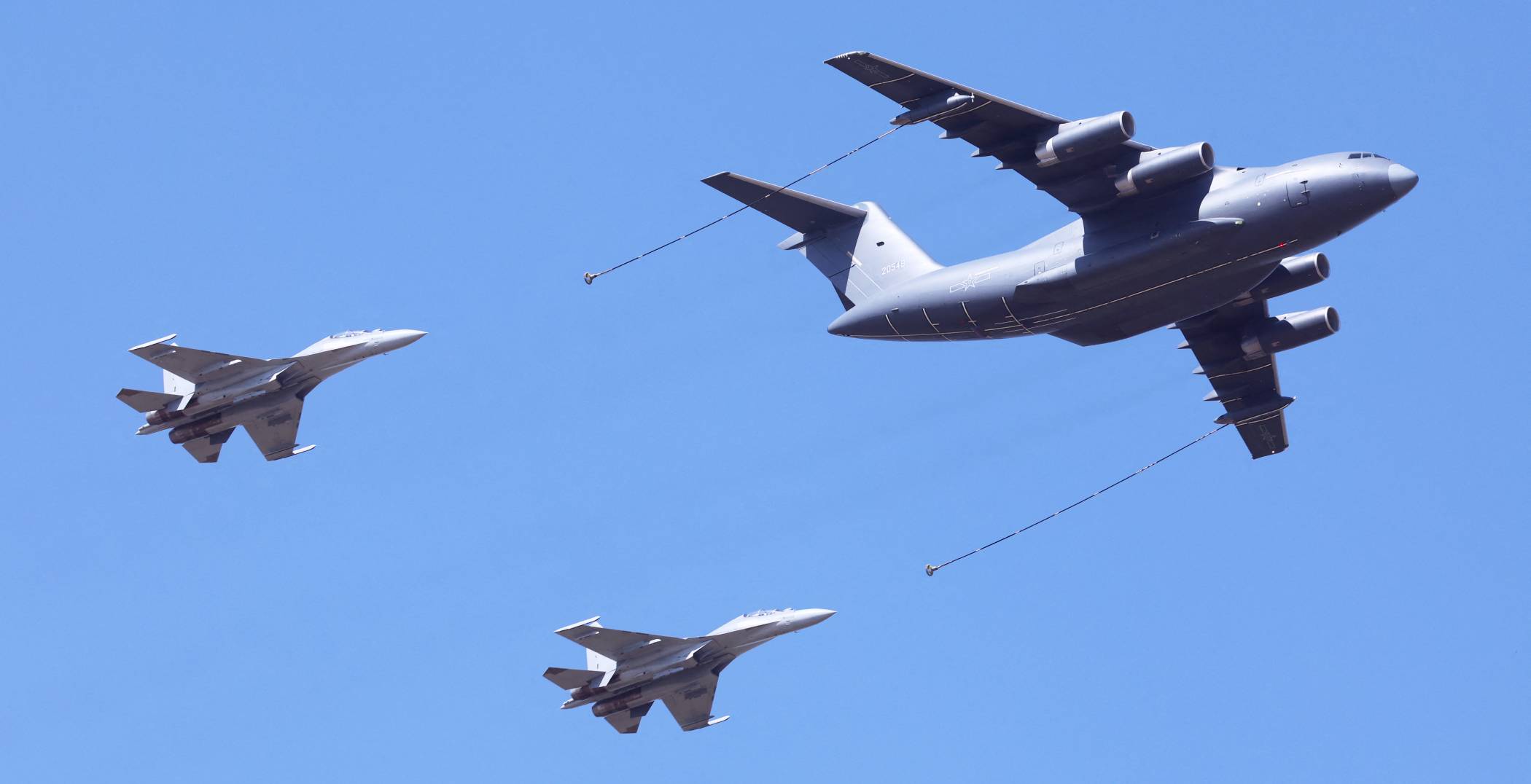
A Chinese YY-20A aerial refueling tanker and two J-16 fighter jets. (Photo:
In a first, Chinese President Xi Jinping traveled to Egypt for a state visit during the exercise, accompanied by leaders from the ruling party’s Central Military Commission (principals who rarely leave China), underlining the geostrategic importance of the exercises for Beijing
China’s expanding military exercise architecture raises important questions for Africa. What are the implications for African partners from enabling PLA warfighting and power-projection capabilities? How do these exercises reconcile with Africa’s longstanding opposition to foreign militarization on the continent? What are the consequences for Africa’s strategic autonomy from supporting China’s expeditionary warfighting capacity given African countries’ established posture of avoiding alignment with competing geostrategic blocs?
Progression of Chinese Military Exercise Formats in Africa
The shift from the J-10/J-10C aircraft in 2025 to J-16s in 2026 increased the range, payload, firepower, and tactical complexity from previous Chinese military trainings in Africa. The exercise incorporated beyond-visual-range and close-in air combat, air superiority, air-to-ground strike, suppression of enemy air defenses (SEAD), forward air control, combat search and rescue, mixed formations, and command-and-control integration—a shift toward more realistic warfighting scenarios
It is likely that Chinese weapons flows will … ultimately challenge African nonalignment and deepen strategic competition
Eagles of Civilization 2026 is the latest in a se.ries of expanded Chinese military drills in Africa, which are progressively larger, longer, and more complex. In addition to Eagles of Civilization, these include the Mosi series on naval exercises with Russia and South Africa (2019, 2023, with Iran joining in 2026), and the series of naval, ground, and air exercises with Tanzania (2014, 2019, 2020, 2023, with Mozambique joining in 2024)
China has conducted 24 exercises in Africa between 2000 and 2026. The evolution in the sophistication of these undertakings reflects the sustained militarization of Chinese policy toward the continent
2000–2011: Low Warfighting Content, High Symbolism. Early drills established a new form of PLA-Africa engagement distinct from China’s earlier train-and-equip support. These drills emphasized familiarization, contact, and signaling and were shaped more around humanitarian/peace support contingencies than warfighting. This is exemplified by “Peace Angel 2009” in Gabon, China’s first post-Cold War joint drill in Africa, which focused on humanitarian medical evacuation
2011–2014: Establishing Sustained Deployments beyond the Western Pacific through Anti-Piracy Operations. From 2011, PLA-Africa exercises increasingly supported China’s Gulf of Aden anti-piracy mission. Launched in 2010, these exercises enabled China’s first sustained deployments beyond the Western Pacific—part of what the PLA has called “New Historic Missions” (xin de lishi shiming, 新的历史使命). Training emphasized mission-relevant skills: fleet maneuver, visit-board-search-seizure (VBSS), maritime patrols, and hostage rescue.
These were extended to Africa’s Atlantic coast, including short-duration drills with Nigeria (May), Namibia (June), and Cameroon (July) in 2014, coinciding with port calls by the PLA Navy’s 16th Escort Task Group (ETG)
2014–2018: Higher Warfighting Content Aligned with Strategic Messaging. This began with the month-long “Beyond 2014” China-Tanzania drill, integrating PLA Navy (PLAN) Marines and Tanzanian People’s Defense Forces (TPDF) Marine Special Forces in high seas anti-piracy and counterterrorism operations. The PLA’s first joint exercise with the South African Navy in May 2016 further added warfighting scenarios to basic interoperability, pitting South African frigate SAS Amatola and submarine SAS Manthatisi against the PLAN destroyer Qingdao and frigate Daqing off the Cape Town coast.
2018–2023: Increasing Complexity and Commitment.From 2018, PLA-Africa drills increased in tempo, enabled by the PLA’s Djibouti base (opened in 2017) and enhanced forward logistics. The China–Russia–South Africa “Mosi” series increased in operational complexity while expanding from a trilateral to a BRICS Plus framework. The China-Tanzania “Beyond” (also called ”Transcend”) series were simultaneously expanded, including a 25-day, 300-troop exercise in Tanzania in 2019 involving PLA Eastern Theater Command’s 73rd Group Army.
Evolution of the China-Tanzania Military Exercises
| Exercise | Focus | Chinese capabilities | Tanzanian capabilities | Duration | Troop Size |
|---|---|---|---|---|---|
| Beyond 2014 | Maritime, anti-piracy, counterterrorism, hostage rescue | Rigid hull inflatable boats, light marine-infantry package | Type 63A Amphibious tanks (Chinese supplied), patrol boats | 1 month | 100 Chinese and Tanzanian marines |
| Sincere Partners 2019 | Live fire, blasting operations, built-up area operations and search, and a command post simulation | Small arms, UAVs, explosives/demolition equipment, individual infantry equipment, urban combat and search equipment | Same | 25 days | 300-plus, drawn from the PLAA 73rd Group Army (Eastern Theater Command), TPDF ground forces and marines |
| Beyond 2023 | Maritime security, counterterrorism tactics, live fire | Small arms, special weapons, UAVs, small boats, marine infantry equipment | Same | 12 days | Not announced |
| Peace Unity 2024 | Integrated land and maritime operations, amphibious assaults, strategic air- and sea-lift, search and rescue, live fire | 3 surface vessels; Y-20 strategic airlift; naval special forces; artillery, self-propelled guns, amphibious landing craft, UAVs, armored/reconnaissance, armored engineering, and tactical vehicles; joint logistics and information-support elements | Four patrol boats, TPDF ground forces, including special operators, infantry weapons and equipment, recce, comms, and tactical capabilities | 14 days | 2,000-plus, including 1,100 Chinese troops from PLA 82nd Group Army, 127th Medium Combined Arms Brigade; the 82nd Group Army, Special Operations Brigade |
2024–Present: Extending China’s Expeditionary Capacity. After the COVID hiatus, Mosi II (2023) and Beyond III (2023) sustained the tempo, while Peace Unity 2024 marked a major step change in China’s expeditionary capability. In China’s largest African deployment since the 1960s, the PLA, TPDF, and Mozambican forces conducted integrated land and maritime operations, including amphibious assaults. For the first time in Africa, Chinese contingents and equipment and supporting elements deployed from mainland China with strategic lift assets, including Y-20 transports and Type 071 amphibious landing ships, demonstrating a heavier joint force-projection capability. The contingents included elements from the PLA’s Joint Logistics Support Force (JLSF) and Information Support Force (ISF), which, like the Y-20, were deployed to Africa for the first time.
Geostrategic Significance for China’s Evolving Military Posture in Africa
The latest Eagles of Civilization exercise, introducing high-end Chinese capabilities into high-tempo exercises in Africa, underscores that key features of China’s evolving training strategy in Africa are more relevant to building China’s warfighting and expeditionary capabilities than to strengthening African force capacities. These Chinese capabilities include long-range logistics, aerial refueling, dissimilar air combat against Western fighters, and sustained overseas power projection. This focus on China’s broader warfighting objectives marks a significant shift from earlier formats.
China’s evolving training strategy in Africa is more relevant to building China’s warfighting and expeditionary capabilities than to strengthening African force capacities
Eagles of Civilization 2026 builds on other recent drills in Africa by projecting and sustaining combat power directly from mainland China rather than redeploying forces already in the theater. Repeating an intercontinental tactical air deployment within 16 months, while expanding the aircraft mix and support architecture, suggests the PLA is focused on developing a recurring expeditionary model rather than conducting a one-off demonstration
The expanding Chinese military drills in Africa have broader geostrategic implications given their ripple effects on partners and rivals. The J-16–Rafale jet fighter engagements in Eagles of Civilization 2026 progressed from one-on-one to two-on-two, and larger formations. This was the first J-16 duel against a Western fighter and its first deployment outside Asia
The drill occurred simultaneously with “Swift Eagle 2026” (China–Belarus) and “Falcon Strike 2026” (China–Thailand), where China’s J-10s sparred with Thailand’s Swedish SAAB JAS 39 Gripens. The Egypt drills, therefore, were part of a global campaign to conduct combat training against an assortment of Western fighters. That these PLA-led exercises were conducted simultaneously underscores China’s objective to rehearse deploying and sustaining forces in multiple global theaters
The Egyptian exercises have prompted intense India media scrutiny as the Dassault Rafale is India’s premier operational fighter, with 36 in service, 26 additional aircraft on order, and 114 under consideration. Following the May 2025 India-Pakistan conflict, in which Pakistani J-10Cs and JF-17s engaged Indian Rafales, New Delhi is concerned that PLA experience against Egyptian Rafales could generate tactical and technical insights relevant to India’s combat capabilities—potentially aiding Pakistan through China’s defense relationship with Islamabad. France likewise monitored the exercise closely. Gen Fabien Mandon, Chief of the French Defence Staff, visited Cairo a day after the first set of J-16-Rafale duels.
The Pakistan-India engagements in 2025 provided Beijing with a defense-marketing and propaganda opportunity for weapons sales in Africa. China first showcased the J-10 to African customers at Egypt’s international airshow in September 2025, 5 months after the Pakistan-India skirmishes. In July 2026, Algeria was reportedly preparing to receive J-10Cs and KJ-500 AEW&C aircraft, while several African governments already operate Chinese J-series or export derivatives, including Namibia, Nigeria, Sudan, Tanzania, Zambia and Zimbabwe.
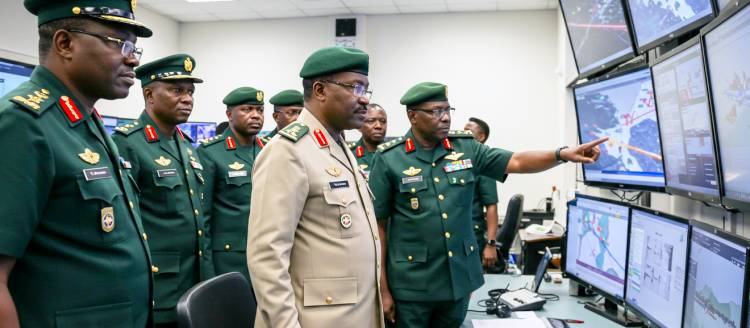
Nigerian military leaders assessing lessons from Pakistan-India aerial clashes in 2025. (Photo: Military Africa)
Implications for Africa
China’s expanding military footprint and growing sophistication of military exercises in Africa have prompted deeper reflection on the strategic implications for the continent
Former South African naval officer and founder of the biweekly China-Africa Security Radar, Lungani Hlongwa argues that deeper Chinese engagement could trigger new arms sales. He observes, “The J-16-Rafale matchup illustrates this dynamic, as might be seen by the deluge of unverified claims on Chinese social media about the J-16’s superior performance over the Rafale. It is likely that Chinese weapons flows will continue and all this will ultimately challenge African nonalignment and deepen strategic competition.”
Hong Kong-based PLA expert Tewodros Woldearegay argues that recent Chinese exercises in Africa “increasingly validate the PLA’s expeditionary logistics and ‘access without basing’ model, reinforcing China’s power-projection capabilities.” He also raises concerns about growing African dependency on Beijing: “While African states gain training and procurement diversification—arms sales, debt, and military education can deepen dependency, enabling Beijing to embed its doctrines and interoperability standards.”
“Many [African states] lack leverage to shape the resulting security dynamics.”
Paa Kwesi Wolesley Prah, a Hong Kong-based specialist on PLA activities in the Sahel, describes a two-way dynamic: “PLA exercises showcase Chinese capabilities, stimulate weapons demand, expand arms flows, and normalize PLA engagement. African states use the drills to signal military capability to domestic and regional audiences, and secure alternative procurement channels, but many lack leverage to shape the resulting security dynamics.”
Egyptian commentators provide a counterpoint. Cairo-based analyst General Samir Farag says Egypt pursues a “diversified portfolio,” with China complementing United States and other security partnerships. Egypt operates more than 200 F-16s, roughly 20 Mirage fighters, and around 30 Rafales while co-hosting the biennial U.S.-led Bright Star exercise. Yet Egypt’s outreach to China remains strong. Military educator Maj. Gen. Adel Al-Omda argues that Eagles of Civilization exposes Egyptian pilots to Chinese “technology, operational concepts, and advanced weapons”—a net benefit to Egypt. Security analyst Lama Farouk notes that “diversification gives Egypt greater flexibility” in sourcing technology while balancing immediate needs and longer-term defense-industrial development.
Prah, nevertheless, argues that China has more leverage given its relative power, allowing it to steer exercises toward its warfighting requirements as opposed to African priorities. “The J-16–Rafale engagement, for example, arguably has limited relevance to the African security threats, which are intrastate in nature. It clearly supports PLA combat training and technical collection against Western systems.”
African agency also depends on whether African partners can shape exercise scenarios around their security priorities like strengthening capabilities in peace support operations and combating irregular and transnational threats. Woldearegay argues that such agency is limited. He notes, “China typically retains greater leverage over exercise design, even when host states formally co-sponsor events. Chinese accounts of Eagles of Civilization, Mosi, and Peace Unity emphasize PLA priorities—including air superiority, amphibious operations, battlefield search-and-rescue, and integrated force packages—indicating Beijing sets the technical and operational agenda.”
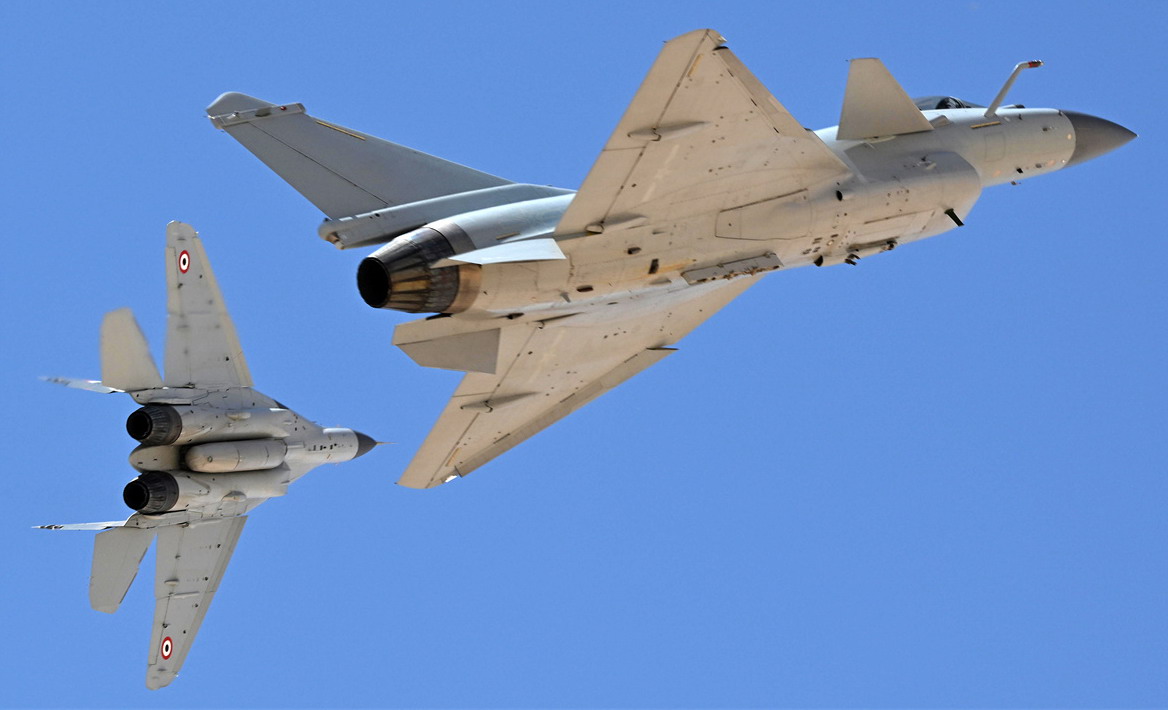
A PLAAF J-10 and a MiG-29 during the inaugural Eagles of Civilization exercise in Egypt
Hlongwa concurs: “Testing Chinese capabilities against Western systems and conducting amphibious shore landings, for example, align more closely with PLA high-intensity operations, even though African countries have conducted beach assaults, albeit rarely. That said, Mosi III was China-led despite being South Africa-hosted, while Eagles of Civilization appears China-initiated. The association of some of these drills with China’s Global Security Initiative further indicates Chinese influence over exercise design.”
Development Reimagined’s China–Africa security specialist Ovigwe Eguegu argues that African agency varies by country, with Egypt, Ethiopia, and South Africa demonstrating greater military ambition and strategic coherence. “Diversification appears to be emerging as the answer for weaker economies, but deeper ties invite competitor pressure, requiring states to leverage strategic competition without entanglement.”
Managing African Interests
Eagles of Civilization 2026 and other Chinese military exercises in Africa underscore the evolution of China’s military engagement on the continent from episodic training and capacity building initiatives toward increasingly sophisticated warfighting activities aimed at advancing China’s geostrategic posture. While the value of such exercises for African capability development and interoperability is ambiguous, they raise challenges of strategic dependency and entanglement in global rivalries.
To maximize African interests in future military engagements, African governments should assert greater ownership of joint exercises, shaping objectives, scenarios, force composition, and access arrangements around their own security requirements
African governments should assert greater ownership of joint exercises, shaping objectives, scenarios, force composition, and access arrangements around their own security requirements
African governments can also preserve strategic autonomy by diversifying defense partnerships, training, and procurement to limit dependence on any external power and sustain nonalignment. To elevate African public interests, commitments to military partnerships should be subject to legislative oversight and approval
Where African governments see value in foreign military exercises to strengthen operational capacity and technology access, they should protect sensitive military information shared by other partners to avoid geostrategic entanglements
With Africa increasingly seen as a theater for China’s expanding geopolitical ambitions, African governments and militaries will need to become adept at capturing potential operational benefits without sacrificing African agency, strategic autonomy, or balanced security partnerships
Additional Resources
- Paul Nantulya, “China’s Military Footprint in Africa Deepens with PLA-led BRICS Naval Drills,”Spotlight, Africa Center for Strategic Studies, January 30, 2026.
- Center for the Study of Chinese Military Affairs, Chinese Military Diplomacy Database, version 6.0 (Washington, DC: National Defense University, June 2025).
- Timothy Ditter, “Africa is China’s Testing Ground for Overseas Military Missions,”In Depth (Blog), Center for Naval Analysis, October 10, 2024.
- Jake Vartanian, “Peace and Unity: China’s Growing Military Footprint in Tanzania,” Strategic Studies Institute, October 9, 2024.
- Zongyuan Zoe Liu, “Tracking China’s Control of Overseas Ports,”Interactive Map, Council on Foreign Relations, August 26, 2024.
- Alex Vines, Henry Tugendhat, and Armida van Rij, “Is China Eyeing a Second Military Base in Africa as the US struggles to maintain one in Niger?” United States Institute of Peace and Chatham House, March 25, 2024, updated May 14, 2024.
- Paul Nantulya, “China’s ‘Military Political Work’ and Professional Military Education in Africa,”Spotlight, Africa Center for Strategic Studies, October 30, 2023.
- Paul Nantulya, “Considerations for a Prospective New Chinese Naval Base in Africa,”Spotlight, Africa Center for Strategic Studies, May 12, 2022.
More On: China in Africa
