


Mark Rappolt spoke with Ho Tzu Nyen, Park Gahee & Brian Kuan Wood about flexibility, incompletion and midlife crises
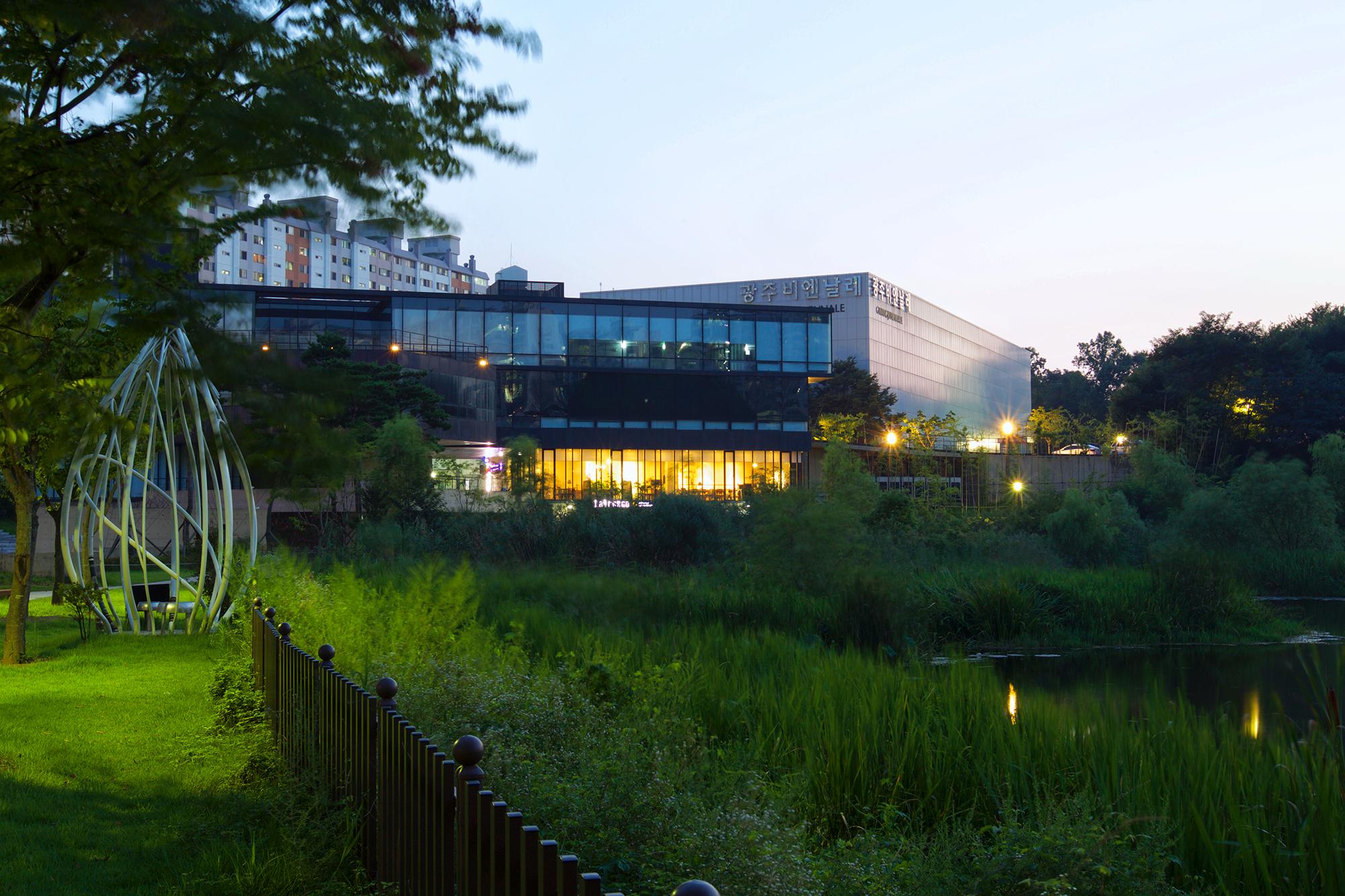
Gwangju is a city located in the southwest of Korea. Its name derives from gwang 광 (light) and ju 주; 州 (province). In modern history it is best known as the site of the Gwangju Uprising (referred to as May 18 in Korean), which occurred in 1980 following a peaceful demonstration against the regime of Chun Doo-hwan, who had taken power during a military coup in 1979. When the demonstration was violently suppressed, many citizens armed themselves and took over large sections of the city. This led, in turn, to an even more brutal army crackdown, which, over the course of nine days, killed hundreds of citizens. A directly elected government was restored in 1987. The first edition of the Gwangju Biennale was launched in 1995 to commemorate the uprising and is primarily housed in a permanent structure – the Gwangju Biennale Exhibition Hall.
Founded in 1994 to commemorate the May 18 Gwangju Democratization Movement and the 50th anniversary of Korea’s liberation, the Gwangju Biennale is now one of the leading art biennales in Asia. The biennale fosters international cultural exchange and discourse on contemporary art, embodying the ‘Gwangju Spirit’, which encompasses the principles of revolution, democracy and community. Over the past three decades, the Gwangju Biennale has challenged Western-centric art narratives, celebrated cultural diversity and tackled global issues such as climate change, race, gender and democracy. The artistic director of the 2026 edition is Ho Tzu Nyen, joined by curators Che Kyongfa, Park Gahee and Brian Kuan Wood. It runs from 5 September to 15 November.
ArtReviewHow did the theme and the title of the biennale develop?
Ho Tzu Nyen The title of the biennale is You Must Change Your Life. That is the last line in a poem from 1908 by Rainer Maria Rilke. The poem is ‘Archaic Torso of Apollo’. In the poem, Rilke transforms the reader into the viewer of an imaginary Ancient Greek sculpture. These torsos are often received by us in fragments. In a way, what is required from this imaginary viewer is to imagine the completion of the fragment
ARThat sounds like an excuse for an incomplete biennale
HTN In a sense, yes, but I would say all artworks are, by nature, incomplete. It requires the audience as the missing component to complete this chain. Sometimes the viewer can <a href="https://healthylife7.com/why-cant-our-gaming-handhelds-also-be-our-work-pcs/” title=”Why Can’t Our Gaming Handhelds Also Be Our Work PCs?”>also be the maker. Sometimes one makes something so that you can see it materialise in the first place
ARMight viewers think that you got the title from a self-help book?
HTN Actually, we would be very excited if they feel this connection. The theme of self-help is something I take quite seriously. At the beginning of our conversations, we often talked about self-help as a genre
ARWhen you say genre, do you mean in art? Or as a genre that’s got nothing to do with art?
HTN I would say at some levels it seems that it has nothing to do with art. We talked about self-help, for example, in the 1980s and 90s as this giant industry. Look at the list of bestsellers, it was often self-help books ranked at the top. Brian, you sometimes talk about Aristotle and his books on the ethics
Brian Kuan Wood It’s a certain foundation for practical philosophy. It’s not only about the care of the self and this design of conduct, but also a reforming of the self as a site for philosophy and for dealing with the world. Outside of the platonic Western tradition, philosophy itself, especially in Chinese tradition, is really about self-help
HTN The self-help genre, one could say, originated from Samuel Smiles. He’s a British writer, a bestseller when he wrote the book titled Self-Help [1859], and I believe this was one of the first books that was translated from English into Japanese during the Meiji period
A lot of what Smiles was trying to impact were qualities of habit, like being on time. I even read that this completely changed the time habits of the Japanese. In the past, it was totally OK for one to be late by 15 minutes or longer. After Smiles was translated – and this was also during the introduction of the market system – punctuality became a super-important quality, which persists today
ARThis relates to Korea through the colonial narrative?
HTN I would say in Korea, too, the time habits have changed. There was a time when it was possible to be late
Park Gahee Not anymore
HTN Of course, self-help has also changed completely in the last decade. Now we have all these YouTube channels and tutorials that literally are about how one can change one’s appearance. One can change one’s behaviour in all aspects of our lives, like changing our diets in the quest for immortality
It’s a different lens of looking at how we are changing and how larger systems are changing as well. Brian earlier mentioned the Asian tradition; that immediately also brings to mind what my parents often used to say, coming from a very Confucian household: that if I desired to change the world, the first thing I must do is to change myself
ARYou believe that still?
HTN I never thought about it in a very intense way when I was younger. Today I would say I believe in changing myself as a way to relate to the world. The way in which I am thinking about how I change probably was not what my parents had imagined for me
Going back to the title, what really attracted all of us to this was the strength of the statement: you must change your life. At the same time, accompanying this imperative to change is also complete openness, because Rilke doesn’t really say why we have to change or how we need to change. This simultaneity of force and openness is one of the key ways we are thinking of the exhibition
ARDo you think that’s also a reaction to the history of the biennial and its origins as a memorial to the May 1980 democracy-movement demonstrations? As a way of dealing with the baggage of its imperatives, and how the biennial is received?
HTN It’s impossible to think about the Gwangju Biennale without thinking about May 18th [the May 18 Democratization Movement, or Gwangju Uprising, a mass protest against Chun Doo-hwan’s military coup of 17 May 1980, put down over subsequent days by the military, during which 600–2,300 civilians are estimated to have been killed]. At the same time, it’s also a question, because May 18th, of course, was an extremely traumatic moment for many of the people who experienced it
One could say that, in the Freudian unconscious, time doesn’t exist. A trauma that you experienced in the past is perpetually in your present, even if you might not know it. This constant revisiting of what happened in May 18 is critical, but at the same time, in its structure, it is also a continuous repetition of that trauma. We started looking at how we would deal with the biennale through this paradoxical position
Change and transformation don’t necessarily mean a break with your past. Sometimes, with transforming, one carries over the past. How one carries over the past changes it into something else. This is something we hope we are able to pull off
ARDoes that include changing the mechanisms and structures of the biennale, and what a largescale exhibition like a biennale might be today, in 2026?
HTN The Gwangju Biennale is now in its 16th edition, with more than 30 years of history
One of the first things we tried to do was to look at how the biennale has been functioning. For example, I participated as an artist in previous editions. What struck me with this edition was the artist fees, which are not that different from the fees I received many years ago. The artist fee seems remarkably in a bubble of its own. One of the first discussions we had with the biennale foundation was in trying to address this. It will still, by no means, make any of our participating artists rich, but it is the beginning of a process, and we hope this process continues after us. We’ve also looked into other aspects, like introducing loan fees and rewording of the contracts. We are finding our ways to change the biennale itself – it’s a necessary part of our concept and our process. These types of changes aren’t something the audience would be conscious of, but I feel that making these gestures changes the tone of the relationships between ourselves, the artist and the foundation. I’m a big believer that these types of energies and moves somehow become tangible in the final episode.
ARGiven the title and theme you’re working with, do you have artists who’ve been in the biennale previously?
HTN Yes, we have quite a number. It’s a habitual mode of thinking to try to avoid artists who were in previous editions of a biennial. In fact, we were quite keen to test if these habits had any sense to them. I’m even open to showing the exact same work that the artist has shown
PG Actually, we have the exact same work from 2008 [by Nina Canell]
HTN The very act of repeating the same work from a previous edition already does something extremely interesting. What is the difference in showing this work now and from ten years ago? We can allow the historicity of what has occurred in the last ten years to then enter into the reception of this work
ARYou’ve stated previously that you’re keeping this edition all within the Gwangju Biennale Exhibition Hall rather than spreading it over multiple venues
HTN I can see certain advantages of spreading a biennale out, activating different spaces and sites, and drawing on local contextual histories. Somehow, these are secondary concerns for us in this edition
Focusing audiences’ time and energies and attention is something we are keen to have
ARThe world is changing and has changed since you first thought about the biennale last year. Do you feel you need to reflect how the world is changing? Do you build in the flexibility to do that?
HTN Certainly the world has changed in the last year, but I would say it has changed in a manner that is not so different from how we were anticipating a year ago. In a way, it still moved along its unfortunate trajectory. The shit just got worse, but it was the same form of shit
PG Rather, we were cautious about the language of the biennale. Previously, the framing was talking about the conflicts and the things that maybe the exhibition of the biennale can change
HTN This was an important point in our early discussions. We avoided mentioning any of these specific catastrophes. You can choose your catastrophe; there are so many. There’s no need to point to a specific one, because it’s all out there in the news. At the same time, one of our starting intentions, and this links back in a strange way to the question of self-help, is exactly what one does when the shit hits the fan
If one doesn’t wish to give in to hopelessness, what does one do? This is the self-help we are interested in. We are imagining our form of self help as some relation to empowerment, like feeling that things are still possible for us. Some of these possibilities are embodied by these artists and their practices, and how they deal with political disasters, how they deal with loved ones or family who are undergoing difficult moments, or how they even deal with their own health problems. How, instead of art being a kind of escape mechanism by which they can leave aside the difficulties they experience in life, they channel these negativities and find a way to convert them, to transform them. Even as I’m describing it, sometimes I feel like our discourse goes a little bit into cheesy territories, like spiritual self-help, care of the self. It’s important that we take on these questions somehow, but not limit them to the fields that they have been discussed in, but rather to create links to these larger political questions that we still face today.
ARIn your work as an artist, you don’t really take on those popular discourses. How is curating the biennale a different way of working?
HTN With a lot of my recent works, I construct a series of parameters, and use them to generate something new, which is quite often beyond how I imagined it at the beginning. A lot of the narratives, concepts and concerns that we have been discussing form the parameters for this next edition of the biennale
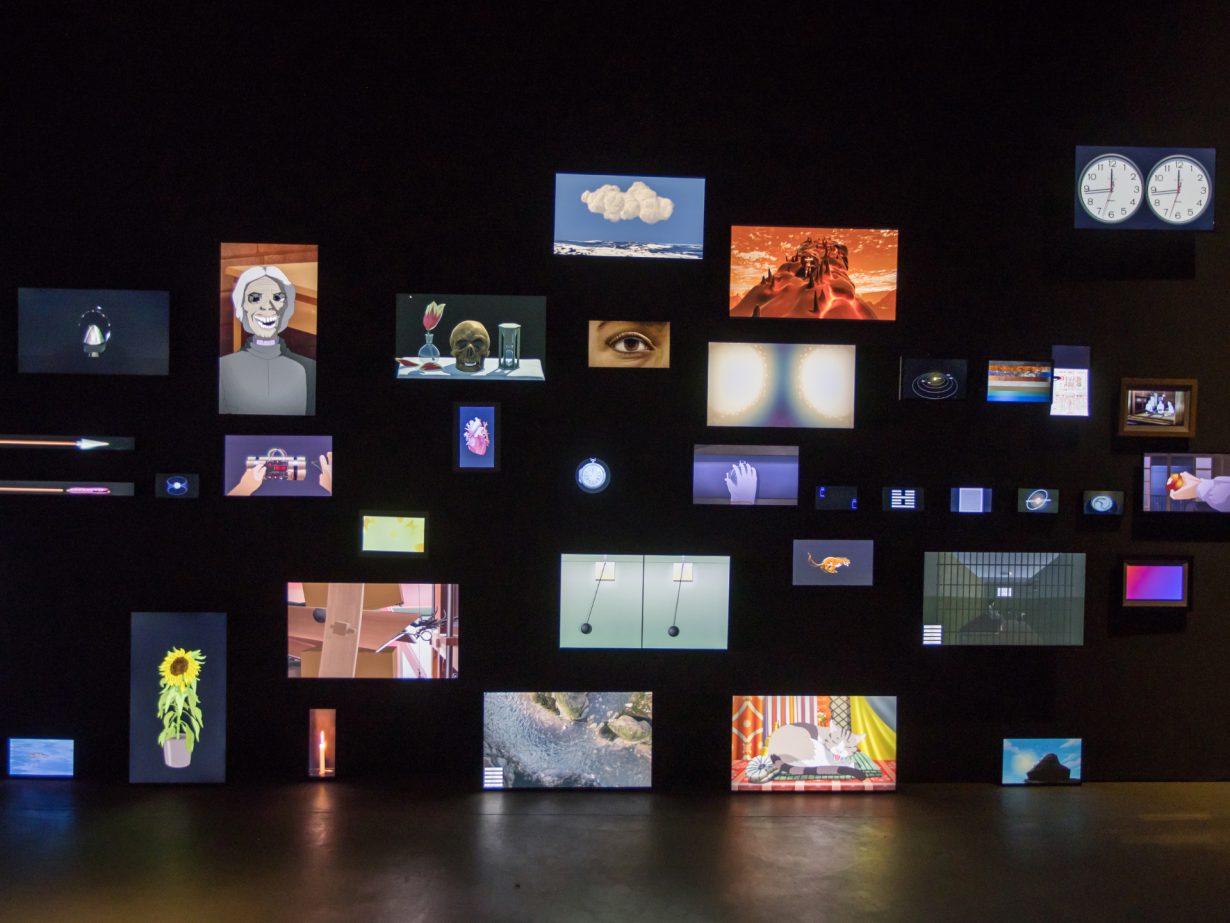
Part of how I arrived at this title and framework in the beginning was that I started to see some kind of shift in my own practice in recent years. For example, T for Time [2024], which was one of the last major projects I did, deals with as serious a topic as one can get, which is time – the eternal riddle of philosophy, religion and science
After I started working on it, I ended up in a very different space. To think about time requires the luxury of one’s own time. A lot of the stories that found their way into the work were anecdotes from friends and people that I’ve met in my daily life. These anecdotes sit next to other stories like Einstein’s theory of relativity. They sit for me in equivalence. This personal dimension was something that, without me being very conscious about it, started seeping into my practice
ARThinking about time could also be thinking about mortality, depending on someone’s age and perspective, and a meditation on complexity
HTN I’m someone who, rather than either/or, is always and/or. To the person who thinks about mortality, I would say the work was about mortality and time at the same time
PG Actually, one of the biggest inspirations is coming from midlife crisis
HTN I was trying very hard for us not to get there, and you just gave it away. Among ourselves, we sometimes joke that this is a midlife biennale. We are sorry to drag Park Gahee, who is the youngest member of our team, into our midlife questions, because Brian, myself and [cocurator] Che Kyongfa are in the same generation. This is us. We are all living at this moment when we have parents who are ageing. These things affect how we live and work and think. I would say these are the immediate concerns of our lives. I’m happy that we can jump into this biennale in a way that I feel is close to these questions. Maybe, after 30 years of the biennale, it’s also time for the biennale to work through these midlife questions.
Gwangju Biennale 2026:You Must Change Your Liferuns from 5 September through15 November
Ho Tzu Nyen is a Singaporean visual artist. His works blend fact, fiction and mythical narratives to give form to simultaneous and different understandings of history, its writing and its transmission. Central to this is a long-term investigation of the plurality of cultural identities in Southeast Asia. In 2019 he cocurated the Asian Art Biennial in Taiwan
Park Gahee is a curator based in Seoul. She previously worked at the Seoul Museum of Art from 2013 to 2017 and again from 2020 to 2025, and served as guest curator in the 2018 Busan Biennale. Approaching curating as a way of learning, she seeks to provoke ‘events of knowledge’ through her curatorial practices
Brian Kuan Wood is a writer, educator and curator based in New York. A cofounding editor of e-flux journal, he was a cocurator of the 2023 Taipei Biennial. He has taught and lectured worldwide
This interview features in theArtReviewKorea Supplement, a special publication celebrating contemporary Korean art, supported by Korea Arts Management Service
