


Where the light comes in
Since the beginning of 2026, major pharmaceutical players have been engaged in fierce competition in the oral GLP-1 track. Beyond frequently updated clinical data, Novo Nordisk has been announcing surging prescription numbers almost monthly, as if afraid the market would doubt its strong momentum
Oral GLP-1 weight-loss drugs carry the expectations of all parties. People seeking weight loss hope for a painless slimming experience, investors expect valuations to rebound, and pharmaceutical companies anticipate it will create another commercial myth. All these expectations make every piece of news about oral GLP-1 highly gripping
Where Light Breaks Through
Despite the prevailing hype, objectively speaking, all currently marketed and soon-to-be-launched oral GLP-1 weight-loss drugs are far from perfect
“The efficacy of oral medications is indeed inferior to injectables,” said Dr. Wang Zhen, Partner of Mingfeng Capital, who has long focused on the GLP-1 weight-loss drug sector and led multiple investments. After personally testing the drugs several times, he told VCBeat that neither peptide formulations nor small-molecule formulations of current oral GLP-1 agents can match the weight-loss effect of injectables. While gastrointestinal side effects are milder than those of injections, low mood after medication remains noticeable. Yet it is precisely this imperfection that gives domestic GLP-1 drugs a ticket to compete in this hundred-billion market.
“Eli Lilly’s tirzepatide outperforms semaglutide in efficacy with fewer side effects, and its subsequent new products will perform even better,” Dr. Wang Zhen pointed out. The GLP-1 injectable space is largely a competition among Eli Lilly’s internal products, leaving little room for other enterprises to intervene. However, small-molecule oral GLP-1 formulations developed by domestic companies are capable of competing head-to-head with Eli Lilly, which represents a key opportunity for domestic players.
Based on existing clinical data, under the premise of keeping treatment discontinuation rates and side effects at relatively low levels, domestic oral GLP-1 pipelines have begun to outperform Eli Lilly and Novo Nordisk on effectiveness, the most core indicator. Of course, directly comparing data from different trial cycles and dosage regimens is not rigorous, but the underlying trend deserves attention
In late May 2026, Chengdu-based Wentai Pharmaceutical announced positive top-line results from the pivotal Phase III clinical trial of its oral small-molecule GLP-1 receptor agonist VCT220 tablets in Chinese overweight or obese subjects. Data showed that at Week 52, weight loss from baseline in the 120mg and 160mg VCT220 groups reached -12.2% and -12.4% respectively. This efficacy data is fully aligned with Orforglipron, but with a shorter cycle and potentially faster onset of action. An industry insider revealed to VCBeat that Hengrui Medicine’s HRS-7535 has achieved similar results, and these two fastest-moving domestic oral GLP-1 weight-loss drugs are both planned to be submitted for marketing approval by the end of 2027.
Earlier in March 2026, Shuodi Biological announced top-line data from its Aleniglipron ACCESS II clinical trial. Aleniglipron from Shuodi has long been regarded by the industry as the most promising pipeline to become the world’s second oral GLP-1 weight-loss drug. Data showed that after 44 weeks of treatment, the placebo-adjusted weight loss in the three groups reached 14.7%, 16.3%, and 16% respectively, approaching the high-dose range of Novo Nordisk’s Rybelsus. In the previously released approval data of Eli Lilly’s Orforglipron, weight loss at 72 weeks was only 12.4%. Shuodi Biological also stated that this data represents the best efficacy among current oral GLP-1 drugs, with no plateau phase in weight loss observed, and the drug will soon advance to Phase III clinical development.
If efficacy is only half the story, another key dimension of effectiveness is how many people are willing to stick to the treatment. “Based on my own usage experience, the overall discontinuation rate of oral formulations is actually higher,” Dr. Wang Zhen noted. He believes the difference in administration patterns accounts for this discrepancy. Most injectables are pre-filled formulations that require re-administration only after a long interval, while oral medications need daily intake, making it easy for patients to pause treatment intermittently. “I often experience this myself: I stop taking it for a period, notice weight rebound, and then resume,” Dr. Wang Zhen added.
VCBeat observed that, according to public clinical data, the discontinuation rate of domestic oral GLP-1 pipelines is much lower than that of Orforglipron. For example, the discontinuation rate of Wentai Pharmaceutical’s VCT220 is 1.8%, and Hengrui Medicine’s HRS-7535 had a discontinuation rate of only 2.1% in previous clinical trials. Similar to efficacy data, cross-trial discontinuation rates do not support direct comparison, but the underlying trend still shows that domestic pipelines are effectively reducing discontinuation rates and achieving favorable results.
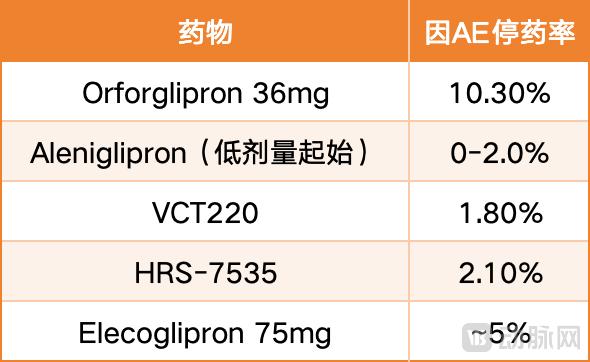
In addition, the impact of long-term medication on liver function is an unavoidable flaw for oral GLP-1 weight-loss drugs. In June 2023 and April 2025, Pfizer successively announced the termination of development of two oral GLP-1 drugs, both due to liver toxicity concerns. Elevated liver function indicators were also observed in some patients during Orforglipron’s Phase III clinical trials. However, existing clinical data of domestic pipelines demonstrate systematic advantages in liver safety. That said, the side effects of oral GLP-1 are mostly tied to the inherent properties of small-molecule formulations, making significant improvements extremely challenging. Longer-term clinical trial data is still needed to verify the liver safety of domestic pipelines.
Thus, the first major track led by Chinese innovative drugs has emerged
02
Hundred-Billion Market Trend and Dimensionality Reduction Strike
“Oral formulations create an incremental market, not a stock replacement,” an industry insider analyzed to VCBeat. In his view, the main application scenarios of oral GLP-1 weight-loss drugs lie in accelerating the initiation phase of weight loss and extending the maintenance phase
The essence of the initiation phase is a “threshold issue”. After the commercial boom of GLP-1-related drugs, the biggest bottleneck of pharmaceutical weight loss has shifted from the lack of effective drugs to patients’ reluctance to take the first step. For most people, weight management should not rise to the level requiring injection therapy. But oral formulations lower the psychological barrier, attracting obese and overweight populations who previously rejected injections
The problem in the maintenance phase is entirely different. Patients who have achieved their weight loss goals no longer face the question of how to start, but how to sustain results. Existing studies show that continuous use of GLP-1 for four years can maintain weight loss effects. However, the associated monthly costs, inconvenience of long-term subcutaneous administration, and accumulated injection site reactions greatly reduce long-term medication adherence. This is where the core value of oral formulations lies: one tablet a day or even one a week, with an administration pattern highly similar to common chronic disease management for conditions like hypertension and diabetes.
In terms of market size, the GLP-1 weight-loss market reached approximately $20 billion in 2025. If oral GLP-1 realizes its value in the initiation phase, it can generate a 30%-50% incremental market in the short term, equivalent to $6-10 billion in additional annual growth. The maintenance phase offers even greater potential: according to Eli Lilly’s forecast, there will be 500 million global users at maturity. The extended weight maintenance period combined with daily oral administration will create a stable hundred-billion-level long-term market.
Dr. Wang Zhen believes that beyond weight loss, oral GLP-1 has even greater potential. “From my personal experience, weight loss may only be one selling point of oral GLP-1 drugs,” Dr. Wang Zhen told VCBeat. “While losing weight, patients often see improvements in blood sugar and fatty liver. These health management functions accompanying weight loss may reshape the business model of oral GLP-1.” In a sense, the real core competitiveness of oral GLP-1 drugs is not the therapeutic effect for a single disease indication, but the ability to address the common pathological needs of multiple metabolic disorders.
As a result, multi-indication applications will become a key trend in oral GLP-1 drug development in the future, reshaping the commercial monetization logic of this drug category
On one hand, commercial strategies will become more flexible. Based on multiple indications, the same oral GLP-1 can achieve full penetration across multiple departments. For example, it can be used for blood sugar control in endocrinology departments, fatty liver intervention in cardiology departments, and weight management in weight-loss specialty clinics, creating more in-hospital access points. Meanwhile, unlike single-indication drugs whose pricing is strictly constrained by the price system of similar competitors, the multi-indication development of oral GLP-1 drugs will continuously break through the ceiling of profit margins.
On the other hand, the patient population and product positioning will expand. With the implementation of multi-indication layouts, oral GLP-1 drugs will complete a product attribute transition: shifting from prescription therapeutic drugs previously exclusive for patients with severe metabolic diseases to chronic disease daily management formulations suitable for people with mild metabolic abnormalities. For example, there is currently a large population with marginal metabolic abnormalities in China: their BMI is near the critical overweight threshold, blood sugar indicators are close to the upper limit of normal values, and they have mild fatty liver. These patients do not meet the official clinical medication indications for GLP-1 drugs, but have clear needs for metabolic health intervention. They can choose oral formulations for daily management, even forming a dimensionality reduction strike against health supplements.
Of course, competition in this track will be extremely fierce. With continuous investment from domestic and international manufacturers, the oral GLP-1 drug market will see a landscape of multiple coexisting players with diverging market shares. In this hundred-billion market driven by dimensionality reduction, efficacy data serves as the entry ticket, while pricing and channel capabilities determine market share, and brand and indication expansion define the upper limit of development
03
A New Landscape
At the end of 2023, AstraZeneca’s deal to obtain ex-China rights to Cheng Yi Bio’s small-molecule oral GLP-1 pipeline ECC5004 for up to over $2 billion once caused a stir in the MNC industry. At that time, the domestic innovative drug primary market cooled rapidly, and people found a new way out for Biotech through cross-border BD transactions. Of course, this exciting path belongs to the few Biotechs focused on original innovation. Subsequently, Chinese oral small-molecule GLP-1 pipelines have become a major force in the global market.
For example, Hengrui Medicine’s HRS-7535 is backed by Kailera Therapeutics, established under the leadership of veteran PE Bain Capital. Wentai Pharmaceutical’s VCT 220 has ties with Jixing Pharmaceutical, incubated by US-based RTW Investments. Hansoh Pharmaceutical licensed the global rights of its oral small-molecule GLP-1 pipeline HS-10535 to Merck for a total amount exceeding $2 billion. CSPC Pharmaceutical Group licensed its oral small-molecule GLP-1 pipeline SYH2086 to US-based Madrigal Pharmaceuticals for a similar total value. Fosun’s Yaoyou Pharmaceutical licensed its oral small-molecule GLP-1 pipeline YP05002 to Pfizer, and Xianweida licensed its oral GLP-1 pipeline to Verdiva Bio. Between 2024 and 2025, the BD boom of oral small-molecule GLP-1 pipelines ignited by Cheng Yi Bio kept breaking total amount records. The subsequent rapid advancement of clinical development has made oral small-molecule GLP-1 drugs the first major track led by Chinese innovative drugs.
“I believe the more important strategic significance of oral GLP-1 drugs lies in further clarifying the global positioning of Chinese innovative drugs in the present and for a long time to come,” Dr. Wang Zhen pointed out. China’s original innovation, combined with MNCs’ clinical rehe in the global pharmaceutical industry with extremely high efficiency and rapid iteration
In his view, the cooperation model between local pharmaceutical companies and multinational corporations is very similar to the way domestic enterprises participated in the global consumer electronics industry chain in the early years. A representative example is the cooperative relationship between Apple and its supply chain system. In this relationship, Apple stands at the top of the entire consumer electronics chain, holding product definition, R&D design, and channel pricing power. Foxconn serves as its core domestic final assembly hub, undertaking mass production of main iPhone and Mac models and building a manufacturing base connecting upstream local suppliers. Domestic component companies such as Luxshare, Goertek, and Sunwoda are embedded in the supply chain at different levels, supplying core components like acoustic devices, batteries, structural parts, and optical modules, forming a finely divided supporting network.
Different from simple product delivery, the two sides share a deeply bonded yet clearly defined cooperative relationship: Apple uses strict quality control and order scale to force OEMs and component enterprises to iterate production lines and refine processes. Local manufacturers accumulate technology and production capacity relying on Apple’s stable orders, but have long been constrained by limited bargaining power and inventory risks. In recent years, Apple has promoted decentralized capacity layout, but the complete domestic industrial cluster remains an irreplaceable core support for its global manufacturing system. Currently, represented by BD transactions of oral GLP-1 pipelines, some domestic Biotechs are also forming a similar one-on-one deep bonding relationship with multinational pharmaceutical companies.
Against the turbulent external environment, this cooperative relationship provides a new underlying logic for the long-term development of the domestic innovative drug industry. In the early stage of the globalization strategy of innovative drugs, the underlying logic was simply that domestic Biotechs were constrained by the capacity ceiling of the local pharmaceutical market, and needed to rely on multinational partnerships to access the global market at low cost. In the current deep bonding relationship, the demand pull from MNCs for efficient original innovation has constructed a new growth logic.
Chinese innovative drugs boast strong innovation capabilities and excellent development efficiency, enabling continuous output of early-stage innovative pipelines. Multinational pharmaceutical companies pay for these innovations and focus on leveraging their mature clinical operation capabilities and global sales networks to maximize the global revenue potential of innovative pipelines. In this process, Chinese innovative drugs have gradually completed their identity transition: evolving from former low-tier OEMs and less competitive players to core R&D partners, securing a stable position in the global pharmaceutical innovation value chain.
Of course, the flip side of the coin is that behind the global division of labor, Chinese innovative drugs are facing a realistic reshuffle. Local enterprises that successfully partner with leading multinational pharmaceutical companies can leverage their global channels, brand momentum, and commercial experience to fully unlock the value of their self-developed pipelines, often achieving survival and continuous scale expansion. Conversely, it will be difficult for others to survive
As Orforglipron is on the verge of domestic approval and Wentai Pharmaceutical and Hengrui Medicine are about to submit registration applications, the boom of oral small-molecule GLP-1 is far from reaching its peak. The changes it may bring will be far more profound than the launch of a single blockbuster new drug
This article is from the WeChat public account “VCBeat” (ID: vcbeat) and published with authorization from 36Kr
