


A devastating bat disease continues to spread in Colorado
Jul 08, 2026
Lucas Boland
Lucas Boland is a multimedia journalist at Rocky Mountain PBS focused on Colorado’s high country.more
EAGLE, Colo. — Displeased chirps rang out through the air at Sylvan Lake State Park on a recent June evening just after sundown.
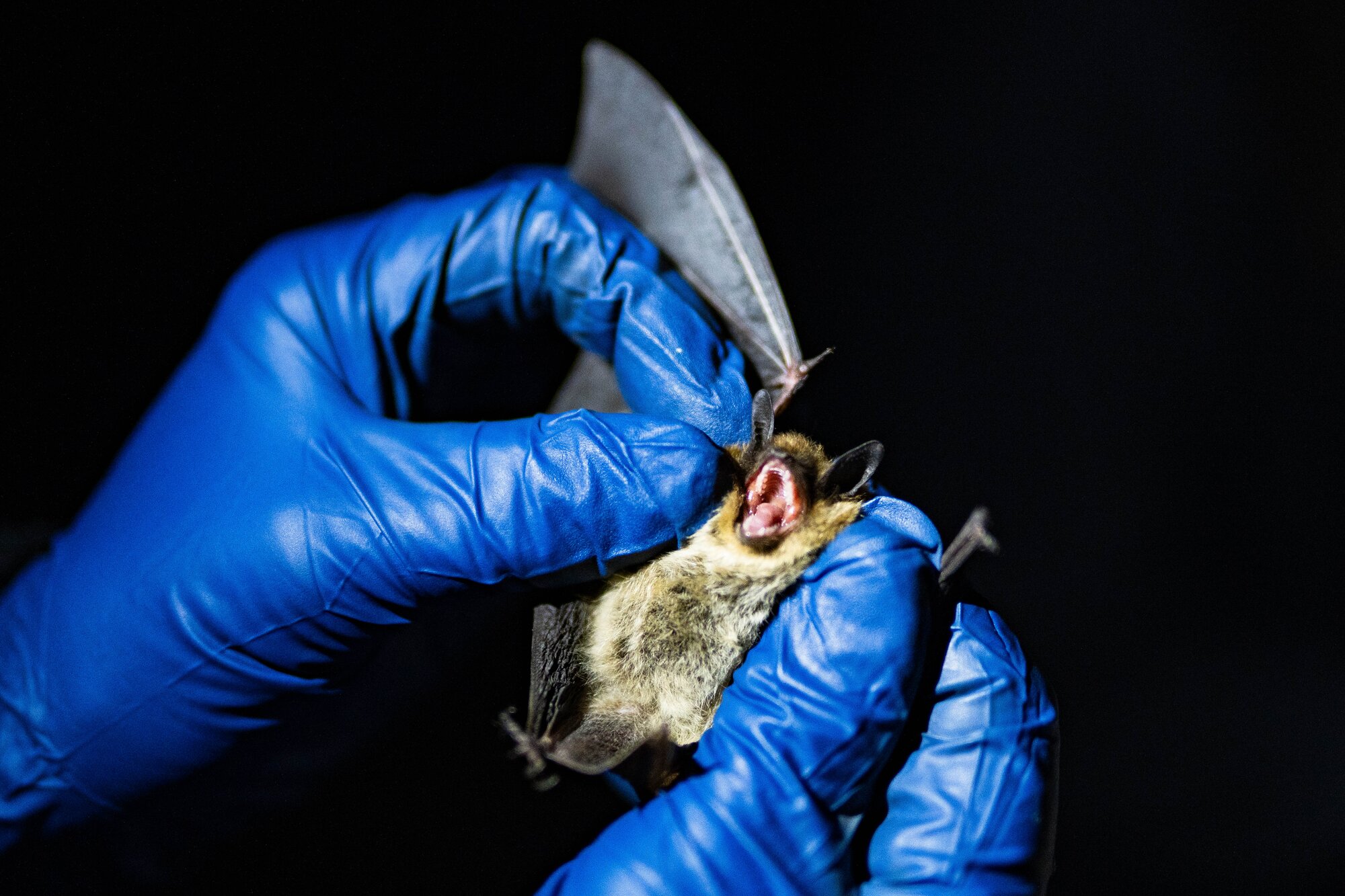
Little brown bats had left the suitcase-sized wooden boxes in which they live in search of dinner as they do every night, but instead found themselves captured in a mist net strung up by researchers. The tiny animals writhed and bared their teeth as they bit the fingers of the crew members inspecting them for signs of white-nose syndrome.
But that night, none of the 25 bats measured, weighed and swabbed appeared to carry the fungus Pseudogymnoascus destructans, which causes white-nose syndrome, a fungal disease that has killed millions of bats across the United States
Four years after the initial discovery of the fungus in Colorado — and three years after the first case of the resulting white-nose syndrome — it remains unclear what the impacts of the devastating fungal pathogen will be in the state.
Dan Neubaum, species conservation program manager for Colorado Parks and Wildlife, leads the state’s bat conservation efforts and cited white-nose syndrome as the agency’s top concern.
“That whole Front Range — basically now we consider the disease to be moving amongst bat populations,” Neubaum said. “And it’s probably starting to work its way up into the mountains
Video: Lucas Boland, Rocky Mountain PBS
The fungus spreads from bat to bat, though it can be transported by other means, like hikers transporting contaminated gear from one site to another. The disease does not infect people or other animals, only bats that hibernate. Infected animals develop a white fuzz on their noses and wings, giving the disease its name.
The fungus is believed to have origins in Europe and Asia, where it’s largely harmless to bats that have evolved alongside it for thousands of years.
It arrived in the United States in 2006, when it landed in New York state like a grenade.
White-nose syndrome, or WNS, rapidly eviscerated bat populations in the Northeast. In a matter of a few years, certain species in the region experienced population declines of more than 90%. The mortality rates from white-nose syndrome make it one of the deadliest wildlife diseases known to ever exist, die-offs that the United States Geological Survey has characterized as “unprecedented” and “devastating.”
After first destroying bat colonies out East, white-nose syndrome began a march across the U.S
“It’s an incredible wildlife disease that we’ve basically watched unfold from the start,” Neubaum said
The fungus thrives in the same conditions that hibernating bats do: cold, moist enclaves. When bats encounter the fungus while hibernating, they’re essentially defenseless because of their suppressed immune systems.
The fungus feeds on the animal’s skin and causes physical damage, preventing some metabolic functions, like circulating blood. The disturbance causes the bat to wake from its hibernation, which is a massive draw on the body fat that it stored up for the winter. When the infected bat goes looking for food most animals suffering from white-nose syndrome die from starvation
“They’re awakening multiple times during the winter, when they would normally just be sleeping and using very little energy stores,” Neubaum said. “They fire up their metabolism and they burn a bunch of energy to do that. So some animals are actually starving to death. Other animals are actually dying from the damage to their tissues and their circulatory systems.”
Some species, typically larger ones like the big brown bat, are more naturally suited to survive exposure to the fungus.
The North American Bat Monitoring Program compiled data for a 2021 report that found the threat level to little brown bats to be “extreme,” and big brown bats to be “serious,” though big brown bats have much higher survival rates. Both of those species are among the most common bats in Colorado, and little brown bats are currently under consideration for listing as “endangered” by the U.S. Fish and Wildlife Service
Colorado is home to 21 bat species. Some species live here year-round, while some visit only in the summer. About 13 of these species likely hibernate in Colorado, meaning roughly 60% of Colorado bat species could be vulnerable to white-nose syndrome.
So far, the fungus causing white-nose syndrome has been confirmed in at least nine species and the disease itself in seven of Colorado’s bat species, according to the Colorado Parks and Wildlife website.
The fungus first reached the state in 2022, when researchers discovered an infected animal during a USGS bat monitoring project at Bent’s Old Fort near La Junta. The next year, a case of the disease was confirmed in a Yuma bat at the same location.
In the years since, the fungus has spread to at least 15 counties, and the disease to at least 10. In 2025, the disease was confirmed on both sides of the Continental Divide in Rocky Mountain National Park, a sign that the pathogen is creeping up into the mountains
Determining the extent of the disease among the notoriously discreet animals is difficult, especially in Colorado. On top of being animals that fly and come out at night, Colorado’s bats are mostly tiny, often weighing between five and 15 grams.
And, unlike the large colonies found on the East coast, bats in Colorado tend to congregate in much smaller colonies, often only a few dozen in any particular location. Rather than caves, most bats in the state’s mountains dwell in talus slopes and rocky crags in remote areas
That makes comprehensive population surveys nearly impossible. Researchers don’t actually know exactly where most bats hibernate and roost in Colorado, or their total populations.
“They use really cryptic, secretive places like rock crevices to roost a lot. And Colorado has some vast landscapes, and so obviously following these animals and studying them can be challenging,” Neubaum said
Because of the difficulty gathering hard numbers, researchers are sometimes left to infer white-nose’s impact on bat populations in the state, and thus far it’s still a large unknown.
Since then, the surveys have shown a rapid decrease in the captures of long-legged bats, and a sharp increase in the number of silver-haired bats, a species far less susceptible to white-nose syndrome.
In 2022, 87% of bats captured at the site were long-legged bats, and 13% silver-haired bats. In 2025, 23% of bats captured were long-legged bats, and 77% were silver-haired bats.
It can’t be said for certain whether white-nose syndrome has killed off the long-legged bats there, but the shift in species distributions coincides with the arrival of Pseudogymnoascus destructans to Colorado in 2022, and at this site in 2024.
“I can’t think of any reason other than WNS, since it is coincident with evidence of the fungus presence,” Dewey said in an email to Rocky Mountain PBS.
Because white-nose syndrome first reached and devastated bat colonies in the Northeast, wildlife managers and researchers in Colorado had time to prepare as best as they could by gathering baseline population data.
CPW has deployed acoustic monitoring sites as part of the North American Bat Monitoring Program for about a decade, and Colorado Bat Watch has even launched citizen science efforts for people to submit bat observations.
The outdoor recreation community has also joined the effort to gather data in the hard-to-reach places that bats love — places rock climbers and cavers love, too
Climbers for Bat Conservation, founded by scientist-climbers at CSU around 2014, has gathered at least 443 observations from climbers on multiple continents.
And the Colorado Cave Survey, or CCS, has worked with government agencies and researchers to help survey bat populations and develop conservation solutions that serve both bats and cavers looking to explore underground.
Former CCS chair Jennifer Zedalis’ history with bats dates back to her introduction to caves as a 20-year-old in Florida. Ever since her first foray underground 34 years ago, she was hooked on the sport and the “less understood, and certainly less seen” animals, for which she developed into a volunteer champion.
“It’s …the mere fact that cavers are out on the landscape and going into caves, and could be kind of like frontline observers for a lot of our biologists in the state,” Zedalis said
The result has been a working relationship between recreation and conservation — two things often in tension — that has yielded valuable insights into species management. For instance, cavers helped discover that most Colorado bats, other than Townsend’s big-eared bats, don’t actually hibernate in old mines and caves all that much. With that knowledge, land managers were more able to avoid blanket-closures of caves.
However, the U.S. Forest Service has implemented measures and restricted access to prevent the spread of white-nose syndrome.
“Sometimes you have to do what’s safest first, and then kind of creak open the door a little bit,” Zedalis said
Some caves have indeed been closed to the public year-round, like the Premonition Cave in the Flat Tops Wilderness. Others are seasonally closed during hibernation. But all caves on National Forest land require registration, a permit and adherence to the Fish and Wildlife Service’s white-nose syndrome decontamination protocols.
“Hand in hand with that exploration goes conservation. I think when you love something so much, you want to see it perpetuate. You don’t want to see it loved to death,” Zedalis said. “Cavers love bats… I think we would do anything to make sure that we don’t lose the species.”
The same elusive nature that makes bats hard to find and survey in Colorado might just save them from white-nose syndrome, too.
Because bats in the state are naturally distributed over a wider area in smaller groups, the disease might not spread as quickly to as many bats. Researchers are hopeful that the outbreak won’t be as severe in the West, where the warmer and drier climate is less friendly to white-nose syndrome. The slower spread could give bats the chance to develop immunity to the disease.
“The fungus really likes a sweet spot of temperatures and humidities to grow in and back East, the caves match those perfectly. But out West, a lot of the roosts that our bats use don’t really match those profiles perfectly. And so it’s possible that just the ecology of the Western bats will be enough to maybe help them, but we’re going to need time to see if that plays out or not,” Neubaum said
The USGS National Wildlife Health Lab has also developed a vaccine that researchers have begun deploying among bats.
Comparing the apparent rates of sick bats after white-nose syndrome reached the Northeast to Colorado, it appears possible that the spread may be slower out West.
There is no official tally of total bats infected with white-nose syndrome in the state, but Neubaum estimated that the total number of confirmed cases of the fungus to be in the couple hundred. Some bat populations out East had already been decimated within four years of the arrival of Pseudogymnoascus destructans. Colorado’s outbreak could be worse than is known, though, because of the difficulty surveying populations.
Given that Colorado’s bat species are vulnerable to white-nose syndrome, it’s possible that there will be population declines, and because bats only have one pup per year, any species regrowth would take a long time.
Any declines in Colorado’s bat populations could have implications for the state’s $47 billion agriculture industry, to which bats contribute a huge amount of pest control. Nationwide, it’s estimated that bats save agricultural producers at least $4 billion annually
A single, nursing female little brown bat can eat up to 4,500 insects in a single night
“Worst-case scenario, we could have 10 species [that] need to be listed on the Endangered Species Act…or that they may even go extinct,” Neubaum said. “We’re hopeful that our bats will develop that resistance too over time. It’s really just a question of how much their populations decline before that occurs.”
Type of story: NewsBased on facts, either observed and verified firsthand by the reporter, or reported and verified from knowledgeable sources. To read more about why you can trust the journalism of Rocky Mountain PBS, please visit our editorial standards and practices page.
