


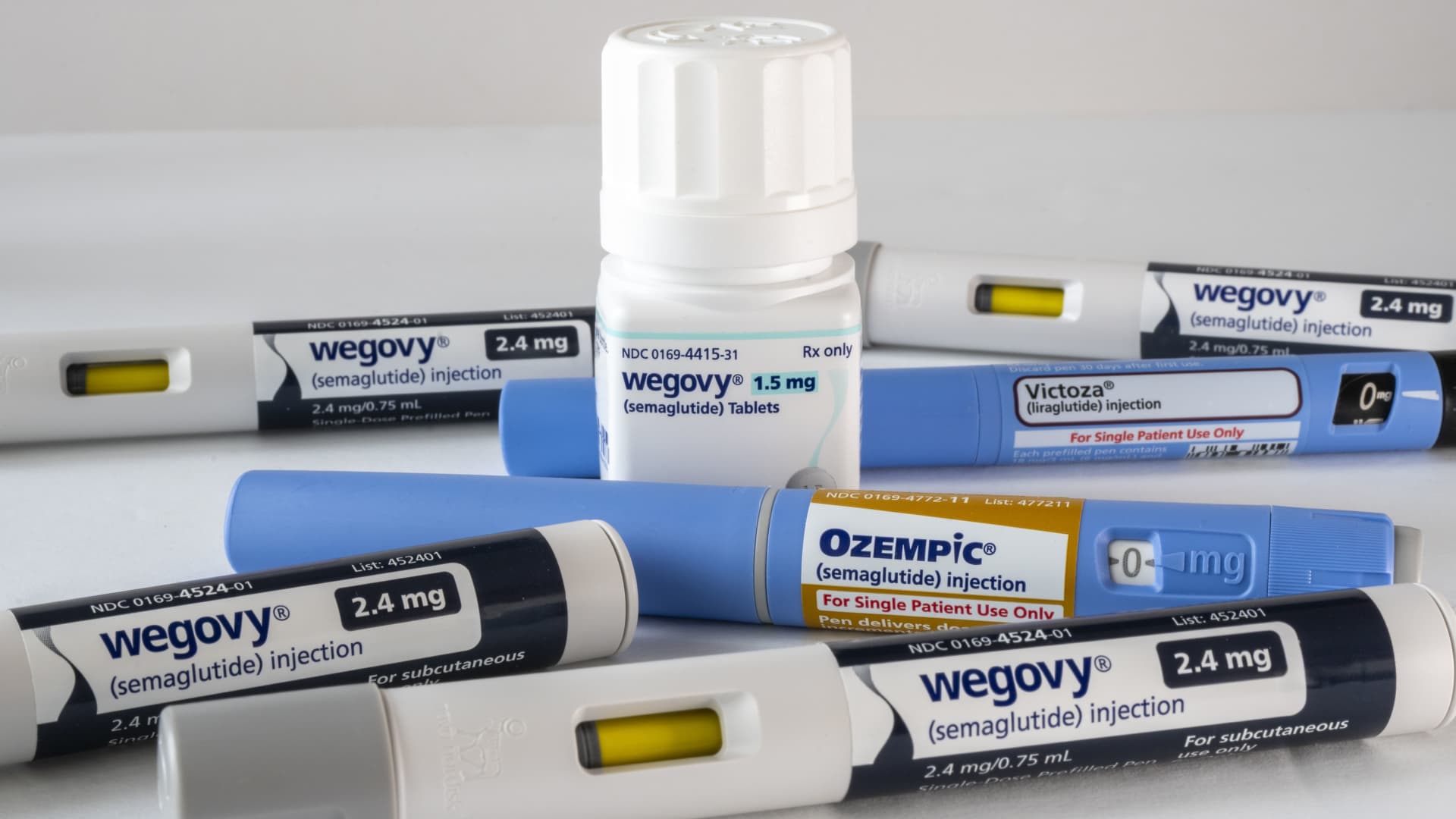
- Vivani Medical believes a tiny implant placed under the skin could help address the biggest issue with blockbuster GLP-1s: keeping patients on treatment to maintain their weight loss.
- The biotech company is in the early stages of developing an experimental implant of semaglutide, the active ingredient in Novo Nordisk’s obesity injection Wegovy and diabetes counterpart Ozempic.
- But the implant still needs to clear several clinical trials and regulatory hurdles before reaching patients, and some doctors raise concerns about the approach.
Michael Siluk | UCG | Universal Images Group | Getty Images
Losing weight with GLP-1 drugs is only half the battle. Keeping it off long term has proved even harder
Factors such as side effects, high out-of-pocket costs, injection fatigue and stigma around obesity treatment drive troves of patients – some studiesestimate roughly half or more – to stop GLP-1s within a year and risk regaining the weight they lost.
Years from now, Vivani Medical believes a tiny GLP-1 implant placed under the skin could help address that problem.
The biotech company is in the early stages of developing an experimental implant of semaglutide, the active ingredient in Novo Nordisk’s blockbuster obesity injection Wegovy and diabetes counterpart Ozempic. The Danish pharma giant announced on Tuesday a new agreement with Vivani to evaluate its lead semaglutide implant, NPM-139.
Vivani envisions patients would initially use it as a maintenance treatment rather than a therapy people take when they start GLP-1s. Under that approach, patients would first reach an appropriate dose of semaglutide using existing injections or pills, then potentially switch to the implant for longer-term treatment
If everything goes to plan, Vivani believes the device could eventually serve as a convenient option administered just twice a year — or even once annually — to help patients stay on therapy and maintain weight loss, while potentially reducing some side effects associated with existing GLP-1 medicines.
“It’s really critical to have options that make it easy for people to get the full benefits of these treatments and to not discontinue at the rates we’re seeing,” Vivani President and CEO Adam Mendelsohn said in an interview. “What these drugs are capable of is not being carefully taken advantage of right now.”
But the implant is still at least several years out from living up to that promise.
The device needs to clear several clinical trials and regulatory hurdles before reaching patients. Some endocrinologists and other doctors said there could be demand for an implant, but they also want to see concrete data on how effective it will be compared with existing medicines and how well patients will tolerate it. They also raised questions about whether providers would be willing to adopt it.
“I really want to see that this is going to work well and deliver results for patients, but I also want to see that it’s something that my patients can stay on long term,” Dr. Miranda Stiewig-Rapp, director of UC Davis Health’s Obesity Clinic, said in an interview. “I’m probably overall very skeptical, but I’m happy to be proven wrong.”
The potential cost of the implant and whether insurers would cover it if approved also remain unclear. That makes it difficult to estimate what the implant’s sales could be in a GLP-1 market that some analysts expect could exceed $100 billion by the early 2030s
In a statement to CNBC, Novo Nordisk confirmed the agreement with Vivani and said it is focused on complementing its internal research and development efforts with external innovation
How the GLP-1 implant works
Vivani’s long-acting semaglutide implant is essentially a tiny titanium reservoir filled with a certain dose of the medicine. The company intends to develop implants that deliver different dosages of semaglutide, allowing a patient and their doctor to select which one is best to switch to after an injection or a pill.
What makes the implant unique is a “specialized membrane” at one end of the device that contains millions of microscopic channels, or “straws,” through which drug molecules can leave the implant and enter the body, Mendelsohn said. He said those channels are designed to release semaglutide at a slow, steady rate over several months, which Vivani says could help reduce fluctuations in drug levels that can occur with periodic dosing of injections.
Dr. Adam Mendelsohn holds an implant from Vivani.
Courtesy: Jami Taylor | Vivani
If a patient’s weight loss is stable on a 2.4-milligram weekly dose of Wegovy, Vivani anticipates that they can receive an implant that provides continuous dosing of semaglutide at roughly that same dosage per week, Mendelsohn said.
Unlike some implants that rely on pumps or other mechanical components, Vivani’s device has no moving parts. Instead, the membrane itself controls the flow of medicine into the body, Mendelsohn added.
He said the approach could lead to more consistent drug levels and improve how well patients tolerate semaglutide, reducing some of its common side effects such as nausea and vomiting. That remains to be proven in clinical studies
Mendelsohn added that patients could choose to have the implant removed at any time, after which drug exposure would decline relatively quickly. A patient can replace their implant with another at a higher or lower dosage level if needed, and it may be feasible to add more than one implant in the body, he said.
On the patient level, Mendelsohn compared the device to Nexplanon, a widely used contraceptive implant. The procedure would take a few minutes in a doctor’s office using local anesthesia, with the implant inserted under the skin of the upper arm or possibly other areas like the abdomen.
“The idea is to try to time the implant insertion with when patients are going to see their physicians anyway, and then tack on just a few minutes to do that procedure,” Mendelsohn said. “That way, in between appointments, no one has to think about or worry about that person getting the medicine that they need.”
The version of the device that Vivani is currently developing would need to be removed and replaced every six months, though the company ultimately hopes to bring to market an implant that lasts a full year
How it could tackle the biggest issue with GLP-1s
Tatsiana Volkava | Moment | Getty Images
Doctors say it is far too early to judge the implant without human clinical data. But if the device proves safe and comes with fewer side effects than existing options, some see an opportunity for it to address one of the biggest challenges in obesity treatment: helping patients stay on therapy and maintain their weight loss over time
Many patients need to remain on GLP-1 medicines long term to sustain weight loss and preserve other health benefits, including lower cardiovascular risks.
“The next wave of science, and it’s already being done, is to answer the fundamental question of number one: How do we maintain the weight reduction? And number two: what are the benefits that are achieved when you do that?” said Dr. Harold Bays, chief science officer of the Obesity Medicine Association
While some patients may stay on a high GLP-1 dose indefinitely and others may eventually stop treatment and maintain their weight loss through nutrition and lifestyle changes, many will likely need different strategies over time, Bays said
Researchers are already exploring approaches such as lowering doses, taking medicines less frequently (like monthly or quarterly), or switching from injections to pills. A long-acting implant that patients don’t have to think about day-to-day could become another option if it’s approved
The device could be a good fit for patients who experience “injection fatigue” or struggle to remember daily pills, among other reasons people stop taking GLP-1s, said Dr. Amy Sheer, an assistant professor of medicine at the University of Florida.
“It sounds extremely exciting, and I think for a lot of people this could be a game changer,” she said
Implants for contraception are already a popular option used by roughly 5% or more of women in the U.S., according to recent estimates, which some doctors say is not tri
Vivani argues that helping patients stay on treatment could also generate savings for the health-care system by reducing the risk of costly conditions linked to obesity. The company has not determined how much the implant could cost if it reaches the market, but Mendelsohn said he expects it to be less expensive than shots, in part because patients may need only one or two implants per year instead of dozens of weekly auto-injector pens
“We certainly are hopeful that payers will see us as a preferred approach, because they won’t have to worry about the person not continuing to get the health benefits that would lead to economic value,” he said
The questions and concerns doctors have
For Vivani’s implant to live up to those hopes, it will need to prove safe, effective and tolerable in human studies. Doctors say it is far too early to know whether it can clear those hurdles
Some physicians also question how many patients will be comfortable with an implant in the first place. Stiewig-Rapp of UC Davis said some people already feel squeamish about devices such as Nexplanon that they can feel under their skin, meaning Vivani’s implant will likely appeal to a specific subset of patients
The in-office procedure involved with the implant could also make it difficult to access for patients who rely on telehealth platforms, such as companies like Ro and Hims & Hers, to obtain their GLP-1s, said Dr. Amy Rothberg, a clinical professor of medicine at the University of Michigan.
More in-person appointments, procedural support and implant-related costs could add expenses for insurers and the broader healthcare system, she said. It is also unclear whether health plans would be willing to cover a GLP-1 implant, given the uneven coverage of existing obesity treatments
Rothberg called the implant a “reasonable option,” but said the procedure could be reobesity medicine
While certain doctors, particularly those in other specialties, are comfortable inserting implants, some endocrinologists and other physicians may require training on the procedure, billing requirements and how to manage complications if a device is inserted incorrectly.
“The procedure is not technically difficult, but it’s going to require another whole skill set of individuals who don’t usually do this to put these implants in, and then sort of do them every six months or every year,” Rothberg said. “It may be a select number of providers who are willing to take on the training.”
For example, Rothberg said she noticed few providers appeared to adopt a continuous glucose monitoring system called EverSense, which is implanted in the upper arm just once a year.
Some doctors said their prescribing decisions could also depend on how effective the implant proves to be relative to existing treatments, which remains unclear at this stage
Vivani last year said pre-clinical data on the semaglutide implant in rats showed roughly 20% weight loss for over 6 months, with the potential for annual dosing. Those results have not yet been replicated in humans. By comparison, Novo Nordisk’s Wegovy has demonstrated average weight loss of about 15% over 68 weeks and up to nearly 28%in some patients using a newly approved higher dose
While Vivani said implants can be removed and replaced at any point with a higher or lower dose, Rothberg said those added procedures could still be a burden for patients and providers.
Side effects, long-term tolerability and whether patients ultimately choose to remain on the implant are among the questions doctors say future clinical trials will need to answer
What the next steps are
Vivani still has a long road ahead before its implant could reach patients, but the company recently cleared an important milestone
In June, Vivani said it received approvalfrom an Australian human research ethics committee to begin SLIM-1, the first human clinical trial of its semaglutide implant. The phase one study is expected to begin in mid-2026 and will enroll about 20 overweight or obese adults who have not previously taken GLP-1 medicines
Participants will be randomized to receive either the implant or a low-dose weekly Wegovy injection over four weeks. The primary goal of the study is to evaluate the implant’s safety, tolerability and pharmacokinetic profile, or how the drug is absorbed and released in the body over time. Researchers will also measure weight loss
If the results are positive, Vivani plans to quickly move into a phase two study, known as SLIM-2, that would test different implant doses and evaluate their effects on weight loss. That trial would help determine the optimal dose to advance into larger late-stage studies required for regulatory approval.
Mendelsohn noted that the agreement with Novo is not a licensing deal, but said it’s a “good validation for where we are and where this product could ultimately end up.”
For now, doctors say several important questions remain unanswered, but also acknowledge the potential of the treatment
“This could be another tool that we’ll have in our toolbox,” said Eduardo Grunvald, medical director of the UC San Diego Health Center for Advanced Weight Management. “In this field, we like to talk about really individualizing treatment for a single patient, so there’s going to be some patients that may really want this option.”
