


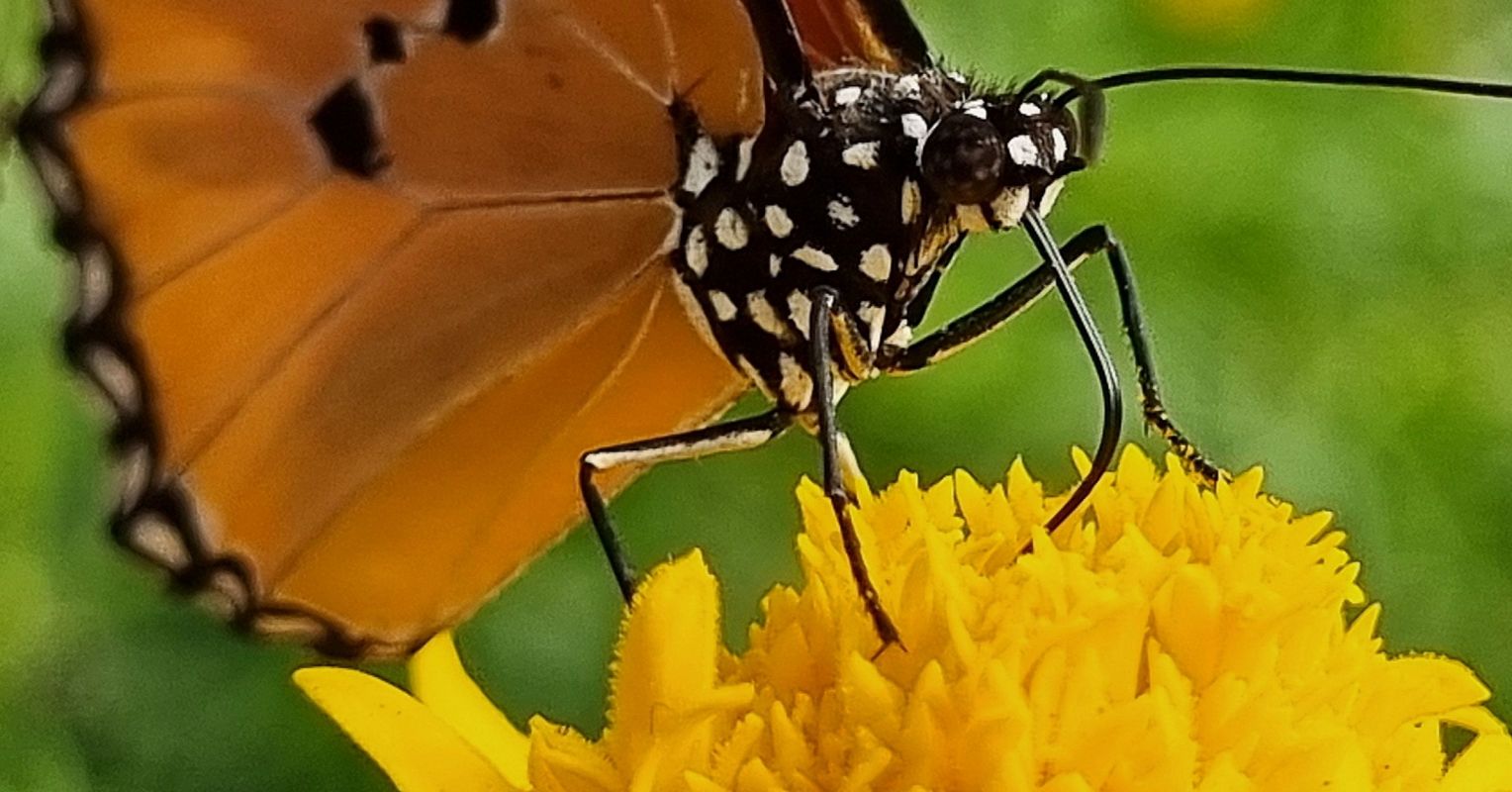
Key points
- Dr. Boria Sax’s new book is “The Butterfly Who Dreamt He Was a Man: Metamorphoses, Entomological and Human.”
- Sax offers a cultural and philosophical journey that shows why losing insects means losing part of ourselves.
- The root of the word “psychology” is psychê, which in Greek means both “soul” and “butterfly.”
Insects are amazing animals. It always baffles me how a single word can be used to refer to the astounding—unimaginable—diversity of around 10 quintillion (18 zeros after the number 10) beings who belong to around 5.5 million species who occupy our planet
I don’t know all that much about the vast majority of these animals but I am greatly attracted to butterflies and bees, so when I learned of Dr. Boria Sax’s new bookThe Butterfly Who Dreamt He Was a Man: Metamorphoses, Entomological and Human,I couldn’t wait to get my eyes on it. Now that I have, I was pleased he could answer a few questions about his landmark book in which he “offers an imaginative lens on the growing crisis of insect extinction … a cultural and philosophical journey that shows why losing insects means losing part of ourselves.” Here’s what he had to say about his highly original book.
Marc Bekoff: Why would readers ofPsychology Todaybe interested in your book?
Boria Sax: In The Butterfly Who Dreamt He was a Man, I write about how stories are the major way in which people organize experience. From the Neolithic forager in a forest to a contemporary teenager surfing the Internet, people have always been surrounded by more items clamoring for attention than they can even notice. Stories tell us what merits special attention and what should be ignored. They divide experience into units that can teach practical or moral lessons
Each of us is a collection of stories, far more than he or she can tell or even know. But the person who is aware of his or her own stories will be more grounded and better able to articulate priorities. Insects have provided major templates for our stories. Their lives, like ours, are divided into phases, analogous to youth and adulthood, which are marked by the shedding of an exoskeleton. Many insects such as cicadas and butterflies undergo a final, dramatic metamorphosis, which is the culmination of their lives.
The root of the word “psychology” is psychê, which in Greek means both “soul” and “butterfly.” The idea of the soul as a butterfly is found in indigenous cultures on every continent except Antarctica. In Mexico, the Day of the Dead coincides with the arrival of migrating monarch butterflies. Among the most beloved folktales in China for <a href="https://healthylife7.com/workers-flag-poor-implementation-of-well/” title=”Workers flag poor implementation of well”>well over a thousand years is that of the Butterfly Lovers, a young man and woman who were separated when the girl’s parents arranged for her to have a political marriage. The young man died and the young woman jumped into his grave, after which the two emerged as butterflies. Early entomologists such as Johannes Goedaert and Maria Sibylla Merian were devout Protestants who believed that the study of butterflies would help them understand the mystery of resurrection. Insects are familiar enough to be taken for granted most of the time, but, when you stop to think about them, strange enough to challenge our conventional perspectives on the world.
MB: Why did you writeThe Butterfly Who Dreamt He was a Man?
BS: Throughout my academic career, I have constantly pushed the limits of what was acceptable in scholarly work by including storytelling, humor, and lyricism alongside academic argument. This has at times led to indignant rejections of my work, though it has not stopped me from publishing about 20 books and scores of articles. In this book, in many ways, I carry this further than ever before
The Daoist philosopher Zhuang Zhou told how he had dreamed of being a butterfly. On waking, he asked whether that was really a dream. Or was he, perhaps, a butterfly dreaming of being a man? I ask the reader to imagine an academic conference, set up using the newly discovered art of time travel, devoted to that question. Among those invited are a Native Australian, a Native American, a late Renaissance philosopher, and so on. Also present are Emily Dickinson, Maria Sibylla Merian, Franz Kafka, Albrecht Dürer, and many others. Finally, Zhuang Zhou himself appears at the end. But this is only a fictional frame for my realistic discussion, which covers the cultural history, symbolism, study, and artistic representation of insects.
At times, my style may have become a way of indirectly addressing themes that were too elusive, emotionally charged, complicated, or repressed to tackle directly. In my latest book, I have tried to increase my scope by articulating a larger range of perspectives. In summary, this book is a culmination of endeavors that I have been working on for most of my life
MB: What are some of the topics you consider and what are some of the major messages?
BS: In the words of psychologist James Hillman, “Nothing equals our murderous passion to eradicate insect pests.” Countless movies from the 1950s featured giant insects carrying off screaming young women. Meanwhile, advertisements for insect poisons depicted flies and mosquitoes as vicious criminals, so that people could enjoy killing them as revenge. This fury at insects has led to their massive disappearance, which now extends not only to cities but even remote areas of Amazonia. It deprives birds of food and plants of pollination, to a point where it is a major threat to the environment.
The rage can also be transferred to other human beings, and people have often spoken of their enemies as “pests, “flies,” or “vermin.” Zyklon B, the gas used by the Nazis to kill people in concentration camps, was first developed as an insecticide. I conclude my introduction with the words:
“My role here is to show how people relate to insects with the same intimacy as they do to mammals but in profoundly different ways. They not only share our lives but our story as well. Insects are also an essential part of the natural environment and human culture, to a point where, without small invertebrates, we could not be very human at all.”
Philosophy Essential Reads

The End of Moral Philosophy

Pursuing the Ethical Approach of “Openness to the Other”
Mammals generally go through a brief childhood, but their lives are lived mostly on the single level of maturity. Insects, by contrast, repeatedly cast off their external covering and undergo metamorphoses such as that of a caterpillar to a chrysalis and, finally, a butterfly. These transformations provide models for our division of human life into stages such as infancy, childhood, adolescence, maturity, old age, and death
MB: Who do you hope to reach?
BS: My book does not target any particular demographic. I want to reach people as individuals, a goal that is notoriously quirky and unpredictable. If my writings can be deeply meaningful to a few people, that means a lot to me. Beyond that, I also hope that my ideas will be discussed, not only in academia but also in libraries, coffee houses, pubs, chatrooms, and wherever people get together
In conversation with eclectic scholar and author, Dr. Boria Sax. Sax currently teaches at Sing Sing prison and in the online graduate English program of Mercy University
Bekoff, Marc. Butterflies: Their Fascinating Lives and How to Protect Them. Psychology Today, July 22, 2025. (An interview with Nigel Andrew.)
