


Download PDF
Abstract
Loneliness and social isolation are linked to higher risks of mortality and a range of adverse physical diseases and mental disorders, yet the extent to which they affect overall health and quality of life remains unclear. Here we show that loneliness and social isolation are more strongly associated with life expectancy free of mental disorder than with life expectancy free of physical disease. This study includes 277,489 adults from the UK Biobank who are initially free of seven major chronic diseases (type 2 diabetes, cardiovascular disease, chronic respiratory disease, neurodegenerative disease, cancer, depression, and anxiety). At age 50, women and men experiencing both loneliness and social isolation, as compared to their counterparts experiencing neither, live 2.4 and 1.7 fewer years free of physical disease and 3.7 and 5.8 fewer years free of mental disorder, respectively. Notably, the loss of disease-free life expectancy associated with social isolation narrows with healthier lifestyles, but the corresponding association for loneliness was not statistically significant.
Subjects
- Epidemiology
- Psychology
- Risk factors
Introduction
Loneliness and social isolation (SI) have become important public health concerns worldwide1. It has been estimated that a third of middle-aged and elderly people in the UK and the US feel lonely, and a third of US adults are considered socially isolated2,3,4. Notably, despite being related, loneliness and SI are distinct constructs, reflecting different aspects of social contact. SI is an objective measure of the quantity of social connection in behavior, while loneliness is a subjective measure of a person’s emotional dissatisfaction with the quality of their relationships5. Several previous studies have shown that both loneliness and SI are associated with higher risks of mortality and a range of serious adverse physical and mental health consequences, including type 2 diabetes, cardiovascular disease, chronic respiratory disease, neurodegenerative disease, cancer, depression, and anxiety1,6,7,8,9,10,11,12,13. However, it is unclear to what extent loneliness or SI is associated with an individual’s overall health and quality of life. Estimation of disease-free life expectancy (LE) is a composite summary measure of overall health and quality of life, which considers both morbidity and mortality and provides an intuitive quantitative indicator for health professionals and the public. It is imperative to evaluate how much of the loss of disease-free LE is related to loneliness or SI.
Identifying effective interventions is necessary to address the health consequences of social isolation and loneliness. Interventions such as social skills training and social support have been commonly applied for alleviating loneliness or isolation, but their effectiveness appears to be limited14,15. Both SI and loneliness may operate through adverse influences on health-related behaviors and lifestyle to affect health outcomes, pointing to a potential mediation effect.1,16. Adopting a healthy lifestyle has been shown to significantly extend disease-free LE17,18,19,20. Therefore, we assumed that a healthy lifestyle could partly alleviate or compensate for the loss of disease-free LE associated with loneliness or SI.
In this study, we aimed to quantify the associations of loneliness and SI with LE free of major chronic diseases, including both major physical diseases (type 2 diabetes, cardiovascular disease, chronic respiratory disease, neurodegenerative disease and cancer) and mental disorders (depression and anxiety) in adults from the UK Biobank. Furthermore, we quantified the extent to which a healthy lifestyle compensates for the loneliness- or SI-related loss of disease-free years
Results
Baseline characteristics of participants according to the combined categories of loneliness and SI status
Of the 277,489 participants without major chronic diseases at baseline, 3.3 % of participants were defined as having only loneliness, 6.8 % as having only SI, and 0.8 % of participants were considered to have both loneliness and SI (Table 1 and Supplementary Table 3). Compared with participants without loneliness or SI, participants with only loneliness or SI had a higher Townsend deprivation index, a lower level of household income, a lower level of educational attainment, and were more likely to have an unhealthy lifestyle. Moreover, participants with both loneliness and SI were more likely to be male, had a higher Townsend deprivation index, a lower level of household income and a lower healthy lifestyle score as compared with those with loneliness only or SI only.
Association of combined categories of loneliness and SI status with LE free of major chronic diseases
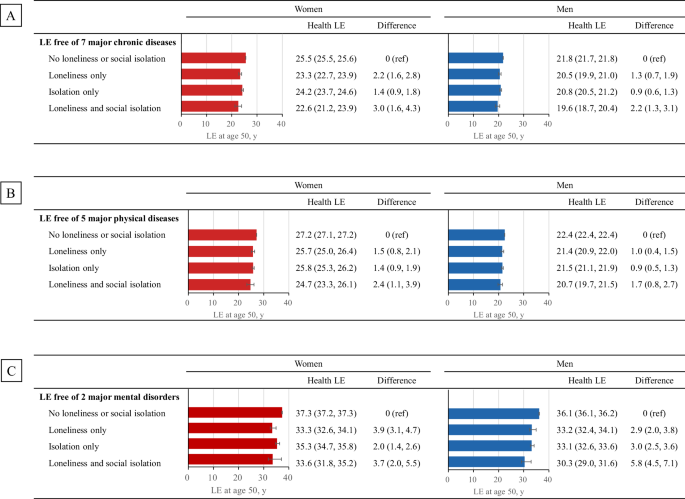
During a median (IQR) follow-up of 13.8 (1.4) and 13.4 (2.2) years, a total of 16,356 events of death and 78,829 events of 7 major chronic diseases were recorded, respectively. We observed that combined categories of loneliness and SI status were significantly associated with a shorter LE free of 7 major chronic diseases in women and men (Fig. 1A). For women, the LE free of 7 major chronic diseases at age 50 was 25.5 (95% CI, 25.5–25.6), 23.3 (95% CI, 22.7–23.9), 24.2 (95% CI, 23.7–24.6), and 22.6 (95% CI, 21.2–23.9) years for those without loneliness or SI, loneliness only, SI only, and both loneliness and SI, respectively. The corresponding LE free of 7 chronic diseases at age 50 for men was 21.8 (95% CI, 21.7–21.8), 20.5 (95% CI, 19.9–21.0), 20.8 (95% CI, 20.5–21.2), and 19.6 (95% CI, 18.7–20.4) years. Equivalently, compared with women without loneliness or SI, women with loneliness only, SI only, and both loneliness and SI lived on average 2.2 (95% CI, 1.6–2.8), 1.4 (95% CI, 0.9–1.8), and 3.0 (95% CI, 1.6–4.3) years shorter free of 7 major chronic diseases at age 50 years, respectively (all P < 0.001). The corresponding shorter years lived free of 7 major chronic diseases at age 50 years for men was 1.3 (95% CI, 0.7–1.9), 0.9 (95% CI, 0.6–1.3), and 2.2 (95% CI, 1.3–3.1) years, respectively (all P < 0.001).
A Life expectancy free of 7 chronic diseases for each exposure groups in women and man. B Life expectancy free of 5 physical diseases for each exposure groups in women and man. C Life expectancy free of 2 mental disorders for each exposure groups in women and man. The sample size used to estimate life expectancy is n = 134,318 for women and n = 143,171 for men. Data are presented as life expectancy and 95% Confidence intervals (CI). LE, life expectancy. Red color represents the life expectancy for women, and blue color represent the life expectancy for men. Source data are provided as a Source Data file.
When the 7 major chronic diseases were analyzed as two separate categories of physical disease and mental disorder, we found that loneliness and SI seemed to be more strongly associated with LE free of mental disease than LE free of physical disease in women and men. Compared with women without loneliness or SI, women with loneliness only, SI only, and both loneliness and SI lived on average 1.5 (95% CI, 0.8–2.1), 1.4 (95% CI, 0.9–1.9), and 2.4 (95% CI, 1.1–3.9) years shorter free of 5 major physical diseases at age 50 years, respectively (Fig. 1B) (all P < 0.001). The corresponding years were 1.0 (95% CI, 0.4–1.5), 0.9 (95% CI, 0.5–1.3), and 1.7 (95% CI, 0.8–2.7) for men (all P < 0.001). By contrast, the corresponding shorter years lived free of 2 major mental disorders at age 50 years was 3.9 (95% CI, 3.1–4.7), 2.0 (95% CI, 1.4–2.6), and 3.7 (95% CI, 2.0–5.5) years for women, and was 2.9 (95% CI, 2.0–3.8), 3.0 (95% CI, 2.5–3.6), and 5.8 (95% CI, 4.5–7.1) for men, respectively (Fig. 1C) (all P < 0.001). In addition, we performed a sensitive analysis by excluding participants who became ill or died within two years, and we found the health life expectancy were not appreciably changed (Supplementary Fig. 2). Moreover, the differences in disease-free LE between groups narrowed with age in both women and men. (Supplementary Fig. 3).
Association of combined categories of loneliness and SI status with LE free of individual chronic disease
When the 7 major chronic diseases were examined separately, we observed that except for the loneliness only group, which was not statistically significant associated with loss of cancer-free LE, all other groups were significantly associated with loss of various individual diseases-free LE, in women and men, but with varying degrees of strength. We also found that SI and loneliness were generally more closely associated with loss of mental diseases-free LE than to loss of physical diseases-free LE (Fig. 2).
Data are presented as life expectancy and 95% Confidence intervals (CI). LE, life expectancy. Red color represents the magnitude of life expectancy for women, and blue color represent the magnitude of life expectancy for men
Joint association of loneliness or SI status and healthy lifestyle with LE free of major chronic diseases
In joint analysis of the association of loneliness and healthy lifestyle with LE free of diseases, we observed that a healthier lifestyle was significantly associated with a longer disease-free LE (7 major chronic diseases, 5 physical diseases or 2 mental disorders) in both loneliness and non-loneliness groups in women and men (Table 2 and Supplementary Fig. 4). When we compared the loss of disease-free LE associated with loneliness (the difference in disease-free LE between loneliness and non-loneliness group) across distinct levels of healthy lifestyle, we found that the loss of disease-free LE did not narrow statistically significantly across higher levels of healthy lifestyle (Table 2 and Supplementary Fig. 4). For example, in women, the loss of 2 mental diseases-LE associated with loneliness were 3.1 (95% CI, 1.7–4.7), 2.6 (95% CI, 1.3–3.9) and 4.2 (95% CI, 3.0–5.5), across unhealthy, median, and healthy lifestyle groups, respectively (all P < 0.001).
In joint analysis of the association of SI and healthy lifestyle with LE free of diseases, we also observed that a healthier lifestyle was associated with a longer disease-free LE in both SI and non-SI groups in women and men (Table 3 and Supplementary Fig. 5). Notably, we observed that the loss of disease-free LE associated with SI (7 major chronic diseases, 5 physical diseases or 2 mental disorders) narrowed substantially across higher levels of healthy lifestyles in both women and men (Table 3 and Supplementary Fig. 5). For example, in women, the loss of 2 mental diseases-LE associated with SI were 2.2 (95% CI, 1.2–3.3, P < 0.001), 1.1 (95% CI, 0.1–2.2, P = 0.032) and 0.6 (95% CI, −0.4 to 1.6, P = 0.222) across unhealthy, median, and healthy lifestyle groups. Notably, there was no statistically significant difference in LE between women with and without SI when the healthy lifestyle score was 4 or higher (P = 0. 222). The results for individual lifestyle factors were shown in Supplementary Fig. 6.
Discussion
In this large prospective cohort of middle-aged and older adults from the UK, we found that loneliness and SI were significantly associated with a shorter LE free of 7 major chronic diseases (5 major physical diseases and 2 major mental disorders) in women and men. Notably, we observed loneliness and SI seemed to have a stronger association with LE free of mental disorder than LE free of physical disease in women and men. Intriguingly, the loss of disease-free LE associated with SI substantially narrowed across higher levels of healthy lifestyles in women and men, whereas the corresponding narrowing was not statistically significant for loneliness.
To our knowledge, this is the first quantitative analysis of the associations of loneliness and SI with LE free of multiple physical diseases and mental disorders. Two previous studies have investigated the association of loneliness or SI with LE21,22. The first study from the Panel on Health and Ageing of Singaporean Elderly (PHASE) observed that participants who sometimes felt lonely had a healthy LE of 5.9 years shorter at age 60 than those who never felt lonely21. Another study from the China Longitudinal Health and Longevity Survey found that loneliness was associated with a 0.95 and 1.35 years shorter LE free of cognitive impairment at age 65 for men and women, respectively; The corresponding loss of LE free of cognitive impairment associated with SI was 2.23 and 2.49 years for men and women, respectively22. Given the differences in the assessment of exposure (loneliness and SI) and the “healthy” LE, the results of current study cannot be directly compared with these two studies. For example, in the PHASE study21, the healthy LE was estimated by self-reported information about participants’ self-perceived health status (choose one of the five options that best describes your health: very healthy, healthier than average, of average health, somewhat unhealthy, very unhealthy), whereas in this study, the disease-free LE was calculated by integrating objectively measured information from multiple sources, including hospital admissions and death registry data.
Our results showed that both loneliness and SI appeared to be more strongly associated with LE free of mental disorder than LE free of physical disease in women and men. Two plausible reasons might explain the observed results. First, previous mediation studies indicate that the association between loneliness or SI and the risk of physical disease or mortality is partially mediated by mental health (e.g., depression)1,23,24,25, consistent with the view that loneliness and SI are more closely associated with mental disorders than to physical diseases. Second, previous studies have shown that there is substantial overlap between genes that influence loneliness and genes that influence depression26,27. Further research is needed to validate these findings, but taken together with previous evidence, our findings are mechanistically reasonable. In addition, we observed that for the LE free of mental disorder, women appeared to be more strongly associated with loneliness, whereas men had a stronger association with SI. One potential explanation for these findings might be the sex-based differences in social needs and their distinct connections to health. Men and women may follow differential pathways to obtain support and achieve psychological well-being, with men tending to require more objective support and women more emotional support. Moreover, we did not find a statistically significant association between loneliness only and cancer-free LE, possibly because we only looked at total cancer incidence but did not consider specific cancer subtypes. A previous study from the Denmark also did not find a statistically significant association between loneliness and total cancer incidence10, and another study from Finland found a significant but weak association between loneliness and lung cancer risk8.
Partially consistent with the hypothesis of this study, we found that a healthier lifestyle appeared to associated with a smaller loss of disease-free LE associated with SI in both women and men, but the corresponding association for loneliness was not statistically significant. Because the association between healthy lifestyle and longer disease-free LE has been well established17,18,19, our findings may reflect differences in the associations of loneliness and social isolation with health-related behaviors. Notably, previous findings that found significant associations between loneliness and health behaviors were mostly based on cross-sectional study design1,16. A prospective study from England found that SI was associated with a range of health-related behaviors, but loneliness was not statistically significant associated with health-related behaviors or BMI over a 10-year follow-up period in older English adults28. Moreover, another study showed that there may be no mediator on the association between loneliness and the risk of depression29. Taken together, our findings suggest that lifestyle behaviors showed no statistically significant modification of the association between loneliness and adverse health outcomes. Other potential pathways, such as psychological stress and neuroinflammation, may be involved and need further exploration. Thus, lifestyle interventions may not be a priority option for participants with loneliness, whereas it may be a potential intervention for participants with SI, and future research is needed to validate our results.
The strengths of this study include the estimation of disease-free LE, the consideration of lifestyle context, and the large sample size. More importantly, this study is the first to include both physical diseases and mental disorders into consideration of disease-free LE, providing a comprehensive health assessment, whereas disease-free LE used in previous studies usually considered either physical disease or mental disorder only. We also acknowledge several potential limitations of this study. First, loneliness and SI were assessed by a 2-item and 3-item scales, respectively, which may not be able to adequately assess the complex phenomenon of social networking and interaction. However, these measures have been widely used in previous studies from different cohorts30,31,32, suggesting such scales are effective in population studies. Multi-item assessment of loneliness or SI had better predictive validity than single-item measures. Second, because only the baseline measurement of SI and loneliness was used in this study, we were unable to analyze the association of dynamic changes in these factors with disease-free LE, which may lead to non-differential misclassification and an underestimation of the true associations. There are few studies on the stability of social isolation or loneliness. A previous meta-analysis suggested that the trajectory of loneliness among middle-aged and older adults remains relatively stable, indicating that a single measurement of loneliness could serve as a valid indicator of long-term exposure33. A recent study found that nearly 50% of the participants experienced changes in their social isolation scores during a 4-year follow-up period34. Third, although the method of calculating disease-free life expectancy using multi-state life table has been widely used in previous studies, it must be acknowledged that this method has limitations—the inherited Markov assumption has not been formally tested. Our findings also require verification using longitudinal data that can satisfy the Markov assumption. Fourth, the assessment of lifestyle factors was based on self-report questionnaires in this study and measurement error is inevitable. The categorization into three groups (unhealthy, medium, and healthy) may also oversimplify the nuances of lifestyle effects. Fifth, given the observational nature of this study, we cannot draw any conclusion with causality. Lastly, UK Biobank is not a representative sample, with a response rate of 5.5%, whereas previous research has shown that the findings from the UK Biobank are highly consistent with those from a representative UK population on the association between risk factors and disease35.
In conclusion, this cohort study indicates that loneliness and SI were significantly associated with shorter LE free of multiple chronic diseases, especially LE free of mental disorders, in both women and men. A healthy lifestyle associated with a smaller loss of disease-free LE due to SI, but for loneliness, the association was not statistically significant
Methods
Study population
The UK Biobank (UKB) is a large population-based, prospective cohort study including more than 500,000 participants aged 40 to 69 years across England, Scotland, and Wales recruited between 2006 and 2010. The study collected information on demographic characteristics, lifestyles, biological measurements, and detailed health records36. All UKB participants provided written informed consent and UKB had ethical approval from the North West Multi-Centre Research Ethics Committee (REC ref. 16:/NW/0274). This study was conducted under approved project number 29256, and this project was approved by the Tulane University Biomedical Committee Institutional Review Board. In the present study, a total of 277,489 participants were eligible (comprising 134,318 women and 143,171 men, whose sex information was self-reported at baseline), after excluding 35,704 participants with incomplete data on loneliness or SI, 189,160 participants with prevalent cardiovascular disease, diabetes, cancer, neurodegenerative disease, chronic respiratory disease, depression, or anxiety at baseline (Supplementary Fig. 1). Detailed methods for identifying baseline disease status can be found in Supplementary Table 1.
Assessment of loneliness and SI
Based on several previous studies by the UKB30,31,32, scales of loneliness and SI were assessed with a self-reported questionnaire. The loneliness scale was assessed with two questions: (1) “Do you often feel lonely?” (high-risk was defined as feeling lonely) and (2) “How often are you able to confide in someone close to you?” (high-risk was defined as being able to confide less than once a month). The SI scale was assessed through three questions: (1) “Including yourself, how many people are living together in your household?” (high-risk was defined as living alone); (2) “How often do you visit friends or family or have them visit you?” (high-risk was defined as having friends and family visit less than once a month); (3) “Which of the following leisure/social activities do you engage in once a week or more often?” (high-risk were defined as no participating in social activity at least once per week). Participants with high-risk factors were coded as 1, and those with low-risk factors were coded as 0. The scale of loneliness or SI was calculated by summing the individual scores of the two or three corresponding factors, respectively, with a range of 0–2 or 0–3. Higher scores indicate higher levels of loneliness or SI. Loneliness status was defined as the loneliness scale =2; SI status was classified as isolation scale ≥2. In the main analysis, we classified participants into 4 groups: participants without loneliness or SI, with loneliness only, with SI only, and with both loneliness and SI.
Assessment of chronic diseases and death
Incident of 7 nonfatal major chronic diseases was identified through linkage to the hospital inpatient records using the International Classification of Diseases 10th edition (ICD-10) codes. The ICD-10 codes for diagnosing the 7 diseases, including type 2 diabetes, cardiovascular disease (coronary heart disease, stroke, heart failure and atrial fibrillation), chronic respiratory disease (asthma and chronic obstructive pulmonary disease), neurodegenerative disease (dementia and Parkinson’s Disease), cancer (all cancers except non-melanoma skin cancer), depression, and anxiety, are summarized in Supplementary Table 1. The accuracy of using hospital inpatient records and ICD codes in the UK Biobank to diagnose these chronic diseases has been shown in several previous studies and suggests that these data are reliable enough for epidemiological studies37,38,39,40. Information on death was obtained by reviewing the death certificates held by the National Health Service Information Centre for participants in England and Wales and the National Health Service Central Register Scotland for participants from Scotland. All 7 major chronic diseases were included as outcomes, categorized into physical diseases (type 2 diabetes, cardiovascular disease, chronic respiratory disease, neurodegenerative disease, and cancer) and mental disorders (depression and anxiety). Participants newly diagnosed with any of the 7, 5 or 2 diseases during follow-up were defined as having incident 7 major chronic disease, 5 major physical diseases or 2 major mental disorders, respectively. Date of diagnoses were defined by the earliest diagnosed date for the 7, 5 diseases or 2 disorders, respectively. The censoring date was defined as the end date of disease and mortality data collection (Dec 31, 2022).
Statistical analysis
To calculate the life expectancy free of disease (the years lived without 7, 5 diseases, or 2 disorders or each individual disease according to the combined categories of loneliness and SI status, we used population based multistate life tables41. We constructed three health states: free of disease, presence of disease, and death. Three possible transition directions were from non-disease to incident disease, non-disease to death among participants free of disease at baseline, and from disease diagnosis to death among participants with incident disease during follow-up. No backflows were allowed, and only the first event into a state was considered.
To build a multistate life table, three sources were combined, including 1) the overall sex and age specific rates for each transition calculated by Poisson regression with “Gompertz” distribution. 2) the prevalence of combined categories of loneliness and SI status by sex, by 10-year age groups, for participants with and without diseases. 3) the sex-specific hazard ratios (HRs) estimated by Cox proportional hazards models for combined categories of loneliness and SI status. The basic assumptions of a Cox model were confirmed by calculating scaled Schoenfeld residuals and inspecting time-based hazard ratio plots. The models were adjusted by age, race (Whites, Non-Whites), Townsend Deprivation Index (continuous), education levels (≤10 years, 11–19 years, and ≥20 years), and household income (<£18,000, £18,000–£29,999, £30,000–£51,999, £52,000–£100,000, and >£100,000). We coded missing covariates as a missing indicator category for categorical variables and with mean values for continuous variables. Four multistate life tables were created for each sex according to the combined categories of loneliness and SI status, starting at age 50 and ending at age 100 years. 95% Confidence intervals (CI) of life expectancy estimation were calculated using a Monte Carlo simulation (parametric bootstrapping) with 2000 runs. The differences in life expectancy between groups were assessed by examining whether the 95% bootstrap CI for the difference excluded zero. To provide a formal P value, a two-sided test was performed using the bootstrap percentile method. Exclusion of zero from the 95% CI and P < 0.05 were considered statistically significant. Similar calculations have been described previously17,20,42 and the methodology details were described in Supplementary Methods. Moreover, we performed another sensitivity analysis by excluding participants who became ill or died within two years. We chose the two-year landmark period because it effectively balances bias reduction from reverse causation, preservation of statistical power, and alignment with common cohort study follow-up cycles.
To investigate whether the loss of disease-free years due to loneliness or SI would narrowed by the higher levels of healthy lifestyle, we investigated joint associations of healthy lifestyle score with loneliness and SI status in relation to life expectancy free of diseases. We classified participants according to the joint categories of loneliness or SI status and levels of healthy lifestyle. Because of the small sample size of participants with both loneliness and SI, we did not separate these individuals into a single group in this part of the analysis; instead, we mutually adjusted for loneliness and SI in the Cox model. The sample size for each joint group was shown in Supplementary Table 2. Healthy lifestyle score was created based on baseline information about 5 modifiable lifestyle factors43,44,45, including smoking, body mass index, physical activity, diet and sleep hours. Details of lifestyle assessment and definition were described in Supplementary Methods. For each of these lifestyle factors, participants received a score of 1 if they met the threshold for healthy or low risk and 0 if they did not meet the criteria. The 5 scores were then summed to yield a final score within the range of 0–5, with higher scores indicating a healthier lifestyle. We categorized overall healthy lifestyle into unhealthy (healthy lifestyle score = 0, 1 or 2), medium (healthy lifestyle score = 3) and healthy (healthy lifestyle score = 4 or 5) levels. Multistate life tables were built to estimate the differences in disease-free LEs between joint categories. All statistical analyses were conducted using SAS version 9.4 (SAS Institute Inc) and R version 4.1.3 (R Foundation for Statistical Computing, Vienna, Austria)46.
Reporting summary
Further information on research design is available in the Nature Portfolio Reporting Summary linked to this article
Data availability
The UK Biobank data used in this study are accessible in a public, open-access repository (https://www.ukbiobank.ac.uk/). The data are available for approved researchers following a formal application and review process
Code availability
The SAS and R code for our study is available on GitHub at https://github.com/Xuan891101/UKB_iso_lone_LE_analysis and on Zenodo at https://doi.org/10.5281/zenodo.1972943946
References
Social isolation and loneliness in older adults: Opportunities for the health care system. (National Academies Press, 2020)
National Academies of Sciences, E, Medicine, a. Social isolation and loneliness in older adults: opportunities for the Health Care System. 2020
Victor, C. R. & Yang, K. The prevalence of loneliness among adults: a case study of the United Kingdom. J. Psychol.146, 85–104 (2012)
Gerlach, L. B., Solway, E. S. & Malani, P. N. Social isolation and loneliness in older adults. JAMA23, 2058 (2024)
Ong, A. D., Uchino, B. N. & Wethington, E. Loneliness and health in older adults: a mini-review and synthesis. Gerontology62, 443–449 (2016)
Lee, S. L. et al. The association between loneliness and depressive symptoms among adults aged 50 years and older: a 12-year population-based cohort study. Lancet Psychiatry8, 48–57 (2021)
Terracciano, A., Luchetti, M., Karakose, S., Stephan, Y. & Sutin, A. R. Loneliness and risk of Parkinson disease. JAMA Neurol.80, 1138–1144 (2023)
Kraav, S., Lehto, S. M., Kauhanen, J., Hantunen, S. & Tolmunen, T. Loneliness and social isolation increase cancer incidence in a cohort of Finnish middle-aged men. A longitudinal study. Psychiatry Res. 299, 113868 (2021)
Henriksen, R. E., Nilsen, R. M. & Strandberg, R. B. Loneliness increases the risk of type 2 diabetes: a 20 year follow-up–results from the HUNT study. Diabetologia66, 82–92 (2023)
Christiansen, J. et al. Loneliness, social isolation, and chronic disease outcomes. Ann. Behav. Med.55, 203–215 (2021)
Beutel, M. E. et al. Loneliness in the general population: prevalence, determinants and relations to mental health. BMC Psychiatry17, 1–7 (2017)
Wang, F. et al. A systematic review and meta-analysis of 90 cohort studies of social isolation, loneliness and mortality. Nat. Hum. Behav.7, 1307–1319 (2023)
Bu, F., Philip, K. & Fancourt, D. Social isolation and loneliness as risk factors for hospital admissions for respiratory disease among older adults. Thorax75, 597–599 (2020)
Hoang, P. et al. Interventions associated with reduced loneliness and social isolation in older adults: a systematic review and meta-analysis. JAMA Netw. Open5, e2236676–e2236676 (2022)
Masi, C. M., Chen, H., Hawkley, L. C. & Cacioppo, J. T. A meta-analysis of interventions to reduce loneliness. Personal. Soc. Psychol. Rev.15, 219–266 (2011)
Luo, J. & Hendryx, M. Mediation analysis of social isolation and mortality by health behaviors. Prev. Med. 154, 106881 (2022)
Wang, X. et al. Association of cardiovascular health with life expectancy free of cardiovascular disease, diabetes, cancer, and dementia in UK adults. JAMA Intern. Med.183, 340 (2023)
Li, Y., et al. Healthy lifestyle and life expectancy free of cancer, cardiovascular disease, and type 2 diabetes: prospective cohort study. BMJ368, (2020)
Nyberg, S. T. et al. Association of healthy lifestyle with years lived without major chronic diseases. JAMA Intern. Med.180, 760–768 (2020)
Dhana, K., et al. Healthy lifestyle and life expectancy with and without Alzheimer’s dementia: population based cohort study. BMJ377 (2022)
Malhotra, R. et al. Loneliness and health expectancy among older adults: a longitudinal population-based study. J. Am. Geriatr. Soc.69, 3092–3102 (2021)
Li, S. et al. The effects of loneliness and social isolation on cognitive impairment-free life expectancy in older adults. Aging Ment. Health27, 2120–2127 (2023)
Holt-Lunstad, J. & Smith, T. B. Loneliness and social isolation as risk factors for CVD: implications for evidence-based patient care and scientific inquiry. Heart102, 987–989 (2016)
Kraav, S. et al. The effects of loneliness and social isolation on all-cause, injury, cancer, and CVD mortality in a cohort of middle-aged Finnish men. A prospective study. Aging Ment. Health25, 2219–2228 (2021)
Luo, Y., Hawkley, L. C., Waite, L. J. & Cacioppo, J. T. Loneliness, health, and mortality in old age: a national longitudinal study. Soc. Sci. Med.74, 907–914 (2012)
Day, F. R., Ong, K. K. & Perry, J. R. B. Elucidating the genetic basis of social interaction and isolation. Nat. Commun.9, 2457 (2018)
Matthews, T. et al. Social isolation, loneliness and depression in young adulthood: a behavioural genetic analysis. Soc. Psychiatry Psychiatr. Epidemiol.51, 339–348 (2016)
Kobayashi, L. C. & Steptoe, A. Social isolation, loneliness, and health behaviors at older ages: longitudinal cohort study. Ann. Behav. Med.52, 582–593 (2018)
Kraav, S. et al. Depression and loneliness may have a direct connection without mediating factors. Nord J. Psychiatry75, 553–557 (2021)
Wang, X., et al. Joint association of loneliness and traditional risk factor control and incident cardiovascular disease in diabetes patients. Eur. Heart J. ehad306, (2023)
Elovainio, M. et al. Contribution of risk factors to excess mortality in isolated and lonely individuals: an analysis of data from the UK Biobank cohort study. Lancet Public Health2, e260–e260 (2017)
Elovainio, M., et al. Association of social isolation and loneliness with risk of incident hospital-treated infections: an analysis of data from the UK Biobank and Finnish Health and Social Support studies. The Lancet Public Health 2023
Mund, M., Freuding, M. M., Möbius, K., Horn, N. & Neyer, F. J. The stability and change of loneliness across the life span: a meta-analysis of longitudinal studies. Pers. Soc. Psychol. Rev.24, 24–52 (2020)
Lyu, C., Siu, K., Xu, I., Osman, I. & Zhong, J. Social isolation changes and long-term outcomes among older adults. JAMA Netw. Open7, e2424519 (2024)
Batty, G. D., Gale, C. R., Kivimäki, M., Deary, I. J., Bell, S. Comparison of risk factor associations in UK Biobank against representative, general population based studies with conventional response rates: prospective cohort study and individual participant meta-analysis. BMJ368 (2020)
Sudlow, C. et al. UK Biobank: an open access rees of middle and old age. PLoS Med.12, e1001779 (2015)
Herrett, E., et al. Completeness and diagnostic validity of recording acute myocardial infarction events in primary care, hospital care, disease registry, and national mortality records: cohort study. BMJ346 (2013)
Rannikmäe, K. et al. Accuracy of identifying incident stroke cases from linked health care data in UK Biobank. Neurology95, e697 (2020)
Eastwood, S. V. et al. Algorithms for the capture and adjudication of prevalent and incident diabetes in UK Biobank. PLoS One11, e0162388 (2016)
Wilkinson, T. et al. Identifying dementia outcomes in UK Biobank: a validation study of primary care, hospital admissions and mortality data. Eur. J. Epidemiol.34, 557 (2019)
Modeling multigroup populations. (Springer Science & Business Media, 2013)
Franco, O. H. et al. Effects of physical activity on life expectancy with cardiovascular disease. Arch. Intern. Med.165, 2355 (2005)
Guasch-Ferré, M. et al. Healthy lifestyle score including sleep duration and cardiovascular disease risk. Am. J. Prev. Med.63, 33 (2022)
Song, Z. et al. Association of healthy lifestyle including a healthy sleep pattern with incident type 2 diabetes mellitus among individuals with hypertension. Cardiovasc. Diabetol.20, 1 (2021)
Lloyd-Jones, D. M. et al. Life’s essential 8: updating and enhancing the American Heart Association’s construct of cardiovascular health: a presidential advisory from the American Heart Association. Circulation146, e18–18e43 (2022)
Xuan Wang, XuanWang1101/UKB_iso_lone_LE_analysis: V2, Zenodo, https://doi.org/10.5281/zenodo.19729439, 2026
Acknowledgements
We acknowledge that the UK Biobank provides high-quality information on this large study population. The study was supported by the Startup grant at Fudan University (No. JIH2645003Y, awarded to XW) and by grants from the National Heart, Lung, and Blood Institute (No. HL071981, HL034594, HL126024, awarded to LQ), the National Institute of Diabetes and Digestive and Kidney Diseases (No. DK115679, DK091718, DK100383, DK078616, awarded to LQ)
Author information
Authors and Affiliations
Department of Nutrition and Food Hygiene, School of Public Health, Institute of Nutrition, Fudan University, Shanghai, China
Xuan Wang
Department of Epidemiology, School of Public Health and Tropical Medicine, Tulane University, New Orleans, LA, USA
Xuan Wang, Hao Ma, Yoriko Heianza & Lu Qi
Department of Nutrition, Harvard T.H. Chan School of Public Health, Boston, MA, USA
Yoriko Heianza & Lu Qi
Department of Obstetrics, Women’s Hospital, Zhejiang University School of Medicine, Hangzhou, China
Zhaoxia Liang
Julius Center for Health Sciences and Primary Care, University Medical Center Utrecht, Utrecht University, Utrecht, Netherlands
Oscar H. Franco
Authors
- Xuan WangView author publications
Search author on:PubMed Google Scholar
- Hao MaView author publications
Search author on:PubMed Google Scholar
- Yoriko HeianzaView author publications
Search author on:PubMed Google Scholar
- Zhaoxia LiangView author publications
Search author on:PubMed Google Scholar
- Oscar H. FrancoView author publications
Search author on:PubMed Google Scholar
- Lu QiView author publications
Search author on:PubMed Google Scholar
Contributions
X.W. and H.M. proposed the concept and designed the methodology. X.W., H.M. and L.Q. supervised the project. XW and H.M. performed the statistical analysis and interpreted the results. X.W. and H.M. drafted the initial manuscript. X.W., H.M., Y.H., Z.L., O.F. and L.Q. revised the manuscript and provided suggestions for revision
Ethics declarations
Competing interests
The authors declare no competing interests
Peer review
Peer review information
Nature Communications thanks the anonymous reviewer(s) for their contribution to the peer review of this work. A peer review file is available
Additional information
Publisher’s note Springer Nature remains neutral with regard to jurisdictional claims in published maps and institutional affiliations
Supplementary information
Supplementary Information (download PDF )
Reporting Summary (download PDF )
Transparent Peer Review file (download PDF )
Source data
Source Data (download XLSX )
Rights and permissions
Open Access This article is licensed under a Creative Commons Attribution-NonCommercial-NoDerivatives 4.0 International License, which permits any non-commercial use, sharing, distribution and reproduction in any medium or format, as long as you give appropriate credit to the original author(s) and the source, provide a link to the Creative Commons licence, and indicate if you modified the licensed material. You do not have permission under this licence to share adapted material derived from this article or parts of it. The images or other third party material in this article are included in the article’s Creative Commons licence, unless indicated otherwise in a credit line to the material. If material is not included in the article’s Creative Commons licence and your intended use is not permitted by statutory regulation or exceeds the permitted use, you will need to obtain permission directly from the copyright holder. To view a copy of this licence, visit http://creativecommons.org/licenses/by-nc-nd/4.0/.
About this article
Cite this article
Wang, X., Ma, H., Heianza, Y. et al. Associations of loneliness, social isolation and healthy lifestyle with life expectancy free of major physical disease and mental disorder.
Nat Commun17, 6816 (2026). https://doi.org/10.1038/s41467-026-74498-8
Received:14 January 2025
Accepted:09 June 2026
Published:20 August 2026
Version of record:20 August 2026
DOI
:https://doi.org/10.1038/s41467-026-74498-8
