


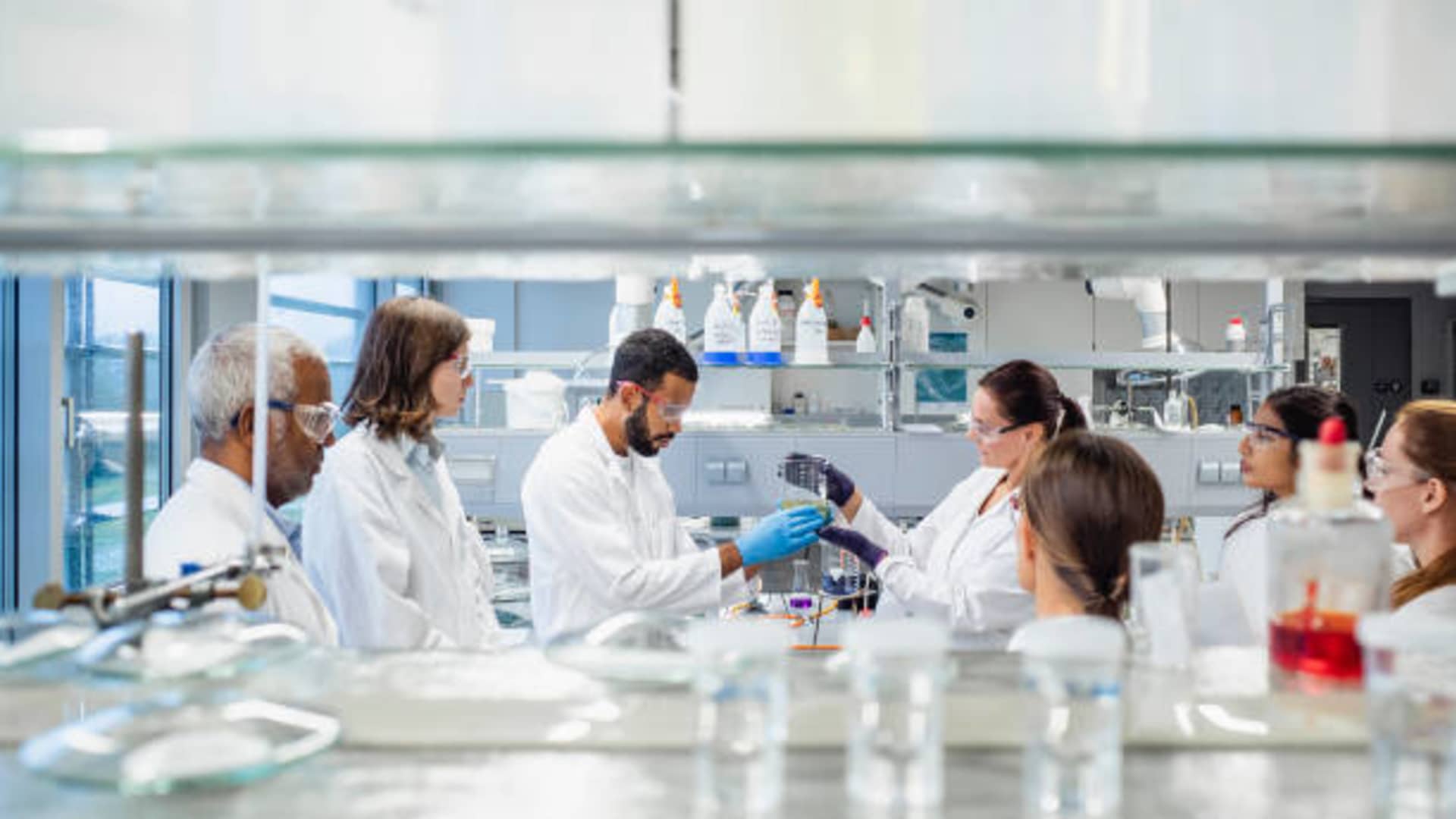
- BioCryst expects up to $645 million in 2026 sales from its HAE drug Orladeyo, giving it capital to pursue external deals.
- As large drugmakers prioritize multibillion dollar assets, small and midsize biotech companies are increasingly stepping in to develop and acquire rare disease drugs.
CNBC Cures is proudly under AstraZeneca Rare Disease, whose support enables our journalism to elevate stories that advance research, innovation and patient care in rare diseases
The science behind rare disease drug development is changing fast, and with it, so is the financial engine that drives it all
This month saw the launch of Rare Ventures — a new venture philanthropy-based accelerator lead by EB Research Partnership CEO, Michael Hund. The launch comes thanks to an investment of up to $25 million from the Richard K. Mellon Foundation, and with the hope that the funding model that contributed to the successful development of 3 FDA approved treatments for epidermolysis bullosa can be applied to other rare diseases — which has been a long-term goal of Hund and EBRP’s founders, Jill and Eddie Vedder.
Eddie Vedder attends the “Matter Of Time” premiere during the 2025 Tribeca Festival at Spring Studios on June 12, 2025 in New York City.
Mike Coppola | Getty Images
Rare Ventures will initially focus on funding the development of new treatments for seven different rare conditions. The accelerator will work on de-risking promising treatments for those disorders and making them more appealing for commercial development. As new investors look to buy or license those assets, the fund will reinvest any returns into its other programs. If the model works, Hund says Rare Ventures will expand to include more diseases and potentially fund more treatments
But its not just philanthropy pushing the science forward. The last year has seen a groundswell of M&A activity focused on rare disease, and dozens of deals to purchase, license or fund new treatments for the rare community
For more stories like this, sign up for the CNBC Cures newsletter
And increasingly, it’s the small and midsize players that are driving that activity. So what’s behind it all?
Sanjeri | Getty Images
When we talk about the struggles faced by small to midsize biotech companies, there are a number of recurring themes that come up: the difficulty getting a new drug approved, dwindling cash reserves and stock volatility, just to name a few.
So when the CEO of a biotech with a market cap that’s under $5 billion says his biggest challenge is deciding how to spend his excess capital, you sit up and take notice
That’s the conversation taking place inside the offices at BioCryst Pharmaceuticals, where CEO Charlie Gayer is in the eng the coffers full. Gayer’s primary concern now is figuring out how to grow the company in an efficient and sustainable way.
“We were profitable last year, we’re going to be more profitable this year, more profitable next year. We will never drop below the line again. We’re going to have that discipline,” said Gayer, who stepped into the CEO role in January. “We do not want to be dependent on, ‘We have to go out and raise money just to keep the lights on.'”
We were profitable last year, we’re going to be more profitable this year, more profitable next year. We will never drop below the line again. We’re going to have that discipline.”
Charlie Gayer
BioCryst Pharmaceuticals CEO
In 2020, the FDA approved Orladeyo, BioCryst’s treatment for hereditary angioedema, or HAE — a rare genetic disorder that causes sudden, severe swelling that can be fatal. Since then, Orladeyo has generated more than $2 billion in sales. For this year alone, BioCryst is forecasting sales of up to $645 million
Investors have taken notice, with shares of BioCryst up about 25% since the start of the year. And now that the company is on firm financial footing, Gayer is rethinking the long-term strategy in order to find more wins in the rare disease space.
“We’re trying to break out of the perception that we’re just an HAE company. We’re a rare disease company, and we’ve got the reis more about looking around to figure out how we can apply our skills where maybe it makes more sense, instead of being another single-product company.”
In the past, BioCryst would have looked internally to develop its pipeline. For Gayer, that approach is no longer the right one
“What has BioCryst done in 40 years? Launched Orladeyo, which was super successful. We launched a drug called Rapivab which served a niche. But two things in 40 years. And so now what we’re realizing is doing it all internally ourselves isn’t feasible. There’s too much risk, too much expense.”
Charlie Gayer, BioCryst Pharmaceuticals CEO
BioCryst Pharmaceuticals
Now BioCryst is looking externally to acquire early stage assets it can develop and build upon. But because of the financial stability provided by Orladeyo’s success, the company is able to take a more flexible approach when looking for potential fits. “At this point, we’re therapeutic-area agnostic. We might end up in something completely different if we find another asset that fits into our model.”
For BioCryst, that does not necessarily mean trying to find the next blockbuster drug. While mega-cap pharma companies typically look to invest in assets that offer peak sales in the billions of dollars, Gayer has smaller targets in mind. “If we found a drug that looks like it serves a need, but only has a $300 million peak potential for us, we can plug this into our commercialization engine,” he said. “We can put up another small sales force. We’ve got real operating leverage on that.”
That approach is a breath of fresh air for many in the rare disease community, where — even if a drug is approved — smaller patient populations often translate to smaller payouts. Smaller payouts scare off potential investors, meaning promising treatments are often left on a shelf.
“Most of pharma is now too big to acquire most rare disease drugs,” said Rod Wong, Managing Partner & CIO at RTW. He said that as the biggest companies shift their sites to target drugs with peak sales of $2 billion or more, small and midsize biotech players are now starting to fill the space that their bigger peers have left behind. “We’re seeing smaller companies buying assets with smaller peak sales. Hopefully this will encourage more companies of this size to become buyers, because we need a new cohort of natural buyers to replace big pharma.”
We’re seeing smaller companies buying assets with smaller peak sales. Hopefully this will encourage more companies of this size to become buyers, because we need a new cohort of natural buyers to replace big pharma.”
Rod Wong
RTW CIO & Managing Partner
Gayer believes BioCryst can be part of that cohort. “Our aspiration is we’d like to be seen as, if not a new model, sort of a contemporary version of old models of rare disease company,” he said. “I’d love to be thought of someday as like Genzyme was back in the day, or Shire… or even Horizon. There are different ways to build a rare disease company, and we’re trying to take the best ideas and take it forward from here.”
Choose CNBC as your preferred source on Google and never miss a moment from the most trusted name in business news.
watch now
watch now

Read More
