


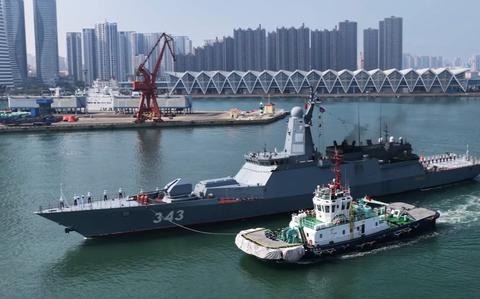
Russian naval vessels arrive in the Chinese port city of Qingdao ahead of a joint exercise in this video posted online by China’s Ministry of National Defense on July 5, 2026. (China Ministry of National Defense)
An annual exercise by the Chinese and Russian navies that began Monday represents a challenge this year to the international order upheld by the U.S. as its diplomatic and military prowess is in question, according to defense analysts
The Joint Sea exercise is taking place in the Yellow Sea off Qingdao, a port city in eastern China, according to a Sunday news release from China’s Ministry of National Defense
After the exercise, the two navies “will conduct a joint maritime patrol in relevant areas of the Pacific Ocean,” the release states
The exercise represents an “implicit challenge to a free and open Indo-Pacific,” an assistant professor of Asian studies and political science at Temple University Japan.
The Chinese and Russians are signaling their combined strength as Japan, South Korea and Taiwan “have reason to question America’s capabilities and resolve,” he said by email Monday
“The strategic quagmire of the American-Israeli war against Iran combined with the Trump administration’s vacillations on aid to Ukraine and force drawdown in Europe have compromised America’s diplomatic and military credibility,” he said
The drills were first conducted in 2012, according to a June 9 Congressional Research Service report on Russian military activities in Asia
Taken as a whole, the annual drills “make it more likely the two regimes might decide to pull the trigger against the West and other free nations … either individually or collectively,” said Grant Newsham, a retired Marine colonel and senior researcher with the Japan Forum for Strategic Studies in Tokyo
“China has been clear about its intentions in the Asia-Pacific — to dominate and control the region and drive the Americans out,” Newsham said by email Monday. “Taking Taiwan is part of this strategy and Joint-Sea 2026 is just one piece of the puzzle as China tightens the noose and expands its regional influence.”
China has vowed to reunite self-governing Taiwan with the mainland, by force if necessary
The exercise runs through July 13, according to an article Sunday in Russian state-run media RIA. Russian ships participating in the exercise include the cruiser Varyag, the corvette Rezkiy, the diesel-electric submarine Ufa and the rescue vessel Igor Belousov
Chinese missile destroyers Kaifeng and Anshan, the missile frigate Wuhu, the comprehensive supply ship Kekexilihu, the submarine rescue ship Yangchenghu and an unnamed submarine will participate, according to a separate release Sunday on the China Defense Ministry’s Chinese-language website
The exercise will include courtesy meetings, joint planning sessions, professional exchanges, joint reconnaissance, air defense, missile defense and anti-ship strike exercises, according to that release
The drills also appear to involve “cognitive warfare” to unsettle Japanese public opinion and disrupt strategic calculations by “introducing the Russian factor,” a senior associate professor of international studies at Meio University
As Japan revises its three security documents focusing on a potential Taiwan contingency, it must “carefully consider the impact of traditional security challenges and threats — such as North Korea and Russia — that existed long before China’s rise,” he said by email Monday
Brian McElhiney
Brian McElhiney
Brian McElhiney is a reporter for Stars and Stripes based in Okinawa, Japan. He has worked as a music reporter and editor for publications in New Hampshire, Vermont, New York and Oregon. One of his earliest journalistic inspirations came from reading Stars and Stripes as a kid growing up in Okinawa.
Keishi Koja
Keishi Koja
Keishi Koja is an Okinawa-based reporter and translator who joined Stars and Stripes in August 2022. He studied International Communication at the University of Okinawa and previously worked in education.
