


Commercializing Canadian Health Research: The Case for Targeting Grants and Increasing Overall Investment

By Jeremy Hirota, Leonard Waverman, Jason Choiand Noah Kornberg
|
July 20, 2026
Downloads
Canada should significantly expand commercialization-focused grant programs through the Canadian Institutes of Health Research (CIHR) and increase Canada’s overall health science research investments to a scale commensurate with global competition
KEY TAKEAWAYS
Canada invests heavily in academic health research, yet its commercialization outcomes trail those of leading innovation economies. The gap is due to structural factors that targeted policy can address.
Key factors include the share of CIHR funding directed toward commercialization, discontinuity of grant programs, an absence of a national IP framework, limited tech-transfer capacity, and an academic culture that could better reward entrepreneurship.
This report shows that commercially focused CIHR grants yield better translational outcomes than do grants more focused on technology development and basic sciences: recipients file more patents, form more companies, and attract more private investment.
Canadian researchers have a funding efficiency ratio 10 times greater than researchers at a comparable U.S. institution, suggesting that the quality of Canadian health research is not the constraint—the scale of investment is.
Canada needs a strategic expansion of commercialization-oriented grant programs and structural reforms to improve its capacity to convert academic research into economically impactful innovations.
To compete globally, Canada also needs to significantly expand government funding for health science research.
Key Takeaways
Key Takeaways 1
Executive Summary 2
Introduction.3
Methods 4
Results and Findings 5
Meaning of Results and Public Policy Implications 8
Conclusion.10
Endnotes 12
Executive Summary
Canada invests heavily in academic health research, yet its commercialization outcomes trail those of leading innovation economies. This report analyzes 10,698 Canadian Institutes of Health Research (CIHR) grants awarded from 2009 to 2024. Grants were classified into three categories: commercialization-focused (COM), technology development (TECH), and basic science (SCI). COM grants produced significantly higher commercialization outputs than did the other two types, including greater rates of patent filing, company formation, and venture investment. COM grants also demonstrated a markedly higher funding efficiency ratio, a measure of how much academic funding leads to downstream investment, reflecting more effective translation of public investment into commercial success.[1] TECH grants had a higher rate of patenting than did basic science grants, but the public funding of basic science did lead to significant patenting, especially when we consider the long lags between basic science lab research and commercial outcomes. For example, Professor John Valiant of McMaster started his investigation of radioisotopes in the early 2000s, a company was formed in 2020, Series A and B monies were raised, and the resulting venture, FUSION Pharmaceuticals, was acquired in 2024 for US$2.4 billion.
Sixty percent of COM grants led to patents, as did 30 percent of TECH grants and 18 percent of SCI grants. Ten percent of COM grants led to company formation. Venture funding and company exit (IPO, purchase, etc.) were negligible for all types of federal science grants. These results support the value of targeted commercialization programs and suggest that structural reforms are needed to strengthen Canada’s ability to convert academic research discoveries into marketable technologies
Between 2009 and 2024, CIHR gave out a total of ~CA$15 billion for health science research and related activities; we analyze CA$5 billion of these grants.[2]
Canada also lags behind peer nations in absolute research funding. In the United States, federal funding for basic research over that period amounted to $580 billion, 36 times as much as Canadian federal funding. In 2023–2024, the U.S. federal government spent US$48 billion on health science research.[3] This was approximately 48 times Canada’s CIHR budget of CA$1.37 billion (when converted to U.S. dollars). While the United States is an outlier, Canada’s funding gap with European peers is also substantial. The United Kingdom in 2023–2024 financed 1.86 billion pounds (approximately CA$3.3 billion) of health science research through the National Institute for Health Research and the Medical Research Council.[4] France, in 2023, allocated €2.014 billion (CA$3.2 billion) and Germany €4.02 billion (CA$6.8 billion) to university health science research.[5] For Canada to compete at a world scale, it should match and multiply federal CIHR funding by a factor of five.
These findings support two policy priorities: significantly expanding CIHR’s commercialization-focused grant programs and increasing Canada’s overall health science research investment to a scale commensurate with global competition
Introduction
The 1980 Bayh-Dole Act transformed the commercialization of U.S. academic research by allowing universities to retain intellectual property (IP) rights from federally funded research. By reducing transaction costs and legal uncertainty, the act shifted academic culture toward a greater emphasis on commercialization, spurring the growth of university technology transfer offices and academic entrepreneurship.[6]
Canada does not have a direct equivalent to the Bayh-Dole Act at the federal level. Instead, each university or accredited research institution establishes its own IP policy. The three federal funding agencies—CIHR, the Natural Sciences and Engineering Research Council of Canada (NSERC), and the Social Sciences and Humanities Research Council of Canada (SSHRC)—do not claim IP rights from the research they fund. This decentralized model creates variation in commercialization incentives across institutions.
Models vary considerably. The University of Waterloo follows an inventor-owned model, allowing researchers to retain full IP rights and commercialize independently, with revenue splits of 75/25 in favor of the inventor if they engage the Waterloo Commercialization Office (WatCo).[7] The University of Toronto employs a joint-ownership model wherein inventors and the university initially share ownership.[8] At the University of Toronto, inventors may elect to assume full ownership and responsibility for patenting and commercialization, or assign the invention to the university.[9] In cases where inventors retain ownership, they must remit 25 percent of revenues derived from licensing, royalites, or equity to the university.[10] These differing approaches reflect the broader absence of a national framework.
Canada demonstrates strong performance in higher-education research and development (R&D) investment and scientific research output, but its commercialization outcomes consistently lag behind leading innovation economies such as the United States, Germany, South Korea, and the United Kingdom. Canada ranked second in higher education R&D intensity across G7 countries in 2022.[11] However, it ranks 17th out of 139 countries in the 2025 Global Innovation index, with comparatively low scores in patenting, scale-up success, licensing income, and the economic value realized from academic discoveries.[12] Canada’s advanced-industries (technology and manufacturing) output as a share of gross domestic product (GDP) also trails peer nations, indicating a gap in translating postsecondary research into industrial performance.[13]
Canada does have notable strengths: It ranks 13th globally on innovation inputs, backed by a robust institutional framework, a high-quality education and research base, and a vibrant venture capital (VC) ecosystem.[14] Canada ranks among the top economies for market sophistication (8th), university–industry R&D collaboration (6th), and late-stage VC deals (8th).[15] Its innovation ecosystem is anchored by world-class universities and dynamic firms. With three major innovation clusters in Toronto, Montréal, and Vancouver, and relatively good intangible asset intensity (17th) and software spending (7th), Canada remains a dynamic innovation leader with room to boost its output performance.[16] Conversely, Canada’s shortcomings include lower labor productivity growth (101st), fewer industrial designs (95th) and trademarks (85th), and modest high-tech exports (37th) relative to its peers.[17] The challenge is converting Canada’s inputs to outputs.
The commercialization gap is partly attributable to limited staffing and expertise in Canadian technology transfer offices compared with their well-funded U.S. counterparts. Most operate near breakeven, with nationwide tech transfer revenues from patents and licenses totaling only US$53 million in 2017.[18] Despite high invention disclosures, many patents remain uncommercialized and successful scale-ups are rare.[19] The traditional academic promotion system, which rewards publications more than commercialization, reinforces these structural barriers.[20]
CIHR is Canada’s largest federal funder of university health science research. It originated from the Medical Research Council (MRC) of Canada, which for decades concentrated primarily on biomedical research.[21] In the 1990s, MRC chair Dr. Henry Friesen recognized that this narrow scope excluded other critical domains such as clinical research, population health, and health services.[22] He proposed the creation of a decentralized agency structured around 13 institutes, each dedicated to a specific area of health research, to foster collaboration and address the diverse health needs of Canadians.[23] This vision culminated in the establishment of CIHR by an Act of Parliament on June 7, 2000. Since then, CIHR has invested over CA$1 billion annually through more than 100 funding competitions, supporting more than 16,000 health researchers and trainees nationwide.[24] This report analyzes commercialization outcomes from one-third of CIHR grants over 2009–2024, examining patent applications, company formation, series investment, and exits (IPOs and acquisitions.)
Methods
Each CIHR grant is given to a principal investigator. We used the recipient’s name to determine the commercialization activities from this grant. This required AI-assisted data mining across a number of websites to determine whether there were any patents, funding investments, company formations, or exits. Because many researchers share common names, each recipient was identified using a combination of name, university affiliation, grant title, and project description to ensure accurate matching. This process was iterative, requiring manual validation of AI-assisted data mining.
The Canadian government has a database of all patents.[25] Unfortunately, patents are not easily traceable. In particular, there is no accessible application programming interface (API) that a software system can interface with to extract data and enable our required research activities. Our first recommendation then is that Statistics Canada develop or deploy open APIs for i) accessing IP activity from Canadians, and ii) accessing all government funded research. This recommendation is not to simplify tasks, but instead to enable the ongoing analysis in an open and industry-standard process.
Once grant recipients, grant titles, institutes, and descriptions of research were collected, they were used to connect to patent filings. Patent records were then linked to company data through Crunchbase and Pitchbook to identify and quantify company formation, funding, and exits/acquisitions
Results and Findings
Three groups of CIHR grants were compared: COM, TECH, and SCI.[26] Outcomes measured include patent filings, company formation, investment, and exits
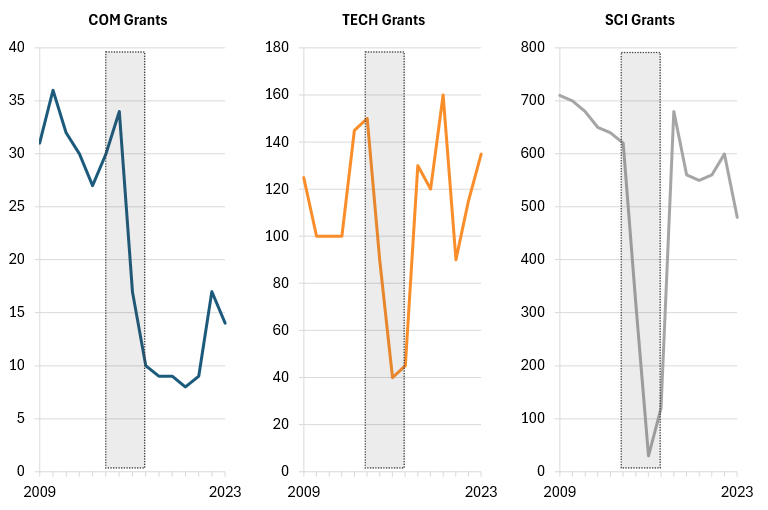
Figure 1 shows the distribution of grants by year. Note the significant change in the composition of grants given in 2014–2017. This was a period in which CIHR underwent a change in overall funding allocation with a new foundation grant scheme that was cancelled after critical analysis of the program identified flaws.[27] We also want to highlight that the Proof-of-Principle (POP) commercialization grants began in 2009 and were sunsetted in 2015.[28] Imagine that a scholar saw the announcement of a program of POP grants and began a body of research aiming to apply later, and they were sufficiently prepared to apply in 2015, but the program had ended. Its cancellation mid-stream likely discouraged researchers who had oriented their work toward commercialization in anticipation of future funding.
The lasting impact of its discontinuity on Canada’s biomedical researcher community is difficult to quantify but very likely negative. Not only has the POP grant competition ended, but in the five years of our data analyzed, it administered just CA$10.4 million. Total CIHR funding in those years was CA$5 billion. So, POP grants represented 2.1 percent of total CIHR grants
Figure 1: Distribution of CIHR funding by number of grants (restructuring period highlighted in gray)
Long time horizons are essential for commercialization-oriented grants: the path from scientific discovery to market can span decades. A good example is Fusion Pharmaceuticals, a Hamilton-based spin-off from McMaster University acquired in 2024 by Astra Zeneca for US$2 billion plus an additional US$400 million in milestone payments. Professor Valiant’s journey began in the early 2000s with funding from NSERC, the Natural Science and Engineering Research Council of Canada. The early development of technologies to link radioisotopes to proteins laid the foundations for the formation of the Centre for Probe Development and Commercialization in 2008 to encourage radiopharmaceutical R&D and subsequent commercialization. In February 2017, Fusion was launched with US$25 million Series A (Johnson & Johnson), with an additional US$46 million raised in September of the same year (new partners). A Series B round was completed in April 2019 with follow-on funding in January 2020. A Class B preferred share financing occurred in June 2020 and AstraZeneca completed the acquisition in March 2024.
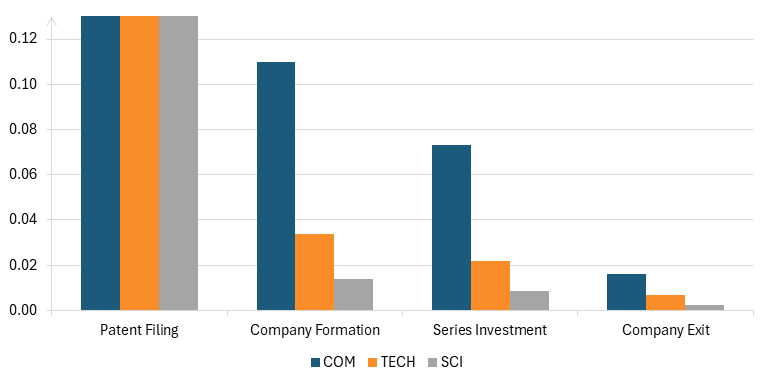
When we dive into the totality of the grants analyzed, COM grants led to the highest patent filing rates: 65 percent of grant recipients filed at least one patent compared with 30 percent of TECH grant recipients and 18 percent of SCI recipients. (See figure 2.) The 18 percent patenting rate among basic science recipients is notable, as it reflects the long but real pathway from fundamental discovery to commercial application, as highlighted by the Fusion Pharmaceuticals case mentioned earlier
Figure 2: Proportions of grant recipients completing different commercialization activities
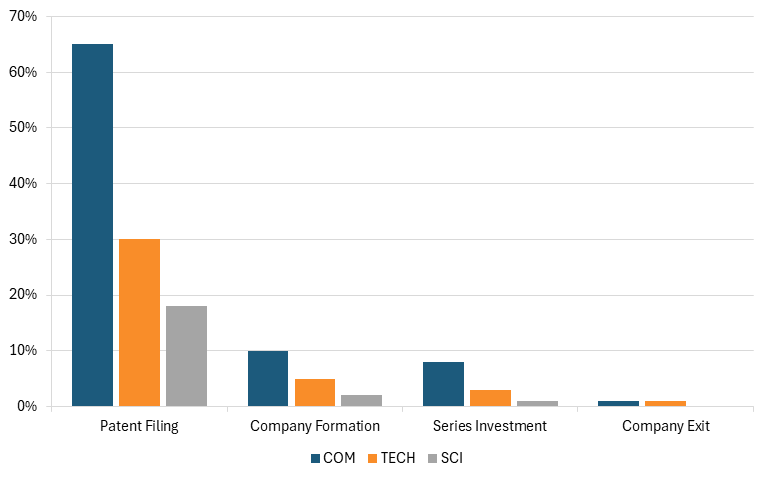
Translating patent filings into company filings, investment, and exists proved more difficult for research funded by CIHR in the Canadian biomedical ecosystem. Our data demonstrates that 10 percent of POP grants, the first dominant form of commercialization-focused grants administered by CIHR, led to company formation, with 8 percent receiving downstream investment. TECH and SCI categories of research grants led to very small levels of company formation, series investments, and company exits
Given the lengthy timelines from basic scientific research to a commercially viable idea to a marketable product, SCI grants in 2020 certainly may not have had sufficient time to move to patent claims being awarded. Thus, for our analyses over 2009–2024, it is expected that COM grants, with the most direct commercialization mandate, would outperform TECH and SCI grants in commercialization outcomes, and that recent SCI grants would not yet have had sufficient time to generate patents or company activity.
When we begin to look at the commercialization impact of each grant type, we show that COM grants resulted in 2.5 patents per individual, TECH grants nearly one patent per individual, and basic science grants 0.5 patents per individual (figure 3). Consistent with patent activity, a deeper dive into company formation and exits also favours COM funded grant recipients to partake in these activities (figure 4). This concentration—a small number of highly productive recipients driving most commercialization output—raises the question of whether funding should be targeted toward these individuals. However, identifying them in advance is difficult. The more practical solution is to significantly expand commercialization-focused grants, which would attract and surface commercially oriented researchers. This is another reason to greatly increase CIHR commercialization granting activity.
Figure 3: Commercialization activities per recipient
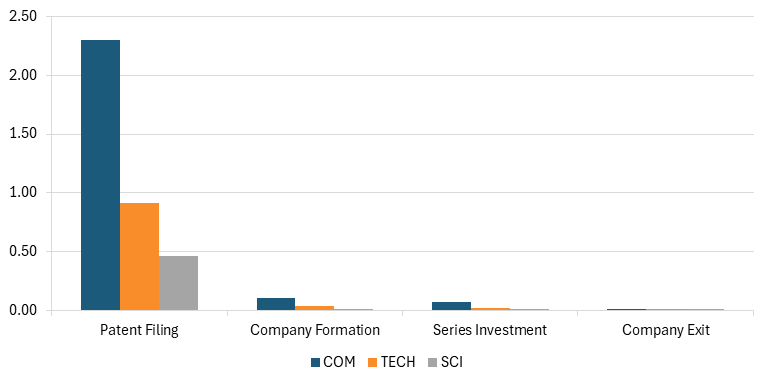
Figure 4: Commercialization activities per recipient (company-related focus)
Meaning of Results and Public Policy Implications
From 2009 to 2024, CIHR invested approximately CA$15.5 billion in university health science research. While substantial in absolute terms, this figure pales in comparison to U.S. investment. Certainly, there are far more universities and colleges in the United States than in Canada, far more than the 10 times larger population that the United States has
In 2023 alone, U.S. federal health science research funding totaled US$35.7 billion, roughly 20 times Canada’s CA$1.362 billion CIHR budget.[29] Insufficient funding is likely a significant contributor to Canada’s commercialization gap
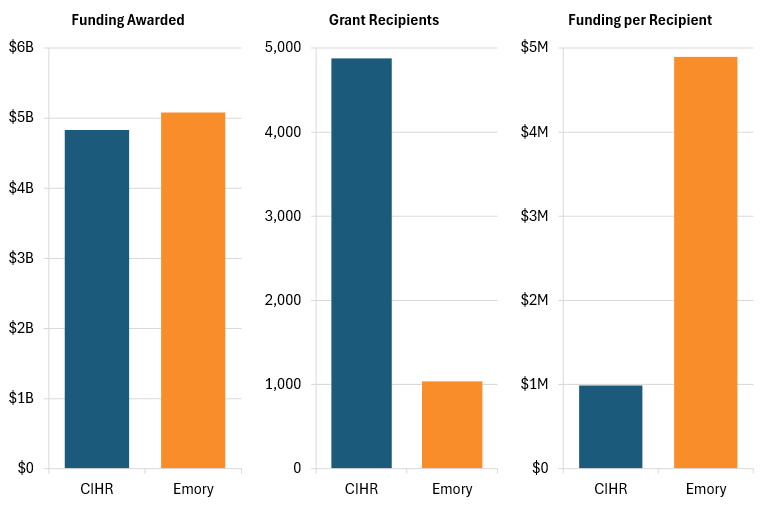
To benchmark Canada’s performance, we compared CIHR grant recipients against U.S. National Institutes of Health (NIH)-funded researchers at Emory University in Atlanta, a single university that received roughly the same total funding (US$5.08 billion) as the one-third of all CIHR grants analyzed in this study (equivalent to US$4.83 billion, as shown in figure 5). Despite similar total funding, the distribution was strikingly different: CIHR funding was distributed across 4,876 recipients, averaging ~US$1 million per recipient, while Emory concentrated funding among 1,038 recipients, averaging US$4.6 million each.
Figure 5: CIHR funding compared to Emory University (U.S. dollars)
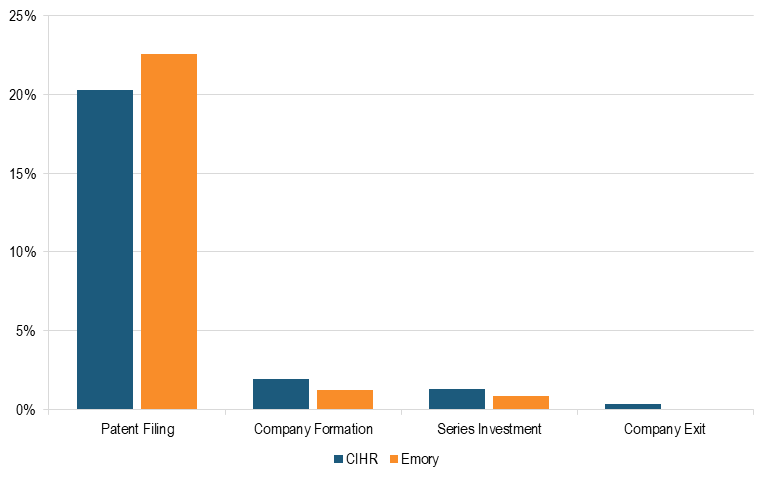
Emory recipients filed slightly more patents (22.6 percent vs. 20.3 percent, as shown in figure 6). But CIHR recipients exhibited greater engagement in company-related activities, including company formation (1.91 percent vs. 1.25 percent), securing Series investment (1.29 percent vs. 0.87 percent), and company exits (0.37 percent vs. 0 percent)
On a per-recipient basis, these trends held: Emory recipients filed more patents on average (0.76 vs. 0.70), while CIHR recipients formed more companies (0.019 vs. 0.013), secured more Series investments (0.013 vs. 0.0077), and secured more exits (0.0031 vs. 0)
Strikingly, CIHR’s funding efficiency ratio—a measure of how much academic funding leads to downstream investment—was 0.35, compared with just 0.034 for Emory. However, Emory University’s strategy is not to maximize patents; it is to maximize income from research through licensing. Over the period from 2016 to 2024, Emory received US$521 million in revenue from its technology licensing and more than US$1.4 billion since licensing began
The data on licensing income of Canadian universities is incomplete, as some universities, notably the University of Waterloo, do not require their professors to go through the Technology Transfer Office
The Association of Technology Transfer Managers (AUTM) surveys 30 Canadian universities and many U.S. universities on their technology activities annually. In 2022, the 30 Canadian universities had CA$164 million in licensing, royalty revenue, etc. The largest revenue was at the University of Toronto—CA$58 million. Waterloo reported only CA$245,000. Emory University had licensing revenue of US$238 million
Choosing only one U.S. University is not a statistically significant finding; more research is needed here. But two points are clear: First, the comparison demonstrates the potential for Canadian researchers and entrepreneurs if given a supportive culture and ecosystem. Second, perhaps more emphasis should be placed on licensing the technology developed at Canadian Universities and maximizing income
Figure 6: Proportion of grant participants participating in each commercial activity
Conclusion
This report provides evidence that commercialization-focused CIHR grants (COM) yield superior translational outcomes compared with non-commercialization-focused funding (TECH and SCI). COM recipients filed more patents and were significantly more likely to form companies and attract private investment. A funding efficiency ratio 10 times that of a comparable U.S. institution suggests that the quality of Canadian health research is not the constraint—scale of investment is. Canada’s commercialization gap reflects structural factors that targeted policy can address: the small share of CIHR funding directed toward commercialization, the discontinuity of grant programs, the absence of a national IP framework similar to Bayh-Dole, limited technology transfer capacity, and an academic culture that does not adequately reward entrepreneurship alongside traditional academic metrics like publications. The opportunity to close the gap is real, and the policy levers to do so well understood. These results support the strategic expansion of commercialization-oriented grant programs and highlight the need for structural reforms to improve Canada’s capacity to convert academic research into economically impactful innovations. Comparison with other countries’ government funding for health science research also suggests the need for a large expansion of Canadian funding to compete globally.
Acknowledgments
Research funding provided by the Delaney Foundation. The authors and ITIF maintain full editorial independence in their work. Any errors or omissions are the authors’ responsibility
About the Authors
Dr. Jeremy Hirota is an associate professor in the Department of Medicine, Division of Respirology and a Tier 2 Canada Research Chair in Respiratory Mucosal Immunology and GSK Chair in Lung Immunology at McMaster University. He has developed translational models for particulate matter, cigarette smoke, and cannabis smoke exposures, contributing to national and international discussions on cannabis and respiratory health. As an extension from his academic R&D, Dr. Hirota is an active innovator and entrepreneur. In 2024, he co-founded Tessella Biosciences, a federally incorporated biomaterials company commercializing proprietary bioink formulations invented at McMaster University. As chief scientific officer, he has guided Tessella from IP development to revenue generation, securing pre-seed SAFE investments, government support for IP strategy and filings, and establishing global distribution partnerships. With over 100 peer-reviewed publications, four patent-pending filings, with additional op-ed contributions on innovation and entrepreneurship, he is always working to integrate discovery research with real-world application, advancing respiratory health and biomaterials innovation.
Dr. Leonard Waverman is a member of the board of ITIF’s Centre for Canadian Innovation and Competitiveness. He is the former dean of the DeGroote School of Business at McMaster University, and a former member of the C.D. Howe Institute’s board of directors. He continues as a professor of finance and business economics and as the acting director of the newly formed Foresight Lab, both at McMaster. He specializes in microeconomics and industrial organization, economics of telecommunications, energy and resource economics, international trade, public utility, and public enterprise economics. His research continues to focus on the impact that developments in the telecommunication industry have on growth and productivity.
Jason Choi is a Ph.D. candidate in Biochemistry at McMaster University, where he serves as an economic research assistant under Dr. Hirota and Dr. Waverman
Noah Kornberg is a designer and developer who served as a data engineer research assistant at McMaster University
About the Centre for Canadian Innovation and Competitiveness
The Centre for Canadian Innovation and Competitiveness is an Ottawa-based affiliate of the Information Technology and Innovation Foundation (ITIF), the world’s leading think tank for science and technology policy. As a separately incorporated and registered charity under the Canada Not-for-profit Corporations Act and Income Tax Act, the Centre’s mission is to help policymakers and the Canadian public better understand the nature of the innovation economy and the types of public policies that are necessary to drive Canadian innovation, productivity, and global competitiveness. For more information, visit innovationpolicy.ca.
Endnotes
[1]. The efficiency ratio is the total investment raised divided by the amount of CIHR funding received
[2]. Canadian Institutes of Health Research, Funding Decisions Database, https://webapps.cihr-irsc.gc.ca/decisions/p/main.html
[3]. Kavya Sekar, “National Institutes of Health (NIH) Funding: FY1996–FY2024” (Washington, DC: Congressional Research Service, May 17, 2023), https://crsreports.congress.gov/product/pdf/R/R43341
[4]. Data from National Institute for Health and Care Research, “NIHR Annual Report 2023/24” (NIHR, September 30, 2024), https://www.nihr.ac.uk/about-us/who-we-are/reports-and-performance/annual-report-202324; UK Research and Innovation, Annual Report and Accounts 2023–24 (Swindon: UKRI, July 2024), 23, https://www.ukri.org/wp-content/uploads/2024/07/UKRI-250724-AnnualReport-2023-2024.pdf
[5]. Eurostat, Government Budget Allocations for R&D by Socioeconomic Objectives (NABS 2007) (health; million euros; France and Germany; 2023; dataset code: gba_nabsfin07; accessed July 9, 2026),https://ec.europa.eu/eurostat/databrowser/view/gba_nabsfin07/default/table
[6]. Matthew Rafferty, “The Bayh–Dole Act and university research and development,” Research Policy 37, no. 1 (February 2008): 29–40, https://doi.org/10.1016/j.respol.2007.06.010; Albert N. Link and Martijn van Hasselt, “On the transfer of technology from universities: The impact of the Bayh–Dole Act of 1980 on the institutionalization of university research,” European Economic Review 119 (October 2019): 472–481, https://doi.org/10.1016/j.euroecorev.2019.08.006; Taylor T. Aldridge and David B. Audretsch, “The Bayh-Dole Act and scientist entrepreneurship,” Research Policy 40, no. 8 (October 2011): 1058–1067, https://doi.org/10.1016/j.respol.2011.04.006.
[7]. University of Waterloo, “Policy 73 – Intellectual Property Rights,” last updated February 28, 2020, accessed July 9, 2026,https://uwaterloo.ca/secretariat/policies-procedures-guidelines/policies/policy-73-intellectual-property-rights; University of Waterloo, “Work with WatCo,” accessed July 9, 2026, https://uwaterloo.ca/research/waterloo-commercialization-office-watco/commercialization-services/work-watco
[8]. University of Toronto, “Protect Intellectual Property,” accessed July 9, 2026,https://research.utoronto.ca/inventions-commercialization-entrepreneurship/protect-intellectual-property
[9]. Ibid
[10]. University of Toronto, “Inventions Policy & Revenue Sharing,” accessed July 9, 2026,https://research.utoronto.ca/inventions-commercialization-entrepreneurship/inventions-policy-revenue-sharing
[11]. Statistics Canada, “Spending on research and development in the higher education sector, 2022/2023,” The Daily, November 1, 2024,https://www150.statcan.gc.ca/n1/daily-quotidien/241101/dq241101c-eng.htm
[12]. World Intellectual Property Organization (WIPO), Global Innovation Index 2023: Innovation in the Face of Uncertainty (Geneva: WIPO, 2023),https://doi.org/10.34667/tind.48220
[13]. Signal49 Research, “2024 Innovation Report Card: Benchmarking Canada’s Innovation Performance” (Signal49 Research, April 11, 2024),https://www.signal49.ca/wp-content/uploads/2022/10/innovation-report-card_2024.pdf
[14]. World Intellectual Property Organization (WIPO), “Canada Ranking in the Global Innovation Index 2025” (Geneva: WIPO, 2025), https://www.wipo.int/edocs/gii-ranking/2025/ca.pdf
[15]. Ibid
[16]. Ibid
[17]. Ibid
[18]. Universities Canada, “University intellectual property and technology transfer: Universities Canada’s submission to the Standing Committee on Industry, Science and Technology” (Universities Canada, June 2017),https://univcan.ca/wp-content/uploads/2017/06/university-intellectual-property-and-technology-transfer-submission-june-2017accessible.pdf
[19]. Robert D. Atkinson and Lawrence Zhang, “Assessing Canadian Innovation, Productivity, and Competitiveness” (ITIF Canada Centre, May 2024), https://itif.org/publications/2024/04/29/assessing-canadian-innovation-productivity-and-competitiveness/.
[20]. Ibid
[21]. Canadian Institutes of Health Research (CIHR), “CIHR at 25,” last modified December 22, 2025,https://cihr-irsc.gc.ca/e/54265.html
[22]. Ibid
[23]. Ibid
[24]. Ibid
[25]. Canadian Intellectual Property Office, Canadian Patents Database (accessed July 13, 2026), https://brevets-patents.ic.gc.ca/opic-cipo/cpd/eng/introduction.html
[26]. All Commercialization and Technology grants were analyzed. A stratified sample of the Basic Science grants was taken. More details in the full write-up
[27]. Canadian Institutes of Health Research, “Key Considerations for Sunsetting the Foundation Grant Program,” last modified April 15, 2019, https://cihr-irsc.gc.ca/e/51418.html
[28]. Kathleen Marsman, “Changes in Canadian Institutes of Health Research Funding: What Will Become of CIHR Proof of Principle Commercialization Grants?” Mondaq, June 22, 2015, https://www.mondaq.com/canada/healthcare/406166/changes-in-canadian-institutes-of-health-research-funding-what-will-become-of-cihr-proof-of-principle-commercialization-grants; Elizabeth Payne, “CIHR cancels funding program that helped bring science discoveries to market,” Ottawa Citizen, December 4, 2015, https://ottawacitizen.com/news/local-news/cihr-cancels-funding-program-that-helped-bring-science-discoveries-to-market.
[29]. Canadian Institutes of Health Research, “CIHR in Numbers,” last modified November 27, 2025, https://cihr-irsc.gc.ca/e/50218.html
Related
July 20, 2026
Paying for Outcomes: Tying University Funding to Commercial Results
May 28, 2024
The Untapped Technological Patent-ial of Canada
June 16, 2026
