


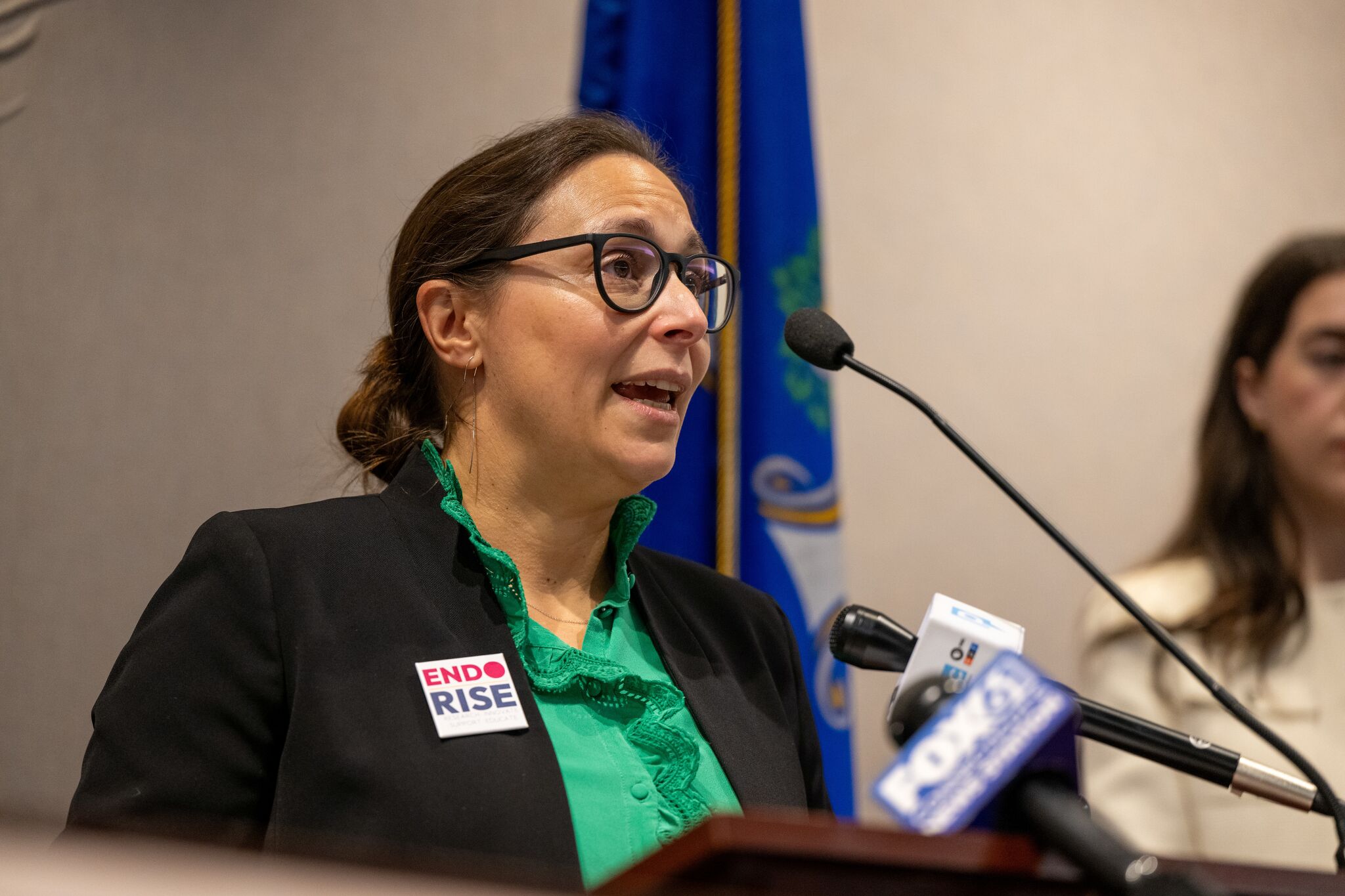
Connecticut lawmakers advanced several initiatives this year designed toexpand access to women’s health services and improve care statewide. This includes boosting research on endometriosis, establishing foundational toolkits for providers,public awareness campaigns and more.
Here are some key takeaways and initiatives to watch for moving forward.
Article continues below this ad
Funding research
Endometriosis is a chronic inflammatory condition that impacts an estimated 6.5 million people across the U.S. There’s no cure, and the exact cause is still not well understood after years of chronic underfunding for clinical research.
Connecticut lawmakers have over the years taken a keen interest in expanding endometriosis research opportunities and public education on the condition. The new legislation is meant to bolster and expand those ongoing efforts by establishing an official state working group and continuing funding for the first state-sponsored research biorepository.
Since about 2021, a group of clinical experts, advocates and lawmakers, led by state Rep. Jillian Gilchrest, has been convening their own working group to offer legislative proposals, said Dr. Elise Courtois, director of the single-cell biology lab at Jackson Laboratories
Article continues below this ad
More For YouHere’s how to get a Connecticut classic license plate for your car
In Connecticut, a 2006 vehicle could be considered a “classic.”
What’s new for women’s health in Connecticut? Key laws and initiatives explained
Some of the CT legislation include a menopause provider toolkit, research funding for endometriosis and coverage for IUDs.
‘Came out of nowhere’: How a CT town is grappling with serious damage, outages
“It just kind of came out of nowhere,” one resident said of the storm. “There was almost no warning.”
Fisherman hooks nearly 6-foot shark off East Haven town beach
An angler fishing for striped bass off East Haven last week hooked something bigger — a 5½-foot-long shark.
Audit finds New Opportunities execs concealed financial problems at CT agency
Despite the audit findings, state officials decided against disbanding the agency.
Make CT Insider a preferred source on Google to see more of our journalism when you search.
Add Preferred Source
However, Courtois, who is a member, said their work was being done in a “semi-official” capacity.
Under the new law, a 20-member working group will be established within the state Commission on Women, Children, Seniors, Equity and Opportunity. The group is charged with studying the prevalence of endometriosis in Connecticut and identifying barriers patients face in obtaining timely diagnosis and treatment
Article continues below this ad
It will also look at how endometriosis impacts women in the workplace, what insurance coverage and reimbursement are available for related care and strategies to address gaps in public awareness and education
Lawmakers also allocated continued funding for an interdisciplinary program focused on expanding endometriosis research.
Launched in 2023, the Endometriosis Research, Innovation, Support, and Education program, known as EndoRISE, is a state-funded, multi-institutional biorepository housed at The Jackson Laboratory in Farmington and coordinated in partnership with UConn Health
Courtois, who is the co-director of EndoRISE, said they study human tissue samples collected from endometriosis patients at UConn Health and other hospital partners.
Article continues below this ad
The biorepository also distributed collected samples to other research institutions, academics, and biotech and pharmaceutical companies to help advance their own research. Courtois said some of the current distribution partnerships include one with John Hopkins Medicine and researchers in Europe.
So far, about 160 patients have enrolled in the study, contributing over 7,000 samples, said Jasmina Kuljancic, program manager for EndoRISE.
“Every patient that we approach wants to be part of this because they want to make an impact in the field,” she said. “They want to… make sure that maybe their kids or generations to come are not as affected as they have been in their lives.”
With continued funding, Courtois said staff is looking to build more partnerships with hospitals across Connecticut to expand and diversify its sample collection network.
Article continues below this ad
“I would say the next step is to ensure that we continue with this impact, and we don’t stop here, and we don’t limit ourselves to just being a biorepository,” she said. “We continue on the education and awareness component, bringing new legislation, or at least recommendations.”
Provider toolkit
Menopauseoccurs when a person’s menstrual periods permanently stop for at least 12 months, typically occurring between the ages of 42 and 58. The Society for Women’s Health Research estimates that about 6,000 women over age 45 enter menopause each day across the U.S.
Although every woman experiences menopause differently, experts say the condition remains widely misunderstood despite its prevalence and complexity, leaving many women without treatment.
Article continues below this ad
“There’s barriers, lack of knowledge, but also stigma,” said Dr. Linda Sprague Martinez, director of the Health Disparities Institute at UConn Health. “There’s a lot of stigma around aging. There’s a lot of stigma around women’s issues, and when you begin to combine those, then it becomes like hush-hush.”
Martinez added that menopause remains underfunded in research and is often overlooked in medical education.
”Just like we see really stark inequities in maternal health outcomes, we see really stark inequities in menopause outcomes, but we’re not talking about those things,” she added
In an effort to address those knowledge gaps, Connecticut lawmakers charged the Health Disparities Institute with developing an evidence-based menopause toolkit for providers who diagnose and treat women in menopause, like OB-GYNs, family medicine, emergency medicine, mental health, social work, dentistry, and more.
Article continues below this ad
It’ll include information such as perimenopause, menopause, and post-menopause symptoms, guidelines on how to treat them, and available insurance coverage for the therapies.
The toolkit is meant to provide a “foundational understanding” how women’s bodies change as they age and how providers can offer well-rounded care, said Trisha Pitter, co-lead for the Collaborations, Community Engagement & Technical Assistance Core at the Health Disparities Institute.
Still very early in development, Pitter said it’ll be designed using a community-based participatory approach, drawing on what they’ve learned from the community. She added that the toolkits will initially focus on three specialties until more funding is secured to expand.
“We want people to understand that this is how providers need to work together interdisciplinary to provide comprehensive care,” Pitter said. “To really look at the whole body and not just parts of it.”
Article continues below this ad
The new law also seeks to improve awareness of menopause in the workplace by establishing a public education campaign, said state Rep. Kai Belton, a major force behind the bill. She said the goal is to help women better understand and access workplace accommodations that are already available to them.
Although she considers it to be a good start, Belton said she will continue to advocate for additional funding to expand the toolkit
“We want to make sure that we can continue to enhance the toolkit, and with the workplace accommodations, we want to do a public awareness campaign,” she said. “So, I think implementation, those are the next steps, just making sure that you know we can reach as many people as possible.”
Contraceptive coverage
Community health centers across Connecticut not only saw a second-year boost in their Medicaid service reimbursement rates this legislative session but also secured state funding to continue a program that covers the cost of long-acting reversible contraceptives for uninsured and underinsured people.
Article continues below this ad
Long-acting reversible contraceptives, like intrauterine devices (IUDs), are an effective and efficient form of birth control, said Deb Polun, chief strategy officer at the Community Health Center Association of Connecticut
However, they can be costly to obtain. Polun pointed out that, even with commercial insurance, some LARCs are not affordable until patients have met their high deductibles.
Established in 2023, the health center’s program offers coverage for LARC devices to people who are uninsured or underinsured. Participating community health centers are reimbursed for those specific services through a contract with the state association.
As of March 2026, about 2,200 people have used the program, Polun said, with the patient pool growing over the years.
Article continues below this ad
The program was established with funds from the American Rescue Plan Act. However, with the ARPA spending deadline on the horizon, Polun said the state included about $250,000 in the budget to help continue the program
“There are a lot of different contraceptive options. People often think about the birth control pill, but it does require going and getting a prescription, getting that prescription filled, remembering to take it every single day,” Polun said. “And these long-acting reversible contraceptives make things a little bit easier for people… but it is expensive, so having the state funding will make this service available to more people.”
