


Download PDF
Abstract
We recently established an external quality assessment (EQA) scheme for next-generation sequencing (NGS) diagnostics in rare neurological disorders (RND) in collaboration with the EMQN. The first assessment rounds revealed limitations and variability in the quality and completeness of genetic testing reports. To improve and harmonize reporting in NGS-based diagnostics for RND, we identified 28 topics requiring recommendations based on EQA findings. These topics were grouped into four areas: clinical information, interpretation, methodology, and reporting. A team of 31 experts with relevant expertise was formed. Using an adapted Delphi approach, two rounds of surveys were conducted to prioritize the topics. Subsequently, area-specific expert groups met to formulate recommendations, followed by a final approval round using the five-finger consensus method involving all experts. In both Delphi rounds, all topics were rated as either very important (n = 12) or important (n = 16), and all were advanced for recommendation development. Consensus recommendations were achieved for 27 of the 28 topics. These include guidance on gene panel composition and updating, addressing disease-specific limitations of NGS (e.g., repeat expansion disorders), defining minimal quality parameters, and promoting sharing of variant interpretations. Each recommendation is supported by real-world examples. Due to differences in national healthcare frameworks and policies, consensus could not be reached regarding which patients should or should not undergo NGS testing. The dissemination of these recommendations is expected to improve the quality of genetic testing and reporting in RND diagnostics, promoting harmonization across laboratories and enabling easier comparison and interpretation of genetic testing reports.
Subjects
- Genetic testing
- Neurological disorders
Introduction
Next-generation sequencing (NGS) technologies have become a foundational tool in the diagnosis of rare neurological diseases (RNDs), offering a rapid and cost-effective means to address their significant clinical and genetic heterogeneity [1,2,3]. As exome and genome sequencing increasingly serve as first-line diagnostic approaches, the reliability and reproducibility of NGS-based testing have become critical to ensuring equitable and accurate diagnoses for patients with RNDs [4, 5]. The complexity of NGS workflows—including library preparation, sequencing quality and depth, bioinformatic pipelines, variant interpretation, and clinical reporting—often results in substantial interlaboratory variability, which may result in disparate testing outcomes for patients across different institutions and countries [6, 7].
The European Reference Network for Rare Neurological Diseases (ERN-RND), established in 2017 [8], has prioritized improving access to high-quality genetic testing throughout the European Union (EU). As part of this mission, ERN-RND has implemented an external quality assessment (EQA) scheme for NGS diagnostics, which has been in routine annual operation since 2021 [7]. Notably, significant differences across laboratories performing genetic testing for RNDs were observed in all major areas, including methodological aspects, data interpretation, and reporting [7]. There is clearly a need for further harmonization by developing minimal standards for NGS-based diagnostic testing in RNDs.
While several broad guidelines for the major areas of NGS-based testing already exist [9,10,11], RNDs share several particularities that make them distinct from other genetic disorders. These include: (1) a relatively high diversity of mutational mechanisms, including single-nucleotide variants (SNVs), but also structural variants such as repeat expansions, (2) a high rate of genetic and phenotypic heterogeneity [12], as well as, (3) specific clinical context considerations, e.g., for (predictive) genetic testing in adult–onset neurodegenerative disorders. Furthermore, the available guidelines for NGS testing are often based on the participation of experts in the field of molecular testing, whereas we anticipate that the involvement of stakeholders from more diverse backgrounds could assist in developing guidelines that are better adapted to the practical context of genetic testing.
To address these gaps, we developed comprehensive recommendations to standardize the processes of NGS-based diagnostics in RND, based on the participation of experts from diverse fields. The aim of this work was to provide clinically oriented practice recommendations for laboratories, clinical geneticists and neurologists to support consistent, high-quality NGS testing, interpretation and reporting in RND diagnostics across institutions and countries
Methods
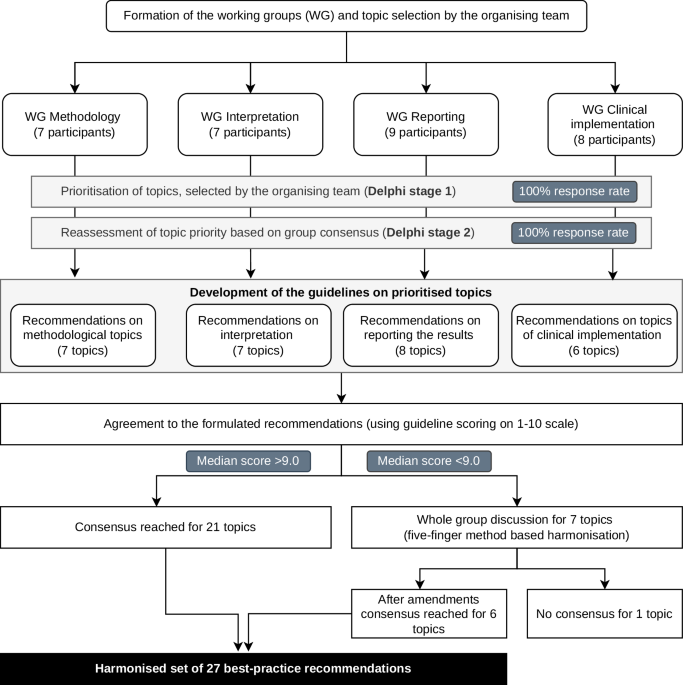
The process of development of best practice recommendations is presented in Fig. 1 and detailed in the sections below
The process undertaken to develop best practice recommendations for NGS-based testing in RNDs
Identification of topics for recommendation development
We based the topic selection for the recommendation development on the outcomes and experience from the EQA scheme for diagnostic NGS in RNDs, which has taken place annually since 2021 [7]. During this process, 28 areas of need for clear recommendations were identified (Table 1) and ultimately, for 27 topics a consensus could be reached (see Results section)
Formation of the working group
The working group (WG) was assembled to ensure a diverse representation of stakeholders participating in the process of genetic diagnostics of RNDs (Supplementary Table 1). Experts participating in the consensus process were selected from the European Reference Network for Rare Neurological Diseases (ERN-RND), a network of nationally designated centres of expertise for RNDs across Europe. Participants were selected to ensure representation of all key areas of expertise relevant to RND diagnostics and care, including clinicians, laboratory specialists, researchers, patient organisations, academia, industry, professional societies, EMQN, and ERN-RND. The composition of the group was further designed to achieve broad geographical representation across Europe and comprehensive coverage of the main stakeholder groups involved in NGS-based diagnostics. Selection aimed to ensure broad geographical and institutional representation in order to reflect differences in institutional practices and national legal frameworks relevant to genetic testing and reporting. The final expert panel represented 11 European countries. Potential conflicts of interest were considered during the expert selection process and during development of the recommendations. Experts participating in the consensus process were formally involved throughout the guideline development process and were specifically contacted during each Delphi round to encourage continued participation and minimize participant attrition. As a result, attrition between rounds was limited and did not substantially affect the overall geographical, institutional or disciplinary representation of the expert panel.
Stakeholders engaged in the recommendation development process included members of the EQA organizing and performing team (n = 3), specialists in neurology and clinical genetics (n = 7), representatives of patient advocacy groups (n = 1), legal experts (n = 1), professionals in quality assurance (n = 3), delegates from relevant professional bodies (n = 5), experts in sequencing and data analysis (n = 3), and experts in clinical variant interpretation (n = 8). The WG members were formally invited and were included in the WG following their acceptance. They were assigned to four focused WGs based on their area of expertise. Seven to nine members of each group focused on: Methodology (n = 7), Interpretation (n = 7), Reporting (n = 9), or Clinical Implementation (n = 8) (Supplementary Table 1).
Prioritization of the relevant topics
In a first step, all WG members were asked to assign importance to each topic selected by the organizing team. Two Delphi rounds were undertaken to achieve this. The first Delphi round was initiated in May 2023, when the WG members were asked to prioritize the broad areas of recommendations and vote on the importance of selected topics. All WG members were asked to rank the importance of topics on a 5-point scale (1 =very unimportant to 5 = very important). The panelists’ responses were then used to calculate the levels of importance. An average importance score was assigned to each topic. During this stage, we also asked participants to provide additional comments for topic formulation.
The second Delphi round was conducted in February 2024, allowing all WG participants to reassess the topic’s importance based on the results of the first Delphi round. For this, the panelists were informed about the median importance score of all topics and their own previous rating. Only the panelists who responded to the online questionnaire in the first Delphi round (n = 27) were asked to respond to the ranked topics in the second Delphi round. An identical 5-point scale was used to re-score topics.
Complete responses from all participants were obtained at each stage of the Delphi process
The topic was considered sufficiently important if the mean score of a topic exceeded an average value of 3.5 and if the majority of the votes rated the topic as “important” or “very important”
To facilitate the process of drafting recommendations, the 28 topics selected during the survey phase were assigned to four thematic categories: Methodology (n = 7), Interpretation (n = 7), Reporting (n = 8), and Clinical Implementation (n = 6). These categories reflect the major aspects of the diagnostic NGS process
Development of the best practice recommendations
The recommendations were initially formulated by each focused WG. In November 2024, the coordinating member of each focused WG defined the strategy to formulate recommendations, either in an initial WG meeting or by forming a draft version of recommendations, which was provided to focused WG members for rating and comments
After draft recommendations were prepared by the focused WGs, they were disseminated to all WGs using an online questionnaire, where all members could vote on their agreement with each statement and provide optional comments on their vote. All members of WG could rate the statements with a score ranging from 1 to 10 (where score 1 indicated complete disagreement and score 10 indicated complete agreement). The ratings obtained in this manner were used to select statements for consensus discussions in the final WG meeting.
For the final recommendation harmonization, the topics rated with an average score below 9.0 were selected for further discussion. These topics were presented at the final consensus meeting, held in May 2025, where participants could discuss their opinions and propose amendments to the statements. The “five-finger” consensus method was employed to facilitate participatory decision-making for reaching a consensus on the recommendations [13]. Participants indicated their level of agreement with a proposal by voting on statements with a score of one to five (“fingers”), where a score of 5 indicated full agreement and a score of 1 indicated full disagreement [14]. A consensus was reached when all WG participants voted with a score of 3 (“will go with the group’s decision”) or more on the statement. When a participant expressed disagreement with a score of 1 or 2, they were asked to propose modifications to the statement, after which another voting round was conducted until a full consensus was reached. WG members who were unable to participate in the consensus meeting were followed up by email using the same procedure. If no consensus could be reached, the topic was left without a recommendation.
Mapping between Delphi-prioritized topics and the final recommendations is presented in Table 1, in which each topic directly corresponds to the associated recommendation identifier and thematic working group
Results
Altogether, 31 members representing diverse aspects of genetic testing were included in the WG to develop best practice recommendations for NGS-based testing in RND. The majority of recommendations were developed within focused WGs consisting of seven to nine members with expertise in (at least) one of 4 principal fields: NGS methodology, variant interpretation, diagnostic reporting, and the clinical use of NGS-testing results
Selection of areas of importance in NGS testing of RNDs
Initially, potential topics for the development of recommendations were selected based on the weaknesses observed through the EQA scheme within the ERN-RND network. Subsequently, WG members were asked to prioritize the topics where the need for harmonization is most pronounced. The results of the two-tiered Delphi survey indicated that the majority of WG members viewed all issues recognized during provision of the EQA scheme as important (n = 16) or very important (n = 12). The topics and the results of the Delphi second round are presented in Table 1.
Best practice recommendations for NGS in genetic diagnostics of RNDs
Altogether, 28 recommendation statements were formulated by four focused WGs, addressing the fields of NGS methodology, variant interpretation, reporting and clinical implementation. These were delivered to the full WG to reach consensus. The initial voting round revealed a high rate of consensus for 21 statements, reaching an average score above 9.0. The remaining 7 statements were further discussed in an online WG consensus meeting or by email with members who were unable to participate in the meeting, using the 5-finger method to measure and reach consensus. Modifications were included in six of these recommendations, and consensus was reached (all WG members voted at least with 3). Notably, for the criterion on “The clinical context of NGS-based testing” no consensus was reached. This topic was rated high, i.e., “very important” in Delphi, however, the discussion revealed that there were insurmountable discrepancies in the idea to restrict NGS-based testing to preselected patients, for instance, based on phenotypic features or disease onset. Therefore, the summary of the recommendations in Table 1 (key points) and Supplementary Information (full recommendations with examples) lists only 27 recommendations.
Discussion
To our knowledge, this work presents the first set of expert recommendations specifically developed to improve and harmonize NGS-based diagnostics for RNDs. They address major components of the genetic testing process—including methodology, interpretation, reporting, and clinical implementation—and are the result of an interdisciplinary participation of diverse stakeholders involved in genetic testing of RNDs
The recommendations were developed through a robust and well-established process that facilitated consensus among a diverse set of experts from 11 European countries. The process began by leveraging insights from ERN-RND EQA scheme [7]—an initiative that has revealed significant variability in current diagnostic practices. Based on this experience, we identified 28 relevant topics that require guidance and harmonization. We applied a two-tiered Delphi approach to prioritize these topics, ensuring that all recommendations address areas identified as important by the diverse group of experts. The recommendation statements were developed through focused WGs, and consensus was achieved using the five-finger consensus method, which allowed for participatory decision-making and ensured agreement across all members of the WG. A consensus could be reached for all items but one recommendation, as there was no approval on the question of whom to test (clinical context). While some participants felt it would be important to restrict NGS-based testing to patients with a high likelihood of a monogenic cause, e.g., early-onset, familial, syndromic, or complex/atypical neurological presentations, and avoid testing sporadic, late-onset, or more common phenotypes without an established clinical indication of a genetic disorder, others favored to omit any limitations here and allow NGS-based testing as the first tier genetic test, and to leave economic circumstances and available resources guide the selection of patients to be NGS-tested [15, 16].
We anticipate the immediate applicability of the developed guidelines and will monitor their use in future rounds of NGS-based EQA schemes in ERN-RND. As such, they will serve as both a framework for evaluating current practice and a set of measurable targets for improvement. This immediate feedback loop between recommendations and implementation provides an opportunity not only to assess but also to actively improve the quality of diagnostic services across and beyond the ERN-RND network. As a matter of fact, this aligns with the principal modus operandi of ERNs: basing the development of a healthcare intervention – i.e. the recommendations – on an analysis of the heterogeneity and inequality of a healthcare service provision in Europe – i.e., diagnostic NGS testing of RND patients – as well as using the measurable target – i.e., the ERN-RND NGS EQA – for both a measurement of the effect of an intervention and to improve the intervention as such. Moreover, we envision the recommendations as a foundation for harmonized genetic reporting practices across Europe, promoting diagnostic consistency, clinical equity, and cross-border interoperability. The European Academy of Neurology has already endorsed the present document.
The recommendations also address specific needs of the RND field that are not sufficiently covered by existing general NGS guidelines. For example, they account for the frequent presence of complex mutational mechanisms, such as repeat expansions, the high degree of genetic heterogeneity, and the clinical challenges associated with testing in adult-onset neurological conditions. Furthermore, they emphasize updating gene panel content, reporting disease-specific technical limitations, ensuring the attainment of minimum quality parameters for sequencing, and encouraging the sharing of variant interpretations. To promote the applicability of the guidelines and clarify the rationale for their inclusion, we also provide real-world examples to support their implementation in clinical laboratories (Table 1 and Supplementary Information).
Although we employed a rigorous guideline preparation procedure, there are limitations that should be considered. First, despite efforts to ensure broad geographical and multidisciplinary representation, some degree of selection bias may have been introduced through the inclusion of experts primarily affiliated with ERN-RND-associated centres and collaborating institutions. Second, the composition of the expert panel may have influenced the prioritization and interpretation of recommendations, reflecting the clinical, technical and regulatory perspectives represented within the group. Finally, as with all Delphi-based consensus approaches, the recommendations are influenced by expert opinion and consensus methodology, which may not fully capture all regional practices, institutional workflows or emerging evidence.
In summary, this work represents a comprehensive, consensus-driven, and implementable effort to establish a quality-controlled standard of genetic diagnostics in RNDs. Through direct integration into the RND NGS EQA scheme and alignment with stakeholder priorities, these recommendations provide a blueprint for both measurable improvement and long-term harmonization in NGS-based diagnostics across Europe and beyond, thereby contributing to improved patient care
Data availability
The data that support the findings of this study are available in the supplementary material
References
Penn D, Amir Y, David GB, Kurolap A, Barel D, Hamiel U, et al. High Genetic Diagnostic Yield for Patients with Rare Movement Disorders at a Single-Center Neurogenetics Clinic. Mov Disord Clin Pract. 2025;5. https://doi.org/10.1002/mdc3.70145
Marsili L, Duque KR, Abanto J, Chinchihualpa Paredes NO, Duker AP, Collins K, et al. Studying Rare Movement Disorders: From Whole-Exome Sequencing to New Diagnostic and Therapeutic Approaches in a Modern Genetic Clinic. Biomedicines. 2024;12:2673. https://doi.org/10.3390/biomedicines12122673
Schüle R, Timmann D, Erasmus CE, Reichbauer J, Wayand M, Schöls L, et al. Solve-RD-DITF-RND Solving unsolved rare neurological diseases-a Solve-RD viewpoint. Eur J Hum Genet EJHG. 2021;29:1332–6. https://doi.org/10.1038/s41431-021-00901-1
Marouane A, Neveling K, Deden AC, van den Heuvel S, Zafeiropoulou D, Castelein S, et al. Lessons learned from rapid exome sequencing for 575 critically ill patients across the broad spectrum of rare disease. Front Genet. 2023;14:1304520. https://doi.org/10.3389/fgene.2023.1304520
Schobers G, Derks R, den Ouden A, Swinkels H, van Reeuwijk J, Bosgoed E, et al. Genome sequencing as a generic diagnostic strategy for rare disease. Genome Med. 2024;16:32. https://doi.org/10.1186/s13073-024-01301-y
Corominas J, Smeekens SP, Nelen MR, Yntema HG, Kamsteeg EJ, Pfundt R, et al. Clinical exome sequencing-Mistakes and caveats. Hum Mutat. 2022;43:1041–55. https://doi.org/10.1002/humu.24360
Maver A, Lohmann K, Borovečki F, Wolstenholme N, Taylor RL, Spielmann M, et al. Quality assurance for next-generation sequencing diagnostics of rare neurological diseases in the European Reference Network. Eur J Hum Genet. 2024;32:1014–21. https://doi.org/10.1038/s41431-024-01639-2
Reinhard C, Bachoud-Lévi AC, Bäumer T, Bertini E, Brunelle A, Buizer AI, et al. The European Reference Network for Rare Neurological Diseases. Front Neurol. 2020;11:616569. https://doi.org/10.3389/fneur.2020.616569
Matthijs G, Souche E, Alders M, Corveleyn A, Eck S, Feenstra I, et al. Guidelines for diagnostic next-generation sequencing. Eur J Hum Genet. 2016;24:2–5. https://doi.org/10.1038/ejhg.2015.226
Austin-Tse CA, Jobanputra V, Perry DL, Bick D, Taft RJ, Venner E, et al. Best practices for the interpretation and reporting of clinical whole genome sequencing. Npj Genom Med. 2022;7:27. https://doi.org/10.1038/s41525-022-00295-z
Souche E, Beltran S, Brosens E, Belmont JW, Fossum M, Riess O, et al. Recommendations for whole genome sequencing in diagnostics for rare diseases. Eur J Hum Genet. 2022;30:9. https://doi.org/10.1038/s41431-022-01113-x
Thomsen M, Ott F, Loens S, Kilic-Berkmen G, Tan AH, Lim SY, et al. Genetic Diversity and Expanded Phenotypes in Dystonia: Insights From Large-Scale Exome Sequencing. Ann Clin Transl Neurol. 2025;12:1648–59. https://doi.org/10.1002/acn3.70100
Nicolaidis C, Raymaker D, McDonald K, Dern S, Ashkenazy E, Boisclair C, et al. Collaboration Strategies in Nontraditional Community-Based Participatory Research Partnerships: Lessons From an Academic–Community Partnership With Autistic Self-Advocates. Prog Commun Health Partnersh. 2011;5:143–50. https://doi.org/10.1353/cpr.2011.0022
Yeow D, Rudaks LI, Siow SF, Davis RL, Kumar KR. Genetic Testing of Movements Disorders: A Review of Clinical Utility. Tremor Hyperk Mov N Y N. 2024;14:2. https://doi.org/10.5334/tohm.835
Yeow D, Rudaks LI, Kumar KR. Barriers to clinical genetic testing in movement disorders. Curr Opin Neurol. 2025;38:355–60. https://doi.org/10.1097/WCO.0000000000001381
Gustavsson EK, Follett J, Trinh J, Barodia SK, Real R, Liu Z, et al. RAB32 Ser71Arg in autosomal dominant Parkinson’s disease: linkage, association, and functional analyses. Lancet Neurol. 2024;23:603–14. https://doi.org/10.1016/S1474-4422(24)00121-2
Hop PJ, Lai D, Keagle PJ, Baron DM, Kenna BJ, Kooyman M, et al. Systematic rare variant analyses identify RAB32 as a susceptibility gene for familial Parkinson’s disease. Nat Genet. 2024;56:1371–6. https://doi.org/10.1038/s41588-024-01787-7
Ryan NM, Corvin A. Investigating the dark-side of the genome: a barrier to human disease variant discovery? Biol Res. 2023;56:42. https://doi.org/10.1186/s40659-023-00455-0
Ibañez K, Polke J, Hagelstrom RT, Dolzhenko E, Pasko D, Thomas ERA, et al. Whole genome sequencing for the diagnosis of neurological repeat expansion disorders in the UK: a retrospective diagnostic accuracy and prospective clinical validation study. Lancet Neurol. 2022;21:234–45. https://doi.org/10.1016/S1474-4422(21)00462-2
Bartlett E, Archibald AD, Francis D, Ling L, Thomas R, Chandler G, et al. Paternal retraction of a fragile X allele to normal size, showing normal function over two generations. Am J Med Genet A. 2022;188:304–9. https://doi.org/10.1002/ajmg.a.62500
Beetz C, Westenberger A, Al-Ali R, Ameziane N, Alhashmi N, Boustany R, et al. LRRK2 Loss-of-Function Variants in Patients with Rare Diseases: No Evidence for a Phenotypic Impact. Mov Disord. 2021;36:1029–31. https://doi.org/10.1002/mds.28452
Krüger C, Lim SY, Buhrmann A, Fahrig FL, Gabbert C, Bahr N, et al. Updated MDSGene review on the clinical and genetic spectrum of LRRK2 variants in Parkinson´s disease. NPJ Park Dis. 2025;11:30. https://doi.org/10.1038/s41531-025-00881-9
Ramakrishnan S, Mohan N, Dong Z, Liu M, Qiang L. Unraveling Isoform Complexity: The Roles of M1- and M87-Spastin in Spastic Paraplegia 4 (SPG4). Mov Disord Off J. Mov Disord Soc. 2025;40:420–30. https://doi.org/10.1002/mds.30072
Pauly MG, Korenke GC, Diaw SH, Grözinger A, Cazurro-Gutiérrez A, Pérez-Dueñas B, et al. The Expanding Phenotypical Spectrum of WARS2-Related Disorder: Four Novel Cases with a Common Recurrent Variant. Genes. 2023;14:822. https://doi.org/10.3390/genes14040822
Seong E, Insolera R, Dulovic M, Kamsteeg EJ, Trinh J, Brüggemann N, et al. Mutations in VPS13D lead to a new recessive ataxia with spasticity and mitochondrial defects. Ann Neurol. 2018;83:1075–88. https://doi.org/10.1002/ana.25220
Deans ZC, Ahn JW, Carreira IM, Dequeker E, Henderson M, Lovrecic L, et al. Recommendations for reporting results of diagnostic genomic testing. Eur J Hum Genet. 2022;30:1011–6. https://doi.org/10.1038/s41431-022-01091-0
Matthijs G, Souche E, Alders M, Corveleyn A, Eck S, Feenstra I, et al. Guidelines for diagnostic next-generation sequencing. Eur J Hum Genet. 2016;24:1515. https://doi.org/10.1038/ejhg.2016.63
Weissbach A, Pauly MG, Herzog R, Hahn L, Halmans S, Hamami F, et al. Relationship of Genotype, Phenotype, and Treatment in Dopa-Responsive Dystonia: MDSGene Review. Mov Disord J Mov Disord Soc. 2022;37:237–52. https://doi.org/10.1002/mds.28874
Laurie S, Steyaert W, de Boer E, Polavarapu K, Schuermans N, Sommer AK, et al. Genomic reanalysis of a pan-European rare-disease rerg/10.1038/s41591-024-03420-w
Majeed S, Johnston C, Saeedi S, Mighton C, Rokoszak V, Abbasi I, et al. International policies guiding the selection, analysis, and clinical management of secondary findings from genomic sequencing: A systematic review. Am J Hum Genet. 2024;111:2079–93. https://doi.org/10.1016/j.ajhg.2024.08.012
Vears DF, Sénécal K, Borry P. Reporting practices for variants of uncertain significance from next generation sequencing technologies. Eur J Med Genet. 2017;60:553–8. https://doi.org/10.1016/j.ejmg.2017.07.016
Brown CG, Bower M, Schomaker M, Goldstein J, Jarnes J, Whitley CB, et al. Detecting the Difficult: An Intronic NPC1 Variant Hiding in Plain Sight. Am J Med Genet A. 2025;197:e64012. https://doi.org/10.1002/ajmg.a.64012
Pineda M, Walterfang M, Patterson MC. Miglustat in Niemann-Pick disease type C patients: a review. Orphanet J Rare Dis. 2018;13:140. https://doi.org/10.1186/s13023-018-0844-0
Acknowledgements
These consensus recommendations have been formally endorsed by the European Academy of Neurology (EAN)
Funding
Open Access funding enabled and organized by Projekt DEAL
Author information
Author notes
These authors contributed equally: Aleš Maver, Katja Lohmann
Authors and Affiliations
Clinical Institute of Genomic Medicine, Ljubljana University Medical Centre, Ljubljana, Slovenia
Aleš Maver & Borut Peterlin
Institute of Neurogenetics, University of Luebeck, Luebeck, Germany
Katja Lohmann & Norbert Brüggemann
Institute of Human Genetics, University of Luebeck, Luebeck, Germany
Katja Lohmann
Institute for Medical Genetics and Applied Genomics, University Hospital Tuebingen, Tuebingen, Germany
Lena-Marie Urbanczyk, Tobias B. Haack, Marc Sturm & Holm Graessner
European Federation of Neurological Associations, Brussels, Belgium
Astri Arnesen
Department of Pediatrics, University Hospital Center Zagreb, Kišpatićeva 12, Rebro, 10000, Zagreb, Croatia
Ivo Barić
Centogene GmbH, Rostock, Germany
Peter Bauer
Department of Clinical and Movement Neurosciences, UCL, Institute of Neurology, NHNN, London WC1N 3BG, UK, Queen Square
Kailash P. Bhatia
Center for rare movement disorders Innsbruck, Dpt. of Neurology, Medical University Innsbruck, Innsbruck, Austria
Sylvia Boesch
Department of Neurology, School of Medicine, University of Zagreb and University Hospital Center Zagreb, Zagreb, Croatia
Fran Borovečki
Section for Movement Disorders, Department of Neurology, University of Luebeck, Ratzeburger Allee 160, Luebeck, 23538, Germany
Norbert Brüggemann
German Center for Neurodegenerative Diseases, Tuebingen, Germany
Zih-Hua Fang
Center for Human Genetics, Paul-Ehrlich-Str. 23, D-72076, Tuebingen, Germany
Heinz Gabriel
Center for Rare Diseases, University Hospital of Tuebingen, Tuebingen, Germany
Tobias B. Haack, Ludger Schols & Holm Graessner
Department of Clinical Neurology, Institute of Neurology, London, UK
Henry Houlden
Institute of Human Genetics, School of Medicine, University of Belgrade, Belgrade, Serbia
Milena Janković & Ivana Novaković
Department of Human Genetics, Radboud University Medical Center, Nijmegen, the Netherlands
Erik-Jan Kamsteeg, Kornelia Neveling & Lisenka E. L. M. Vissers
Department of Clinical and Experimental Medicine, Neurological Institute, University of Pisa, Pisa, Italy
Michelangelo Mancuso
Department of Public Health and Caring Sciences, Centre for Research Ethics and Bioethics, Uppsala University, Uppsala, Sweden
Deborah Mascalzoni
Institute of Genomic Medicine and Rare Disorders, Semmelweis University, 1083, Budapest, Hungary
Maria Judit Molnar
Center for Rare Diseases, University of Lübeck, Lübeck, Germany
Alexander Münchau
Center of Neurology and Hertie Institute for Clinical Brain Research, University of Tübingen, Tübingen, Germany
Ludger Schols
German Center for Neurodegenerative Diseases (DZNE), Tübingen, Germany
Ludger Schols
Center for Medical Genetics, Ghent University Hospital, Ghent, Belgium
Nika Schuermans
EMQN CIC, ICE Building, 3 Exchange Quay, Salford, M5 3ED, UK
Katie Shiels, Rachel Taylor & Victoria Williams
UMCG Expertise Centre movement disorders, Department of Neurology, University Medical Center Groningen (UMCG), Groningen, the Netherlands
Marina A. J. Tijssen
Authors
- Aleš MaverView author publications
Search author on:PubMed Google Scholar
- Katja LohmannView author publications
Search author on:PubMed Google Scholar
- Lena-Marie UrbanczykView author publications
Search author on:PubMed Google Scholar
- Astri ArnesenView author publications
Search author on:PubMed Google Scholar
- Ivo BarićView author publications
Search author on:PubMed Google Scholar
- Peter BauerView author publications
Search author on:PubMed Google Scholar
- Kailash P. BhatiaView author publications
Search author on:PubMed Google Scholar
- Sylvia BoeschView author publications
Search author on:PubMed Google Scholar
- Fran BorovečkiView author publications
Search author on:PubMed Google Scholar
- Norbert BrüggemannView author publications
Search author on:PubMed Google Scholar
- Zih-Hua FangView author publications
Search author on:PubMed Google Scholar
- Heinz GabrielView author publications
Search author on:PubMed Google Scholar
- Tobias B. HaackView author publications
Search author on:PubMed Google Scholar
- Henry HouldenView author publications
Search author on:PubMed Google Scholar
- Milena JankovićView author publications
Search author on:PubMed Google Scholar
- Erik-Jan KamsteegView author publications
Search author on:PubMed Google Scholar
- Michelangelo MancusoView author publications
Search author on:PubMed Google Scholar
- Deborah MascalzoniView author publications
Search author on:PubMed Google Scholar
- Maria Judit MolnarView author publications
Search author on:PubMed Google Scholar
- Alexander MünchauView author publications
Search author on:PubMed Google Scholar
- Kornelia NevelingView author publications
Search author on:PubMed Google Scholar
- Ivana NovakovićView author publications
Search author on:PubMed Google Scholar
- Borut PeterlinView author publications
Search author on:PubMed Google Scholar
- Ludger ScholsView author publications
Search author on:PubMed Google Scholar
- Nika SchuermansView author publications
Search author on:PubMed Google Scholar
- Katie ShielsView author publications
Search author on:PubMed Google Scholar
- Marc SturmView author publications
Search author on:PubMed Google Scholar
- Rachel TaylorView author publications
Search author on:PubMed Google Scholar
- Marina A. J. TijssenView author publications
Search author on:PubMed Google Scholar
- Lisenka E. L. M. VissersView author publications
Search author on:PubMed Google Scholar
- Victoria WilliamsView author publications
Search author on:PubMed Google Scholar
- Holm GraessnerView author publications
Search author on:PubMed Google Scholar
Consortia
on behalf of the European Reference Network for Rare Neurological Disorders (ERN-RND)
- Aleš Maver
- , Katja Lohmann
- , Lena-Marie Urbanczyk
- , Astri Arnesen
- , Sylvia Boesch
- , Norbert Brüggemann
- , Tobias B. Haack
- , Erik-Jan Kamsteeg
- , Michelangelo Mancuso
- , Maria Judit Molnar
- , Alexander Münchau
- , Kornelia Neveling
- , Borut Peterlin
- , Ludger Schols
- , Nika Schuermans
- , Marc Sturm
- , Marina A. J. Tijssen
- , Lisenka E. L. M. Vissers
- & Holm Graessner
Contributions
AM, KL, and HG led the principal working groups, prepared the draft guideline statements, performed the statistical analyses, and drafted the manuscript. LMU participated in the guideline preparation process and coordinated the Delphi process. All authors (AM, KL, LMU, AA, IB, PBau, KB, SB, FB, NB, ZHF, HGab, TBH, HH, MJ, EJK, MM, DM, MJM, AMu, KN, IN, BP, LS, NS, KS, MS, RT, MAJT, LELMV, VW, and HG) contributed to the development of the best-practice recommendations through participation in the Delphi process, workgroup discussions, statement formulation, harmonization, and rating. All authors reviewed and approved the final manuscript.
Ethics declarations
Competing interests
Peter Bauer is an employee and shareholder of Centogene GmbH. Syl Reata Pharmaceuticals, and Biogen; serves on advisory boards for Biogen, Reata Pharmaceuticals, and Biohaven; and has received honoraria from Ipsen Pharma, Merz Pharma, Reata Pharmaceuticals, and Biogen. All other authors report no conflicts of interest pertaining to this work
Additional information
Publisher’s note Springer Nature remains neutral with regard to jurisdictional claims in published maps and institutional affiliations
Supplementary information
Supplementary Tables (download DOCX )
Supplementary information – The best practice recommendations (download DOCX )
Rights and permissions
Open Access This article is licensed under a Creative Commons Attribution 4.0 International License, which permits use, sharing, adaptation, distribution and reproduction in any medium or format, as long as you give appropriate credit to the original author(s) and the source, provide a link to the Creative Commons licence, and indicate if changes were made. The images or other third party material in this article are included in the article’s Creative Commons licence, unless indicated otherwise in a credit line to the material. If material is not included in the article’s Creative Commons licence and your intended use is not permitted by statutory regulation or exceeds the permitted use, you will need to obtain permission directly from the copyright holder. To view a copy of this licence, visit http://creativecommons.org/licenses/by/4.0/.
About this article
Cite this article
Maver, A., Lohmann, K., Urbanczyk, LM. et al. Consensus recommendations for next-generation sequencing-based genetic testing in Rare Neurological diseases.
Eur J Hum Genet (2026). https://doi.org/10.1038/s41431-026-02198-4
Received:16 March 2026
Revised:11 June 2026
Accepted:10 July 2026
Published:28 July 2026
Version of record:28 July 2026
DOI
:https://doi.org/10.1038/s41431-026-02198-4
