


- CVS Health blew past second-quarter earnings and revenue estimates and raised its 2026 guidance, as its insurance unit Aetna shows signs of recovery.
- All three of the healthcare giant’s business segments – insurance, pharmacy and health services —surpassed Wall Street’s revenue expectations.
- CVS also announced a new collaboration with Eli Lilly that will make its obesity injection Zepbound and new weight loss pill Foundayo accessible to eligible patients on the CVS Health app.
watch now
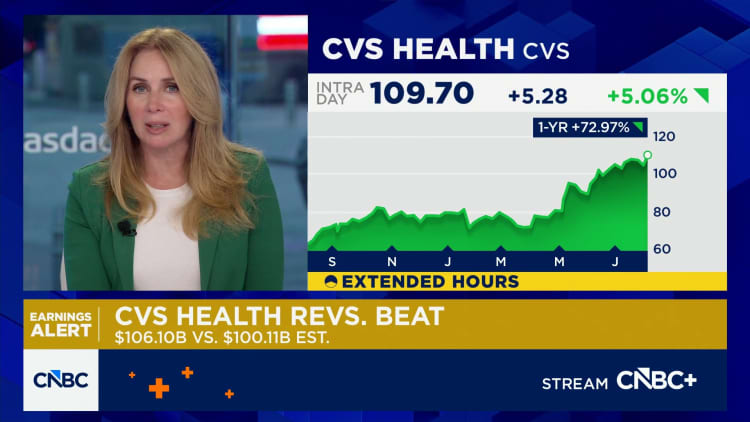
CVS Health on Wednesday blew past second-quarter earnings and revenue estimates and raised its 2026 guidance, as its insurance unit Aetna shows signs of recovery.
Despite the strong results, shares of the healthcare giant were down more than 6% in morning trading Wednesday. That appears to be due to remarks on CVS’ earnings call about the company expecting membership declines in Caremark, its pharmacy benefit manager
CVS, which operates the nation’s largest pharmacy chain, sees full-year adjusted profit coming in between $7.90 and $8.10 per share. That’s up from a previous guidance of $7.30 to $7.50 per share.
The company also expects revenue of at least $414 billion in 2026, up from its prior outlook of at least $405 billion
In a release, CVS said the higher profit guidance reflects strength in its insurance and retail pharmacy segment, but noted that the company is maintaining a “cautious view” for the rest of the year amid high medical costs and potential challenges in the broader economy
All three of the healthcare giant’s business segments – insurance, pharmacy and health services —surpassed Wall Street’s revenue expectations. But Aetna’s results have been top of mind for investors, who have watched high medical costs in privately run Medicare plans batter several major health insurers for the last two years.
The results indicated continued progress in CVS’ broader turnaround plan, which has involved cutting $2 billion in costs, closing underperforming stores, shuffling leadership and reducing costs within Medicare Advantage plans. CVS’ report also adds to a solid second quarter for the broader health insurance sector.
Also on Wednesday, CVS announced a new collaboration with Eli Lilly that will make its obesity injection Zepbound and new weight loss pill Foundayo accessible to eligible patients on the CVS Health app. That offering, which will be available by early in the fourth quarter, will include both patients with insurance coverage and those paying out of pocket
Here’s what CVS reported for the second quarter compared with what Wall Street was expecting, based on a survey of analysts by LSEG:
- Earnings per share: $2.58 adjusted vs. $1.85 expected
- Revenue: $106.10 billion vs. $100.11 billion expected
The company posted net income of $2.98 billion, or $2.31 per share, for the second quarter. That compares with net income of $1.02 billion, or 80 cents per share, for the same period a year ago.
Excluding certain items, such as restructuring charges and capital losses, adjusted earnings were $2.58 per share for the quarter
CVS booked sales of $106.10 billion for the second quarter, up 7% from the same period a year ago, as all three of its business segments showed growth.
Insurance unit improves
Insurers have grappled with higher-than-expected medical costs as more Medicare Advantage patients return to hospitals for procedures they delayed during the pandemic. Medical costs remain high, but Aetna and other insurers appear to be becoming better equipped to manage the trend, as many cut membership and benefits for patients and exit unprofitable markets.
Aetna’s medical benefit ratio — a measure of total medical expenses paid relative to premiums collected — decreased from the prior year to 87.4% from 89.9%. A lower ratio typically indicates that a company collected more in premiums than it paid out in benefits, resulting in higher profitability
Analysts expected a ratio of 89.8%
The insurance business brought in $37.54 billion in revenue during the quarter, up around 3.5% from the second quarter of 2025. That came in higher than the $35.66 billion that analysts were expecting
In a release, CVS also said the year-over-year improvement in the unit was due to strength in its government plans and the lack of a so-called premium deficiency reserve, which was recorded in the same period in 2025. That refers to a liability that an insurer may need to cover if future premiums are not enough to pay for anticipated claims and expenses
The unit’s medical membership of 26 million as of June 30 was about flat compared with March 31, CVS said.
CVS’ pharmacy and consumer wellness division posted $33.82 billion in sales for the second quarter, only slightly higher from the year-ago period. Analysts expected sales of $33.16 billion, StreetAccount estimates said
That unit dispenses prescriptions in CVS’ more than 9,000 retail pharmacies and provides other services, such as vaccinations and diagnostic testing
The company’s health services segment generated $51.8 billion in revenue for the quarter, up 11.5% from the same period a year earlier.That also topped Wall Street estimates of $47.78 billion
That unit includes the pharmacy benefits manager Caremark, which negotiates drug discounts with manufacturers on behalf of insurance plans, creates lists of medications, or formularies, that are covered by insurance, and reimburses pharmacies for prescriptions
