


- Report
August 25, 2026
From Diagnoses to Treatments, Why Americans Use AI Chatbots for Health
Do Americans think chatbots help or hurt people using them for loneliness, depression or stress?
ByEmma KikuchiGiancarlo PasquiniEileen Yam
Table of Contents
- From Diagnoses to Treatments, Why Americans Use AI Chatbots for Health
- Do Americans think chatbots help or hurt people using them for loneliness, depression or stress?
- Acknowledgments
- Methodology
About this research
This Pew Research Center report looks at Americans’ use and views of chatbots for health
Why did we do this?
Pew Research Center does research to help the public, media and decision-makers understand important topics. This research builds on our work studying Americans’ views of medicine and health to explore how Americans use chatbots for health
Learn more about Pew Research Center, our research on medicine and health and other research on science and society
How did we do this?
For this report, we surveyed 3,488 U.S. adults from June 22 to 28, 2026. Everyone who took part in this survey is a member of the Center’s American Trends Panel. The survey represents the views of the full U.S. adult population
Here are the survey questions used for this report, the detailed responses and the survey methodology
Key takeaways:
- Americans are more likely to say chatbots do more to hurt than help people who use them for support with loneliness, depression or stress.
- Younger adults are largely pessimistic that chatbots can help people who use them for social and <a href="https://healthylife7.com/perez-hiltons-brother-in-law-shares-update-on-his-injuries-mental-health-amid-hospitalization/" title="Perez Hilton’s Brother-in-Law Shares Update on His Injuries, Mental Health Amid Hospitalization”>mental health support.
- But sizable shares of Americans aren’t sure. Older adults are especially likely to be unsure of chatbots’ impact on people using them for these reasons.
- Asian adults stand out as being more positive about using chatbot for social and mental health support.
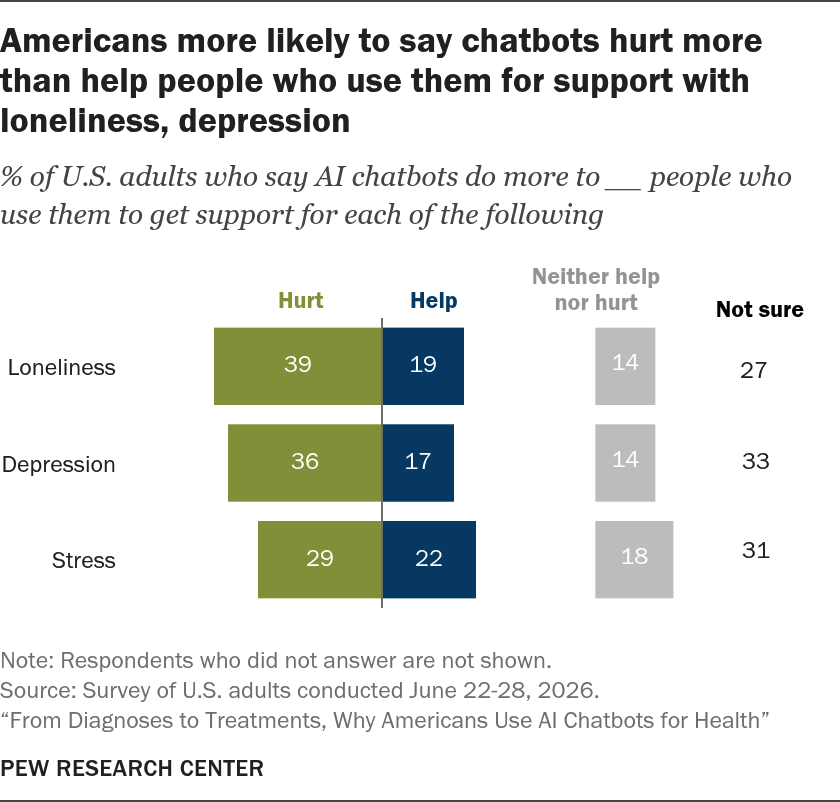
At a time of public debate and high-profile cases of chatbot use for social and mental health, a new Pew Research Center survey finds that, on balance, Americans say chatbots do more to hurt than help people who use them for loneliness, depression or stress
% of U.S. adults who say AI chatbots do more to __ people who use them to get support for each of the following
Note: Respondents who did not answer are not shown.
Source: Survey of U.S. adults conducted June 22-28, 2026.
“From Diagnoses to Treatments, Why Americans Use AI Chatbots for Health”
PEW RESEARCH CENTER
Americans more likely to say chatbots hurt more than help people who use them for support with loneliness, depression
% of U.S. adults who say AI chatbots do more to __ people who use them to get support for each of the following
| Hurt | Help | Neither help nor hurt | Not sure | |
|---|---|---|---|---|
| Loneliness | 39 | 19 | 14 | 27 |
| Depression | 36 | 17 | 14 | 33 |
| Stress | 29 | 22 | 18 | 31 |
Note: Respondents who did not answer are not shown.
Source: Survey of U.S. adults conducted June 22-28, 2026.
“From Diagnoses to Treatments, Why Americans Use AI Chatbots for Health”
PEW RESEARCH CENTER
- Using chatbots forloneliness: 39% say they do more to hurt people, while 19% say they do more to help.
- Using chatbots fordepression: 36% say they do more to hurt, while 17% say they do more to help.
- Using chatbots forstress: There’s less of a difference in opinion for using chatbots for stress, but still, 29% say they do more to hurt, while 22% say they do more to help.
Butsizable shares of Americans are unsure of AI’s impact on people who use them for social and mental health support. About three-in-ten say they’re not sure about AI’s impact on loneliness, depression or stress. And between 14% and 18% don’t lean one way or the other, saying AI neither helps nor hurts people who use them for support with these struggles
This analysis is based on a broader Pew Research Center survey exploring Americans’ views on and experiences with AI in healthcare, conducted June 22-28, 2026, among 3,488 U.S. adults. For more, read: From Diagnoses to Treatments, Why Americans Use AI Chatbots for Health
Related:Americans and AI 2026: Chatbots, Smart Devices and Views on Impact
Related:Where Do Americans Get Health Information, and What Do They Trust?
Differences by age: About half of adults under 30 say chatbots hurt people who use these tools as support for loneliness
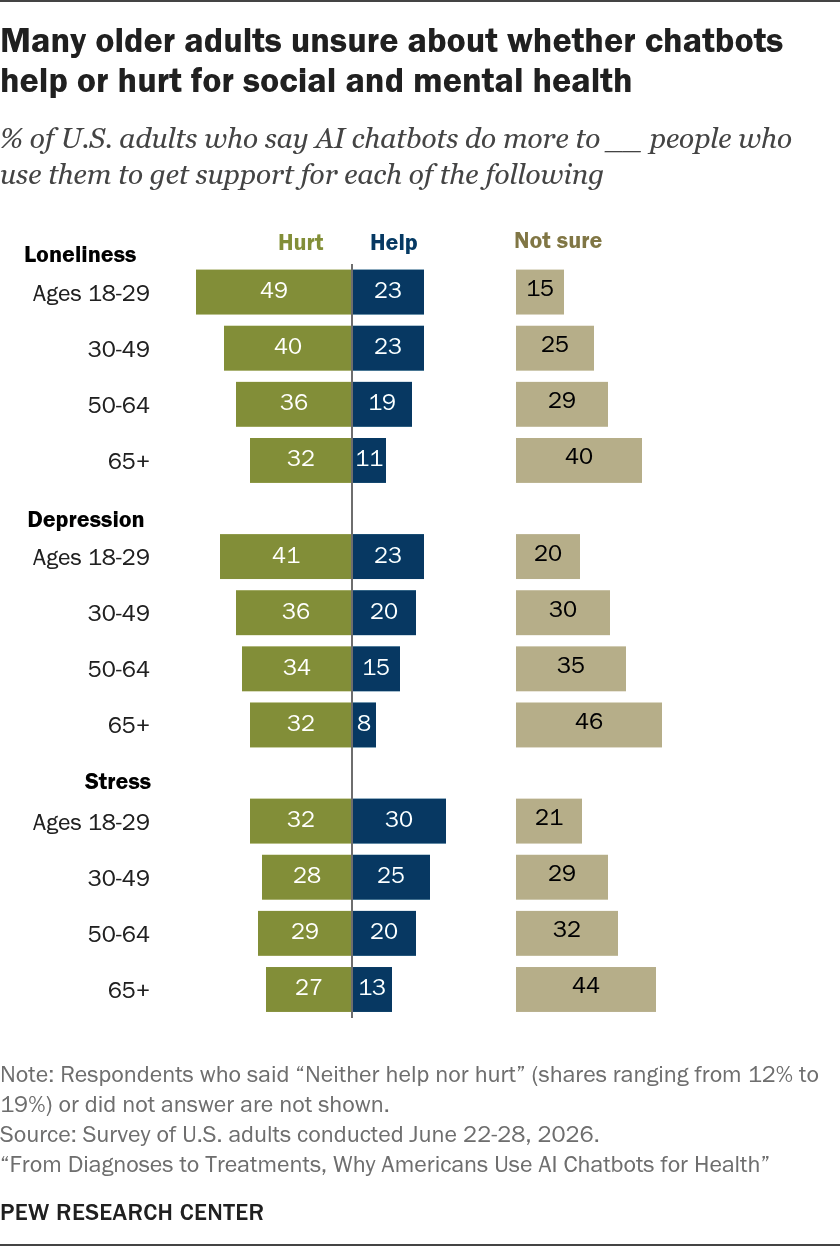
Younger adults are more likely than older adults to say they use chatbots for emotional support. Yet, younger Americans are largely pessimistic that chatbots can help people who use them for social and mental health support. About half of adults under 30 (49%) say chatbots do more to hurt people who use them for loneliness, and 41% say the same for depression. Far fewer say chatbots do more to help people with loneliness and depression (23% each)
% of U.S. adults who say AI chatbots do more to __ people who use them to get support for each of the following
Note: Respondents who said “Neither help nor hurt” (shares ranging from 12% to 19%) or did not answer are not shown.
Source: Survey of U.S. adults conducted June 22-28, 2026.
“From Diagnoses to Treatments, Why Americans Use AI Chatbots for Health”
PEW RESEARCH CENTER
Many older adults unsure about whether chatbots help or hurt for social and mental health
% of U.S. adults who say AI chatbots do more to __ people who use them to get support for each of the following
| Age group | Mental Health | Hurt | Help | Not sure |
|---|---|---|---|---|
| Ages 18-29 | Loneliness | 49 | 23 | 15 |
| 30-49 | Loneliness | 40 | 23 | 25 |
| 50-64 | Loneliness | 36 | 19 | 29 |
| 65+ | Loneliness | 32 | 11 | 40 |
| Ages 18-29 | Depression | 41 | 23 | 20 |
| 30-49 | Depression | 36 | 20 | 30 |
| 50-64 | Depression | 34 | 15 | 35 |
| 65+ | Depression | 32 | 8 | 46 |
| Ages 18-29 | Stress | 32 | 30 | 21 |
| 30-49 | Stress | 28 | 25 | 29 |
| 50-64 | Stress | 29 | 20 | 32 |
| 65+ | Stress | 27 | 13 | 44 |
Note: Respondents who said “Neither help nor hurt” (shares ranging from 12% to 19%) or did not answer are not shown.
Source: Survey of U.S. adults conducted June 22-28, 2026.
“From Diagnoses to Treatments, Why Americans Use AI Chatbots for Health”
PEW RESEARCH CENTER
Of those who take a side, by a wide margin, adults across age groups say chatbots do more to hurt than help people who use them to get support with loneliness or depression
Using chatbots for stress is one area where younger Americans aren’t as likely to say they will hurt. Adults under 50 are about equally likely to say chatbots help as say they hurt
Across the board, older adults are far more likely to be uncertain. The largest shares of adults 65 and older – four-in-ten or more – say they are not sure if AI chatbots do more to help or hurt people who use then for loneliness, depression or stress
Asian adults are the only racial or ethnic group that skews more positive than negative for any of the items we asked about. (Estimates for Asian adults are representative of English speakers only.)
Asian adults more positive about chatbots for social and mental health support
% of U.S. adults who say AI chatbots do more to __ people who use them to get support for each of the following
* Estimates for Asian adults are representative of English speakers only.
Note: Respondents who said “Neither help nor hurt” (shares ranging from 13% to 21%) or did not answer are not shown. White, Black and Asian adults include those who report being only one race and are not Hispanic. Hispanic adults are of any race.
Source: Survey of U.S. adults conducted June 22-28, 2026.“From Diagnoses to Treatments, Why Americans Use AI Chatbots for Health”
PEW RESEARCH CENTER
When it comes to people using AI chatbots for loneliness, Asian adults are more likely to say chatbots do more to help than hurt (37% vs. 25%)
The same for stress: 34% of Asian adults say chatbots do more to help, compared with 21% who say they do more to hurt
Views of chatbot use for depression among Asian adults are more mixed: Similar shares say chatbots do more to help versus hurt (30% vs. 26%)
This follows overall racial and ethnic differences in how adults use and view AI even after accounting for education and income. Asian adults tend to stand out for their higher optimism about AI
There were modest or no differences by gender, education or income
- Report PDF
- Questionnaire
- Topline
