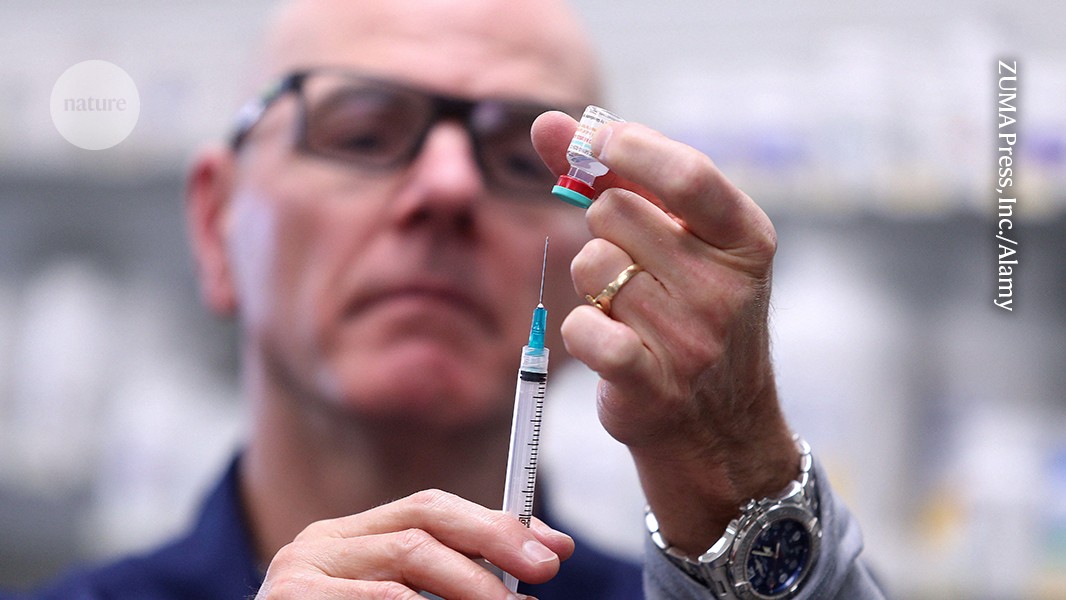
The shingles vaccine in use today has been linked to a reduced risk of heart disease and heart failure, according to a study of more than 70,000 people who received either the current vaccine or an older formulation1. The results were published on 26 August in Nature Medicine
The findings are “particularly exciting” because they are more robust than those from previous work2 on the heart-protective effects of shingles vaccination, says Emily Rayens, an epidemiologist who specializes in vaccine development at the health-care provider Kaiser Permanente in Pasadena, California. Still, more work is needed to confirm whether the jab truly lowers the risk of cardiovascular events. “We cannot definitively conclude that there is a causal link,” adds Rayens, who was not involved in the study.
Chickenpox’s second act
Shingles is a painful rash condition that is caused by varicella zoster, the same virus that causes chickenpox. It occurs when the virus reactivates in the body later in life, most often in people over the age of 50. Previous observational studies suggested that the Shingrix ‘recombinant’ vaccine — which is a mixture of a surface protein from the varicella zoster virus and an immune-boosting compound — might provide extra perks by reducing the risk of cardiovascular disease and even dementia3.
But most of these studies compared vaccinated people with unvaccinated individuals, which can make any benefit seem larger than it is, says study co-author Maxime Taquet, a psychiatrist at the University of Oxford, UK, who has investigated the effect of the shingles vaccine on dementia risk3. That’s because those who opt to get the jab tend to be healthier than people who don’t. “We know that this is a very biased way of answering the question,” says Taquet
To address this issue, Taquet and his colleagues turned to TriNetX, a database that includes the electronic health records of people from across the United States. They compared the heart health of two groups of more than 36,000 people aged 60 and over. One group got the Shingrix recombinant vaccine and the other had received Zostavax, a now-discontinued vaccine that contains a deactivated version of the virus. Shingrix replaced Zostavax in the United States after October 2017, allowing the team to conduct a natural experiment.
The researchers tracked the participants’ incidence of heart disease, heart failure and stroke for seven years after their immunizations, looking specifically at ‘disease burden’ — the time span spent living with a diagnosed cardiovascular condition
They found that people who received Shingrix spent, on average, 9% more time free of cardiovascular disease over the seven-year period than did those who received Zostavax, suggesting that the recombinant vaccine could prevent or at least delay the onset of heart conditions. People who received the recombinant jab were also 10% and 12% less likely to be diagnosed with heart disease and heart failure, respectively. The recombinant vaccine was also associated with a 12% lower risk of stroke in men.
Enjoying our latest content?
Log in or create an account to continue
- Access the most recent journalism from Nature’s award-winning team
- Explore the latest features & opinion covering groundbreaking research
Access through your institution
Sign in or create an account
Continue with Google
Continue with ORCiD
doi: https://doi.org/10.1038/d41586-026-02663-6
References
Corsi-Zuelli, F. et al. Nature Med. https://doi.org/10.1038/s41591-026-04606-0 (2026)
Rayens, E. et al. Clin. Inf. Dis.81, e441–e445 (2025)
Taquet, M., Dercon, Q., Todd, J. A. & Harrison, P. J. Nature Med. 30, 2777–2781 (2024)
Subjects
- Vaccines
- Cardiovascular biology
- Medical research
Latest on:
- Vaccines
- Cardiovascular biology
- Medical research

Systems vaccinology and the architecture of human immunity
Review Article26 AUG 26
Moderna cancer vaccine stops melanoma returning: what’s next for personalized treatments?
News20 AUG 26
Will the mRNA flu shot work better than a regular seasonal one? What the science says
News13 AUG 26

More muscle, less belly fat: mutations to a gene are linked to wide-ranging benefits
News05 AUG 26
The heart has a ‘little brain’ — and it protects against stress
News22 JUL 26
A hidden predictor of sudden cardiac death uncovered by deep learning
News & Views24 JUN 26

A binding-to-release strategy for targeted anticancer drug delivery
Article26 AUG 26
Researcher, heal thyself: meet the scientists studying their own diseases
Career Feature20 AUG 26
Safety and security of large language models in healthcare
Review Article19 AUG 26
Jobs
Faculty Positions at SUSTech Department of Biomedical Engineering
We seek outstanding applicants for full-time tenure-track/tenured faculty positions. Positions are available for both junior and senior-level
Shenzhen, Guangdong, China
Southern University of Science and Technology (Biomedical Engineering)

Faculty Position in Neuroscience – University of Colorado Anschutz Medical Campus (Pharmacology)
Assistant or Associate Professor faculty position in the Department of Pharmacology at University of Colorado School of Medicine in Neuroscience
Aurora, Colorado
University of Colorado Anschutz
Group Leader Position at the Center For Cancer Research, Medical University of Vienna
Tenure-track Junior Group Leader in Cancer Prevention and Genome Stability at the Center for Cancer Research, Medical University of Vienna
Vienna (Landbezirke) (AT)
Medizinische Universitaet Wien
2027 Overseas Outstanding Young Scholars: NKU Invites Talents From Around the World
Nankai University sincerely invite outstanding talents at home and abroad to apply for the 2027 Overseas Outstanding Young Scholars Fund
Tianjin, CN
Nankai University
Postdoctoral Associate in Computational Biology
The Haber Lab at the Harvard T.H. Chan School of Public Health and the Broad Institute is seeking a highly motivated computational Postdoc
Boston, Massachusetts (US)
Harvard T.H. Chan School of Public Health – Haber Lab