


Download PDF
Abstract
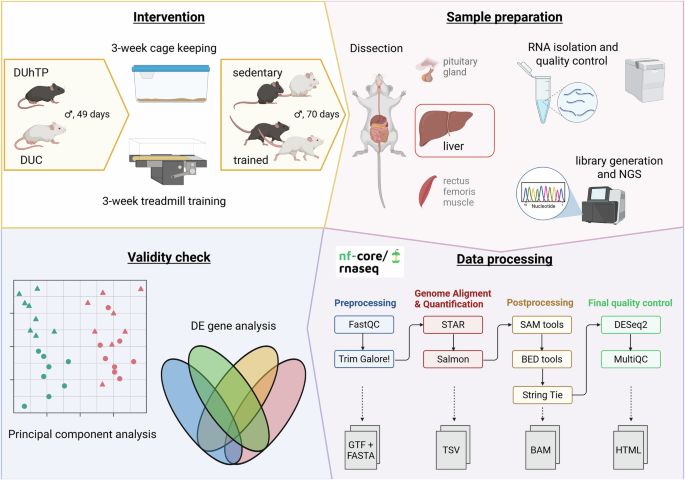
Experimental evolution through selection experiments is a vital tool for exploring the special features of polygenic traits. Here, we provide liver transcriptome data from a paternally selected marathon mouse model (DUhTP), characterized by exceptional running performance, and unselected controls (DUC), both descended from the same polygenic background. To study training responses, both lines were either challenged by three weeks of high-speed treadmill training or remained sedentary. For each condition, eight animals were used for liver tissue isolation and next-generation sequencing. Raw sequencing files were submitted to the ArrayExpress collection under accession number E-MTAB-12071. High data quality was confirmed by appropriate mean read lengths, high mean quality scores, and low duplication rates after adapter trimming. With an average of 16.9 million reads per sample mapping to 19,930 genes, the dataset enables comprehensive gene expression analyses. A multiQC report for the dataset, together with a sample-by-gene count matrix, is available on Figshare. The provided data offer a valuable resource for research in polygenic traits associated with physical activity.
Acknowledgements
We would like to thank Luong Chau for her technical support, as well as the team at the Lab Animal Facility of the FBN for caring for the mice and conducting the treadmill test
Funding
Open Access funding enabled and organized by Projekt DEAL
Author notes
These authors contributed equally: Anne-Marie Galow, Frieder Hadlich
Authors and Affiliations
Research Institute for Farm Animal Biology (FBN), Wilhelm-Stahl-Allee 2, 18196, Dummerstorf, Germany
Anne-Marie Galow, Frieder Hadlich, Nares Trakooljul, Christina Walz, Andreas Hoeflich & Julia Brenmoehl
Authors
- Anne-Marie GalowView author publications
Search author on:PubMed Google Scholar
- Frieder HadlichView author publications
Search author on:PubMed Google Scholar
- Nares TrakooljulView author publications
Search author on:PubMed Google Scholar
- Christina WalzView author publications
Search author on:PubMed Google Scholar
- Andreas HoeflichView author publications
Search author on:PubMed Google Scholar
- Julia BrenmoehlView author publications
Search author on:PubMed Google Scholar
Ethics declarations
Competing interests
The authors declare no competing interests
Additional information
Publisher’s note Springer Nature remains neutral with regard to jurisdictional claims in published maps and institutional affiliations
Supplementary information
Supplemental Table1 (download XLSX )
Rights and permissions
Open Access This article is licensed under a Creative Commons Attribution 4.0 International License, which permits use, sharing, adaptation, distribution and reproduction in any medium or format, as long as you give appropriate credit to the original author(s) and the source, provide a link to the Creative Commons licence, and indicate if changes were made. The images or other third party material in this article are included in the article’s Creative Commons licence, unless indicated otherwise in a credit line to the material. If material is not included in the article’s Creative Commons licence and your intended use is not permitted by statutory regulation or exceeds the permitted use, you will need to obtain permission directly from the copyright holder. To view a copy of this licence, visit http://creativecommons.org/licenses/by/4.0/.
About this article
Cite this article
Galow, AM., Hadlich, F., Trakooljul, N. et al. Effects of genotype and exercise on hepatic gene expression in phenotype-selected marathon mice.
Sci Data (2026). https://doi.org/10.1038/s41597-026-07935-4
Received:04 December 2025
Accepted:16 July 2026
Published:19 August 2026
DOI
:https://doi.org/10.1038/s41597-026-07935-4
