Emotional health supports physical health in survivors of childhood cancer
Alex Generous, PhD• August 20, 2026
A pediatric cancer diagnosis can bring a whirlwind of treatments and appointments, with little time for families to catch their breath. As therapies have improved, most children treated in the United States now survive their disease and return to daily life. But after active care ends, many survivors and families are left navigating high levels of emotional and psychological distress. At St. Jude, researchers are studying how that stress impacts long-term biological health, such as chronic diseases and inflammation, and finding that there may be simple, cost-effective ways to manage emotional health that help protect physical health.
“Emotional health is important,” said Rachel Tillery Webster, PhD, Department of Psychology & Biobehavioral Sciences, “It’s a vital sign, and it is related to health outcomes in our survivors, independent of treatment exposures and their cancer diagnosis.”
Survivors of childhood cancer face many of the same emotional challenges as their peers, but they also carry worries that are unique to survivorship. Many know they are at a higher risk of developing chronic conditions earlier in life than other young people, and that awareness can become a lasting
Webster sought to understand the relationship between psychological stress and biological risk factors for these chronic conditions, with results published in the Journal of Cancer Survivorship. She, alongside her postdoctoral fellow Nele Löcher, PhD, formerly of St. Jude, leveraged data supported by National Institutes of Health funding previously awarded to Kevin Krull, PhD, Department of Psychology & Biobehavioral Sciences chair. Webster and her colleagues examined blood levels of C-reactive protein (CRP), a biomarker of inflammation, which is associated with a higher incidence of these chronic conditions. In tandem, they surveyed emotional distress in patients and their families, finding multiple strong connections.
“We found that not only does survivor emotional health impact inflammation, but caregiver stress also seems to have a notable physiological impact on our survivors,” said Webster
Survivors who reported higher levels of depression and anxiety had higher levels of CRP in their blood, which was expected from previous research. However, depending on the survivor’s age, caregivers’ emotional health also had a significant impact. In older adolescents, caregiver emotional distress was associated with higher CRP levels. This could be because these older survivors were more able to recognize and internalize the feelings of the adults around them. Caregiver strain was also associated with increased CRP levels in both pre-adolescents and older adolescents, suggesting that children may be affected not only by what caregivers say, but by the strain they observe.
“Our results show that our interventions need to focus on more than just survivors,” Webster said. “They really need to focus on the whole system, as the family is impacted by the cancer journey alongside our children who are being treated.”
Mindfulness shows measurable benefits for survivors’ mental health
For survivors and families, the need for emotional support is not new. Patients have long made clear that psychological well-being shapes whether they can follow through on the other aspects of survivorship care
“When we transition people from treatment to survivorship care, we recommend healthy behaviors such as diet, exercise and regular screening. But they’ve told us, ‘If you don’t treat our emotional health, none of this other stuff is going to matter,’” Webster explained. “So, we’ve begun testing ways to support their emotional health.”
One such intervention was a simple mindfulness exercise. Published in Pediatric Blood & Cancer, Webster, alongside Pediatric Oncology Education trainee Brian Ram and other collaborators, measured how survivors felt about their disease, finding that more negative illness perceptions were associated with greater anxiety and depression and lower quality of life. Mindfulness, an in-the-moment, nonjudgmental awareness of the self, also appeared to help explain some of these relationships, suggesting it may be a useful strategy to support emotional health in survivorship care.
Those results are particularly encouraging because mindfulness is a simple intervention that can be done at home and is relatively inexpensive for survivors and their families. As many families struggle to access healthcare, medical screenings and psychological support, interventions like this — that are easy to implement — are especially important
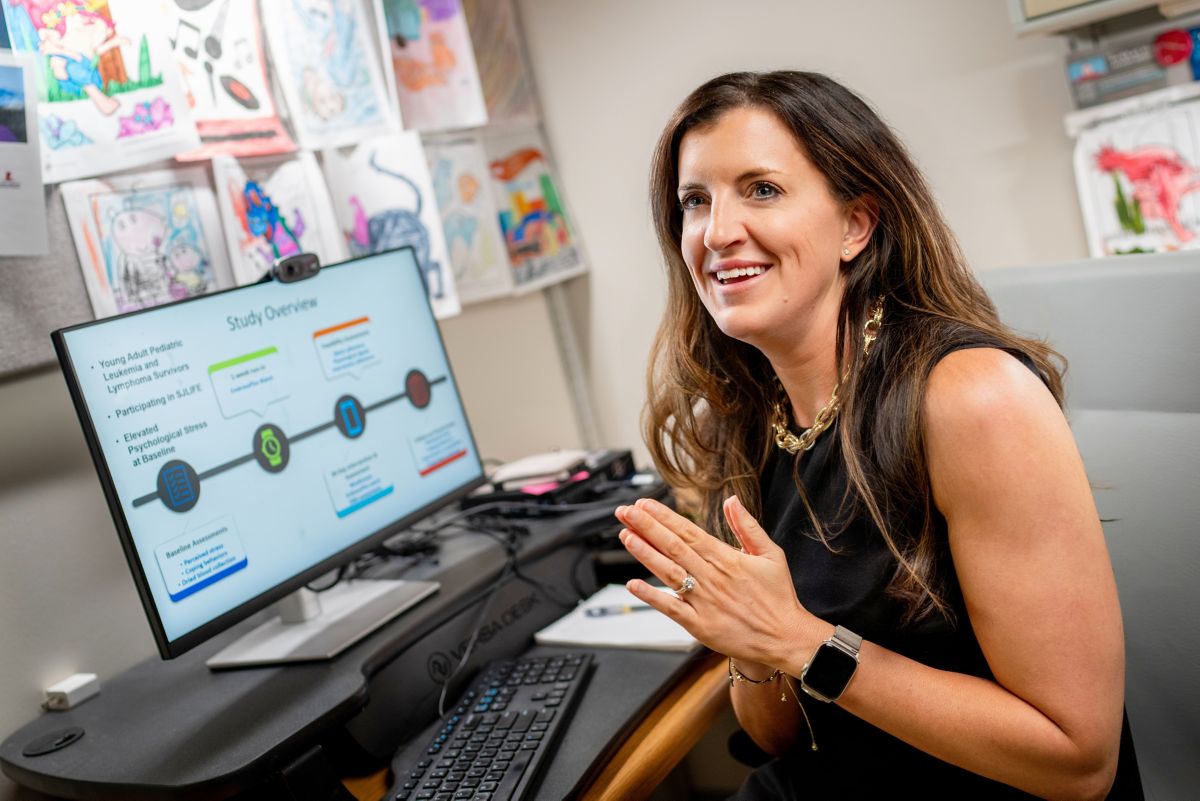
Building on these findings, Webster and Tara Brinkman, PhD, Division of Pediatric and Health Psychology chief and Department of Psychology & Biobehavioral Sciences member, are testing a brief, remote mindfulness intervention for survivors: 10 minutes a day for 30 days. The goal is to understand whether simple, accessible strategies can improve both emotional and physical health after cancer treatment. Although the initial study focused primarily on feasibility, the early findings are promising, with potential benefits for emotional well-being and cardiometabolic health.
“As we expected, we found mindfulness was associated with increased engagement and decreased psychological stress by reducing feelings of anxiety and depression,” Webster said. “We also found that it improves their autonomic nervous system activity, which is what’s triggered when you’re stressed, and can cause a physical responseity.”
These physiological measures matter because dysregulation of the autonomic nervous system is associated with cardiometabolic health. For survivors who may be at a higher risk of later heart problems because of prior cancer therapy, reducing that stress-related burden may offer an additional layer of protection. The results are helping set the stage for a larger trial
Treating survivors’ mental health is cost-effective for all
Webster’s work also suggests that survivorship care should look beyond cancer diagnosis and treatment history to include how survivors are feeling day to day. Webster and collaborators’ eClinicalMedicine study identified distinct patterns of physical, neurological and psychological symptoms among more than 17,000 adult survivors in the Childhood Cancer Survivor Study. Nearly 40% of survivors fell into higher-burden symptom groups, and those groups were more likely to report future risky health behaviors, such as smoking and physical inactivity, as well as greater emergency room use. Importantly, survivors with higher levels of distress and pain were more likely to engage in health behaviors that can worsen long-term outcomes and were more likely to need emergency care later.
Traditionally, physicians have relied on treatment history and original cancer diagnosis to direct long-term follow-up care. Webster’s findings suggest that those factors alone may miss survivors who are carrying a high burden of symptoms, particularly psychological distress and pain. Routine symptom assessment could help identify survivors who need added support, including mental health care, pain management and behavioral health interventions. Recognizing and addressing these needs early may help reduce maladaptive coping behaviors before they become entrenched and worsen health outcomes.
“What we’ve shown is that when we make mental healthcare and symptom management accessible, it has the potential to be preventative,” Webster explained. “Supporting emotional health may help reduce emergency room visits, unnecessary healthcare utilization and expensive health outcomes, such as developing these chronic conditions. It can save families time and stress, as well as reduce the burden on our healthcare system as a whole.”
A model of mental healthcare support for survivors
Many patients and families undergoing cancer treatment do not have consistent access to adequate mental health services. At St. Jude, patients and families have access to emotional and psychological support throughout treatment, offering a model for how embedded mental health services can help families cope, adapt and continue in their treatment journey
“At St. Jude, we’re fortunate that social workers and psychologists are part of the care team from the beginning,” Webster said. “We see how much that support matters. Our patients and families face extraordinary challenges, but they are also incredibly resilient. When we give them tools to manage stress, regulate emotions and cope in healthy ways, we help protect not only their emotional well-being but also their long-term health.”
Currently, Webster and Brinkman are working to build on this early evidence by expanding access to interventions that can support survivors and families beyond the walls of the clinic. Larger studies are still needed before these approaches can be integrated more broadly into care. However, the growing evidence already points in a clear direction: Emotional health and physical health are deeply connected in survivorship
“We see that emotional regulation and distress are tied directly to chronic disease, and also to behaviors that can make risk worse,” Webster said. “So, we need to treat it just as seriously as we treat physical health conditions in survivors.”
About the author

Alex Generous, PhD, is a Senior Scientific Writer in the Strategic Communications, Education and Outreach Department at St. Jude
More Articles From Alex Generous
Related Posts

Nursing researchers illuminate symptom relief for mucositis
Supporting mental health may improve hydroxyurea adherence in sickle cell disease